The Universal Soldier

He is five feet two, and he’s six feet four
He fights with missiles and with spears
He is all of thirty-one, and he’s only seventeen
He’s been a soldier for a thousand years
— Buffy Sainte Marie

Donovan sang the song well, probably had the largest audience for it, but I liked Buffy’s version of “The Universal Soldier” better. The Public Affairs Office (PAO) onboard the USS Ranger (CVA-61) played the Donovan version while on station off the coast of Vietnam during that waste of time, money, and life war. We loved the irony of that song aboard a warship.

The folk singers–Bob Dylan, Joan Baez, Eric Bogle–have always told the truth straight about war and other injustices. We play their songs and sometimes we protest the war of the day, but I think we worship the Universal Soldier because s/he makes damn sure we are always fighting somewhere and extolling the patriotism and glory of it and keeping that defense budget high enough to create the expensive toys of war that war profitable and necessary for the economy to such a large extent that weall have blood on our hands.

Come you masters of war
You that build the big guns
You that build the death planes
You that build all the bombs
You that hide behind walls
You that hide behind desks
I just want you to know
I can see through your mask”

–Bob Dylan

In a few days, a lot of folks will Blog4Peace like children going up against monsters with sticks and posters and songs. Will these bloggers defeat the military industrial establishment. I doubt it. Will they raise our consciouness and or belief that some day, somewhere we will find better ways of conflict resolution that break the chains typing us to the universal soldier. Yes. Meanwhile, how many lifetimes will it take until we know that too many people have died, until we seriously look around and ask where have all the flowers gone and why are the graveyards full to overflowing.

Did they Beat the drum slowly, did the play the pipes lowly?
Did the rifles fir o’er you as they lowered you down?
Did the bugles sound The Last Post in chorus?
Did the pipes play the Flowers of the Forest?

–Eric Bogle

Those who march away, at once tin soldiers (canon fodder) and the best and the brightest (flowers of the forest) pay with their lives (and more) for the country’s love of the universal soldier. When it comes to fixing the problem, Presidents promise while allowing the cycle of war to turn again and again. They’re powerless, aren’t they? Our love of battle is our universal need even though it’s fool’s gold.

–Malcolm

New Post

Getting adopted by a cat

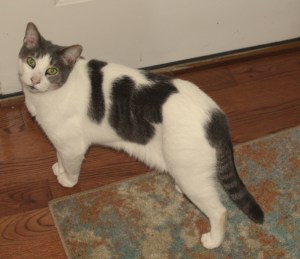
Six or eight months ago, possibly more, some sh_thead dumped a heathy male cat off near our house. He was in such good physical shape, we thought he must be a lost pet. We asked neighbors on and off facebook if they knew of the black and white shorthair cat that was missing. None did. The weather was cold then, so we set him up with upside down box with a door in it, filled it with old towels, wrapped plastic around it to keep the wind out, and placed a microwavable heating sack in their every night to keep him warm. We gave him plenty of food and water.

Waiting to go outside.

We finally took him to the vet and heard that his age was 3-8, got him a rabies shot, and a feline leukemia test because we had known for sometime he would end up in the house and we didn’t need that disease transmitted to either of our two 18-year-old cats. The test cam back negative. Okay, so now he’s an indoor-outdoor cat, in at night and out during the day. His name is Robbie and he’s slowly starting to recognize it.

Here’s what we’ve learned so far:

  1. He brings fleas inside which the other cats get but that don’t seem to stay on him. We’re buying more FrontLine flea protection than usual.
  2. Robbie has to be fed first because he’s large enough to shove our other cats away from their bowls if Katy or Marlo get their food a nanosecond before he does. Marlo, our lightest weight cat stands up to Robbie when there’s food involved.
  3. Robbie has been a house cat. He knows the sound of a poptop cat food can being opened, knows where the litter box is and what it’s for, and knows that towels on the bed or the sofa are places designed for cats to sleep.
  4. Like the other two cats, he comes in the bedroom at night but knows he’s not supposed to stand on top of us while we’re asleep.
  5. Like the other two cats, he tends to fall asleep when Lesa and I are in the livingroom watching TV. He (usually) doesn’t try to get the food off our plates when we’re sitting at TV trays.
  6. If he ever sees a room he’s never been in, he wants to go in there.
  7. It’s been amusing watching a new-to-the-household cat adapting to our routines as well as the mood and habits of Katy and Marlo. Lesa and I have been together since 1980. We’ve always had one or more cats. Even so, every day brings something new. Sometimes it’s good. Sometimes it’s, well, not so good. But we soldier on with our scratches and claw marks with critters underfoot and on the furniture.

Malcolm

When people ask how I get my cat details right in the folk magic series beginning with Conjure Woman’s Cat. I say “forty years of experience.”

Captain Kirk Did a Brave Thing Today

Captain Kirk, aka William Shatner, was absolutely fearless when he flew aboard a Blue Origin mission nearly 350,000 feet above the Earth’s surface. The risk wasn’t his age–the oldest guy to ride a rocket into space–but all the villains waiting for him to let his guard down.

Let’s look at what Kirk did not have:

  • Warp Drive
  • Shields
  • Phasers or photon torpedoes
  • Spock
  • Scotty who could recalibrate anything into something else

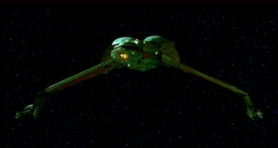
Bird of Prey

Who was out there?

  • Khan
  • The Borg
  • Dominion
  • Q
  • Xindi
  • Romulans
  • Klingons
  • Nero

Shatner would have been a sitting duck if a Klingon War Bird had suddenly de-cloaked over in the West Texas blue sky and beamed Shatner into another story. Jeff Bezos would have had a lot of explaining to do if the capsule and come down empty. Heaven help us if Congress had gotten involved.

In fact, had Shatner, Dr. Chris Boshuizen, Glen de Vries, and Audrey Powers been beamed aboard a Klingon ship, a wormhole would have opened up between the Star Trek reality and our consensus reality, allowing all kinds of stuff into our world.  The Borg Queen would have been running for Congress and Q would have been appointed Secretary of State. Needless to say, Boeing would be coming out with a new line of ships.

We were lucky today. Shatner’s presence in space could have changed everything. Perhaps it did.

Malcolm

Happy Indigenous People’s Day

Day 286- Indigenous Peoples Day (8084917906).jpgIndigenous Peoples’ Day is a holiday that celebrates and honors Native American peoples and commemorates their histories and cultures. On October 8, 2021, U.S. President Joe Biden became the first U.S. President to formally recognize the holiday, by signing a presidential proclamation declaring October 11 to be a national holiday – Wikipedia
We were taught something else in school, one version or another of the poem credited to Jean Marzolo that began:

IN 1492

In fourteen hundred ninety-two
Columbus sailed the ocean blue.

He had three ships and left from Spain;
He sailed through sunshine, wind and rain.

Later we learned that Columbus wasn’t a nice guy, and yet, we kept giving him credit for discovering a continent where there were might have been as many as ten to 50 million people living in 600 tribes.

When students asked teachers how somebody could discover a place that was already settled, the answer was that savages don’t count. The nation bought into that absurd notion for years. In fact people still believe it. Sure, they’re giving up on Columbus in favor of, say–the Vikings even though that still begs the question of the continent’s residents whenever the first Europeans showed up.

“We” are slowly trying to clean up our act, at least in terms of politically correct rhetoric. Real change is another matter that’s slower than Christmas. Celebrating this day in honor of the people who lived here when “we” showed up and took over North America by force is progress of a sort. It falls short of what we need to do.

First, I think we should be honest about what we did, what the proud words “manifest destiny” meant to the people in our way. Most of the world was conquered over and over by somebody, and trying to return boundaries to what they were 100, 1000, or 10,000 years ago sounds like a recipe for chaos.

Second, we need to look at Indigenous Peoples as they are now rather than romanticizing them as they were several hundrfed years ago. We, those of us of European extraction, are not who we were in the 1600s, 1700s, 1800s, and 1900s and neither are Native Americans. Most of us of European extraction would take offense if we were portayed as no more advanced then we were many generations ago, and yet, we keep “celebrating” Native Americans as a people purportedly stuck in the past.

Third, we need to legalize in every possible way our statements that reservations are sovereign Indian Nations that owe no allegiance to the patriarchal “Great White Father” in Washington. They are just as sovereign as Canada and Mexico and their rights extend a lot farther than being able to run gambling casinos. The reservations need the power of the states and the voting rights that go along with that power.

Doing such things will create a mess and yet that will be positive progress.

–Malcolm

Malcolm R. Campbell

Publisher: Thomas-Jacob Publishing

Website

Facebook Author’s Page

Amazon Author’s Page

Action or Speculation: what drives the plot?

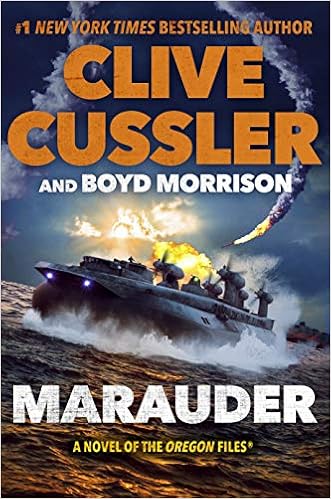
When you read a novel like Clive Cussler’s 2021 Marauder in the Oregon Files series, you know you’re reading unapolgetic commercial fiction designed for readers of “page-turner” novels who appreciate high-stakes danger and lots of stuff that gets blown up, shot up, or shot down. I’m a fan of the books in the Oregon Files series and enjoy them for what they are: books in which action drives the plot.

I prefer suspense thrillers when they’re written by authors such as John Hart, like The Last Child and The Hush that place more emphasis on the location and the characters but still include high-stakes action. The Hush is, perhaps, one of the darkest books I’ve ever read, filled with mystery and a pervasive feeling of menace which I find more memorable than unvarnished commercial fiction.

The Hush: A Novel by [John Hart]Lately, I’ve been disappointed in several suspense books, the names of which I won’t mention here, that had interesting and compelling mysteries that might have been memorable novels had the authors not relied so heavily on speculation. That is to say, too much time was spent with the duller aspects of police work (the paperwork and the phone calls) and long chapters in which the main characters sat around over several bottles of wine and speculated about that was behind the mysterious events and what the bad guys have done and might be planning to do next. They’ve been warned not to look into these matters, but unlike the characters in Maurauder and The Hush, this danger isn’t overt or urgent.

While these speculation-driven plots might be more realistic to most of us since they focus on everyday people who are suddenly plunged into a mess, they don’t really engage the reader’s wont to be scared or to feel the rush of “nail-biting” danger. The result isn’t very satisfactory. Now, one need not sell his/her soul and fill a novel with nothing but sex and violence on every page. The characters can face other issues such as personal trials, ethical/moral questions based on their past or on what the future migh demand, family entanglements, and other plot- and theme-driven storylines that keep the reader interested and, when all is said and done, can be viewed as a substantial and satisfying book.

Sitting around and speculating about the cruel world outside the livingroom door is seldom as compelling or intersting to readers as being engaged in the cruel world outside that door–unless the characters have other kinds of challenges to face.

–Malcolm

Malcolm R. Campbell

Publisher: Thomas-Jacob Publishing

Website

Facebook Author’s Page

Amazon Author’s Page

Listen or read, and I promise to keep you interested unless you’re, well, dead.

Show me the wisdom

The world tree is a motif present in several religions and mythologies, particularly Indo-European religions, Siberian religions, and Native American religions. The world tree is represented as a colossal tree which supports the heavens, thereby connecting the heavens, the terrestrial world, and, through its roots, the underworld. It may also be strongly connected to the motif of the tree of life, but it is the source of wisdom of the ages. – Wikipedia
One common theme in magic, mythology, and fantasy is the idea that this “wisdom of the ages” is (or was) known by individuals called “the old ones.” Some say they came and went eons ago and left their wisdom right in front of us, and that all we had to do was figure out what we were looking at. Others say that whether the “old ones” still walk amongst us unseen or left eons ago, that their knowledge can only be found by years of meditation, study, and withdrawal from the day-to-day world.

I’ve been fascinated with this stuff since I was in high school and first came across the mystery school mysteries, comparative mythology, and similar approaches to “the big question.” I’ve noticed a lot of commonality between systems even though the myths and techniques are often somewhat different.

The only thing I’m sure of is that the more one studies all this, she less s/he knows. That doesn’t imply, though, that if one hadn’t studied it at all, s/he would know everything by the time s/he reached my age. All I have so far at my sage other than aches, pains, medications, and trips to the hospital is a monthly copy of “AARP Magazine.”

Maybe all this has been bunk. If so, it’s been joyful and addictive bunk that’s provided a lifetime of wondrous insanity. As luck–or the gods would have it–I’m not living on the street or, worse yet, in an institution where the psychiatrists ask, “Do you hear or see things that aren’t there?” My only response to that would be, “How would I know?”

When I became an old one, I didn’t have a visit from an older one who handed me a book titled “Here’s The Wisdom.” Or, if that did happen, I was asleep and missed it.

So, all I have to say about the wisdom is that it’s been a nice hobby and it’s given me some mysterious things to put in my novels. I have no idea what percentage of my readers think the wisdom is out there waiting for them and end up in an asylum where they’re asked “Do you hear or see things that aren’t there?” If so, I hope they know the right answer.

So reading about mysterious things is a risk sort of like bungee jumping. You might be yanked up into the high clouds where all will become known or you might hit bottom where nothing more will be known–or vice versa.

But what a ride.

–Malcolm

Conjure Woman's Cat Audiobook By Malcolm R. Campbell cover artMalcolm R. Campbell

Publisher: Thomas-Jacob Publishing

Website

Facebook Author’s Page

Amazon Author’s Page

Listen, and if you’re still “okay,” move on to the second audiobook in the series.

Resource for those interested in magic

“Ley lines (/leɪ/) refer to straight alignments drawn between various historic structures and prominent landmarks. The idea was developed in early 20th-century Europe, with ley line believers arguing that these alignments were recognised by ancient societies that deliberately erected structures along them. Since the 1960s, members of the Earth Mysteries movement and other esoteric traditions have commonly believed that such ley lines demarcate “earth energies” and serve as guides for alien spacecraft. Archaeologists and scientists regard ley lines as an example of pseudo-archaeology and pseudo-science.” – Wikipedia

If you’ve read a lot of novels focusing on ancient magic, including The Da Vinci Code, you’ve probably encountered the concept of Ley lines. I’m interested in them, but have never had the opportunity to investigate them, much less travel to a purported location.

If you are curious about them, here’s a link to a post from Dreamcatcher Reality that’s the best explanation of Ley lines I’ve seen in ages: https://dreamcatcherreality.com/ley-lines-matrix/

I don’t necessarily agree with Wikipedia except to say that they are speaking about the view of mainstream science. I find Dreamcatcher reality to be an interesting site, but I don’t use its information in my novels because it’s rather like Jane Roberts’ “Seth Materials” in that I can’t prove it. Even thought I write fiction, I want the details to be true; doing that makes for a stronger story.

Malcolm

Florida Folk Magic Stories: Novels 1-4 by [Malcolm R. Campbell]Malcolm R. Campbell is the author of the four-part Florida Folk Magic Series in which the hoodoo magic was verified to the greatest extent possible.

My odds of winning the Nobel Prize are pretty much zip

After Bob Dylan won the Nobel Prize for Literature in 2016, I figured there was a chance for those of us odds makers had written off. So, I have my speech ready. It begins, “Åh, det borde du inte ha.” And it ends, “Så länge och tack för alla kronor.”

If you speak Swedish, you can see I tried to be humble. If you don’t speak Swedish, then you don’t know what I said, which is just as well.

I checked the latest line at Ladbrokes, and they still favor French author Annie Ernaux (shown here) at 8 to 1 odds. Jamaica Kincaid is sitting at 12/1 and Jon Fosse was at 14/1. The first couple of times I went to a horse race, I put $2 on along shot when I saw that if I won I’d get a big pay off. I lost the $2.  I wonder how many people had money riding on Bob Dylan in 2016.
I was happy when Louise Glück won the nobel last year because I’ve been reading her work for ages. She writes with power and truth, both of which have attracted me to her work.

Alex Shephard writes, in the New Republic, “Every year I publish this preview, and people bet real, actual money based on it. If you are reading this because you want to bet on the Nobel Prize in Literature, please—and I can’t stress this enough—don’t do that. Buy something useful instead, like a lottery ticket. Or bet on the Nobel Prize in Literature, just do the exact opposite of what I say.”

Nonetheless, he thinks Maryse Conde, Ngũgĩ wa Thiong’o, Yan Lianke, Can Xue, and Yu Hua. As he warns, don’t bet on it.

No Americans are favored this year. So, there it is. I thought that if this wasn’t my year, then it was probably going to be Nora Roberts’ year. Or even Tom Clancy, may he rest in peace even though “he” keeps churning out new stuff.

It’s a real crap shoot.

Malcolm

Malcolm R. Campbell is the author of books, including “Fate’s Arrows,” which somebody needs to translate into Swedish before next year’s prizes.


UPDATE: 10-7-21 Apparently Tanzanian writer Abdulrazak Gurnah wasn’t on anyone’s radar. He lives in England and has a publisher there, but not a U.S. publisher. I suspect that will change. You can read the BBC story here: https://www.bbc.com/news/entertainment-arts-58828947


Facing the Climate Catastrophe

On August 9, the Intergovernmental Panel on Climate Change released its assessment of the state of the climate — the panel’s grimmest yet. The window to stop some of the worst effects of the climate crisis is rapidly closing, the report found, and world leaders must act with urgency to prevent catastrophe.

The report, prepared by more than 200 top scientists around the globe and approved by the 195 UN member states, is the first of three expected this year to inform emission reduction commitments at the 26th annual international summit known as the Climate Change Conference of the Parties (COP26) this November in Glasgow, Scotland.

Photo: Sunset over St. Mary Lake at Glacier National Park. The namesake glaciers at this park are rapidly melting as a result of climate change. In 1850, the region had 150 glaciers. There are now just 25 left. Photo © Kan1234/Dreamstime.

Source: Facing the Climate Catastrophe: What We Do Now Matters · National Parks Conservation Association

Do most people worry about climate change? Apparently more people are taking it seriously as shown, in part, by their willingness to switch to products that they think are better for the environment.

In this article, the NPCA suggests four critical areas we can focus on:

  • Reducing emissions from cars.
  • Retiring power plants to clear skies of haze pollution.
  • Reducing methane, one of the most potent climate-warming emissions, from oil and gas development.
  • Securing critical climate provisions in the federal budget.

Climate change is such a huge issue, it often seems outside the power of the individual to address. Articles like this one help us narrow down target areas where we can focus our efforts.

Malcolm

Trailguide publishers: stop leaving out the trees

When I walk through a forest, I really do want to know what kinds of trees I’m seeing. I’d think visitors to national parks and other scenic areas with trails and trailguides would like to know what, too. Apparently the trailguide publishers don’t think so.

As I research Glacier National Park, looking for the specifics of various trails and roads, I’ve come across a lot of trailguides. For example, just Google Glacier National Park and include the mountain or lake you want to climb or hike, and you’ll find numerous trailguides. Many of these are sufficient for the day hiker looking for things to do.

The online guides usually include directions to the trail, how long and difficult it is, what to take (water, bear spray, food), and include photographs of the mountains, lakes, and valleys. Those made by amateurs (who may be strong hikers) don’t mention the names of the mountains in the views because they probably don’t know what they are. The same is often true for the lakes.

As for the trees, no mention of them except, perhaps, to say, that a trail begins in a forest. It wouldn’t really be that hard to say Engelmann spruce forest (as shown in the photo) would it? The showier, well-known wildflowers get mentioned; the rest are simply called, well, meadows of flowers. I really wish more people who know the flora, fauna, and landforms would make these guides to they can give prospective hikers the complete picture.

Otherwise, those using the trailguides won’t know what they have seen after they get back from the hike.

Malcolm

Malcolm R. Campbell was one of the editors of the first editions of “Place Names in Glacier National Park” and “Geology Along Going-to-the-Sun Road.” His novels set in the park include “The Sun Singer.”