My Kindle short “Dream of Crows” will be free on Amazon between January 21 and January 23. (The story is always free for Kindle Unlimited subscribers.)
Description: After going on a business trip to north Florida, you have strange dreams about something lurid and/or dangerous that happened in a cemetery next to Tate’s Hell Swamp. You try to remember and when you do, that’s all she wrote.
Picture This: When a person has too much to drink and gets mixed up with a stunning conjure woman, exciting things can turn into dangerous things. That’s why folks need to be careful when walking into a bluesy bar where a temptress is serving drinks–and more.
Tate’s Hell Stories: This story is one of a series of books that are connected by one thing only: a forbidding swamp. The swamp, which is real, is on Florida’s Gulf Coast near the town of Carrabelle. You probably haven’t heard of the swamp or the town because they’re in what’s often called “the forgotten coast.” Those of us who grew up there hope it stays forgotten.
Obviously, this short story leans a bit into the paranormal side of things. You might also say it’s a bit experimental since you are the main character.
The Kindle editions of my dark contemporary fantasy Sarabande and my magical realism novella Conjure Woman’s Cat are both available for 99¢ each on December 3rd. (In fact, the price has already been marked down.)
From the reviewers:
Sarabande: “Campbell describes a rape scene that is difficult to read, yet at the same time, earns my respect with his skill in describing this scene, and its aftermath on the woman. Indeed, I had to keep reminding myself I was reading the writing of a male author. It is rare to find this ability in an author to cross genders even in everyday basics such as conversation, mannerisms. To do so in describing the effect of rape on a woman’s body and psyche is nothing short of amazing. Campbell nails it: her anger, her pain, her humiliation, her ferocity that eventually takes her from victim to survivor to avenger.” – Zinta Aistars, Smoking Poet Magazine
While Sarabande follows-up on the story told in The Sun Singer, it can also be read as a standalone novel.
Conjure Woman’s Cat: “The story is set in the Florida panhandle in the 1950’s in a society dominated by racism, and tackles the serious issues of white violence, rape, day-to-day prejudice and mother/daughter relationships. This is a book that packs a lot into its 166 pages. Despite this bleak subject matter the book is beautifully written, allowing this Brit a vision of a place which the author knows well and clearly loves. The contrast of the natural beauty highlights the ugliness of human behaviour.” Zoe Brooks, Magical Realism Review Site
–Malcolm
Malcolm R. Campbell is also the author of “Emily’s Stories” and “The Sun Singer.”
My Kindle short story “Willing Spirits” will be free on Amazon during the July 4th weekend. This is a ghost story inspired by the real St. Louis spirit named Patience Worth who, among other things, wrote a novel called Hope Trueblood.
Description
Prudence is a student who isn’t always prudent. Let us point to the night before her school book report is due. She hasn’t finished reading the book. Time to panic?
Perhaps, for the spirit of the book’s long-gone author seems to have appeared in Prudence’s bedroom. Off hand, this can’t be good.
Opening Lines
“The power went out when Prudence Lowe began reading chapter two of Hope Trueblood. The darkness startled her and the book fell to the floor with a thud. Her bedroom window rattled in the wind bringing St. Louis its first snowfall of the year. She knocked her hairbrush and several makeup bottles off the vanity while searching with gloved hands for the power outage candle. Frugal to a fault, her father kept the house colder than a morgue throughout the winter.”
“Who was Tate, you wonder? In Sumatra they still tell his story: how he left the frontier village at dusk a century ago with his two hunting dogs and his puppy Spark, to kill a panther that had been raiding Sumatra livestock. He carried a Long Tom shotgun and a Barlow knife, and he thought he knew where the darkening waters ran.”
– Gloria Jahoda, The Other Florida (1967)
Tate’s Hell is a Florida forest located in the counties of Franklin and Liberty.
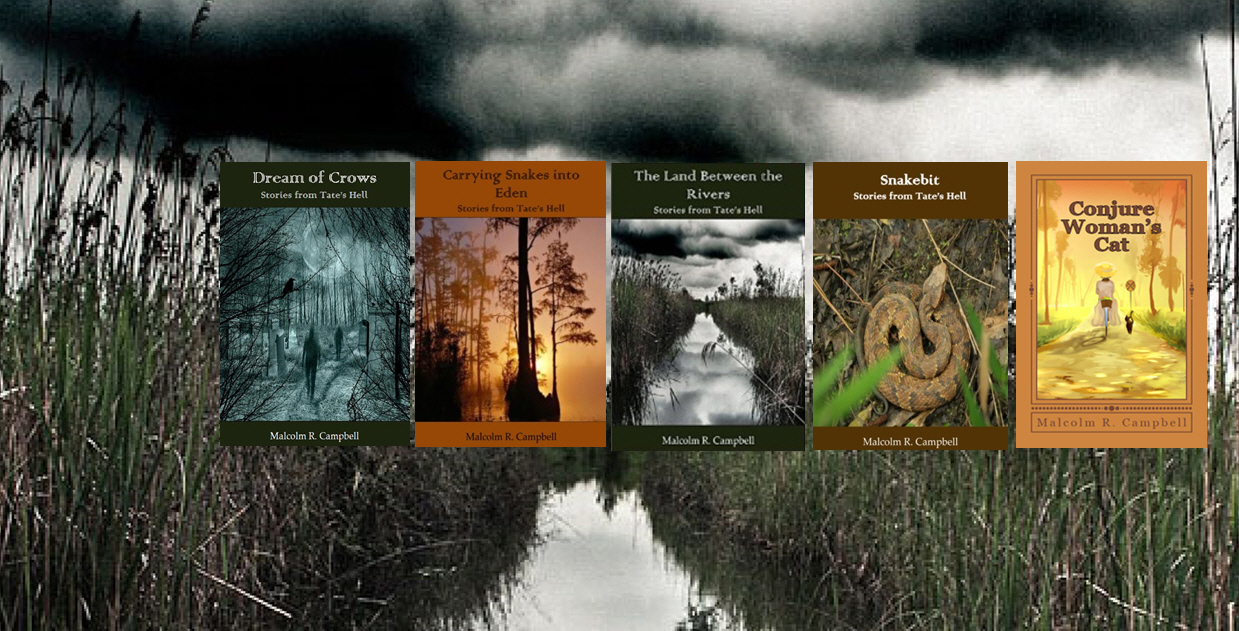
When my 1950s-era novella Conjure Woman’s Cat came out, my publisher said that with all the book’s mentions of Tate’s Hell Swamp, how about a Kindle series of stories about the place?
Fortunately I had a bunch of things on hand, including a short story from an anthology and scene from my out-of-print novel The Seeker that just happened to be set there and in nearby Carrabelle.
I couldn’t resist the idea of taking snakes to Eden. Most of all, I enjoyed learning more about the animals and their Florida wild places environments for the folktale collection.
I’ve enjoyed coming up with three short stories and one short collection of folktales for the series.
Dream of Crows: This dark story about a businessman and a sexy conjure woman who lives next to a cemetery on the edge of Tate’s Hell is the most recent. It originally appeared in the Lascaux Prize 2014 Anthology.
If you’re prone to nightmares, be warned that this story is written in the second person and makes the reader the main character. Free June 24-28.
Opening lines: During the coroner’s inquest into the matter of your death, a well-meaning friend or relative will step forward with your affidavit stating that you read Dream of Crows because you saw it in your spouse’s copy of The Lascaux Review, heard several clerks at Barnes and Noble speculating about its deeper meanings, or—more likely—because you were intrigued by the probable connection between the short story and an odd string of assisted suicides in a Florida’s Tate’s Hell Swamp.
Snakebit: This slightly less dark short story came out just before Dream of Crows. Two college students fall in love while working as seasonal employees at a resort hotel in the northwest.
At the end of the summer, they return to their respective colleges that are far apart. When she’s assaulted on a dark street outside the college gates, she refuses to let him visit her. Finally, when he’s allowed to travel to Florida in June, he finds her much changed. The more he sees, the more he thinks he’ll have to sever the relationship. However, before he does so, the magic of Tate’s Hell intervenes.
The Dream: Then the squalling wheels in the coach’s rear truck in a tight curve fetched up the memory of the caterwauling panther of a nightmare that stalked him thirteen miles up the track. He ran between small ponds beneath a bright moon. Coowahchobee sprang out of a dark stand of hat-rack cypress and chased him through shallow water. He was trapped, suddenly, in an unyielding thicket of titi where the small white flowers exploded overhead like a dying constellation. He saw brown eyes above a deep growl that ran through his soul seconds before the claws snagged his left arm when the large cat dragged him away from the water.
Carrying Snakes Into Eden: “Eden” in this story refers to Florida’s former Garden of Eden attraction on the Apalachicola River. It’s rather a tongue in cheek story about two college students who pick up a hitchhiker with a sack of snakes he captured in Tate’s Hell. He says they’re need in the Garden of Eden.
The students learn that skipping church that Sunday morning may have long-term consequences.
Opening Lines: When John and I drove to Carrabelle on a gray Sunday morning for brunch with the Boynton sisters, skipping church was the least of our sins. Julie and Kathy were seniors, cheerleaders, and the most popular blondes in high school. John and I, mere juniors, wore clean sport shirts and Jade East aftershave. Brunch was canceled when the parents returned from New Orleans on Seaboard’s Gulf Wind a week early. They saved us from prospective sins of the flesh. But we weren’t home free. In fact, our transgression on that April day in 1961 was a first for the Florida Panhandle.
The Land Between the Rivers: This series of three folktales set in Tate’s Hell at the dawn of time is introduced by Eulalie, my conjure woman in the novella. They begin where the Seminole creation myth leaves off with stories about Panther, Snakebird and Bear–the first animals to walk the earth in the old legends.
Panthers, of course, are highly endangered in Florida. When I was young, there were panthers in Tate’s Hell. Now they’re gone from the panhandle and can only be found in central and south Florida.
Openning Lines: One day when I was just a piddling kitten no bigger than a crow, I fell into Coowahchobee Creek while helping my conjure woman look for crawfish. The cold water spun me around like pinecone. I sulled up into a snarling fit three times my normal size and swatted the rocks and roots along the bank with my claws. “Hush, little one,” Coowahchobee whispered. “Lena, look directly into Eulalie’s haint blue eyes and your thoughts will tell her you are ready to hear our stories.”
These stories all see for 99 cents and occasionally are featured free in book sales. I hope you enjoy them even if you don’t live in the Florida Panhandle.
–Malcolm
“Conjure Woman’s Cat”is available on Kindle ($2.99) and in paperback ($8.58) and, in addition to Amazon, can also be found at Powell’s, B&N, Smashwords and other online book sellers.
Zeke Zany here at Zany Antics & Books where I chronicle my life as a car mechanic and part-time gigolo while working on my epic novel about a man who fixes the transmissions of rich widows. I’ve wanted to be a writer ever since I accidentally spelled a four-letter word beginning with “F” with my ABC blocks and my daddy’s reaction taught me the power or writing. Today’s guest is Malcolm R. Campbell who’s going to fill us in on who he is and why.
Zeke:Tell us about yourself
Malcolm: Well, Zeke, if you’d done your homework like a real interviewer, you’d know that I made my first fortune by selling my novels under pseudonyms that just happened to be the most famous names on the planet, starting with my bestselling novels Hunt for Brown November and Hunt for Blue December “by Tom Clancy” in 1987 and 1986. They were so good, even Tom thought he’d written them and came to my cell in the state pen to shake my hand.
Zeke: What are you currently writing/working on?
Malcolm: I’m writing answers to your one-size-fits-all interview questions. I’m working on getting done writing these answers as soon as possible, preferably before the Scotch runs out.
Zeke: When did you discover you wanted to be a writer?
Malcolm: I never discovered any such thing. Unfortunately, a muse named Siobhan with nothing better to do latched onto me like ugly on and ape (even though we’re both beautiful people) and demanded that I go into the biz. We got off to a bad start when critics around the world laughed at my debut novel To Kill a Blue Jay written under my Lee Harper alias. Since then, it’s been “write good, or else.”
Zeke: Is there any part of you in your characters.
Malcolm: The worst parts. That’s what sells, Zeke.
Zeke: Are you a plotter or a pantser?
Malcolm: As God as my witness, I’m going to kill the next person who asks me this lame question. This question is so lame, it takes two crutches to hold it up. Suffice it to say, I wear pants at all times except during baths and sex.
Zeke: If Hollywood gave you the power to cast your novel in progress, what stars would you pick?
Wikipedia photo
Malcolm: Hollywood never gives writers that power. You just want some names in this post that will attract search engines. Well, I can help you out with that: Olivia Wilde, Mila Kunis, and Megan Fox in my soon-to-be-released Three Bucks in the Fountain.
Zeke: When you are developing a book, what tools or techniques do you use, e.g. timelines, Ouija boards, character interviews, copy and pasting from obscure novels, sentence diagrams, or novel writing software?
Malcolm: Jack Daniels and a pencil work for me.
Zeke: Has your technique changed over time?
Malcolm: I started out with Ripple and a pen, but that’s what landed me in the slammer.
Zeke: Where you you get your ideas?
Malcolm: The mother ship beams them down.
Zeke:What kind of writing environment do you prefer: couch, bed, coffee shop, music, noise, abandoned hearse, the great out doors.
Malcolm: Siobhan says my best work comes when I’m writing in the drunk tank, and I’m sure as hell not calling my muse a liar.
Zeke: Do you have any advice for aspiring writers.
Malcolm: Avoid bloggers with canned interview questions that make you look like an amateur. Otherwise, promise your mother that “I’ll be all around in the dark – I’ll be everywhere. Wherever you can look – wherever there’s a fight, so hungry people can eat, I’ll be there. Wherever there’s a cop beatin’ up a guy, I’ll be there. I’ll be in the way guys yell when they’re mad. I’ll be in the way kids laugh when they’re hungry and they know supper’s ready, and when the people are eatin’ the stuff they raise and livin’ in the houses they build – I’ll be there, too.”
Thomas-Jacob Publishing has released Conjure Woman’s Cat, a novella by Malcolm R. Campbell (“The Sun Singer”), set in the 1950s Florida Panhandle world of blues, turpentine camps, root doctors, the KKK and a region of the state so far away from everywhere else that it’s often called “the other Florida” and “the forgotten coast.”
Lena, a shamanistic cat, and her conjure woman Eulalie live in a small town near the Apalachicola River in Florida’s lightly populated Liberty County where longleaf pines own the world. Black women look after white children in the homes of white families and are respected, even loved as individuals, but distrusted and kept separated and other as a group.
A palpable gloss, sweeter than the state’s prized tupelo honey, holds the spiritual and temporal components of the Blacks’ and Whites’ worlds firmly in the stasis of their separate places. When that gloss fails, the Klan restores the unnatural disorder of ideas and people that have fallen out of favor.
Click her to see the trailer.
Lena and Eulalie know the Klan. When the same white boys who once treated Eulalie as a surrogate parent rape and murder a black girl named Mattie near the saw mill, the police have no suspects and don’t intend to find any. Eulalie, who sees conjure as a way of helping the good Lord work His will, intends to set things right by “laying tricks.”
Eulalie believes that when you do a thing, you don’t look back to check on it because that shows the good Lord one’s not certain about what she did. It’s hard, though, not to look back on her own life and ponder how the decisions she made while drinking and singing at the local juke were, perhaps, the beginning of Mattie’s ending.
All that’s too broke to fix, but beneath the sweet sugar that covers crimes against Blacks, Eulalie’s pragmatic, no-nonsense otherness is the best mojo for righting wrongs against both the world and the heart.
I’m a disorganized writer. My den, and especially my book shelves, is a mess. When my publisher sends me free author’s copies of my books and/or I order books for gifts, reviewers and book signings, I often order more copies without checking to see how many I already have. Extra copies are everywhere.
Here’s my solution. The following is a list of extra copies of some of the books I’ve written. All of them are available on Amazon, Smashwords and OmniLit so you can check them out. If you decide you would like a copy mailed to you (continental U.S.), you can have one at no charge. Limit is one per person on a first-come, first served basis.
With the exception of the last item on the list, all of these are from Vanilla Heart Publishing.
If you would like a copy, send me an e-mail with the title of the book you want, your mailing address and whether or not you want the copy signed. If you have a second or third choice, include those titles in case somebody else gets to your first choice before you do.
Send the e-mails to me at malcolmrcampbell [at] yahoo [dot] com.
Offer expires May 30, 2014
Titles and Copies Available
Emily’s Stories (three short stories set in north Florida) – 1 copy
The Seeker (magical realism with fantasy elements) – 4 copies
The Sailor (magical realism with fantasy elements) – 3 copies
Jock Stewart and the Missing Sea of Fire (comedy/mystery, original cover) – 2 copies
The Sun Singer (fantasy) – 3 copies
The Sun Singer (fantasy, iUniverse edition; same as VHP edition except that it blurs the real locations used in the story) – 2 copies
If you find anything that sounds like your cup of tea, e-mail me and I’ll send it to you. There’s no obligation, but if you love it, an Amazon review would be nice.
Jock Stewart Strikes Back, Collected Stories, by Malcolm R. Campbell, Vanilla Heart Publishing (March 6, 2014), 122 pp, paperback ($9.46) and Kindle ($3.99).
The book contains farcical and satirical news stories written by “Jock Stewart,” a reporter for the Junction City, Texas Star-Gazer. Here’s an excerpt:
Literary Investigators Discover Jane Austen Actually Wrote ‘Prude and Prejudice’
Pinnacle, MT—Forensic literary sleuths digging through the long lost ashes of a Jane Austen notebook have discovered that a publisher’s typography error forever changed the title of the witty satire incorrectly known as Pride and Prejudice.
Dr. Horace Wickam, chairman of the department of forensic literature at Slippery Slope College, told reporters that correcting Austen’s body of work will most likely be the pinnacle of his career.
“The novel we have known and loved as Pride and Prejudice was initially called First Impressions,” Wickam said. “But according to Jane’s reassembled ashes, a typographer inadvertently changed the word in the new title from ‘prude’ to ‘pride.’”
Graduate assistant Judy Netherfield said that while foul play was not yet suspected it was not yet ruled out.
According to Wickam, the error in the title was compounded, and therefore obscured, by the fact that a crucial line of dialogue was omitted from a conversation in chapter four between protagonist
Elizabeth Bennet and her sister Jane.
Elizabeth’s reassembled comment reads as, “Dear Jane, you see, don’t you, that prudes are the most prejudiced creatures in the world because they are so afraid the next person they see will say the very thing they’re most afraid of hearing.”
Mainstream literary sources said Wickam and Netherfield’s preposterous speculations were “highly prejudicial.”
Professor Darcy, chairman of the Slippery Slope department of psychic psychology, told reporters that two students working with a digital Ouija board contacted Ms. Austen who confirmed the veracity of the discovery.
“Ms. Austen, who always thought prudes to be disagreeable, remains perturbed to this day about the errors in Prude and Prejudice,” said Darcy. “Austen admitted, via the Ouija board, ‘I to not want people to be very agreeable, as it saves me from liking them a great deal.’”
London scholar Edward Bingley, who has been working for 20 years on his epic What Jane Really Meant, said that since he continues to be denied access to the digital Ouija board at Slippery Slope, he doesn’t yet know what Jane really meant.
Wickam said, “as the novel illustrates in matters of love, when you have an empty-headed mother trying to expediently marry off her five daughters, prude goeth before the fall.”
Future projects on the department of forensic literature department’s 2006 schedule include investigations of The Clown of the Baskervilles, The Adventures of Blackberry Finn and The Ruby Yacht of Omar Khayyam.
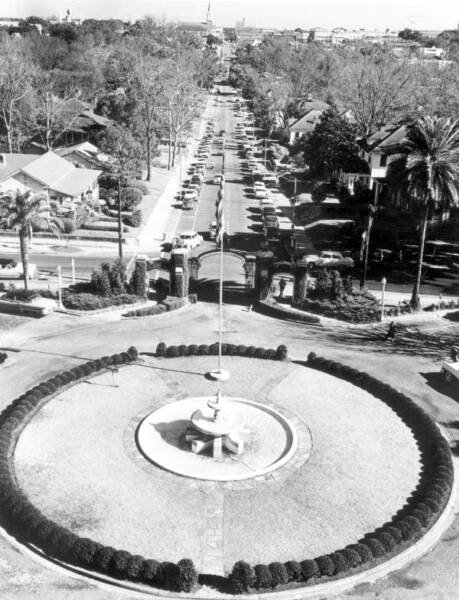
College Avenue in 1964 looking from the unniversity toward downtown
I grew up in a town where College Avenue led straight from the main business district to the university’s main gate. I liked the sweeping hill, the brick paving, and the older homes that owned the street as it drew closer to the university’s administration building. As I wrote The Seeker, College Avenue at night looked like the perfect place for a stalker.
And I knew exactly where that stalker would come from: the university library. I worked there as a student assistant to help pay the bills. It was my favorite place on campus except for the fact somebody there was spying on young women. He pushed books out of the shelves in a signature way so he could, apparently, look up dresses and ogle legs.
We never caught him. One minute an aisle leading through the open stacks was pristine; the next minutes there were books on the floor. I often wondered what kind of a sick person was on the loose. I never knew, but my imagination supplied plenty of details for the 1960s-era College Avenue chapter of The Seeker.
Protagonist David Ward is there in the dream world because he fears the stalker is following his girl friend Anne Hill. There’s little he can do, though, but watch the night unfold. He feels as powerless as I did in the library trying to get “the library guy.”
Except from The Seeker
Kindle Version
David stood at the corner of College and Monroe in Tallahassee, Florida. To the north: the primary downtown business area, including the Florida Theater, which was showing Send Me No Flowers with Rock Hudson and Doris Day. To the west: the State Theater presented Elvis Presley in Roustabout. Farther west, College Avenue grew dark as it approached the university and the night beyond.
He dreamt and he knew he was dreaming. The sounds of the city were clear and, so, too, the conversations of the people on the sidewalk between the theaters, and some of their thoughts as well, expectations of popcorn, concerns about recent exams and questions about who they would see this evening and whom they would be with. Unlike his standard dreams, David walked like a ghost, unseen and unheard among the students and family groups and scattered grandparents. Yes, he could follow Anne or Nick or even RC without their knowledge. But if danger threatened, he could shout no warnings nor take any action.
He walked north and found Anne in front of the Florida Theater with Marta and Karen. Karen and Marta wanted to go out to a hamburger place with three students in a double-parked car. Anne didn’t.
“I’m fine, just a bit of a headache,” she said.
“We should stay together,” said Marta.
Staying together is smothering me.
“The streets are crowded,” said Anne. “It’s a safe night for walking back to the dorm.”
The car pulled away and Anne walked toward College Avenue with David, though she didn’t know it. Her hair was in a ponytail and she wore a light blue sweater against the gentle chill of the evening. The rivers of people coming and going from the theaters converged at College Avenue with cars driven by dates, friends, and parents in a clamor of horns and shouted greetings.
Very few people are walking toward the campus. The hill is dark past Schwobilt’s Department Store and the Baptist Church. Not good. Somebody’s whistling off key across the street. Maybe I should see Roustabout. Afterwards, perhaps a group of students will head back toward from front gate.
David also heard the whistling, but he saw no one there, heard no thoughts to follow within the rag-tag, repetitive “Lord, I Want to be a Christian” that swirled like an ill wind around the YMCA building and several small clothing shops across the street.
Anne hovered hear the ticket booth within the safe glow of light beneath the marquee.
“Go inside, Anne,” he said. While she didn’t hear him, David heard her think of him, wishing she had invited him down for Thanksgiving. The young woman in the glass booth looked up, smiled.
David would hate Roustabout, but at least he would be here.
“I’m thinking about it,” said Anne.
This is silly.
She looked at the movie posters in the glass cases. Glanced across the street, and then walked away, comforted—he could tell—by the elderly couple standing in front of the jewelry store. She heard them talking about wedding rings and didn’t want to intrude. The Big Bend Bookstore caught her eye. She tried the door. It was locked.
Why are they closed so early? A good night for strolling, movies, and bookstores. I could pick up a copy of Herzog even though Marta thinks it’s strange.
Except for the wedding ring couple and the two girls looking at clothes in the Schwobilt’s window, people were disappearing into the night. The lady in the ticket booth turned off her light after putting up a SOLD OUT sign. Anne stood in front of the bookstore looking at the stacked up bestsellers for ten minutes. David saw a few tempting titles, but then, he wasn’t really there.
But he who whistled that song was there.
He’s watching me.
David stared past the clothing shops toward Monroe Street. Nobody. The notes we louder now and more off key, rather like the sound from a poorly made slide whistle prize out of a cereal box.
“Anne, go inside the theater.”
In my heart, in my heart, in my heart. Damned mocking notes, it’s “Nick of Time” Nick looking for girls to pray with him and then what, a private communion?
The song unsettled her. She hurried across Adams Street and tried the locked door at Schwobilt’s as the notes of the song grew closer, then farther away; there were no polices car in sight, no wedding ring couple, and no RC.
The dorm will be safe. No men in the hall.
David walked through every shadow and looked around all the corners, but the tune was everywhere at once.
The church was locked.
No sanctuary here. Just: “ … be a Christian, to be more loving, to be more holy, to be like Jesus,” over and over like a 45 rpm record stuck on a turntable replaying until the power fails.
–
If I were to visit my old hometown today, I seriously doubt I’d feel comfortable walking down College Avenue at night: I’ve seen that stalker scene so many times, the street has changed.
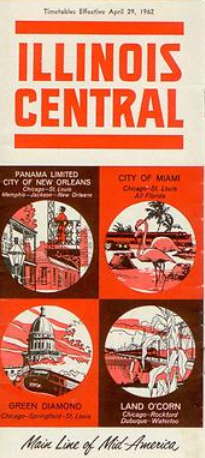
Known as The Main-Line of Mid-America, the Illinois Central (chartered in 1851), connected Chicago with Sioux City, Omaha, Mobile, New Orleans and points in between. Perhaps its most famous train was the City of New Orleans which began running in 1947 and still operates today under Amtrak. Steve Goodman’s 1971 folksong “City of New Orleans,” celebrates that train with its “Good morning Anerica how are you” in recordings by everyone from Judy Collins to Willie Nelson.
When I was in college in Florida and working in Glacier National Park in the summer, I traveled by train. Even though the Great Northern Railway sold its historic park hotels in 1950, the railroad still provided low-cost tickets to seasonal park employees such as bellmen, maids, desk clerks, and waiters. On my return trips, I rode the Illinois Central’s lesser-known train called the Seminole. Since Tallahassee had no north-south rail service, I got only as far as Albany, Georgia (100 miles away) where my parents picked me up.
Passenger Timetable
My worst experience aboard that train came one winter when I was coming home from a visit with friends in Chicago. Somewhere north of Albany in Central of Georgia Railway territory, the train stopped in the middle of a forest recently glazed over by an ice storm. A trainman came through after a while, and said we were free to get off and stretch our legs because we were going to be there a while. A huge tree lay across the tracks. The train crew, with help from the passengers, attacked that tree with fire axes. It took four hours and many blistered hands to clear the tracks. (My parents saw more of Albany that day than they planned.)
Nostalgia Through Fiction
In my recent contemporary fantasy The Seeker (Vanilla Heart Publishing, April 2013) my main character travels from Chicago to Albany via the Seminole to see his girl friend. Since I rode that train many times, it was fun re-creating ambiance of 1960’s train travel in the novel.
Several months later, the sequel called The Sailor, included some of my memories of the Great Northern Railway. In fact, my protagonist David Ward got to do what I always wanted to do: run the train.
In both novels, train travel is a relatively minor part of the action. But I like to make my settings real as well as historically accurate. Train travel was by no means perfect, but it was how we got where we wanted to go when airline travel was still too expensive for most people. There’s nostalgia in the memories, and that’s another reason I included them in my fiction.
Illinois Central Excerpt from The Seeker
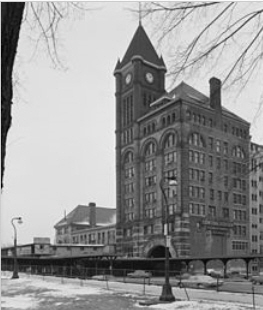
When the taxi dropped David off beneath the clock tower of the 72-year-old Romanesquestyle Illinois Central terminal in Chicago for his May 1 trip to Florida on IC train #9, the Seminole, he wondered if Anne still considered the spontaneous marriage proposal he sprang on her while the Empire Builder raced between Williston and Minot, North Dakota last September with a no-holds-barred, unconditional, leap-of-faith yes.
I loved IC Station in Michigan Avenue. It was built in 1893. It was torn down in 1974 when municipal vandalism won out over preservation and common sense.
Thirteen stories up, the clock read 4:00 PM. Roughly 21 hours later and 940.7 miles down the Main Line of Mid-America, Anne would meet the Jacksonville-bound train at Albany, Georgia as —she claimed—a “different person.” “Za aníwaz?” Eagle would ask. Had she become a blonde? Taller, thinner, shorter, heavier? Or, more like Katherine Hepburn and less like Elizabeth Taylor?
As he found his seat in the old heavyweight coach in the chocolate and orange colored train, the “different person” comment, made so lightly on the phone several weeks before, played on his mind in a minor key.
By the time the pair of General Motors E9 diesel locomotives eased the train out of the station at precisely 4:45 PM, the minor key was dangerously close to a dirge. He was going south from Chicago with love, but was his blind date Daniela Bianchi, playing the sexy Tatiana Romanova with the bedroom eyes; or Lotte Lenya as the sinister agent Rosa Klebb with a lethal knife in her shoe?
At 63rd Street, he opened Barnard Malamud’s A New Life to the first page in hopes that “S.Levin, formerly a drunkard” would be entertaining enough to distract him from idle speculations about the Wicked Witch of the West vs. the Good Witch of the North.
Journey’s Beginning
Dinner—between Champaign and Effingham—distracted him. For one thing, he shared a table with Ed and Mary Saunders of St. James Street in Waukegan, Illinois, who were heading to Miami for their gala fiftieth wedding anniversary celebration at the Fontainebleau, and Mary had a lot to say about Ed’s failure to book them on the more luxurious City of Miami instead of the more utilitarian Seminole. For another thing, the Canapé Lorenzo set before him on the railroad’s coral china was actually quite good—as were the Athens Parfait (compliments of Ed Saunders who, according to the waiter, was a snake when it came to forgetting the tip) and coffee for desert.
David fell asleep south of North Cairo, Illinois, soon after Laverne told S. Levin, “I’ve never done it before with a guy with a beard.” He awoke abruptly 245.9 miles later in Haleyville, Mississippi. A New Life lay on the floor at his feet. He looked at his watch, almost 5:00 AM. The car was quiet until a woman leaving the restroom at end of the coach misjudged the uneven movement of the train through a pair of switches, screamed “shit” in a voice loud enough to wake the unborn before falling against the push-down door handle and careening out into the noisy vestibule. The sleeping passengers’ heads moved, shoulders scrunched or unscrunched, feet slid out into the aisle or were pulled in tight, and arms stretched out like the legs of large insects in a continuing wave from the front to the rear of the car. And then all was at rest again.
Then the squalling wheels in the coach’s rear truck in a tight curve fetched up the memory of the caterwauling panther of a nightmare that must have stalked him thirteen miles up the track at Hackleburg … he had been running between small ponds beneath a bright moon … Coowahchobee sprang out of the dark stand of hatrack cypress and chased him through shallow water … trapped, suddenly, in an unyielding thicket of titi … the small white flowers exploded over head like a dying constellation when … brown eyes above a deep growl that ran through him seconds before the claws snagged his left arm … as the large cat dragged him away from the water, he was conscious first of the pain and then of the dance of its exceptionally long tail … a vague sound deep in the swamp—the novel hitting the floor or the horn of the diesel at an ungated crossing—brought him back to his reclining coach seat on the southbound Seminole. The name Anne wrote in her last letter—Coowahchobee—was the Seminole name for the increasingly rare Florida panther. He had looked that up in the college library.
Kindle Version
David wandered into the dining car a little before 8:00 AM as the train arrived in Birmingham. Couldn’t sleep. Every time he closed his eyes he saw the panther’s eyes. He tried to read, but S. Levin’s fate—teaching English composition in a college with no love of the liberal arts—ticked him off. Was he destined to end up like that? Long before Laverne commented about his beard, Professor Fairchild told Levin to focus on the college’s pet grammar book and “give your students plenty of wholesome, snappy drill.” Holy shit. Death by panther was a more merciful fate. Ed and Mary were nowhere to be seen, and that fact alone almost nullified the impact of the Coowahchobee nightmare. He ate his bacon and egg soufflé in peace and drew strength from the sunny Alabama morning.
–
I hope you enjoy the book, including my memories of the old trains.
 Description: After going on a business trip to north Florida, you have strange dreams about something lurid and/or dangerous that happened in a cemetery next to Tate’s Hell Swamp. You try to remember and when you do, that’s all she wrote.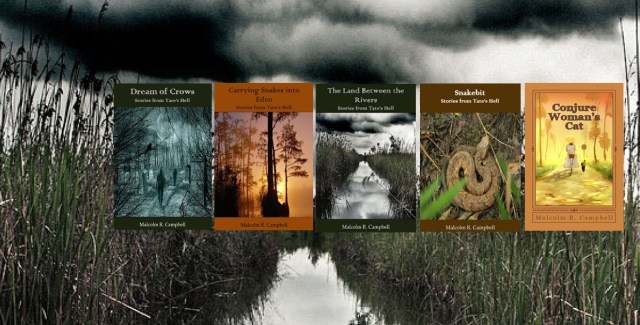
 Sarabande: “Campbell describes a rape scene that is difficult to read, yet at the same time, earns my respect with his skill in describing this scene, and its aftermath on the woman. Indeed, I had to keep reminding myself I was reading the writing of a male author. It is rare to find this ability in an author to cross genders even in everyday basics such as conversation, mannerisms. To do so in describing the effect of rape on a woman’s body and psyche is nothing short of amazing. Campbell nails it: her anger, her pain, her humiliation, her ferocity that eventually takes her from victim to survivor to avenger.” – Zinta Aistars, Smoking Poet Magazine
 Conjure Woman’s Cat: “The story is set in the Florida panhandle in the 1950’s in a society dominated by racism, and tackles the serious issues of white violence, rape, day-to-day prejudice and mother/daughter relationships. This is a book that packs a lot into its 166 pages. Despite this bleak subject matter the book is beautifully written, allowing this Brit a vision of a place which the author knows well and clearly loves. The contrast of the natural beauty highlights the ugliness of human behaviour.” Zoe Brooks, Magical Realism Review Site













 Malcolm's Round Table