Basil: powerful for more than pesto

My father escaped from his typewriter by experimenting with new food concoctions in the kitchen. Most of them came out very well. One of them even got into a cookbook. While the number of meals I cook is limited to a “safe group” that my wife and I have agreed are fit for weekly consumption, I seldom experiment in the kitchen except when it comes to herbs.

Basil - Wikipedia photo
Basil – Wikipedia photo

Basil, oregano and rosemary are my favorites and find their way into all kinds of things. My mother’s old Betty Crocker cookbook had a chart inside the front and back covers listing foods and the herbs that went with them. According to the chart, basil goes into lots of recipes. This chart has kept me from venturing too far into the inedible.

The last time we went to a high style restaurant, they were in their basil phase, creating numerous lunch and dinner dishes encrusted with, simmered with, or liberally garnished with fresh basil. While this was good stuff, it was a cautionary experience, reminding me to be careful with fresh herbs. Everything with basil on the restaurant’s menu was too strong.

I tend to use basil in stews and spaghetti sauce more often than not. However, as I discovered in my research for Conjure Woman’s Cat, one can also use basil outside the kitchen for bringing happiness (other than a tasty meal) or as a protection from evil. If you do this all the time, you might refer to the herb as “holy basil” or “sweet basil” and grow your own rather than getting it off the McCormick spice display at Kroger or Publix.

For example, basil–used alone–or with clover, rosebuds, lavender, etc.–can be placed in a bath or sprinkled or placed in sachets around doors and windows, or kept in bowls to bring happiness and love to your home. Likewise, when sprinkled dry or used as a cleansing wash, it is said to protect a home or a person from evil.

  • When you buy basil from a magic shop, you'll almost always see that it's sold as a curio, that is to say, not with any magical claims.
    When you buy basil from a magic shop, you’ll almost always see that it’s sold as a curio, that is to say, not with any magical claims.

    According to the Candle Spells website,  “It has been said that when tied in a cheesecloth bag and tossed into a hot bath, sweet basil will activate your money drawing abilities and you will be seeing money come to you.”

  • Carolina Conjure says that, “Basil is said to attract customers to a business by placing some in the cash register, or sprinkling basil-water near the threshold. “
  • Catherine Ywronwode (who also has a Hoodoo Herb and Root Magic book available on Amazon), writes on Conjure Lists by Hoodoo Psychics that basil is “A multi-talented magical herb, this one protects the home, brings love and peace to the family, and draws money to the kitchen; Sprinkle some on the floor and sweep it out the back door, for “No evil can come where Basil has been.”
  • Do a search on Google using something like “basil conjure” and you’ll get a lot more hits than you ever imagined the last time you put a little basil on your beef pot roast.
Basil Conjure Oil, meditation, relaxation, altar

Needless to say, I’m a passable cook (within fairly narrow parameters) and not a conjurer at all. So I pass these magical ideas along as curiosities only and as interesting beliefs. As a famous scientist (I forget who) once said when asked why he placed a horseshoe above his door, it’s there just in case.

One can always sprinkle basil outside the front door just in case. Otherwise, if you don’t use too much of it, Betty Crocker and others have plenty of basil suggestions for your cooking and eating pleasure.

I make sure I never run out of basil.

–Malcolm

KIndle cover 200x300(1)Malcolm R. Campbell is the author of “Conjure Woman’s Cat,” a 1950s story about a root doctor who fights the KKK with magic.

Conjure Woman’s Cat website


Comparing apples, spiders and switchblades

Consider this: your editor assigns you the task of looking at the available apples, spiders and switchblades and compiling the top ten for 2015 into an annotated list for the upcoming Sunday paper.

appleYou could look at the apple, spider and switchblade lists that have already come out, mix them up a little, and create your own list. It helps if you’re already familiar with some of the suggestions from the other lists so that you can write what you know rather than stealing what you don’t.

Or, you can try to do a little research, though time is short, and you might–out of well-intentioned ignorance, write something like “1. The Black Widow spider, while ubiquitous is illegal if its legs are over five inches long.”

You see the trouble right away–or, actually, multiple troubles. First, the attributes that make for a good apple don’t necessarily work for knives even though red is often a popular color for both. Second, even if these disparate items did have enough attributes in common to be placed on one authoritative list, nobody has first hand knowledge of all of the potential candidates.

spiderFor those who take the herd-behavior approach to creating their best of the year list, you can weed out all the apples, spiders and switchblades that nobody’s ever heard of even if you’ve heard of a few of them and think they’re superior to those that everyone’s heard of. Your editor has told you before that nobody wants to see a top ten list of stuff they don’t know anything about.

Needless to say, if the best switchblade you’ve ever seen in your life is made by the Ace Knife Company of Two Egg, Florida, you can’t mention the knife unless it was reviewed by, say, Kirkus, the Washington Post or the New York Times, and/or sold 100,000 units. If Oprah picked it for the Knife Club, that’s another plus.

To create a viable list, then, you have to balance shameless popularity with actual quality and ensuring value. The creators of viable lists are often forced to acknowledge sentimental favorites such as the case of the inventor of the most famous apple in the world who, after years of not doing anything, comes out with a new apple that’s said by people who actually tasted it to be a bad apple. This bad apple will probably be on everyone’s list, so it better be on your list as well.

switchbladeSometimes inventors have a drawer full of old stuff that never worked in the past and they hook it all together as an all-purpose apple, spider or switchblade and manage to get it into the homes of 10000000 people because they (the inventors) are already famous. People buy the things because they don’t want to be left out. Critics are forced to acknowledge that even though an item has no redeeming value that they can find, it may have redeeming value they can’t see. So they write stuff like, “Joe Smith’s new 52-leg Swiss army spider is a cutting-edge insect that’s as tart and sharp as a Granny Smith without falling into the mundane trap of being routinely useful.”

Having thought all this through in my usual cynical fashion, I walked off the job when my editor told me to compile our newspaper’s top-25 list of 2015 books. Frankly, it seemed pretty much like comparing apples, spiders and switchblades and equally absurd.

–Malcolm

Malcolm certifies that he did not write this post simply because none of his books showed up on any of the year’s best books for 2015 lists.

99¢ Sale: ‘Conjure Woman’s Cat’ and ‘Sarabande’

The Kindle editions of my dark contemporary fantasy Sarabande and my magical realism novella Conjure Woman’s Cat are both available for 99¢ each on December 3rd. (In fact, the price has already been marked down.)

From the reviewers:

SarabandeCover2015Sarabande: “Campbell describes a rape scene that is difficult to read, yet at the same time, earns my respect with his skill in describing this scene, and its aftermath on the woman. Indeed, I had to keep reminding myself I was reading the writing of a male author. It is rare to find this ability in an author to cross genders even in everyday basics such as conversation, mannerisms. To do so in describing the effect of rape on a woman’s body and psyche is nothing short of amazing. Campbell nails it: her anger, her pain, her humiliation, her ferocity that eventually takes her from victim to survivor to avenger.” – Zinta Aistars, Smoking Poet Magazine

While Sarabande follows-up on the story told in The Sun Singer, it can also be read as a standalone novel.

KIndle cover 200x300(1)Conjure Woman’s Cat: “The story is set in the Florida panhandle in the 1950’s in a society dominated by racism, and tackles the serious issues of white violence, rape, day-to-day prejudice and mother/daughter relationships. This is a book that packs a lot into its 166 pages. Despite this bleak subject matter the book is beautifully written, allowing this Brit a vision of a place which the author knows well and clearly loves. The contrast of the natural beauty highlights the ugliness of human behaviour.” Zoe Brooks, Magical Realism Review Site

–Malcolm

Malcolm R. Campbell is also the author of “Emily’s Stories” and “The Sun Singer.”

Website


No, our Christmas decorations aren’t up yet

We like to give each holiday it’s due.

happythanksgiving2015That means Santa knows that if he messes around decorating our house prior to December 1, he’ll be shot.
(Among other things, we don’t celebrate Black Friday, though Small Business Saturday is kind of nice.)

Today still feels like a continuation of Thanksgiving because we’re eating leftovers. My brother and his wife from Florida were here for a week and they just left this morning because they know from experience that driving back to the sunshine state on the Sunday after Thanksgiving is often a nightmare.

We’re thankful they were here.

Tomorrow, we’ll start thinking about our Christmas decorations. As it turns out, a lot of people have already have lighted trees in their windows and various other lighted decorations in their yards.

We start a bit later and keep our Yuletide lights and greenery up until the last day of Christmas on Twelfth Night.

However you celebrate, I hope you had a happy Thanksgiving and won’t be one of those buffoons who throws out his Christmas tree before nightfall on the 25th. (Gee, what’s the rush?)

–Malcolm

Malcolm R. Campbell is the author of ‘Emily’s Stories,” the Pushcart Prize nominated “Conjure Woman’s Cat,” “Sarabande,” and “Jock Stewart and the Missing Sea of Fire.”


Jock Stewart’s Thanksgiving Memories

  • thanksgiving2015clipart2002 – Turkey and smoker blow up taking out 27 windows of the Smith family’s house next door. Fire department called. Grandpa reminded by battalion chief that this has happened before. Grandpa punches chief and spends holiday in jail much to the family’s relief.
  • 2003 – Mother and Aunt Irene wake up at 4 a.m. to prepare turkey, discover it’s not quite thawed out, decide to drink Irish coffee until they can stuff turkey with Mother’s traditional radishes and spam stuffing, get soused and use too much sage. Most of family gets sick and spends holiday in emergency room.
  • 2004 – Nothing happens. Family decides this is the most boring Thanksgiving ever and resolves to do better in 2005.
  • 2005 – Two distant cousins get pregnant while mostly everyone is asleep on the couch pretending to watch football game. After a family vote, we decide that “stuff happens” and that we can all be thankful this year wasn’t a repeat of 2004.
  • 2006 – Two distant cousins bring their brand new babies and they (the babies) look like everyone else in the family. Nobody steps up to the figurative plat to take responsibility for 2005’s “stuff happens” because they’re all too busy getting the green apple quick step from Mother’s radish and apple pie. DFACS is called and confiscates the babies pending a full review.
  • 2007 – Everyone arrives drunk and nobody gets anything to eat until Dad fries up grits and jalapenos on Black Friday. Smith family gets disgusted and moves out of town until holiday is over.
  • 2008 – An argument begins during a missed call in the big football game. Grandpa settles argument by unloading his new 12-guage shotgun into the TV set. Everyone laughs and agrees this is the best Thanksgiving ever.
  • 2009 – Family agrees to go their separate ways this year to promote family harmony. We eat at a fast foot restaurant where the French fries are soggy and cold but not as bad as Mother’s French fries. We’re more thankful for that than you can imagine.
  • 2010 – Every gets their calendars mixed up and arrives a week early for Thanksgiving. By the time the holiday arrives we’re all sick of each other and go home.
  • 2011 – A political argument breaks out right after the turkey is carved. The blue state family members sit on one side of the table and the red state family members sit on the other. Grandpa throws stuffing at Uncle Walter whom we realize isn’t even part of our family and just dropped in to check the sump pump. We agree to hire TSA reps to maintain front door security in 2012.
  • 2012 – TSA reps confiscate Mother’s carving knife so we end up having to use a hedge trimmer at the table. The noise makes it hard to talk about anything. We’re grateful for that after last Thanksgiving’s blue state/red state argument.
  • 2013 – Things go smoothly without TSA goons at the front door until Grandpa boots up his new smoker in the guns and ammo closet. Nobody is harmed, but the smoker, the closet and multiple firearms are a total loss. We end up getting an injunction to ensure that Grandpa and a turkey smoker won’t be allowed in the house at the same time.
  • 2014 – Dad buys Stouffer’s TV dinners and we all agree our dinner has never tasted this good in the past. Mother’s feelings are hurt and she files for a divorce. Dad admits that some or all of the family’s extra children might be his. I hide in my room with enough crack to last until Christmas.
  • 2015 – Too soon to tell. Dad and Mom are back together again and are happily working in the kitchen preparing our surprise dinner. The place smells like sauerkraut and this doesn’t bode well. Fortunately, we ordered a 55-gallon drum of mimosas and will be well fortified against whatever happens.

–Jock Stewart

Do Million Dollar Debuts Give Writers Hope?

Nope.

Sure, if we were the ones getting a million dollar advance from a major publisher, we would feel hopeful about our future.

Otherwise, the feeling is one of despair.

bestsellerSure (sorry to use the word again), there may be some sour grapes behind our feelings when we read articles like Betting Big on Literary Newcomers.

After all, with the promotion, glitz, buzz and hoopla behind a book with a million bucks behind it, we could skip all the years of being anonymous, of writing novels many people like but that still don’t have the clout to get editorial reviews, of being asked what we’ve written and then getting a blank stare when we list a few of our novels.

As Jennifer Maloney writes in the Wall Street Journal article about betting big, “Social media sites such as Twitter, Facebook and Goodreads have contributed to a culture in which everyone reads—and tells their friends about—the same handful of books a year. It’s increasingly a winner-take-all economy, publishing executives say. ”

That’s the why behind our despair when we read about such huge advances. If your book is not one of these books, or if you’re not already a big name author, you book basically doesn’t exist in spite of all the blog tours, Amazon sales days, and GoodRead giveaways.

Our argument–as the writers down in the steerage section of the publishing ocean liner–has always been that literature would be better served if that million bucks were dedicated to the promotion of, say, ten books for one hundred grand each, or maybe twenty books at fifty grand each rather than being lavished in an advance to one person. That million doesn’t include the advertising budget.

Sometimes BIG BOOKS turn out to be really good, even wonderful. But they’re bad for literature because–like black holes–they suck all of publishing’s efforts into a small minority of what’s out there. We understand, of course, that publishers claim that the profits from big books help fund little books. Maybe, but I never see any evidence of it.

The authors who write the books that jump into the stratosphere like this worked just as hard as the authors who didn’t. But their work is being turned into a fabricated event. Big advance = lots of buzz = justified large promotional and advertising budget = high sales and many articles and book reviews. The publisher has paid to put the book on top from the starting gate.

Yes, I read these books when the critics have good things to say about them. I’m tempted like everyone else to the books I hear about. Unfortunately, like everyone else, I miss the books I don’t hear about because no advertising or promotional budget brought them to my attention.

What a shame.

–Malcolm


Isis Bookstore vandals must be stupid

Here’s the news story that caught my attention: Bookstore named ‘Isis’ becomes target of vandalism

IsisbooksEven though this Denver bookstore has been around for thirty-five years, some bumpkins think it’s associated with the recent terrorist group ISIS.

The store has been hit four times recently: does this mean one stupid vandal hitting the store over and over or multiple stupid vandals hitting the store one time each?

The terrorist group is giving the Egyptian goddess Isis a bad name, not to mention spoiling the 1975 Bob Dylan song by the same name.

This Dáesh (ISIS) logo seems hard to mix up with the bookstore's logo.
This Dáesh (ISIS) logo seems hard to mix up with the bookstore’s logo.

The the bookstore’s owner said that “the goddess represents women, healing and magic, and she says it’s a fitting name for a store that features books and gifts from all types of world traditions and spiritual sources. The shelves include Christian, Hindu, Native American and Pagan texts, to name a few.”

Obviously the vandals have never heard of the goddess, much less noticed that nothing about the store (inside or out) looks like it has jihad sponsorship. The logos don’t look the same either, even if one is color blind as well as stupid.

At times I wonder how it is that the facts and myths that were once basic common knowledge are shrinking. On the other hand, maybe the criminals who targeted the store wouldn’t know squat in any era.

–Malcolm

Moon mysteries and the lunation cycle

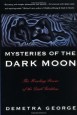
“The moon, with its repeating cycles of waxing and waning, became a symbol to the ancients for the birth, growth, death, and renewal of all life forms. The lunar rhythm presented a creation (the new moon), followed by growth (to full moon) and a diminution and death (the three moonless nights, that is, the dark moon).” — Demetra George in Mysteries of the Dark Moon

Whenever we see a beautiful moon, we stand in awe of it. Newspapers and the social media love pictures of harvest moons and blue moons along with suitable scientific descriptions of how and why such moons look the way they look.

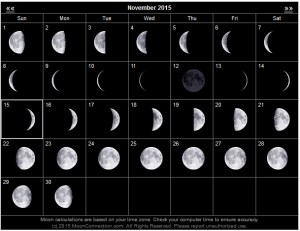
Click on this lunar calendar to find the calendar for any month.

Other than sky shows, we notice the moon less often these days unless we live along the coast and see the changing tides or maintain our farms and gardens by planting by lunar phases. Science and technology have taken us away from the lumation cycle, the interplay of light resulting from the monthly dance of the sun and the moon, so most of us are unaware of the moon’s affect on us throughout each lunar month.

In a patriarchal world, the lunar cycles are generally ignored, distrusted or feared because–in a mythic sense–they represent feminine cycles, the unconscious, emotions, and purported instability. In fact, our word “lunacy” stems from an old belief that insanity came with moon phases, and our word “moonstruck” implies that when in love and affected by the moon, we cannot act normally.

Moonless nights suggest mysteries in many ancient traditions. Jonah was in the belly of the whale for three days; Christ rose from the dead on the third day. In his “hero’s journey” sequence, Joseph Campbell refers to the belly of the whale step as a period of rebirth. We have, however, come to fear those three nights that Demetra George sees as “a time of retreat, of healing, and of dreaming of the future. The darkness is lit with the translucent quality of transformation; and during this essential and necessary period, life is prepared to be born.”

The lunation cycle

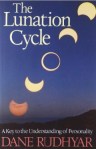
This pioneering 1967 book examines the sun and moon's relationship in the context of our lives
This pioneering 1967 book examines the sun and moon’s relationship in the context of our lives

Since my novel Sarabande is a story of a heroine’s journey, the chapter titles follow the sun/moon lunation cycle in support of the action throughout the book. When the person who formatted the book asked about the significance of these headings, I realized that moon symbolism is not front and center in our daily lives in a world of texting and Facebook posts, jobs and hobbies, relationships with others, or even in our thoughts of day and night.

One post cannot do justice to the work of Dane Rudhyar, Demetra George and others who have written extensively about the meaning and impact of moon phases.  Briefly, though, here are the over-simplified basics:

  1. Dark Dawning: New moon (and up to three and a half days afterwards). Life, or any other event, is a potentiality that is felt rather than seen. Think of a seed germinating in the dark earth.
  2. Light Quickening: Crescent moon (appearing three and a half to seven days later). A challenging time for moving forward after a first look at the reality of the new moon’s vision. Think of the seed’s first shoots appearing above the ground.
  3. Light Ascending: First quarter moon (seven to ten days after the moon was new). A time of conscious steps toward a goal. Think of a plant’s stems and roots forming to support the process of growth.
  4. Light Dominant: Waxing gibbous moon (ten and a half to fourteen days into the journey). The vision, development and knowledge to date are fine-tuned to meet conditions. Think of buds appearing on the rose.
  5. Summit of Light: Full moon (fifteen to eighteen days into the journey). The promise of the initial vision is realized as a reality in the temporal world and has a transformative condition within. Think of blooming flowers.
  6. Stirrings of the Dark: Waning gibbous moon (three and a half to seven days after the full moon). The purpose of the vision comes to fruition, an apt word that means bearing fruit.
  7. Withering of the Light: Last quarter moon (seven to ten and a half days after the full moon). With the potential realized, one begins turning away from the task. Think of flowers and stems withering away.
  8. Depth of Dark: Waning crescent moon (ten and a half days after the full moon). As the person prepares to fully look within, this phase–also referred to as the balsalmic moon–links life and death, past and future in a way that’s often viewed as destiny before darkness returns and germination begins again with the new moon.

georgemysteriesThe lunation cycle is often described as the result of an interplay between the active sun and the passive or receptive moon. This is somewhat misleading, I think, because it gives the impression that the moon (or the psyche) is accepting and then transmitting light from elsewhere (from without) as though no creative growth is taking place.

Darkness and light are often equated logically and symbolically with evil and good rather than as components of an interactive process in which yin and yang are equally necessary. As Dane Rudhyar has pointed out, it’s incorrect to refer to the lunation cycle as a lunar cycle. Instead, it is soli-lunar, that is to say, a cycle of sun and moon in relation to each other like the warp and weft strands of well-woven cloth.

–Malcolm

SarabandeCover2015Malcolm R. Campbell is the author of the magical realism novella “Conjure Woman’s Cat” and the contemporary fantasy “Sarabande.” (See GoodReads for the current “Sarbanade” giveaway.)


Creator and Founder of Worlds of Comfort Seeks Donations

Marie
Marie

Today’s guest post is provided by Worlds of Comfort on behalf of its founder. The site features spiritually oriented intuitive messages, poetry and advice by Sara Isabelle Marie. The organization’s blog can be found here.

Please help and assist Sara Isabelle Marie with a donation, to be able to journey back home to Sweden and keep a roof over her head! Your support is deeply appreciated!

We have all been faced with personal and extreme difficulty at one point in our life, being forced to reach out, beyond our comfort zone. I ask that this situation is being met with understanding and compassion.

Sara Isabelle Marie is currently in Faliraki, Greece, and is such a wonderful and compassionate being, fully and completely here in service to humanity and the planet through her work of Worlds of Comfort, where she is sharing powerful and Healing Poetry and Words of Wisdom (healing messages) She is currently in Faliraki, Greece and because of the unfoldment of a recent event, her financial situation is at a breaking point, not knowing if there will be food on the table or a roof over the head, in a week, let alone, be able to journey back home to Sweden. She has not been in communication with her earthly family for several years, because of her spiritual awakening, and when she is able to journey back home to Sweden, life will begin at point zero, with no available assistance from the social structure or government in Sweden. She is completely dependent on every single donation, that is being received with a tremendous amount of gratitude, to be certain that she is able to keep a roof over the head and food on the table.

PLEASE donate if you are able to, through her website at: www.worldsofcomfort.com (She will be responding with a personal thank you, and when donating 50$, a powerfully healing poem will be sent, intuitively received from your Higher God Self.)

Take the time to read the powerful and Healing Poetry and Words of Wisdom on the website. She is a brave young woman and is determined, focused and willing, but in URGENT need of your and our help, assistance and support during this difficult transition.

I do not know the story behind the financial reversals referred to in this message. But I am happy to turn today’s post over to Worlds of Comfort in the hope Sara will be able to take the next step in her journey.

–Malcolm

When free and cheap transcend plots and themes

The header of an e-mail message this morning proclaimed: “Download Two Free Audio Books.”

I get e-mails like this all the time, variously titled Get Free Books, This Week’s Deals, and 99¢ Books in Your Favorite Genres.

ebooksodaThese deals don’t tempt me at all. I can’t imagine basing my reading choices on books that happen to be free or cheap this week. For one thing, the list of books on my To Be Read List is already long enough. Reading the books I select based on plots and themes (and, yes, on authors’ names) will represent an investment in time. Seeing a deal for a cheap or free book doesn’t grant me a cosmic gift of 30-hour days of extra reading time.

booksendsMy books have benefited from their listings in newsletters like ebooksoda and booksends. When I reduce the price and advertise the book in a newsletter for 99¢, there’s a lot of movement on the book’s Amazon page. My hope here is that people who are already tempted by a book from an author they don’t yet know (me) will try out the book while it’s on sale. Some of those who enjoy the book come back and write reviews.

Newsletters, tweets and e-mail messages offering low-cost books definitely offer a service too readers. I’ve found and enjoyed books by known and unknown authors this way. I image lots of people do.

99centsNonetheless, I’m bothered about the process because after seeing the seemingly infinite number of pitches and promotions for cheap and near-cheap books, I start worrying that everything I say about the plots and themes of my own books–or recent books I’ve enjoyed–doesn’t matter to anyone without the presence of a deal.

Seriously, are large numbers of people reading books based on free and cheap rather than anything else? Or, with the advent of e-books (after all, it’s just a file), is there no room in the economy for books that sell at a high enough price to actually pay the authors’ for the time it took to write them?

Most little-known authors won’t sell 11787.8787879 books to earn $11,787 during the year. ($11,787 is the federal poverty level threshold for one person.) In fact, if they’re paying to get their books included in the deals newsletters, they’ll be running at a loss if they sell 11787.8787879 copies at 99¢.

noAmazonThe economics from the author’s perspective are rather grim when the marketplace–with Amazon’s constant pushing–looks at the default book price for anyone who isn’t on the New York Times bestseller list as 99¢. Amazon, of course, can make a profit when selling by volume because Amazon isn’t using up a year or two worth of writing hours to create the books on its site.

For authors and others who love great books and well-told stories, the main concern here really isn’t personal income because earning enough to live on is assumed for the most part to be impossible. The biggest concern is that more and more book-buying choices aren’t based on great books and well-told stories, but on free or cheap. When that happens, quality becomes the lowest common denominator in ones book-buying choices.

Wikipedia photo
Wikipedia photo

I used joke with my mother about the “savings” of spending a several extra hours’ worth of shopping time each week (and a lot of extra gallons of gasoline in the car) for going to multiple grocery stores to “benefit” from a few pennies off here and a few pennies off there. My view was that she was running in the red looking for deals. Now, the Internet makes the deals easier to find with little time and energy devoted to the search.

So where do we end up? Are books’ plots and themes losing out to free and cheap because the Internet helps us find the deals without having to spend much time looking for them? Or, are readers who care about plots and themes still finding the books they’ve always loved at a reduced price?

I don’t know if quality is suffering or not. But I worry about it.

–Malcolm