Oblique Voices Press of Portland, Oregon has released a selection of dark satire stories by author and George Fox University Professor Emeritus Douglas G. Campbell, Parables Ironic and Grotesque.
From the Publisher
Irony reigns in these biting and ofttimes darkly humorous tales. Campbell invites us to ponder upon the common follies of his fellow man, highlighting such weaknesses as pride, selfishness, fear, and greed, and pointing out the further foolishness of ignoring such shortcomings. Allegorical in nature, this body of work challenges the reader to a closer look into their own frailties and deficiencies and invites him to a healthy dose of quiet introspection.
From the Foreword by Jay Beaman, PhD
 The irony of this artifact, this book, is the irony of how we communicate with each other in post-speak society. In the cyber-world, I can send off a message, and a few seconds later someone else speaks back to me or at me with a tweet, but usually there is a time interval between parts of the same message. Alexander Graham Bell’s first message on the telephone, “Mr. Watson –come here- I want to see you,” was instantaneous and continuous. Cyber-communication is discontinuous, disjunctive, and in that sense ironic. Here we are just now getting around to reading a book by Doug Campbell, written when he was a great speaker, when his voice was in the moment, some years ago before his stroke. Given his current difficulty in saying words, it is ironic to read such prescient work written about our society. I hope to have lunch with Doug again in days, and our conversation will be halting, frustrating, even primitive. But here I read him with such thoughtful and deft clarity. Doug loves puns, like his painting of a frog workshop, titled “toad’s tools.” This book is filled with puns. I hope Doug will forgive me for my pun, quite in bad taste, but written with deepest empathy, I weep as I write it, that this book reads like “a stroke of genius.”
I won’t commit the faux pax of reviewing my brother’s book, though I have to say, I love puns, satire, and irony and find this collection (in those terms) a comforting read.
 To be sure, the connection between writer and reader depends not only on the skill of the writer, but the a reader’s (often) long-time experience with books (how they work), the subject matter, the reader’s state of mind and (probably) physical comfort. When conditions are optimal, the reader is swept up into the story as though s/he is sitting with the storyteller next to a fire in a quiet forest or within cabin’s sweet shadows.


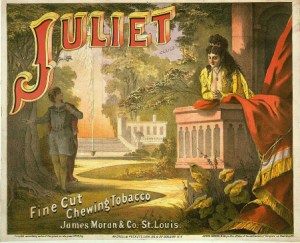 In my case, I mention real products in my novels, partly to set the scene, partly to give the reader a sense of the times, and partly just to show what I’m talking about. For example, if I were writing a novel set in Montana in the 1800s, I would probably mention (or have the characters attend) one of the presentations of the traveling Shakespeare companies. Showing a handbill would be wonderful. Or, I would have one of my characters who likes chewing tobacco get swept up in the craze of related products. I love the artwork from the Juliet tobacco pouch.
 Bob Dylan released “Mr. Tambourine Man” in March 1965 in his “Bring It All Back Home” album when I was at the last place I wanted to be (college), tied down, I thought, by an ancient canon of learning that was taught and graded in an ancient style of “education” that did not meet my needs nor my temperament. What would have met my needs would have been saying “to tell with all this” and then telling Mr. Tambourine man “I’ll come following you.”
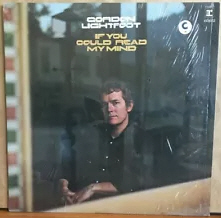 Because of my belief in dreams, I am nothing if not impractical, and heavily influenced–actually under the spell–of these two songs for a lifetime, and while I cannot duplicate the quality of the songs, much less an old-time Troubador, I have always infused their spirit and spell in my work. That is to say, I lead my characters astray and want to hypnotize readers into following them–as Lightfoot says–“While the old guitar rings.”


 Malcolm's Round Table