Book Review: ‘Nero’s Concert’

Nero's Concert Nero’s Concert by Don Westenhaver

My rating: 4 of 5 stars
“A Nero: Any bloody-minded man, relentless tyrant, or evil-doer of extraordinary cruelty; from the depraved and infamous Roman Emperor C. Claudius Nero.” – “Brewer’s Dictionary of Phrase & Fable”

Almost twenty-one centuries after the Great Fire of Rome, most people believe that Nero fiddled while Rome burned. In reality, Nero–who ruled as Emperor between AD 54 and AD 68–played a lyre, and the fiddle as we know it had yet to be invented. Even the historian Tacitus discounts the rumor that Nero sang and played his lyre while enjoying the six-day spectacle of his city on fire. But the fiddling myth lives on.

Nobody knows whether the fire was accident or arson. Disgruntled Romans said Nero started it for reasons of insanity or to clear away land for a new palace. Nero blamed and persecuted Christians to direct the public’s antagonism away from himself. Don Westenhaver’s well-researched novel “Nero’s Concert” provides readers with a what-might-have-happened scenario for the calamitous days of July, 64 AD and their aftermath.

In “Nero’s Concert,” Nero does not start the fire. He asks his close friend Rusticus to investigate in hopes of proving Christians are responsible. Nero doesn’t get the answers he’s looking for. Tensions mount and the friendship between Nero and Rusticus becomes strained. Subsequently, Rusticus’ life and safety are jeopardized when Nero turns to Tigellinus, the sadistic prefect of the Praetorian Guard, for more appropriate conclusions and when Rusticus falls in love with a Christian.

In addition to Nero and Tigellinus, Westenhaver’s novel includes Seneca, Poppaea, St. Peter and other historical characters. Rusticus, who is wholly fictional, attends to both his duty and his heart, making him a wonderfully level-headed protagonist for a story about a chaotic city with an erratic Emperor.

When Camilia, a nurse helping the injured during the fire, tells a Tribune she’s found a murdered senator among the dead, the Tribune says he will take her information to Rusticus rather than Tigellinus.

“I don’t know Tigellinus obviously,” says Camilia, “but his reputation is that he punishes those who bring bad news.”

“Yes,” the Tribune responds. “Whereas Rusticus seems quite different–analytical and professional. Somewhat distant rather than friendly. But I worked with him on the fire and he was fair to everyone.”

Through the novel’s wide window into the past, readers see the workings of the Roman hierarchy via Rusticus’ investigation and his interactions with Seneca, Nero and Tigellinus. As Camilia and Rusticus spend time together, readers learn about daily life and about the horrors of being a Christian at a time when such beliefs are likely to lead to imprisonment, torture and death. The author has taken great care in his presentation of facts about Rome’s rulers, buildings and people. An author’s note at the end of the novel supplies additional details.

While Westenhaver’s writing is highly readable, his modern-day words and phrases add a disruptive casualness that doesn’t fit the time or place. When Thaddeus calls out to Rusticus with the words “Hey boss,” the reality of Rome within the novel crumbles a bit. So, too, when Nero’s efforts to improve his image are referred to as “public relations,” an individual is called “your guy,” a parade is called a “big deal,” and sexual encounters are described as “getting laid.” Personal taste may dictate whether or not this is distracting.

The research behind the story gets in the way of the story occasionally when the primary plot line is diverted into travelogue-style moments around the city and a vacation trip Rusticus and Camilia take to the Bay of Naples. Likewise, a visit with an imprisoned St. Peter strays past its intended purpose into a monologue about Christianity. Such information does provide interesting facts and insights into the characters and the times, but at the expense of the novel’s pacing. Some readers may skim these sections while others may enjoy the additional atmosphere.

On balance, “Nero’s Concert” is an engaging love story as well as an entertaining and informative account of a time that lives in our consciousness as myth more than fact. Readers will come away from the novel knowing that, in all likelihood, Nero neither played a violin nor fiddled around while Rome burned.


Copyright (c) 2010 by Malcolm R. Campbell

View all my reviews >>

Glacier Centennial: Bears don’t eat beargrass

Often considered the park flower, common beargrass (Xerophyllum tenax) is one of the most popular wildflowers in Glacier National Park. Captain Meriwether Lewis collected a specimen in 1806 in Idaho and referred to it as a species of beargrass.

Flickr commons photo by Curt
Since this perennial, a member of the Lily family, isn’t similar to eastern plants named beargrass, Lewis’ rationale for the name are unclear. He did say that the horses wouldn’t eat it, and described watertight baskets made of the leaves and cedar bark by Native Americans.

In his book “The Old North Trail,” Walter McClintock reports that the roots of beargrass (eksisoke in Blackfeet) were ground up and boiled to stop bleeding from cuts and to fight the inflammation accompanying sprains and fractures by the Southern Piegan in Montana. It was also used to stop hair from falling out.

But bears don’t eat it, and it’s not actually a grass. Mountain goats eat the leaves and elk, deer and bighorn sheep eat the blossoms. Grizzly bears occasionally haul the plants into their winter dens for nesting materials.

Visitors to the park will find the creamy yellow, six-to-eight-inch dense raceme flowers on stalks up to six feet tall along the trails to Grinnell Glacier, Iceberg Lake, and Swiftcurrent Pass from June to August. The displays of this flower are often quite profuse, and few hikers with cameras come home without several striking photographs taken along forest trails and in sunny meadows.

When I worked in the park, we told guests that bears dried their paws on beargrass after trying to wash off the rather indelible juice from huckleberries. No doubt, today’s bellmen and bus drivers are still spinning a similar yarn.

If you’re planning a trip to Glacier during this centennial year and are interested in wildflower information, “Wildflowers of Glacier National Park” by Kimball and Lesica is a handy resource.

Copyright (c) 2010 by Malcolm R. Campbell, author of a mythic adventure novel set in Glacier National Park called “The Sun Singer.”

Editing on a snowy afternoon

Lesa Campbell photo

What a perfect afternoon for finishing the edits for the new edition of “The Sun Singer” coming soon from Vanilla Heart Publishing. The afternoon snow ensured that (a) few people would be showing up at the front door and (b) everyone would be trying to get home before a big traffic jam started rather than dialing my phone number.

After we took a few pictures and warmed up some leftover stew for dinner, I e-mailed the file to the publisher.

I haven’t heard about any traffic jams in Jackson County, but WSB radio out of Atlanta was monitoring bumper-to-bumper traffic around the Metro area as an above-average number of people left work early on a Friday afternoon. The Atlanta Journal-Constitution was reporting (as of 7:30 p.m.) “Over 160 accidents reported as metro area receives 2-3 inches of snow.”

Area roads are expected to get worse as temperatures drop beneath 32 degrees in light snow.

When one is on the road, snow can be an annoyance, though I certainly got used to it during the seven years I lived on the Illinois/Wisconsin border and commuted into Chicago. But around here, the snow is some how different: we’re not used to it, we don’t have the equipment to contend with it, and we definitely aren’t driving with chains or studded snow tires.

But when one is inside, the snow tends to quiet down the world and make ones home feel even more like a sanctuary. The quiet alone makes it a good time to work on a book.

Malcolm

Glacier Centennial: Historic Red Buses

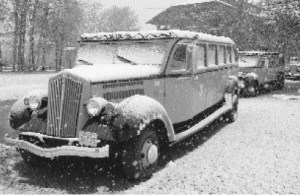
Glacier National Park’s fleet of 33 buses might just be the oldest working fleet of passenger vehicles in the world. Built by the White Motor Company between 1936 and 1938, each 15-passenger, convertible bus with a rollback canvas top has an estimated 600,000 miles on it. And each one has always been painted bright red, to match the berries of the Mountain Ash.

Sun Road - 1939 GNRR Brochure

The Cleveland, Ohio company that built them—once a leading maker of trucks and buses that began as a subsidiary of the White Sewing Machine Company—was purchased by Volvo in 1987. The similar White Motor Company buses that once ran in other national parks have long since been retired.

The noisy manual transmissions responsible for the bus drivers’ nickname “gear jammers” were replaced with automatic transmissions in 1989. The buses themselves were almost lost during the summer of 1999 when developing cracks in the chassis were discovered.

Author Ray Djuff wrote in a 1999 issue of the Glacier Park Foundation’s Inside Trail newsletter that “an expert on White Motor Company vehicles stated recently that, but for an unfortunate retrofitting project in 1989, Glacier’s reds might have run without major problems for another 60 years.” The power steering added when the transmissions were replaced created stresses on the vehicles’ frames.

Since repairing the fleet didn’t appear financially viable, the Glacier Park, Inc. transportation company, once a subsidiary of the Great Northern Railway, told the National Park Service that the buses should be retired. But the pubic saw it differently

After all, when “The Reds” were introduced, they became the most popular way to experience Sun Road or to travel the Chief Mountain Highway from Many Glacier Hotel on the east side of the park up to the Prince of Wales Hotel in Canada’s Waterton Lakes National Park. “Everyone rode them—including Clark Gable, Carol Lombard, William Randolph Hearst, and, more recently, then-Vice President George H. Bush, the Queen of the Netherlands, and Robin Williams,” wrote Amy B, Vanderbilt in On the Road Again: Glacier National Park’s Red Buses. “The Reds provided a memorable experience to every visitor and a reminder of when adventure.”

Designed by Count Alexis de Sakhoffsky, a famous industrial stylist and advocate of streamlining styles, the buses represented the park’s golden age when visitors arrived on the Great Northern Railway’s Empire Builder and Oriental Limited. The visitors were lured by western myths and a See-America-First advertising campaign that used some of the best writers and artists in the country. In 1999, the majority of the 7,000 comments received during the park’s General Management Plan review wanted the National Park Service to keep Glacier the way it was—including the historic buses.

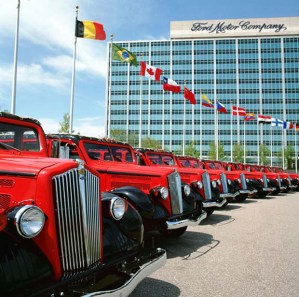
Refurbished Buses at Ford
An endowment was created through the contributions of park concessionaire Glacier Park, Inc, the Glacier Park Foundation and the Ford Motor Company to inspect and evaluate the fleet for prospective restoration. Ford was seriously interested in the project. The rehabilitation solution included a lengthened Ford F450 chassis, a 5.4L V8 bi-fuel power-train, and upgraded flooring, insulation, doors, wiring and instrument panel.

According to Vanderbilt, “The Red Bus project took more than 2 years and a team of over 200 experts from over six different organizations to make the dream of returning the historic Red Buses a reality. Ford completely renovated the Red Buses using new technology and its extensive expertise in alternative fuels. While preserving the exterior of the buses along with their historic charm, Ford used alternative fuel technologies to change the engine and drive-train, making them cleaner and quieter than the originals.” The buses now run on either gasoline or propane.

In the world of restoration, one might say that the buses are rather like the standard example of “Paul Bunyan’s Axe.” The handle is replaced, then the head is replaced, then later another handle is needed. Are these Reds the same buses the White Motor Company built in the 1930s? Yes and no. Even without the old symphony of whirring and squalling gears, the essential ambiance of the riding experience remained in 2002.

Sure, the bus drivers no longer jammed the gears as they double-clutched their ancient horses up over Logan Pass. But they were the once again the knights of the mountain roads who spun tall tales along the backbone of the world with the mysterious daring-do deportment of all minstrels who know how to enchant and steal hearts.

When the buses came back from their rehabilitation at Ford in June, 2002, the mountain gods chased the celebration inside with a heavy snow storm. It was a good sign.

Snowy Celebration - NPS Photo

Copyright (c) 2010 by Malcolm R. Campbell, author of “The Sun Singer,” a mythic novel set in Glacier National Park

Glacier Centennial: Green Business Program

from NPS Glacier…

The National Parks Conservation Association has teamed up with the Centennial Program to launch a Green Business Program. This program will empower local businesses to reduce their environmental impact, resulting in a more efficient and sustainable means of doing business.

Through collective action, Glacier Centennial Green Businesses will help to reduce the environmental impact on our region; decrease the amount of unnecessary waste that goes into our landfill, reduce energy use, conserve water, and foster a healthy local economy by supporting local businesses.

Mark your calendars! Join us for several Green Business Activities on April 20-22, 2010. Stay tuned for more information.


Click here for more information and a PDF application form. Even if you’re not applying, the form itself has a lot of valuable tips and links.

Malcolm

Jock learns Race Ready not meant for real men

from Jock Stewart and the Missing Sea of Fire, a comedy/thriller about horses, horse thieves, girl friends and murderers. In the following excerpt, he’s on the trail of whoever stole Mayor Clark Trail’s race horse Sea of Fire.

Coral Snake Smith needed two omelets to loosen his tongue. For an informed source who made his living trading information for food, one might think Smith would have picked up some table manners along with the details of everyone else’s life. Jock drank half a cup of cold, gritty coffee and tried not to watch. Smith’s pig-in-a-trough noise was bad enough.

Jock’s dear old daddy always said, “Jock, take my word for it. Sloppy people are all going to hell.” He also said, “If a man smells like a whore house, he’s going to hell.” Smith had two strikes against him today and it wasn’t even noon yet.

“What did Lucinda Trail have to say?” asked Jock while Smith was licking his plate like an all day sucker.

Smith almost dropped the plate.

“Are your people following me around?”

Jock shrugged. “That, plus you’re wearing her perfume.”

“We were together, but not in the Biblical sense,” said Smith, and he grinned like it was something he spent a fair amount of time contemplating. “A man can do worse.”

“Word is, Clark has.”

Smith did a spit take with the remains of his coffee.

“So has your boss, but none of this is what Lucinda asked me about. She wanted to know why Monique Starnes bought two sacks of Race Ready.”

“What is that, some kind of Viagra knockoff?” asked Jock, recalling that while his Scotch tasted funny last night his performance had been better than usual.

Smith sat there with his mouth open, for once empty of anything approaching food. He looked like he’d seen a dunce.

“Race Ready is a brand of horse feed,” Smith said, with a fair amount of exasperation and condescension. “Martin and Brian Bentley over at the seed and feed stock it especially for Clark Trail. A new employee who didn’t know the feed had been set aside for Sea of Fire sold one sack to Ms. Starnes at seven AM and another sack at seven thirty-two AM. Brian called Lucinda and apologized for being out of stock.”

Since the waitress had temporarily lost interest in her job, Jock went to her station, selected a pot of coffee with the least amount of sludge in the bottom, and refilled Smith’s cup as well as his own. Doing this gave him time to collect his thoughts such as they were. Out of the universe of probabilities, one begged him to allow it to come to mind. But he wasn’t ready to think that way. So Jock temporarily dodged that line of thought by considering why Lucinda came to the Purple Platter.

“What was a woman like Lucinda doing in a place like this?”

“We keep in touch on a daily basis,” said Smith. “She facilitates that by sitting where you’re sitting now. She’s not exactly eye candy, but she trumps your sourpuss look without having to bat an eyelash or shove a shoe up a man’s trouser leg under the table.”

“Fine.”

So far, Smith had slung four sugar cubes into his cup. Now, he seemed to be studying the sugar bowl as though, what with the rain and all, Monday was turning into a five-cube day. He tasted his coffee, and then he dropped in another cube.

“Lucinda came in this morning dressed to the nines even though it was only eight thirty. Her face was blanched out more than her hair. She was disappointed when she learned that my network of quasi-ubiquitous sources knew nothing about the two sacks of Race Ready.”

“You’re not a seed and feed kind of guy,” observed Jock.

“Hardly.”

Copyright (c) 2009 by Malcolm R. Campbell

COMING SOON

An interview with Smoky Trudeau, author of “Observations of an Earth Mage.”

Golden Eagle’s Gift

Píta, the Golden Eagle, leaned forward into Wind’s gentle breath and came to him on soft wings. David looked up to the outstretched legs uncomprehending like a lamb, tagged, docked, weaned and newly out of the pen into greened up spring. When the talons closed around his head, he saw pain and brighter light, then a sudden upward thrust of great wings pulled him free of the world.

Safe beneath the shadow of those wings, vision came to him as a pure chaos of cloud, as talons dangling above his head as from a mirror, as glimpses of earth. He was almost air. He heard elk mating, stones disturbed on high ridges beneath his feet, water clear and cold. The sky carried snow’s scent.

Manna flung back to heaven, he was limp and drugged by height and claws, his hands and arms flapped uselessly beside him, slightly feathered and somewhat wing. Blood trickled into his eyes and mouth.

He spat salt, choked and felt himself bank southward.

He blinked until his eyes were clear and there lay the world, horizons shattered and clarified out to uncommon distances. He saw the unseen.

He saw the Mokakínsi, the backbone of the earth, and its seven points of power from the crown of the continent running south shone like suns.

He saw Grandmother standing upon a great wall of rock above Apinákui-Píta, the falls of Morning Eagle, facing east, her arms raised to the sky.

He saw lives unfolding along great rivers that emptied into one ocean and in this land where substantial water is a treasure, the rivers flowed as liquid gold.

He saw ignorant men desecrating Mother Earth.

He saw old men telling stories, the smoke of pipes and camp fires rising to the sun.

He saw the far sides of clouds.

He saw the elements dancing naked as secret lovers.

He saw tomorrow and the day after.

He saw lambs waiting to be born.

He saw the seasons change beneath his feet in a spinning blur of white, then green, then the a rainbow resolving to gold, around and around, with sparkling lights and stirring music and bobbing horses, with laughter and tears.

He saw with absolute clarity that an absolute clarity of objects was a crafted illusion, there were no defined edges, no chasms between viewer and viewed, no spaces between here and there, no times between here and now.

The universe spoke, was speaking with Píta’s voice keeeee his vision clearing keeeee over a clarified world keeeee where he merged with his horizons. Lost in limitless light, he was an ocean of stars, a deep flowing tide of emotion, a flooding river of thought, wave after wave of energy, keeeee keeeee keeeee, heard the light coalesce and there the photons were named Mokakínsi, were named Grandmother, were named this person and that person, were named river, were named smoke rising, were named sun, were named cloud, were named lambs, were named autumn, were named God.

Copyright (c) 2010 by Malcolm R. Campbell, excerpted from “Garden of Heaven,” a work in progress.

COMING SOON

An interview with Smoky Trudeau, author of “Observations of an Earth Mage.”

Glacier Centennial: Nature is YOU

“That was the moment that defined my place in the natural world. The moment I understood that I, a human being, was not above the other creatures of Creation. Not better than the bees and the birds and the bears. Not superior to the snakes and the snails and the swallows. I was Nature. Nature was me.” –Smoky Trudeau, writing of an early childhood experience in Observations of an Earth Mage

Glacier
Like many visitors to Montana’s Glacier National Park, I enjoy the historic hotels, the ancient red tour buses, the launch trips on the lakes, and a fine meal in the dining room with a wide-windowed vista such as Waterton and Swiftcurrent Lakes.

The highlighted sites and activities in park service and hotel brochures hardly scratch the surface of what a park is–and what it could be.

There has always been a fight over what the parks are for. Are they wildlife habitats and protected ecosystems or are they recreation areas that must continue to be “developed” for use by visitors at the expense of that which is preserved?

Montana’s Glacier National Park and Alberta’s Waterton Lakes National Park form the world’s first International Peace Park, a designation they received in 1932. Since 1976, the parks have also been designated by the U.N. as Biosphere Reserves; and, since 1995, also has World Heritage Sites.

Biosphere Reserves focus, to great extent, on the relationship between man and nature. I like the idea, but see in that outlook the fiction that nature and man are opposing forces with different agendas. True, it often looks that way, and we have a lot of damage to show for it. Nonetheless, the biosphere approach and designation take us deeper into the heart of what wilderness is, deeper than the red buses and the old hotels, and the sightseeing approach to the natural world.

The National Parks Second Century Commission wrote in its recent “Advancing the National Park Idea” report that “In 1916, Congress created the National Park Service to manage a growing collection of special places ‘unimpaired for the enjoyment of future generations.’ The world has changed profoundly since that time, and so has the national park idea, adapting to the needs of a changing society. But at the core of the idea abides an ethic that embraces the preservation of nature and our shared heritage, and promotes regard for their significance inside the parks and throughout our country.”

I hope this report will help generate the positive discussions we need for ensuring that continuation of Glacier National Park as a safe haven for wildlife and a continuation of the natural world of the Crown of the Continent. What, indeed, will we have in here in this mountain fastness to celebrate 100 years from now. While public access and enjoyment is part of the picture, I see no entitlement there that allows access at the expense of what we are trying to preserve. Perhaps this means limits to daily visitor counts, the elimination of park overflights, the reduction of vehicle traffic, and other facilities and features that lend themselves more to crowds and theme parks than wilderness.

Not everyone wants to step off the historic red bus and get out on a trail. That’s fine, but it’s also a pity. For, as Robert Pirsig said in “Zen and the Art of Motorcycle Maintenance,” seeing the world from a car window is just like watching TV. I agree. One only experiences a fraction of his own heritage–as opposed to a separate nature heritage–by riding on launches and buses. And, attempts to sanitize and make nature overly accessible simply put the world of which we are a part at a further remove while creating unnatural eyesores where the mountains, lakes and forests are all that we need.

Copyright (c) 2010 by Malcolm R. Campbell
Glacier Centennial: Caroline Lockhart

Newspaper reporter, bestselling novelist and rancher Caroline Lockhart (1871-1962) was probably the first woman to go over Glacier National Park’s Swiftcurrent Pass. Working for a Philadelphia newspaper under the pseudonym “Suzette,” she came to Altyn, Montana in 1901 and spent the rest of her life in the West.

At the time, Altyn was a boisterous mining boom town in the Swiftcurrent Valley in present-day Glacier National Park, a town its promoters said would soon become the rich center for gold, silver, copper and even oil. (See my essay about Altyn and the Swiftcurrent Valley in the upcoming “Nature’s Gifts” anthology to be released in March.)

In Cowboy Girl, an excellent biography of Caroline Lockhart, John Clayton writes that “Suzette’s arrival represented major news for Altyn, which had been born less than three years previously, when a strip of land was taken from the Blackfeet Indians and thrown open to mining. Altyn’s prospectors believed that within a few years its destiny would be decided: ‘the richest and biggest camp on earth or nothing.'”

By all accounts, Lockhart was ornery, strong-minded, strong-willed, and outspoken. (She called novelist Zane Grey a “tooth-pulling ass!”) Some suggest that her liberated personality kept Lockhart and her novels–several of which were made into movies–from being better known over the long term. Her novels include Me-Smith, Lady Doc, The Man from Bitter Roots, and The Fighting Shepherdess.

Lockhart owned a newspaper in Cody, Wyoming, where she also served as the first president of the Cody Stampede. Her fight against prohibition would keep Lockhart and her paper in the public’s often-angry eye. Even though she came west as a Phildelphia “Bulletin” reporter, she had grown up on a ranch; she found her dream again when she bought a ranch at Dryhead, Montana near the Pryor Mountains. She increased the size of the ranch and became, in her mind, a true cattle queen. The ranch is now owned by the National Park Service as part of the Bighorn Canyon Recreation Area.

In his article “Project Slows Decay at Lockhart Ranch,” Clayton addressed challenges of restoration–historical authenticity vs. practicality–when he noted that “the research also provides delicious evidence of how characters of the past dealt with hardships. For example, Lockhart had an old-style plank floor in her kitchen. She liked the look of it, but mice could easily creep through its gaps. So she kept two bullsnakes in the house to kill the mice. Today, by contrast, the Park Service uses gravel fill beneath the planks to keep out the rodents.”

Lockhart came west via the Great Northern Railway looking for adventure. By all accounts she not only found it but became a part of it. According to a the National Park Service’s Caroline Lockhart page, the aging liberated lady wrote, “There are no old timers left anymore. I feel like the last leaf on the tree.”

Copyright (c) 2010 by Malcolm R. Campbell, author of two novels, “The Sun Singer” (set in Glacier Park) and “Jock Stewart and the Missing Sea of Fire” (set in an imaginary Texas town).

Disappointed in Jerry and Bobby

I don’t know how I would react to fame, the ever-prying lenses of cameras, the crush of people’s expectations, the constant roar of the crowd. Fame kills, I think, and it does so without remorse.

When I was young and in need of heroes, I saw chess champion Bobby Fischer as a viable candidate. I played chess badly, and so it was that I admired a guy about my age who played better chess at 13 than most chess players will ever play in their prime.

As a writer in training, I grew up with the canon of literature as it was preached during the 1950s; I rebelled against it, and so it was that I admired a guy of my mother’s generation who brought the Caulfield and Glass families to life outside the scope of what my teachers taught.

No one likes to see their heroes rusting away with age and crumbling into apparently flawed and strange creatures. Perhaps neither man expected the fame he achieved or understood its dangers. Bobby Fischer became eccentric and mean spirited and J. D. Salinger hid away from the public eye with what, at times, was an admirable persistence and what, at other times, seemed more like a self-righteous disdain for the rest of the world.

Rightly or wrongly, I am disappointed in both men because each of them threw his talent away. If Bobby’s mission was chess and if Jerry’s mission was short stories and novels, then let the vicissitudes of fame be damned and find a way to stay on course.

Bobby’s chess, including his innovations for the game, will continue to influence prospective masters who might benefit from his contributions to openings and end games. Jerry’s “The Catcher in the Rye” may well fade with time as its focus becomes more and more dated, but his writing brought us more than that in his sparse, but strong collected works. And perhaps there’s more, novels and stories sequestered for years in a safe that may one day find a friendly light of day.

Bottom line, though, I disappointed in Jerry and Bobby because they both quit, perhaps for cause, but that’s ultimately the weakest of rationale.

Malcolm