Review: ‘Buffaloed’ by Fairlee Winfield

Buffaloed Buffaloed by Fairlee Winfield

My rating: 5 of 5 stars
When teenager Ovidia Odegard arrives in the United States in 1904, her first duty is to find suitable work so she can begin paying back her uncle for his out-of-pocket costs in sponsoring her immigration from Norway. Her dream, though is not only to be an American, but a Westerner, and that includes wearing a fancy buckskin jacket.

Providentially, Nancy Russell–the wife of the famed Montana cowboy artist Charles M. Russell–is looking for a housemaid at the couple’s home in Great Falls. When Ovida sees a copy of Russell’s pictorial “Studies of Western Life,” she can’t wait to board the train and head for the West she’s seen at the Nickelodeon.

When she arrives in Great Falls, she finds a dirty, modern city, and once she meets Charlie Russell, she begins discovering that the idealized West as it exists in books and movies is gone–if it ever existed. While Nancy Russell wants contracts and sales for Charlie’s art, Charlie would rather spend his time spinning yarns about the old days with his “bunch” down at the saloon. Not surprisingly, the house is a mess.

“Buffaloed” is Ovidia’s story as told to her grandson just before she died at 94, and it all begins when she mentions a secret she has never shared with anyone: the famous Charles M. Russell mural “Lewis and Clark Meeting the Indians at Ross’ Hole” at the Montana State House of Representatives” wasn’t really painted by Russell. It was a con, or so Ovidia claims.

Ovidia dangles this con before her grandson’s eyes throughout her remembrances because, as she sees it, he wouldn’t understand it if he didn’t know what happened in the Russell household from the moment she reported for work. What had she gotten herself into?

This well-researched book is just the kind of yarn that the master of tall tales, one Charles Marion Russell (1862-1926), would endorse without hesitation. The dialogue, the atmosphere, and the historical period in “Buffaloed” are superb. Fans of Russell and Montana history will discover that the book includes real events and places along with a supporting cast of historical personages.

In his book “Montana Adventure,” a friend and contemporary of Russell, Frank B. Linderman, writes that “Charlie Russell was the most lovable man I have ever known.” This is the Charlie Russell who emerges in Fairlee Winfield’s wonderful novel.

Now, if you live in Montana, mostly everything having to do with Charlie Russell is sacred, and that includes a lot of living and story telling that was also delightfully profane. Ovidia does have a confession to make in regard to that mural, but this is a novel, of course.

Winfield’s disclaimer at the beginning of the book reminds us that “Buffaloed” is a work of fiction. In addition to the standard reference books about Charles and Nancy Russell, Winfield also had a more personal resource for this story: her Norwegian grandmother did work in the artist’s home and had a lot of humorous and gritty stories to tell.

View all my reviews >>

Copyright (c) by Malcolm R. Campbell, author of “The Sun Singer” and “Jock Stewart and the Missing Sea of Fire”

A Sense of Wonder

“If I had influence with the good fairy who is supposed to preside over the christening of all children, I should ask that her gift to each child in the world be a sense of wonder so indestructible that it would last throughout life.” — Rachel Carson

After the basic needs are met, I can think of little that is more important in the upbringing of a child than cultivating a sense of wonder.

When I see adults who have bright and twinkling eyes, who are forever learning new things, who are inquisitive and gentle about the natural world, who have the grit and spirit to take risks, who are not afraid to cry, who take responsibility for their own actions, who believe one way or another in magic and worlds they cannot see, then I know they were loved as children.

Where there is creativity and an infinite ability to dream, there is hope. As a father, I could do no better than teach the joy of an open mind; as a writer I could do no less than write it and live it.

BOOK REVIEW COMING SOON

I’m currently reading a wonderful and well written novel by Fairlee Winfield called “Buffaloed.” In a word: it’s a hoot. It shows the West like it was rather than like it was idealized to be. And, one of the main characters is none other than Montana’s best artist: Charlie Russell.

Malcolm

Glacier Centennial: Grace Flandrau

GNRR Booklet

“It is due to the discovery made by John F. Stevens in 1889 that four years later the evil spirit of the Blackfeet fled forever from Marias Pass before the onrush of a transcontinental express. A continuous highway of steel at last connected, by the straightest and lowest route, the headwaters of the Mississippi with Puget Sound.” — Grace Fandrau, “The Story of Marias Pass,” 1925

Author Grace Flandrau (1886-1971) was a journalist between the 1920s and 1940s who received high acclaim for her short stories and novels. Her novel “Being Respectable” is, perhaps, her best known.

At the time when the Great Northern Railway was seeking popular writers such as Mary Roberts Rinehart to help promote the wild country of Glacier National Park, they selected Flandrau to write a 24-page booklet about Montana’s Marias Pass.

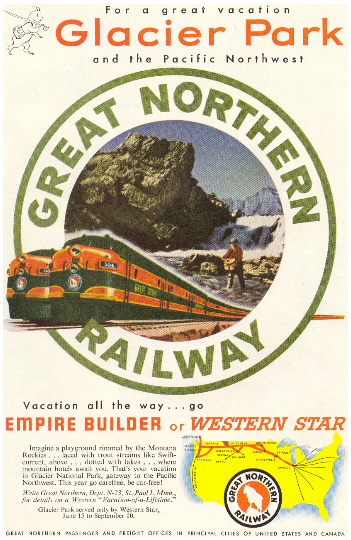
1940s GN Ad
Rail travelers on today’s AMTRAK Empire Builder, named for the famed Great Northern train of an earlier era, see Marias Pass as the train traverses the Continental Divide south of Glacier National Park. U.S. Highway 2 also uses the pass.

Flandrau’s booklet promotes the discovery of the pass by Great Northern civil engineer John F. Stevens in 1889. “Travelers, unless they happen to be civil engineers, which, of course, most of them are not, are in the habit of taking the passing of railroads through mountain ranges, entirely for granted,” she writes on the booklet’s first page.

The booklet promotes a high point of Montana railroading history: it’s epic stuff, perfect for the eyes of prospective passengers who might be enticed to head west and experience the grandeur of the Backbone of the World first hand.

You can learn more about the career of Grace Flandrau in Georgia Ray’s 2007 biography of the author, “Voice Interrupted.”

In his review of the biography, Paul Froiland writes that “Ray has elevated St. Paul, Minnesota, novelist and journalist Grace Flandrau from obscurity to her rightful place alongside her contemporaries — Scott Fitzgerald, Sinclair Lewis, Willa Cather and Ring Lardner. This book is the first step in rehabilitating the reputation of one of the great — and most undeservedly forgotten — descriptive writers of the twentieth century.”

Copyright (c) 2010 by Malcolm R. Campbell, author of “The Sun Singer,” a novel set in Glacier National Park. My article about the park’s Swiftcurrent Valley appears in “Nature’s Gifts,” an anthology of fiction, nonfiction and poetry celebrating nature to be released by Vanilla Heart Publishing in March.

Glacier Centennial: Mary Roberts Rinehart

“If you are normal and philosophical; if you love your country; if you like bacon, or will eat it anyhow; if you are willing to learn how little you count in the eternal scheme of things; if you are prepared, for the first day or two, to be able to locate every muscle in your body and a few extra ones that seem to have crept in and are crowding, go ride in the Rocky Mountains and save your soul.” — Mary Roberts Rinehart, in “Through Glacier Park,” 1916
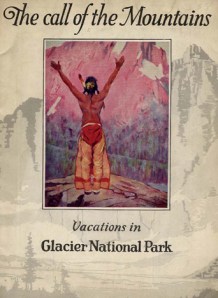
Mary Roberts Rinehart (1876-1958), a popular mystery novelist of the day, wrote about Glacier National Park under the sponsorship of the Great Northern Railway. The railroad built and owned the primary hotels in the park and conducted an extensive “See America First” publicity campaign to promote its playground. Rinehart wrote “Through Glacier National Park” and followed that up with “Tenting Tonight” two years later.

Rinehart, whose novels and “Saturday Evening Post” short stories were popular with the public was perfect for the GN’s publicity department because she had readers ready to follow her exploits in the wilderness, and then to take a Great Northern train to view the “care-killing” scenery she described. Rinehart also wrote the introduction to the railroad’s 48-page “The Call of the Mountains” brochure in 1925.

In his book “Man in Glacier,” C. W. Buchholtz writes that Mary Roberts Rinehart’s, books, “while contributing a female point of view, gave substantial credit to railroad investments. In ‘Through Glacier Park,’ published in 1916, Rinehart gave a dutiful, twenty-page chapter describing the various hotels, chalets, and camps.”

The railroads pushed hard on the “See America First” campaign. Great Northern–a predecessor of today’s Burlington Northern Santa Fe–had sixty miles of track along the southern border of Glacier National Park that set the tone for its brochures, dining car menus, advertisements, and even many of his passenger car names and decorations. An idealized version of the mountain goat, “Rocky,” was a Great Northern logo for years.

As C. W. Guthrie notes in her book “All Aboard! for Glacier,” “If there was one attraction American had that Europe did not, it was the Wild West. The world’s image of the frontier landscape, peopled by the likes of mountain man Jim Bridger, scout Kit Carson, hard-riding, fast-shooting cowboys, and proud, fearless, sometimes savage Indians was born of fact, nurtured by myth and is distinctly and proudly American.”

Rinehart’s tour of the park–complete with river boats, multiple guides and packers, and two photographers–was by no means typical of those experienced by most tourists who arrived at East Glacier or West Glacier (Belton) via the railroad’s 1,816-mile mainline between St. Paul and Seattle. But her words resonated with those who wanted a taste of the adventures she described at hotels owned by a railroad that would operate as Glacier’s primary concessionaire until 1960.

“Now and then the United States Government does a very wicked thing,” she wrote. “Its treatment of the Indians, for instance, and especially of the Blackfeet, in Montana. But that’s another story. The point is that, to offset these lapses, there are occasional Government idealisms. Our National Parks are the expression of such an ideal.”

You can read Rinehart’s “Through Glacier Park” online here. You can see beautiful examples of railroad promotional brochures here. For additional detail, C. W. Buchholtz’s park history “Man in Glacier” can also be found online.

Copyright (c) 2010 by Malcolm R. Campbell, author of “The Sun Singer,” a novel set in Glacier National Park. My article about the park’s Swiftcurrent Valley appears in “Nature’s Gifts,” an anthology of fiction, nonfiction and poetry celebrating nature to be released by Vanilla Heart Publishing in March.

Review: ‘Now is the time to do what you love’

Now is the Time to Do What You Love: How to Make the Career Move that Will Change Your Life Now is the Time to Do What You Love: How to Make the Career Move that Will Change Your Life by Nancy Whitney-Reiter

My rating: 5 of 5 stars
Picture this: Joe, a fry cook in Gainesville, Florida, wows his family and friends with his Chesapeake Bay Wild Striped Bass and Braised Short Ribs on evenings and weekends. After dreaming of opening a restaurant “somewhere near the Big Sur,” he sells his house, packs his family into a car and heads for California. Joe will learn the multiple definitions of “nightmare” and “disaster” before year’s end.

Or picture this: Joyce, who lives in Decatur, Illinois, has always loved children. She’s wondered for years whether to become a teacher or open a daycare center once her own children leave the nest. But she keeps waiting for some future moment when her world is more settled, ensuring that “what night have been” will remain “what never was.”

Dreams, some say, will take up as much space as we allow. According to Nancy Whitney-Reiter, most of us spend our careers trying to achieve success as it’s defined by others rather than proactively following our dreams and doing what we love. Yet, “Now is the time to do what you love” makes clear that ill-defined career-change goals may remain pipe dreams if we take no action or may become nightmares when we fail to consider realities and create a comprehensive plan.

After establishing the rationale for changing careers sooner rather than later, Whitney-Reiter leads readers through a frank assessment of exactly how their dream jobs will impact that lives, their emotions, their finances, their physical condition and their families. She includes pros and cons, examples, reality checks and “Is-It-Worth-It?” checklists.

When considering finances, for example, the checklist includes such statements as “I am willing to invest a significant amount of time on understanding and improving my financial picture” and “I understand that my expenses might actually rise during my transition between careers.” If one doesn’t agree with such statements, s/he may face roadblocks to his or her success.

After successfully working through the advice and checklists in part one, part two leads career-change dreamers into “Taking the Plunge.” To avoid the financial and emotional nightmare of becoming trapped in a new career that doesn’t meet expectations, one should make a sound written plan and find various ways for trying on the proposed career to see if it fits.

“Jumping into a new career,” says Whitney-Reiter, “is akin to jumping into an unknown river. It may look beautiful and inviting from a distance, but you really have no idea what it’s like until you become immersed in it. Sticking your big toe in–taking a trial run–allows you the opportunity to test the waters first.”

Part three analyzes the realities and requirements of popular career and second-career choices, including converting hobbies into money-making opportunities, leading travel groups, teaching and care-giving, social work, public speaking, nonprofits, real estate and law enforcement. Those considering these careers will find options, laws, certifications and other vital specifics. Others may discover a career they hadn’t yet thought of and/or sound examples of the kinds of considerations any new career includes.

Immensely well organized and practical, “Now is the time to do what you love” is the perfect companion for anyone who is dissatisfied with their current career and/or who is considering a second career after they retire from the first. To become viable realities, dreams require work. Whitney-Reiter’s experience, research and interviews show those ready to take the journey the important milestones to leaving a job that’s just a job and entering a fulfilling career doing that makes them personally feel successful and happy. The book is a very wise dream catcher.

View all my reviews >>

Glacier Centennial: Art of Preservation

Fourteen pieces of art have been selected for Glacier National Park’s Centennial. Wild places inspire artists. In turn, their work inspires others to love wild places. The art follows the Centennial theme: Celebrate, Inspire, Engage.

On tour throughout the state, Glacier’s Centennial art can currently be seen at the Natural History Center in Missoula between January 14 and February 24 from 8 a.m. to 4 p.m. The Center is at 120 Hickory Street.

MNHC will have a special reception Friday, February 5th from 5 to 8 p.m. The reception is free.

Malcolm

Coming Soon

Vanilla Heart Publishing will issue a new edition of my 2004 novel “The Sun Singer” this spring. The novel is set in Glacier National Park.

Pied Type Doesn’t Have a Flaky Crust

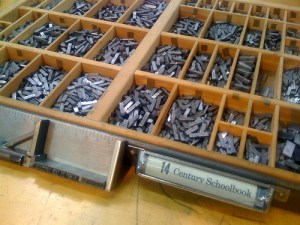
Job Case Photo by Heather on Flickr
The title of this post comes from my novel “Jock Stewart and the Missing Sea of Fire.” For better or worse, it’s a play on words. In this case, “pied” has nothing to do with the apple and cherry pies grandma used to make.

The term “pied type” refers to handset type that’s been dropped on the floor, scattering in a mess.

Handset type was stored by font in a California Job Case, a removable drawer in a cabinet. The letters were arranged in the case in order of their frequency of use. Printers created words, one letter at a time in a composing stick–a small hand-held tray which the typesetter viewed upside down. (The Linotype did this automatically, one line at a time–quite a time savings)

When the typesetter finished a column or part of a column, he tied the type tightly together with string and then transferred it to a form to be mounted on the press. If he dropped it, he said he had pied his type. “Pi” or “Pie” type refers to mixed up stuff whether it’s a dropped block of type or pieces of the wrong font mixed up in a job case.

Handset type was still prevalent enough in the late 1960s that my journalism course work included a printing class in which we were all trained to set type this way. Years later, I would still find some printers–especially those doing formal invitations on small platen presses–to be setting type in a stick and letting lose with a lot of profanity whenever the type got pied.

Malcolm

Guard Cat

Katy and her spooky reflection
After three of us uploaded pictures of our offices on a Yahoo group for writers, somebody asked if all writers keep cats near at hand while writing.

The answer to that question is probably “no” unless we’re talking about witches who can’t write without their familiar standing by.

Nonetheless, Katy guards my den while I’m at work. From her position next to the file cabinet, she can see all the way down the hall. This way, other entities–such as my wife, guests coming in the front door, or the other three cats in the house–cannot approach without challenge.

When Katy gets bored with her duties, she squeezes in behind me on my desk chair and falls asleep–with one eye open.

Malcolm

Vistors Brave Cold, Attend Museum Opening

The discovery of the use of ether as the first viable anesthesia for use during surgery by Dr. Crawford W. Long in Jefferson, Georgia on March 20, 1842 looms very large as a medical milestone. It’s on a par with–and predates by over 20 years–Joseph Lister’s discovery of antiseptics for sterile surgery and Louis Pasteur’s germ theory of disease. That the discovery happened in a rough and tumble frontier town makes it all the more remarkable.

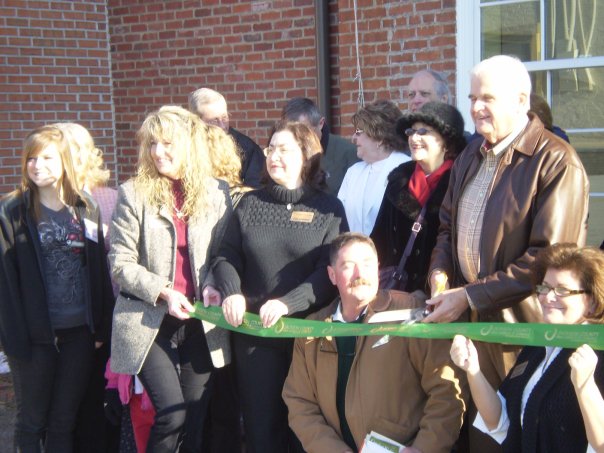
CWL Ribbon Cutting- Dave Rosselle Photo.
The museum, billed as “the Birthplace of Anesthesia,” reopened Saturday morning, January 9th, on one of Georgia’s coldest days of the winter after a two-year restoration and exhibits update project lead by consultant and acting museum director Lesa H. Campbell (front row, in black). In spite of the weather, the Crawford W. Long Museum at 28 College Street in Jefferson was packed.

Mayor Jim Joiner (standing, brown jacket) said at a Chamber of Commerce preview party the day before that some said that Crawford W. Long’s discovery in 1842 successfully put the town of Jefferson asleep. But then he indicated that the work done revamping the museum on a $200,000 USDA Rural Development Grant was another example of the reality that the town is very wide awake.

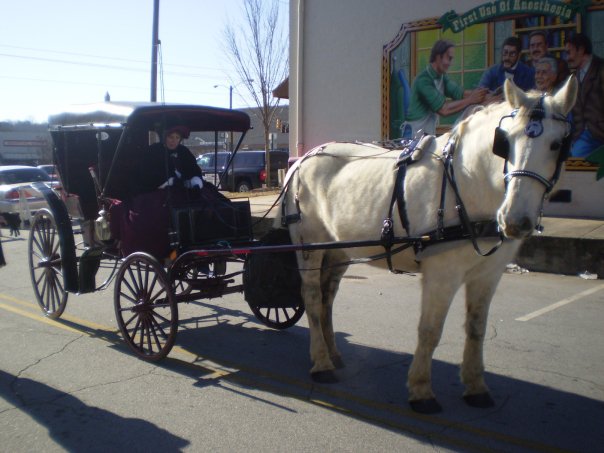
Historic District Surrey Ride - Dave Rosselle photo.
Over 100 of the visitors surged through the front doors within the first 90 minutes. They flowed through the museum’s three, interconnected historic buildings seeing updated and enhanced displays with new information, and artifacts that had never been shown before. Outside, visitors were treated to a surrey ride through Jefferson’s historic district followed up by free coffee and hot chocolate across the street at Fusion Restaurant.

A visitor from Massachusetts said, “I think what they’ve done is absolutely excellent. I received a degree in museum studies from Harvard and this is even better than the Warren Anatomical Museum at the University.”

After the long hours put in by Campbell, by Vicki (to Campbell’s right) and Karen (far right) (museum staff), by Frank and Terry (contract craftsmen), Beth (Mainstreet Manager) and by Barbara, Jackie, Jim, Gerry, Reggie and other volunteers, such compliments are a tonic. So too, the wide eyes, smiles and kind words of the visitors upstairs in the new Anesthesia History Exhibit, on the main flow in the completely redone Crawford W. Long gallery illustrating the ether discovery and Long’s family and education, and down in the 1858 General Store.

The day ended with a fund-raising dinner, conducted in two seatings at Fusion, that featured guided tours conducted by Campbell. At the end of the last tour of the evening, she said that it was a little daunting explaining the import of Long’s work and the features of the anesthesia machines to an audience that included practicing anesthesiologists, one of who is a Crawford W. Long expert.

Everyone who shares the long-term vision for a museum hopes, on any given day, to treat visitors to an interesting and educational world of wonders. But in spite of the aching backs and tired feet that result from putting on a great show, there’s the inevitable pull by the work yet to be done. There are always new displays to construct and more research waiting to be done. The world inside the museum is infinite and both the staff and the volunteers are wide awake with the possibilities.

Malcolm

Glacier Park Centennial: Josephine Doody

Josephine Doody (1853-1936) was a moonshiner, mountain lion hunter, and a McCarthyville, Montana dance hall girl. Known as the “Bootleg Lady of Glacier National Park,” she married one of the park’s first rangers and fur trappers, Dan Doody. A mountain in the park is named for him, and Lake Josephine might be named for her or a mule.

McCarthyville was a railroad boom town on the Great Northern Railway line at Marias Pass. The town attracted the usual low lifes who follow railroad builders. Life centered around Slippery Bill’s Saloon. According to historian Jack Holterman, the hospital’s doctor was so bad “you never knew how many men had died until the spring thaw.”

Doody pulled her rifle on the railway man in charge of the town and persuaded him to get the town under control. He did. Reportedly, Josephine was wanted for shooting a man, possibly in self defense, down in Colorado where the law was looking for her. She hid out in Dan’s cabin until the whole mess blew over.

The Great Northern built a siding on Josephine and Dan’s ranch so Jim and Louis Hill’s private car could stop. The Hill family loved the little woman with her great cooking, rough language and big earrings. Meanwhile, Dan was one of those rangers who did a little trapping and poaching within the confines of the park he was being paid to police.

Josephine operated several stills on that ranch; railroaders knew to stop their trains there and blow the whistle once for each quart of refreshment they needed.

John Fraley writes about Josephine in his book Wild River Pioneers. “She was an incredible woman who lived across the Middle Fork, in a remote area, at one point she didn’t see another woman for seven years, she was a bootlegger, that’s why she’s called the Bootleg Lady of Glacier Park,” Fraley said.


Malcolm