Glacier Centennial: ‘Glacier Album’

This upcoming new book from Montana’s Riverbend Publishing is sure to be a real treat for those who love Glacier National Park and its history.

Seasonal ranger and historian Michael J. Ober has collected in “Glacier Album” photographs and stories dating back to the creation of the park in 1910. These rare images show the changing times at the Crown of the Continent from the Great Northern Railway’s early influence to the coming of automobile travel after World War II.

Another paperback for my coffee table, and just in time for the Glacier Centennial.

Malcolm

With each purchase of my novel “The Sun Singer” (set in Glacier Park) in any format, Vanilla Heart Publishing makes a donation to Glacier National Park in support of this year’s centennial celebration. It’s only $5.99 on Kindle.

So long Jim Newton of the Broken Wheel Ranch

When most people heard of the death of actor Peter Graves yesterday, they probably thought of him as Agent Phelps on “Mission Impossible” or as Captain Oveur in “Airplane.” My memories go back father than that to a time (1955-1960) when he played the role of Jim Newton in the TV series “Fury.”

A city boy, I didn’t grow up on a spread anything the Broken Wheel Ranch–it was a ranch-style house, but in a sprawling, north Florida neighborhood. So of course I didn’t know Jim’s adopted son Joey or Pete, the foreman of the place, but I knew people like them. Truth be told, had I lived on the fictional ranch or been anywhere near the set where the show was filmed, my best friend probably would have been the American Saddlebred stallion named Beaut who starred as Fury–and on other shows as well along with the movie “Giant.”

Fury was as wild as his name; Joey could ride him, but no one else except on special occasions. Jim Newton was a nice guy and, like Peter Graves in most of his starring roles, he played a strong, upstanding kind of guy, a Gary Cooper kind of guy that had strong values and didn’t tolerate a lot of shades of grey when it came to sorting out right from wrong.

On “Fury,” greenhorns were always getting into trouble and Fury–like Lassie–was there to rescue them. Things always worked out fine on “Fury” and that included the rather sappy closing shot with the cast laughing at something at the gate to the ranch.

In those days, my heroes were the plain-spoken guys who owned ranches and solved problems or rode into town when trouble was brewing and stood up against the clowns and riffraff in spite of the odds. I liked that, and I liked the fact they always had a faithful horse.

Sure, I remember Agent Phelps, but Jim Newton rings a louder bell.


Fans of the old series will enjoy two websites with memorabilia and information: Broken Wheel Ranch and A Fury Scrapbook.

Hints for the Hero on the Path


“A Quest of any kind is a heroic journey. It is a rite of passage that carries you to an inner place of silence and majesty and encourages you to live life more courageously and genuinely.” –Denise Linn, Quest – A Guide for Creating Your Own Vision Quest

“The more you push yourself to understand something that you are not ready for, the less likely you will be to achieve understanding. You must surrender, let it go, and be fluidic. You cannot force this door [the door to your awakening] open. It does not work like that.” –Eric J. Pepin, The Handbook of the Navigator

“Resistance is an opposition, due to some belief, to experiencing something just as it is. It’s an attempt to create from consciousness rather than from awareness.” –Harry Palmer, in The Avatar Journal, Summer 2005.

“Quests are personal journeys, and every step is taken alone.” –Deepak Chopra, The Way of the Wizard

“The hero adventures out of the land we know into darkness; there he accomplishes his adventure, or again is simply lost to us, imprisoned, or in danger; and his return is described as a coming back out of yonder zone. Nevertheless—and here is the great key to understanding of myth and symbol—the two kingdoms are actually one.” –Joseph Campbell, The Hero With a Thousand Faces

If there is a subtle message in my novel The Sun Singer it is this: the great words of the great masters about your life’s journey are—at best—hints.

The words of the masters may suggest to you that there are other worlds and other levels of consciousness and other levels of awareness. And they may also suggest techniques that will help you find the doorways, paths, enlightenments, and awakenings you desire.

After that, the great words are lies insofar as your journey is concerned. The great masters’ great words describe the great masters’ journeys. As such, they are the gospel of the great masters’ experiences.

Your journey is yours alone and cannot be undertaken by following in the great masters’ footsteps or by concretizing the great masters’ thoughts into a recipe book. You alone know the terrain upon which you are walking and when all is said and done, the great masters’ view from the mountaintop will never be yours. Attempting to see what they saw creates blindness.

You alone will write the gospel of your life, and it will be based on your awareness of your own experience. Nothing else matters; nothing else exists. You are both the creator of your path and the one who walks upon it enjoying the scenery and surprising yourself with the wonders you encounter.

Copyright (c) 2005 by Malcolm R. Campbell

The Sun Singer and Jock Stewart and the Missing Sea of Fire are available in multiple e-book formats at Smashwords during Read-an-Ebook Week for only $4.49. Sale runs through March 13.

Fu Dog Substitute

Allerton Fu Dog
Stone Fu Dogs, displayed in pairs, guarded the entrances of Chinese imperial palaces and temples for years, and now can be found at the entrances of homes and businesses. They serve the same function as gargoyles, figuratively–or perhaps, magically–guarding the structure and those inside from harmful people and evil vibes.

When I visited Robert Allerton Park, in Monticello, Illinois, as a child, I was not only impressed by the statue of the Sun Singer, but with the numerous Fu Dogs. I imagined that one day I would own an estate with a pair of these dogs at the entrance, the female on the left and the male on the right greeting all who might visit.

My estate and my Fu Dogs haven’t materialized. Perhaps it’s fate or the humor of the universe or–more likely–simply a lack of funds.

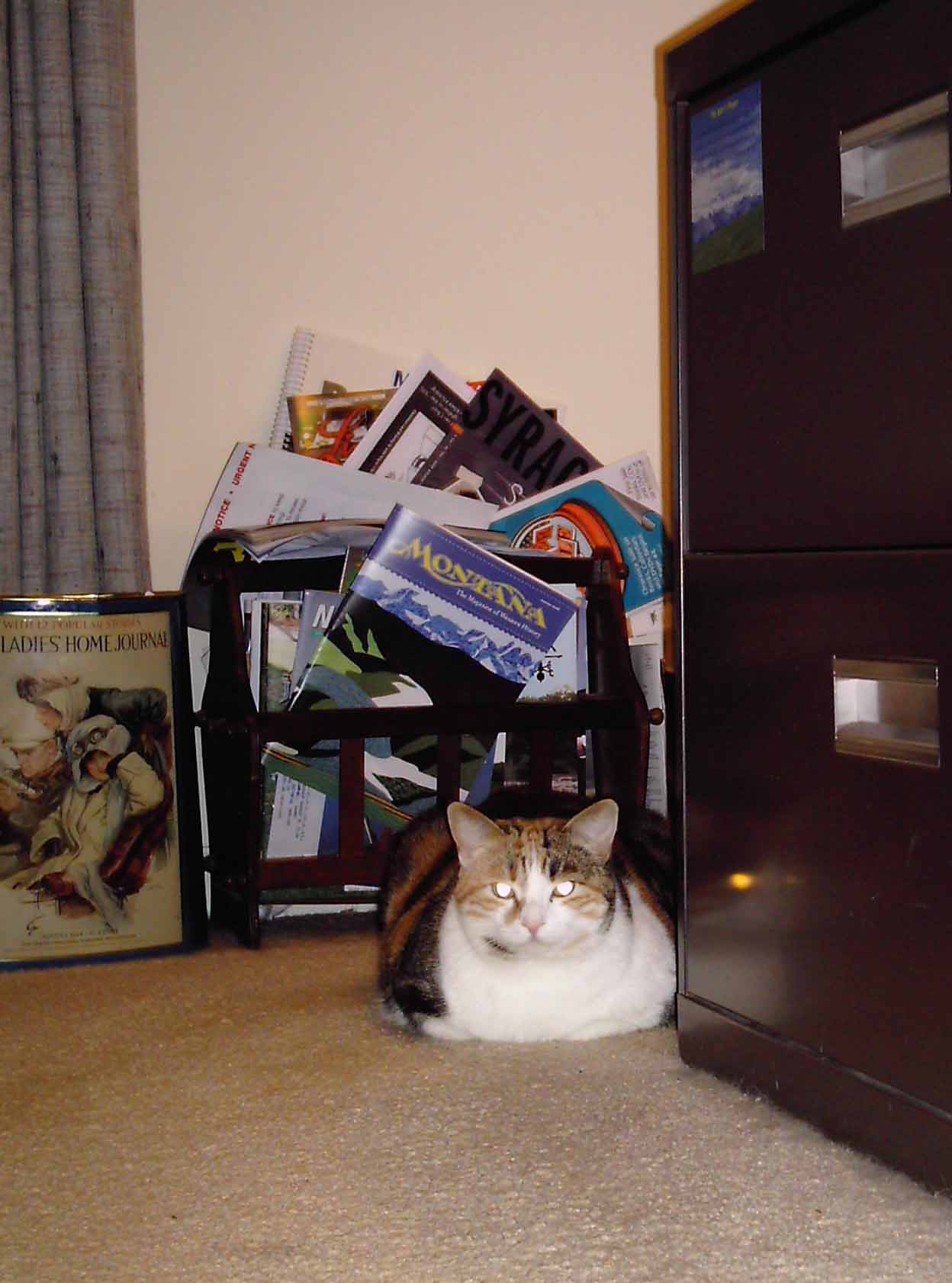
Even so, my den is is guarded by two substitute Fu Dogs. One is a two-inch high gargoyle modeled after those at Asheville’s Biltmore house. The other is Katy, a large–and potentially overweight–calico cat who persists in monitoring everything that happens in my office. She either sits on the back of my large desk chair or positions herself next to the file cabinet so she can see all the way down the hall toward the foyer of the house.

If another cat or my wife or anyone else ventures into my domain, Katy is right there, quick to show her displeasure by either her posture or the flattened-back position of her ears. Fortunately, she doesn’t move on to hissing, growling or biting.

We are all somewhat amused, but not having real Fu Dogs at my front door or even at the door to my den, Katy provides all the protection of need from the slings and arrows of evil spirits to the (probably) malicious intentions of other cats sneaking down the hallway.

I feel so fortunate.

Malcolm

Glacier National Park Trivia

Did you know…

…The bald eagles seen on the western side of the park began showing up in 1916 when koanee salmon were introduced in nearby Flathead Lake.

…a snow field shaped like the continent of South America appears on the slope of Mt. Altyn at Many Glacier Hotel every year.

…after Many Glacier Hotel employees worked diligently through the night fighting the wind-driven inferno of the Heaven’s Peak fire of 1936 and wired the Great Northern Railway management that they had saved the company’s hotel, the return telegram said: WHY?

…Glacier National Park’s hotels were closed due to wartime austerity measures between 1943 and 1945.

…the light-colored limestone and dolomite of the Altyn Formation rocks along the Going-to-the-Sun highway show ripple marks and fossil algae from the warm seas of their birth.

…in 1900, there was a mining boom town named Altyn in Swiftcurrent Valley a few miles from the present day site of Many Glacier Hotel where copper, oil, gold and other minerals lured developers to what many thought would become a great mining center.

…the ice of Grinnell Glacier moves 30 to 50 feet a year.

…the rain and snow melt from Triple Divide Peak flows away from the park in three directions ending up in the Atlantic, Pacific and Hudson’s Bay.

…at 10,438 feet, Mt. Cleveland is the highest peak in the park.

…the monument where U.S. Highway 2 and the BNSF mainline go over Marias Pass attributing the discovery of the route through the mountains to John F. Stevens stems from Great Northern Railway mythology rather than fact–Native Americans as well as explorers had been using the pass for years.

…while Libby Smith Collins, the Cattle Queen of Montana, did come to the mountains of present-day Glacier National Park in search of copper in the 1890s, the “Cattle Queen of Montana” movie staring Barbara Stanwyck and Ronald Reagan has little to do with her life.

…while the Japanese lanterns hanging in Many Glacier, a Swiss Style Hotel, had little to do with the time, place or ambiance, the Great Northern Railway hung them there in 1915 to help advertise its steamship traffic between the U.S. and Japan.

…the glaciers in the park will probably have finished melting away by 2030.

…Civilian Conservation Corps (CCC) men logged off 5,000 acres of Glacier’s forests in the 1930s for use as fence posts and telephone poles.

…The park’s restored fleet of 1930s White Motor Company convertible tour buses will not run on either gasoline or propane.

…this year is the 100th birthday of the park.

TSScover2014–Malcolm R. Campbell, author of “The Sun Singer,” a novel set in Glacier National Park.


Submissions wanted for CAMAS Glacier Issue

Camas, the literary magazine of the University of Montana is dedicating its Summer 2010 Issue to Glacier National Park in concert with Glacier’s Centennial Anniversary. The deadline is March 15, 2010.

The magazine is seeking feature articles (2000-3000 words), essays (500-2000 words), interviews and profiles (250-2000 words), fiction (500-2500 words), and poetry of varying lengths.

For complete guidelines and submission information, click here.

It should be a great issue for fans of Glacier National Park.

–Malcolm, author of “The Sun Singer,” a novel set in Glacier National Park.

Digital Books – Saying Goodbye to Paper


As a junior high school student delivering the Florida Times-Union to customers throughout my neighborhood, it never occurred to me that one day we’d say goodbye to newspapers. But we are, sadly and surely doing just that.

Soon, I suppose, hardback and paperback books will become as rare as papyrus scrolls and possibly just as hard to find.

I grew up on 35 cents-per-gallon gasoline, telegrams, party line telephones, cars you could fix yourselves without hooking them up to computers, and real books. Real books were more than words on paper: they were the paper itself and the type selection and the binding.

Digital books have no binding or paper–it’s all just pixels on a screen–and the tactile sensations of paper choice and weight and type font are going, going, almost gone with the wind.

I resist this, of course, as I must, while simultaneously seeing little point in fighting it. I see the value in it, too, and hope that accessibility and ease of purchase will make up for what we are losing in the transition from paper to screen.

You will have a chance to “pick-up” a few e-books between March 7 and March 13 at a bargain, for this is Read and E-Book Week. My personal preference is books made out of paper; I’ll admit, though, to having a few e-books on my computer. As for Kindle, no, I’m not ready for that, or for reading books on my phone, for Pete’s sake. But sometimes price and convenience trump everything else.

I wonder if anyone employs newspaper boys any more. I suppose I could Google that and find out some day when I’m feeling nostalgic for news left on my driveway by a kid riding a bike. Kids still ride bikes, don’t they?

You can find “The Sun Singer” and other Vanilla Heart Publishing books at Smashwords, a sponsor of Read and E-Book Week.

Review: ‘Torden, Hear the Thunder’

Torden, Hear the Thunder Torden, Hear the Thunder by C. Kirkham

My rating: 5 of 5 stars
“Torden, Hear the Thunder” is a delightful story about eleven-year-old Niesje Brouwers and her powerful, high-stepping Friesian horse. Niesje, who is helping her aunt and uncle for a year on their Dutch farm, discovers a seriously wounded black stallion on the property. While her uncle is dubious about the horse’s chance of survival, Niesje is determined to save it; ultimately, a strong bond is formed. While the Brouwers don’t know where the horse came from, the reader knows it has survived an explosion on a World War I battlefield in Belgium.

While this historical novel was written for children 9-12 years old and older, it’s an interesting story for adults and young adults, especially those who love Friesian horses and/or who are attuned to the world of dressage The story focuses on Niesje, farm life, and her developing friendship with Torden. She worries about being allowed to participate in dressage–for which she must ride astride in an “unladylike manner”–and about what she will do when it’s time for her to leave the farm and go back home where there is no provision of keeping the horse.

C. Kirkham, who has written a realistic and accurate book, ends up indirectly teaching the reader a lot about a horse breed that almost became extinct. And then, in the final climatic chapters, an unexpected adventure teaches Niesje more about the world’s dangers than she expected to learn.

View all my reviews >>

Copyright (c) 2010 by Malcolm R. Campbell, author of “Jock Stewart and the Missing Sea of Fire” and “The Sun Singer” from Vanilla Heart Publishing.

Favorite Place of Relaxation

Some guided meditation techniques begin with the leader/facilitator saying, “Close your eyes, take deep breaths, and as you slowly exhale, visualize your favorite place of relaxation.”

In most groups, a fair number of people will choose real or imagined sunny meadows, mountain valleys, quiet ocean beaches, and silent lakes. These are soothing places.

I tend to pick actual locations for my favorite places of relaxation because they are so easy to visualize. And then, if the meditation–or shaman’s style journey–calls for me to move around, I can quickly see myself walking along an actual trail I know well.

Whenever I return to that place “in real life,” I find that a psychic bond has been created via my frequent visualizations of it. In ways difficult to describe, I am closer and more attuned to the land, the animals, the trees and the flowers in that location than I would be if I had never visualized the spot in meditations and dreams. The favorite place of relaxation has now become a place of power.

The land “gives back” in response to our appreciation of it. As we honor it, it honors us in return and in greater measure.

Copyright (c) 2005 by Malcolm R. Campbell

Every Kid Needs a Dog

Every kid needs a dog even if that dog belongs to somebody twenty blocks away.

I had a paper route for years, the kind where you go out on your bike at the crack of dawn (in rain, sleet, snow, etc.) and throw papers into yards throughout the neighborhood.

There were numerous rodent-sized dogs along the way that came snapping across yards all full of themselves but would shut up when the newspapers knocked them in the side of the head.

There was an ugly collie named Danger that bit me, getting me out of jury duty some years later in a dog bite case when the attorney asked for a show of hands from those of us in the jury pool of anyone who had ever been bitten by a dog. Goodbye, he said. Aw, shucks.

And then there was a boxer dog named lazy that started following me every morning as I did the route. Then he started showing up at hour house before I got up and would wait out there for the daily run to begin. Finally, he started staying at our house all the time.

His owners were okay with it, since the dog had adopted other kids before. They knew to drive by our house whenever they they wanted to take Lazy home.

Lazy couldn’t resist following a kid on a bike. Unfortunately, when I did the biking merit badge in Boy Scouts, he followed me out of town on one of my 25-mile treks. Needless to say, I couldn’t ride fast enough to get away from him. He gave out before I did at the twenty mile mark.

He ran under some people’s house–one of those on blocks–and wouldn’t come out. They wouldn’t come out either because they thought the shaving-cream-style foam around his mouth meant RABIES. I said boxes always look like that though, truth be told, he was foamier than usual. I couldn’t coax him out from under that house for love or money.

Finally, thinking I had probably been attacked by wolves or fallen into a ditch, my parents found me. They persuaded the people in the house that it was safe for them to open the front door four inches and hand out a bowl of water. Lazy drank it like he’d been running in a desert. After another bowl, he allowed himself to be coaxed into the car.

Lazy (his full name was Lazy Bones) loved coming inside the house when the parents weren’t home. He enjoyed being swung around in a wide circle at the end of a rope: people driving by almost ran their cars into the ditch when they saw that. And he loved play-growling around the hands of anyone wearing gloves. (We might have taught him to do that after seeing police shows on TV. Mother wasn’t amused when Lazy lurched out of some bushes when she innocently game outside wearing gardening gloves). Lazy was in no way lazy.

Lazy was “our dog” for some ten years, maybe longer. When I gave up my paper route, he followed my brothers. He knew that my brothers and I were three kids in need of a dog.

Malcolm

Update: I posted a photo of Lazy, my two brothers and I in a “formal portrait” over on my Writer’s Notebook blog’s “Wordless Wednesday” post on 2/14/2010.