That Little Horse They Call ‘Miracle’

While horses have played important roles in my novels “The Sun Singer” and “Garden of Heaven: an Odyssey,” I haven’t ridden a horse in 30 years. Nonetheless, within the infinite pastures of my memory, I recall riding bareback across a snowy field on a cold morning, sitting like a proverbial sack of potatoes on an old roan named “Flame” in the sunshine on a high Alberta mountain trail, and fording a wide Montana river by the light of a bright moon.

These days, I might find a stationary carousel horse to be a riding challenge, proving, I think, that my practical horsemanship skills are limited. Yet, even from my limited perspective, I’m quite sure that there’s a special hell for those who abuse horses and a special heaven for those who save them.

Miracle: “Well Broke Under Saddle”
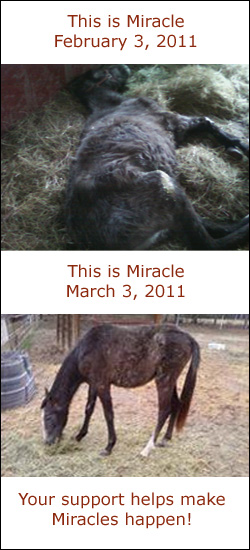
In February, a friend whose farm stands across the road from my father-in-law’s farm here in Georgia, drove out to look at an 8-10-month-old filly he saw advertised as well broke under saddle. The horse he found had been so badly injured, starved and otherwise abused, that he convinced the seller to let him haul it away and at least give it a decent burial.

The top photo, taken February 3, shows the horse lying down because it couldn’t stand or walk. The lower photo shows Miracle a month later. Our friend cared for her until she could travel again, and then she was moved to the nearby Sunkissed Acres in Summerville, Georgia for a rehabilitation.

According to the Sunkissed Acres blog of February 3rd, “She has no legs, she has no chest, she has no hope. She is literally run into the ground. I can almost pick the little thing up by myself. She is eating and drinking well, when we stand her up, she can walk around but when she gets tired, she lies down again and cant get herself up.” (Click on the photo for the entire post from SunKissed.)

Miracle’s New Home

On March 14th, the angels at Sunkissed Acres finished their work. The starved and damaged horse that couldn’t stand up was now able to run. Miracle now runs and eats well in the heaven of a horse retirement farm named Paradigm.

On the day the filly arrived, the Paradigm Farms blog said, “Today Miracle had an ending and a beginning. Her time at Sunkissed Acres came to an end today. Lori, the founder of Sunkissed Acres Rescue, did an amazing job of rehabilitating Miracle and getting her healthy and strong enough to move on to her new life. When one chapter ends a new one begins, and today was the beginning of Miracle’s new life with us.”

The U.S. Equine Rescue League defines neglect “as failure to provide sustenance and care sufficient to maintain an equine’s good health. This includes food, water, shelter, veterinary and farrier care.” Because of the compassion of a farmer named David, the loving rehabilitation by a rescuer named Lori and the long-term care being provided by Jason, the little horse they still call Miracle no longer fits this definition.

This is one story with a happy ending. With our donations and with the good work of the folks at farms such as Sunkissed Acres, the number of prospective miracles is infinite.

You May Also Like: Night in the Shape of a Horse

Malcolm

Review: ‘The Tiger’s Wife’ by Téa Obreht

The Tiger’s Wife by Téa Obreht
My rating: 5 of 5 stars

The tiger’s roar filled the cave with thunder. Mother Wolf shook herself clear of the cubs and sprang forward, her eyes, like two green moons in the darkness, facing the blazing eyes of Shere Khan. — Rudyard Kipling in “Mowgli’s Brothers” from “The Jungle Book” (1894)

Gather around, my friends, and I will tell you the story of the man who could never die, who, some say, still walks the streets of our village at night, and then—if most of you are still awake—I’ll tell you the story of the tiger Shere Khan whose eyes burn brightly in the night when he prowls near campfires like this looking for his wife.

Like all great storytellers, author Téa Obreht demonstrates beyond the shadow of a doubt in “The Tiger’s Wife” that memorable stories live at the crossroads of fact and fable. Doctor Natalia Stefanovic is treating children at an orphanage in an unspecified Balkan country when she learns that her beloved grandfather has died. The details are unclear. They provide no closure.

While seeking closure, Natalia remembers the times they spent together when she was young, their trips to the zoo to see the tigers, and the rather fantastic stories he told of his own youth. He told her the story of the deathless man and he told her the story of the tiger’s wife. Her grandfather experienced the events in these stories when he was a child, and like all memorable stories, they were somewhat true and somewhat pure potential and supposition, believed to varying degrees by those in the village who kept their children indoors at night when the tiger owned the streets.

Obreht tells us these stories in bits and pieces as Natalia juggles the real world of the orphanage and the superstitions of those in the village where the orphanage is located with the fables out of her grandfather’s past. To learn how and where he died, she will walk present-day roads laden with stories and she will walk into her memories of the tiger and the man who could never die, and when all is said and done, the truth of the matter will be a mix of everything she encounters at the crossroads.

“The Tiger’s Wife” is dark and deep and perfectly crafted, and if you allow yourself to be immersed in it, you will see the blazing eyes of Shere Khan.

View all my reviews

Malcolm R. Campbell is the author of Garden of Heaven: an Odyssey, a novel of magical realism where fact and fable mix.

Review: ‘Equinox’ by Robert Hays

Equinox, A Short StoryEquinox, A Short Story by Robert Hays
My rating: 5 of 5 stars

Essie’s late husband Arthur built her a sturdy house, taking care to place it just right to catch the Spring sunshine. Arthur carefully placed the silver maples and the catalpas to provide many years of perfect summer shade. The trees are grown now. The kids and grandkids are gone, and so is Arthur.

In Robert Hays’ well written and poetic short story “Equinox,” Essie and Plato follow long-established rhythms throughout the changing seasons, and that’s a comfort, for after their long years together, a schedule of sleeping, waking, meals and the daily arrival of the mailman anchors her life.

She had expected Arthur to be her anchor until he was killed in a coal mining accident years ago. He approached his job in the dark mine with same care and deliberation as he approached the construction of their house in the sunny valley. Like the house and the marriage, it was supposed to last.

This year, Winter has seemed permanent, closing her up inside the house with snow and ice. Essie broods about all that’s been lost and finds brief solace in fantacies about what might have been.

With Plato, she waits for the Spring equinox. It’s one of the few events she can count on, and Essie hopes it will be enough.

View all my reviews

Available in paperback and Kindle

Three ‘Jock Talks’ Satires Published

Vanilla Heart Publishing has released three Jock Talks satire collections available in multiple e-book formats.

Written by Malcolm R. Campbell (Jock Stewart and the Missing Sea of Fire, 2009) Jock Talks Outlandish Happenings, Jock Talks Politics, and Jock Talks Strange People are jam-packed with the best and the wildest post from his Morning Satirical News weblog.

The e-books are available on Kindle for 99 cents each. They are also available in multiple formats, including PDF, at Smashwords at 99 cents.

Except from Jock Talks Strange People

Readers Looking for ‘The Lust Symbol’ Ravish Bookstore

Angry, and apparently horny, shoppers tore apart the Main Street Book Emporium at high noon today looking for a book purportedly called The Lust Symbol.

Owner Jim Exlibris, who accidentally promoted a one-hour half price sale for Dan Brown’s new novel The Lost Symbol with a 48-point Century Gothic “‘LUST SYMBOL’ REDUCED FOR HARD-UP READERS” headline, said that he could only blame himself for the misunderstanding.

“I just a country bookseller, not a advertising specialist or a bloody proofreader,” said Exlibris.

“I’ve never seen anything like it, so many people in heat at the same time. They ran through my shop like bulls from Pamplona trying to find The Lust Symbol. They tripped over a life-size cardboard cutout of Dan Brown next to my display for The Lost Symbol without even noticing it.”

Police, who were enjoying lunch-time doughnuts across the intersection at the Krispy Kreme are being criticized for failing to respond to the bookstore riot.

“We presumed the whole thing was just customers having fun,” Chief Kruller. “Sure, we thought there might be porn involved, but the FEDs handle all of Junction City’s porn.

Witnesses report that Exlibris escaped from the mob, ran across the street, threw a copy of The Lost Symbol against the side of Sergeant Wayne Bismarck’s head, and screamed “arrest somebody, dammit, they claim I’m hiding all my lust from them.”

“Nobody’s ever thrown the book at me before,” Bismarck said.
According to local bookmakers who serve as police consultants, Exlibris “has a lot of priors” when it comes to misleading advertising. Main Street Book Emporium entries in the police database include advertisements for books called Bone With the Wind, Jane Error, The Hell Seekers, For Whom the Belle Rolls and the Handmaid’s Tail.

Friends of the Library board members Hilda Meek and Anna Van Landingham, who were in the store to pick up a box of books Exlibris was donating to the lost readers program, said under interrogation they believed the purported “lust for lost” misprint was a publicity stunt.

“We make proofreading mistakes at the Public Library all the time,” said Meek. “Last year when we promoted a ‘fun at the pubic library ball,’ we feigned embarrassment and everyone ended up having a bang-up time.”

Police warned Exlibris to improve his proofreading skills or else.

Glacier to Celebrate New Quarter

Glacier National Park will celebrate the launch of the Glacier Park Quarter on April 13th at the Columbia Falls High School Gymnasium at 1:00pm. The public is invited to attend.

The quarter is the seventh coin in the America the Beautiful Quarters® Program.

After a brief ceremony, visitors may swap their currency for the new quarters in $10 rolls. All children under 18 will receive a free quarter.

The coin, one of five new coins honoring National Parks to be released this year, features a mountain goat surveying the high country with Reynolds Mountain in the background.

According to Glacier Park superintendent Chas Cartwright, “The design of the coin is one of the iconic views of Glacier National Park and will be very familiar to the thousands of visitors that drive over the Going-to-the-Sun Road each summer.”

Novel partially set in Glacier's Swiftcurrent Valley

Review: ‘Good-Bye, Emily Dickinson’

Good-Bye, Emily DickinsonGood-Bye, Emily Dickinson by Smoky Trudeau Zeidel
My rating: 5 of 5 stars

She’s homeless and she believes she’s Emily Dickinson’s daughter. She observes the world, writes poems wherever she parks her shopping cart of notebooks and other treasures. She ponders the fate of great artists who didn’t get any respect until after they were dead. But, she’s patient (though some say she should be a patient until she gets her mind right).

Smoky Trudeau Zeidel (“The Cabin” 2008) tells a story that’s born in a respected teacher’s English class and played out on the hot streets between the church, the Sinclair service station and the underpass. She—real or imagined daughter of the long-gone Emily—truly understands that “the mere sense of living is joy enough.”

View all my reviews

Going-to-the-Sun Road Geology

Every year thousands of people enjoy the views from Glacier National Park’s engineering marvel known as the Going-to-the-Sun Road. Whether you’re looking at the scenery from the seat of your bicycle, a red tour bus or your car, the trip from St. Mary’s to Lake McDonald provides some of the best high country ambiance in the Rocky Mountains.

Up close and personal, you will notice the rock formations. They are stunning and colorful but, unless you have a good tour guide or a handy reference book, the geology on display may remain incomprehensible.

Geology Along Going-to-the-Sun Road, Glacier National Park, Montana will meet your needs perfectly. First published by the Glacier Association in 1983, this practical, well-illustrated guidebook has met the test of time. The book is organized into twenty-one stops from east to west along Sun Road that illustrate many of the park’s geological features.

Sun Road Tour Stops

Sun Road's Logan Pass - NPS Photo
The book includes color photographs of both the far-away and the close-up features. For example, you can compare what you see when you look at Curly Bear Mountain 3.9 miles from the entrance station with a diagrammed photograph that illustrates the mountain’s visible rock formations.

Or, at Stop 5, “Grinnell Formation,” text and close-up photographs in the book help you better understand this colorful red rock. Logan Pass, Stop 10, at 6,680 offers excellent views of the horn-shaped mountains created by glaciation, including Clements Mountain (shown in the book).

In addition to the stops, the book includes a glossary, information about rock colors, a list of the park’s rock formations and a handy shaded relief map of the road. Written by geologists in a language intended for non-scientists, the guide adds to a visitor’s understanding and enjoyment of a highway that has thrilled millions of tourists since its completion in 1932.

Malcolm R. Campbell, who worked as an editorial assistant for this Glacier Association book project, is the author of two novels partially set in the park, The Sun Singer and Garden of Heaven: an Odyssey.

On not looking inward

In a recent post called On Looking Inward, author Dani Shapiro begins with “Increasingly, we are scattered.”

Yes we are. The Internet and other addictions pull us away from listening more often to the voice within.

It’s especially interesting to me to think about just how often I’m not looking inward. I’ve spent a fair amount of time writing stories about characters who are looking inward. But, as I commented on Dani’s blog, it’s as though these characters are my children and I’m giving them better than I’m giving myself.

In Garden of Heaven: an Odyssey, protagonist David Ward is told by his wild woman grandmother when he is a child that the important things in life are found within. By the end of the book, I think he understands her wisdom.

He went through hell to understand it. The paradox is that I wrote about him going through hell to understand it and I’m wondering if I understand it. David, like Robert Adams in The Sun Singer, goes through a spiritual transformation that I (at times) I’m witnessing through a glass darkly.

I need to buy some Windex, wash off the class and follow the examples of my fictional characters rather than saying, “I’ll just check Twitter and Facebook for a while today and then I’ll go light a candle and look for other worlds within the flame.”

I know what’s more important, but the addictions of the outer world are very strong.

Malcolm

BOOK GIVE-AWAY WINNER: Congratulations to Leah, whose name was drawn out of a hat in the GARDEN OF HEAVEN give-away on my Almanac weblog.

Thank you to everyone who entered.

New USS Ranger Foundation Video

The USS Ranger Foundation, currently working to transform the decommissioned carrier into a museum and heritage center in Fairview, Oregon, has posted a new video of YouTube.

The video displays a combination of great in-service photographs along with a selection of current-day photographs.

Fairview has a population of slightly less than 10,000 residents.

Project Overview (from the foundation web site)

The USS Ranger Foundation is dedicated to preserving USS Ranger as a community heritage center through public and private partnerships.

Ranger represented our country’s interests around the world as the “Top Gun of the Pacific Fleet” from 1957 through 1993. Earning 13 battle stars in Vietnam and taking a lead role in Desert Storm in the Middle East. She also supported humanitarian missions like Operation Restore Hope off the African coast.

The supercarrier is more than three football fields long, towering 15 stories above the waterline. A floating city that held over 5,000 crew members, Ranger has a 4.5 acre flight deck, 60-bed hospital, communications center and classrooms.

With Ranger’s active service over, the USS Ranger Foundation is working with the Navy to secure her donation and preserve important Naval history. Ranger will serve her new mission as the centerpiece of a destination complex. This will include a museum, memorial to those who served, educational training facility, emergency preparedness site and civic /convention resource.

Chinook Landing Marine Park, on the Columbia River in Fairview, Oregon, will be Ranger’s new home. Market research confirms the potential for the new
destination complex is significant, boosting local and regional economies. Support for the project has been widespread given the favorable research and
the obvious impact on jobs, business growth and a significant resource to the community.

The Foundation has launched a major fund raising campaign to support ship acquisition, site development, and completion of the heritage center.
The success of Ranger’s new mission will be the result of partnerships that create an exceptional public resource and the largest floating museum in the world. For more information on this project, please check our website at http://www.ussranger.org, or call 503-558-8519.

Malcolm
I served onboard the U.S.S. Ranger on two Western Pacific cruises (1968-1970) and based parts of my novel Garden of Heaven: an Odyssey on my experiences.