Allowing children to experience the innocence of childhood

These Victorian Christmas images are expressions of one of the greatest gifts we can give our children, the parental support within a happy home that allows them to begin their lives safe within the innocence of childhood.
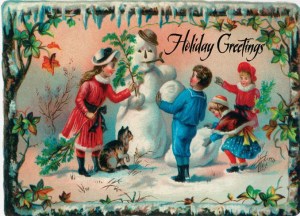
Children will learn the harsh truths of the world soon enough. Some say, their kids have a better chance of survival when they’re reared from day one in a boot camp-style environment with Pop as the Great Santini and Mom as the Wicked Witch of the West. I don’t agree. A few years of innocence made me stronger because those years taught me that strength and honesty don’t require us to wear cynicism and brutal honesty on our coats like badges of honor.

Once lost, recapturing the magic of innocence lost too soon is more difficult than unringing a bell. Children, then young adults, and then adults can build on that magic forever regardless of the slings and arrows they see or experience as they grow older. Like all wonderful memories, the innocence that’s given time to grow can be drawn on later on in life as a talisman against everything that’s ugly and unjust.

The old question “when do you tell your kids Santa isn’t real in the way portrayed in Christmas cards?” seems to represent the dilemma most parents face about all kinds of truths they must ultimately explain to their children. Sooner or later, we’re all told not to take candy from strangers or accept a ride home from school by an adult we don’t know. It’s hard to say “why not?” without communicating the reason why not. Today’s parents have opted for postponing that explanation for a while by driving their kids to school when older generations of kids rode bikes or walked. A lot of variables come into play when deciding, for one’s own children, when to take away some of the magic and when to take away some of the freedom available when they slowly gain their independence from a parent’s smothering and watchful eye.

In a world where instances of child abuse and human trafficking are higher than many adults allow themselves to believe, some will ask how we can celebrate the innocence of any child by displaying Victorian Christmas cards or other positive messages of the season when many children are suffering. My response, is how can we not? We can’t solve the wrongs of the world by keeping quiet about what’s right with the world.

Every child, I think, deserves a chance to experience the innate goodness into which s/he is born. Then they’ll always have that strong magic do draw upon when confronted by those who have no magic or goodness.

Malcolm

Malcolm R. Campbell’s hero’s journey novel “The Sun Singer” and heroine’s journey novel “Sarabande” are based on the concept that that while the trials we survive can make us stronger, the magic each of us carries ensures we’ll survive those trials.


Getting rich writing? Some are, most aren’t!

“The world’s 11 highest-paid authors sold 24.5 million print books combined in the U.S. during our scoring period, logging $283 million. The prolific James Patterson takes first place, earning $86 million and selling 4.8 million books in the U.S. alone, according to NPD BookScan, which tracks 85% of the domestic print market.” – Hayley C. Cuccinello, Forbes

Most authors pay little to no attention to this list. We don’t expect or aspire to be on it because we don’t need that kind of money, don’t want to be public figures, write because it’s what inspires us and drives us, and really don’t want to be busy picking out red leaf lettuce in Kroger when somebody comes up and says, “Hey, aren’t you what’s his face?”

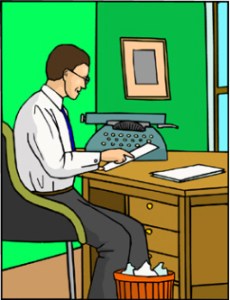
I don’t know why clip artists think we still use typewriters.

The worst thing about this list is that it gives many readers the idea that all authors make more than we do and are probably charging too much for our books. But otherwise, hearing that James Patterson, J. K. Rowling, Stephen King, and John Grisham are the top four authors on this year’s list isn’t surprising or exciting, nor does it provoke feelings of jealousy.

Every once in a while, I look at the advertising for book promotional sites to see what they’re pushing. All too often, I see that they provide studies and algorithms that will tell me what topics and plots authors should choose in order to make the most money. When I see that, I click on the X in the upper right corner of my screen and the site goes away. I have no interest in a list of hot themes and hot character types that the public is currently excited about. This is not to say that authors should pick ideas that nobody cares about and stubbornly write about them.

Most of us have our comfort areas, themes that interest us, character types that we love writing about, and locations that lend themselves to the kinds of plots we prefer. Most of us do our best work within our comfort areas and probably would fail miserably if we tried to write a novel that sounded like something any of the top writers on the list are writing. That truth has more to do with who we are than the fact we’d be in competition with a well-known author.

Some of my readers might think that I wrote the Florida Folk Magic trilogy of novels about racism in Florida during the 1950s because racism has become a hot topic again.  But I didn’t. The racism I saw when I was growing up in the Florida Panhandle had been on my mind for a long time. While working on the first book in the series, Conjure Woman’s Cat, I had no idea that the topic was “trending.” I’m pretty sure that when Michael Wolff wrote Fire and Fury, he knew his topic was trending. Did he think his book would catapult him into the list of top-earning authors? I doubt it. I think his book did better than he expected. At the same time, my trilogy didn’t capture the attention I expected.

According to Forbes, Wolff’s book has sold over a million copies in the U.S. Most writers don’t think about sales figures like that. We do think about selling a few thousand copies of each of our books per year. That’s not easy to do for self-published or small-press authors. For one thing, we’re too dependent on Amazon though they certainly can’t be faulted for focusing their efforts on the books that bring in the most bang for the buck, that is to say, the top writers on the Forbes list. For another, reviewers tend to focus on books from large presses that everyone is talking about. That’s simple economics: what brings readers to your publication or website: reviews of books nobody’s ever heard of or reviews of books everybody’s talking about? Not a hard question to answer.

Most readers don’t have enough time to read everything they want to read. I sure don’t. So we all make choices: what books are the most likely to be worth an investment of our time? I read books from many authors on the top of the book selling lists because I like their books and they aren’t likely to disappoint me. But still, I don’t think it’s that hard to add a few self-published or small-press authors to my reading list for the year. Many of them surprise me: wow, these books are great. When I feel that way, I try to post positive reviews and tell my friends about them. I know those authors face the same barriers that I do when it comes to people finding out about their books.

Goodness knows, my opinion isn’t going to send an author’s book into the the James Patterson/Jo Rowling stratosphere of book sales. Yet, if we talk about the self-published and small-press books we like, more people will purchase them and keep those authors busy writing and finding readers who enjoy their work.

Malcolm


Making Free Book Trailers with Lumen5

“When was the last time you had fun doing book promotion? I know; not my favorite thing, either. However, that was before I discovered Lumen5.com.”

Source: Make Free Book Trailers with Lumen5 – Indies Unlimited

Author Melissa Bowersock provides a handy introduction to Lumen5 that you can use to get started making book trailers for your books. Fortunately, my publisher does this for me. But some of my books are self-published and somehow, I hadn’t heard of this app.

I think book trailers, along with author websites and updated Amazon author’s pages are among the promotional techniques that help indie (the word now means self-published) authors sell books. It’s part of your platform.

–Malcolm

P.S. Bad news for Georgia’s independent authors. The Georgia Writers Association has announced that it is no longer accepting self-published books in its annual author of the year competition.

Hello Withdrawal, My Old Friend

When I began smoking cigarettes, they relieved stress. They probably kept me from getting fat. They also made me smell like a campfire, but in those days smelling like a campfire was acceptable.

According to what I’ve read, a nicotine dependency is about as bad as a cocaine or a heroin dependency, though supposedly nicotine withdrawal is easier than the hard stuff. People using marijuana doesn’t have as or high a dependency as strong a withdrawal problem as cigarette smokers, so I’m among those who wonder why marijuana–even for health uses–is still generally illegal.

I haven’t smoked a cigarette for 25 years. However, if I see people smoking or think about smoking, my withdrawal returns at almost the same intensity as it did the first time I tried to quit smoking. It took numerous attempts to quit. But I’m not free of it. If my wife weren’t hideously allergic to cigarette smoke, it would be easy to start again.

My smoking began as a “cure” for a failed romance and then as a crutch for military service. That doesn’t mean that I blame either the lady or the navy. Smoking was a conscious choice, one that seemed to work. I don’t think I was smoking because it was supposedly cool or badass.

Like many people, I didn’t plan to get addicted. I thought I’d smoke a few cigarettes a day and quit whenever I wanted to. I ended up smoking three packs a day 25 years later with the distinct impression that I’d never be able to quit. The addiction was so bad, I smoked when I had the flu or a cold and once walked to the store in a snowstorm when I was out of cigarettes and my car was snowbound in the driveway.

As I write this, I want to light a cigarette. That’s how invasive nicotine is. I’m happy that there appear to be fewer people smoking these days than there were in the 1960s. The health risks are bad enough, but the withdrawal is a constant companion long after all the ashtrays have been thrown away.

My writing suffered when I quit smoking because I always lit a cigarette when I sat down to write. Fortunately, I can write now without lighting up a Marlboro. I am also capable of answering the phone or walking into a bar without lighting up a Marlboro. The trouble is, I really want to light up a Marlboro. Daily, I make a conscious choice not to do that.

It’s better if one just doesn’t get started. That seems so obvious now. But, in 1968 when I started smoking, we didn’t trust anyone over 30 and those were the people who said you’ll be sorry you ever got started. Hell, the bastards were right.

Malcolm

Malcolm R. Campbell is the author of the magical realism novels “Conjure Woman’s Cat,” “Eulalie and Washerwoman,” and “Lena” in which one of the characters chews tobacco and one of the characters smokes. 


Glacier Park 2019 Artist-In-Residence Applications Available – Deadline Soon!

from NPS Glacier

West Glacier, MT – Artists are encouraged to apply for the 2019 Glacier National Park Artist-in-Residence Program. The application period will be open November 1, 2018-January 1, 2019.

The Artist-in-Residence program offers professional artists focused time to creatively explore the park’s numerous and varied natural and cultural resources, and to share their work through educational programs and exhibits.

Each session will run for four weeks during June, July, and September. The sessions offer artists uninterrupted time to pursue their artistic discipline and provide artists with a furnished house located in the park.

Those selected are required to present several public programs during their residency. The programs must be related to their experience as an artist-in-residence and can be demonstrations, talks, exploratory walks, or performances. Digital images of selected work produced as a part of the residency may be used in park publications, websites and presentations for education and outreach.

Artists of all disciplines are encouraged to apply.  Applications are available online at https://.callforentry.org. More information on the program can be found at https://www.nps.gov/glac/getinvolved/air.htm and biographies of last year’s Artists-in-Residence can be found on the park’s website. For more information contact the Volunteer Program Office at e-mail us, or 406-888-7851.


Destroying the box and shredding the envelope

Here is a box:

It has its uses. As you see, you can store books in them. They’re not places where one should go to think.

Here is an envelope:

Someday soon, nobody will know anything about envelopes because they contain snail mail and someday soon, nobody will know what that is. If there’s an envelope on your desk, you’ll soon discover that its easy to push.

When I read the news, I see that a lot of people have found a handy box and have gone inside it to do their thinking. They’ve done that for so long, they don’t feel claustrophobic. They’re good candidates for solitary confinement because they would never notice their plight. It never occurs to them to think outside the box.

Likewise, a lot of people are afraid to push the envelope. The phrase refers to traditional boundaries and presumed limitations rather than a physical envelope, though I have a feeling most people think of the paper container that comes in the mail.

I’m among those writers who don’t understand the attractiveness of thinking inside the box or of being afraid to push the envelope. I prefer destroying the box and shredding the envelope. Years ago, when I was writing management and supervisory training materials for corporations, my view–which, fortunately, was in tune with the prescribed best practices of the time–was that saying “we’ve always done it this way” was the weakest reason for doing anything.

People seem to find comfort in “we’ve always done it this way,” staying inside the box, and leaving the boundaries defined by the envelope alone. What a waste. Why put arbitrary limits on oneself? I don’t get it. For one thing, it’s boring. For another, it stifles innovation in business, government, the arts, and one’s personal life. It goes almost without saying that the writers we remember didn’t write their best novels and most groundbreaking nonfiction while sitting in a box.

I remember sitting in a high school humanities class when the teacher said to the class, “How many of you hate death?” Rather than boldly raising our hands, we all looked around to see who else was raising their hands. Nobody wanted to be the first to take a stand. Of course, in school, conformity is the ideal way of staying out or trouble. Apparently, it still is.

We still look around, don’t we, when new ideas arise to see who’s embracing them. It’s as though we can’t make a move without seeing what our peer group is doing? (I think Congress works like this.) So many people are afraid to be different!

Here’s a confined space:

The horizons in this space are very narrow. Yet, there seems to be a comfort in that. It’s the same every day. No worries. No censure from others who are afraid to step outside the space and think on their own. Thank goodness history’s innovators were unhappy with confined spaces.

I often ask people, when it comes to thinking outside the box or pushing the envelope, “what have you got to lose?” Inevitably, they have more reasons for not doing it than for doing it. I want to say, “why are you making yourself smaller than you are?” But I don’t. It’s not polite. If they ask me if I agree, I say that I don’t. This makes them nervous as though thinking outside the box or pushing the envelope will bring down the wrath of fate upon them.

Okay, that could happen. It probably won’t. Meanwhile, we’re more creative and innovative than we’re giving ourselves credit for. I see nothing to be gained by hiding our light underneath a bushel.

Malcolm


Reminding Readers About Your Previous Books on Facebook

When a small-press or self-published author announces a new book on Facebook, s/he has a reason for posting information about it. When early reviews come in, there’s an opportunity for more posts. So, too, later on if the book is a finalist or a winner in a competition. Giveaways and book sales also help get the word out.

But once a book is several novels or poetry collections into the past, it becomes more difficult to think of relevant things to say that don’t sound like SPAM.

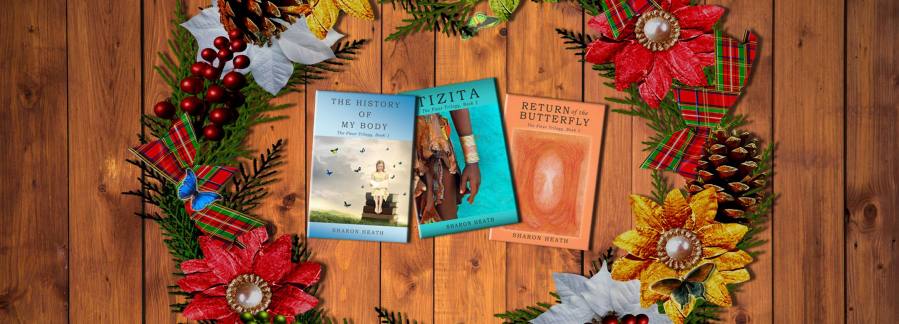
My publisher, Thomas-Jacob Publishing, has helped fix that problem by creating Facebook cover pictures that display all of an author’s titles. Sometimes the book covers are arranged with an interesting background; sometimes they appear on shelves. These covers can sit at the top of an author’s profile or page for weeks or months, keeping previous titles in the public eye during times when there’s no legitimate news to post about the older titles. Or, as in Melinda Clayton’s cover photo, you can use a quotation from an earlier book.

Here’s the batch for the holidays for Malcolm R. Campbell, Smoky Zeidel, Robert Hays, Sharon Heath, and Melinda Clayton:


That book on the end of the shelf

I’ve written a lot of words on this blog during the past two years about my three magical realism, conjure and crime novels set in north Florida: Conjure Woman’s Cat, Eulalie and Washerwoman, and Lena. But what’s the book on the end of the shelf?

That book, Sarabande, was the most difficult novel for me to write. Previously, I’d written The Sun Singer, a hero’s journey contemporary fantasy told from a young man’s point of view. But the hero’s journey is only half of the world’s mythic cosmic story. I needed the heroine’s journey, a novel told from a young woman’s point of view.

The hero’s journey is a series of events out of comparative mythology developed by Joseph Campbell in The Hero With a Thousand Faces. While some authors have tried, the heroine’s journey cannot be shoe-horned into the hero’s journey scheme. It’s too different, more moon and seeds and underworld secrets than derring-do and sky-god stories and changing oneself while risking one’s life in the service of others.

As an author, it’s difficult for a man to put himself into a woman’s shoes and tell a woman’s story. While he may have worn such shoes in previous lifetimes, he doesn’t belong in those shoes in this lifetime. Fortunately, my main character, Sarabande also appeared in The Sun Singer and that meant I had known her for a long time, so there was a history there that was stronger than it would have been if I had used a new character.

I liked Sarabande in The Sun Singer and avoided writing a novel about her for many months because I didn’t want to see her go through the heroine’s journey, a journey that included a physical assault by a man and a vicious and life threatening sexual overture by a female denizen of the underworld. The book was a learning experience for me, though one that was most likely limited to the confines of the book rather than my coming anywhere close to truly knowing the trials and joys of women.

My happiest moment after the book was released was the comment by a female reviewer who said that the story was so real she had to keep reminding herself that it had been written by a male author.

Sarabande is a dark women’s story written primarily for women. The man’s hero’s journey, when it unfolds naturally, ends in transformation. Likewise, the woman’s heroine’s journey. Two paths, each undertaken out of the necessities of the real world, yet each ending in profound, spiritual changes on opposides of the male/female coin.

Sarabande is available in paperback, e-book, and audiobook.

Malcolm

Tarot: Step inside the cards

Sooner or later, most good cooks throw away their recipe books. What they know is not rote memorization, but an understanding of food, the impact of heat and cold, and the results of mixing one thing with another.

Knight of Swords – Thoth Deck. Other decks use the term “King.

Effective Tarot card readers throw away books that list the standard meanings of each card because they have discovered that the card is a prompt–or perhaps a spirit–that directs the reader to his/her own intuition and knowledge.

Personally, I don’t believe the future is fixed in place, so I’m going to see a reading (whether it comes from the I Ching, Tarot Cards, Bones, or some other system) as a story about what is now the case or is developing. How the reader sees this matter will also impact how they react to either the so-called standard meanings of the cards and/or to their intuitive glimpses into the question on their minds that is prompted by seeing the cards in a certain order.

In time, the reader no longer needs the cards. That’s much simpler, but perhaps a long time coming for many people who pick up a Tarot deck and wonder if it will speak to them.

I am influenced when I look at the cards by knowing that they are “ruled” by the elements Earth, Water, Fire, and Air. Fire and Air are considered active. The Swords suit (modern-day spades) is within the realm of Air. Knights are always considered the fiery/active part of each element. The active nature of a Knight is shown in the movement of the figure on the card. As described on Raven Tarot, “The element of Air is the pure mind, the thought and the intellect, synthesis and analysis, the proceeding of the amorphous spirit of Fire and the unconscious emotion of Water into definitions and concepts. Air is both structure and conscious realization, both formation and abstraction.” 

Other readers come to the Tarot with other basic ideas and they will be influenced by those and they will find the cards to be catalysts to their intuition in a somewhat different way, though they “should” more or less come to the same conclusions about a subject as I do.

The deck I use.

Some people “learn the cards” by meditating on each one and allowing ideas about each card to come to them without actively trying to “figure out the card.” Others do multiple readings about things they will know in the “future” and see how what they saw in the “spread” (the card’s layout on the table) coincides to the unfolding future. When one does this, it helps to do readings about others because if you do them about yourself, you can always change the way things unfold an invalidate the reading.

The Card as a Doorway

In my imagination, I visualize being in a nondescript room with a large doorway in it that’s painted like the card I want to learn more about. After I’ve relaxed and gotten rid of all the general chatter going on inside my head, I walk to the door and open it. What do I see outside? What do I hear? First impressions are important because they simply are and haven’t had time to get twisted into logical deductions about what’s going on. When I open the door painted like the Knight of Swords card, I see swirling fog, sometimes by day and sometimes by night, and hear the sound of the wind.

Sometimes my intuition leads me to sit on the doorstep there–as we’re supposed to do at a railroad crossing–and Stop, Look, and Listen. Sometimes my intuition leads me to step outside, and when I do that, I’m usually in the sky, swirling around like a leaf in the wind with no control of its own. There’s no fear in this, no sensation of falling, and no worry that I might be carried so far away from the door, I won’t know how to get back. Since this is “my card” in Tarot readings and as I see myself generally, floating, swirling, sailing, and tumbling in pure air is a basic, womb-like experience. I’m often content to do nothing and just soak of the nourishment of the moment.

I can exert control if I like, though it’s more intuitive than logical. Rather than, say, deciding to fly over a specific place, I simply wonder “what’s down there” or “what else is up here.” I might see cities and oceans the way I would seem them from a plane or stars the way I might see them through the lens of a telescope. Air carries me whither it wants to.

Doing this kind of meditation is not unique to me. Many intuitives have said that Tarot cards are, for them, like windows or doorways. I suppose, though, that I bring a shaman’s journey technique and, rather than seeing figurative worlds or literal places, I see what’s outside the door of each card.

And, in a sense, whenever we do a Tarot reading, we are looking at what’s outside the doorway of the present moment and our present time and current place.

Malcolm

Malcolm R. Campbell is the author of novels filled with magic.


Going to the library

“The library is a whispering post. You don’t need to take a book off a shelf to know there is a voice inside that is waiting to speak to you, and behind that was someone who truly believed that if he or she spoke, someone would listen. It was that affirmation that always amazed me. Even the oddest, most peculiar book was written with that kind of courage — the writer’s belief that someone would find his or her book important to read. I was struck by how precious and foolish and brave that belief is, and how necessary, and how full of hope it is to collect these books and manuscripts and preserve them. It declares that stories matter, and so does every effort to create something that connects us to one another, and to our past, and to what is still to come.”

― Susan Orlean, The Library Book

The library was my favorite place in my grade school, junior high school, and high school. Early on, some of my teachers would take their classes to the libraries the introduce them to what was there, how you found it, and how you borrowed it. I went back many times. My parents were active in the group that started my county’s public library. Once the doors opened for the first time, I found a new place to explore. University libraries, where I worked throughout college, had the same allure, though it was more mysterious with multiple floors and sections and sometimes old stairways and badly lighted stacks.

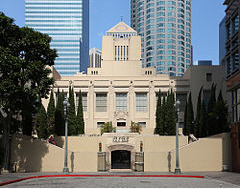
Los Angeles Library – Wikipedia Photo

Some of my classmates seemed lost, generally speaking, about who they were, where they were going, how they fit into the scheme of things, and what might be missing from their lives. I wanted to say, “Walk into the library and you’ll find everything you’ll ever need.” I didn’t say it, of course, because saying it would quickly put a student on the bullying list of everyone else in the school from class thugs to class leaders.

“A book feels like a thing alive in this moment, and also alive in a continuum, from the moment the thoughts about it first percolated in the writer’s mind to the moment it sprang from the printing press — a lifeline that continues as someone sits with it and marvels over it, and it continues on, …”
― Susan Orlean, The Library Book

I wonder about the future of libraries. Where will they end up in a world that is sliding into the morass of digital art that can be read on a screen without having to drive to that old building in the middle of town where the physical books not only take up a lot of expensive space, but can’t keep up with the deluge of each year’s new books. Frankly, I don’t think libraries will survive no matter how many new perks and services they add. I would like to be wrong about this. I would like to see viable ways to keep libraries up, running, and vital.

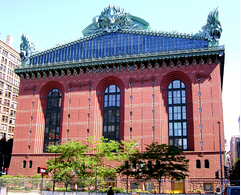
Chicago Public Library – Wikipedia Photo

The answer to “how do we keep libraries alive?” probably requires a look at ourselves first because since many of us didn’t walk into libraries when we were in school, we never figured out who we were and why knowledge and stories and rooms filled with books are important. So now, here we are. We don’t value what’s inside those buildings, so we don’t pay to keep the buildings and their contents alive: even our silly texts about mundane matters of the moment seem more important. The world often seems to have shrunk down to the mundane and endless cell phone texting between two people, each of whom thinks “It’s all about me.”

Meanwhile, the larger world, including books in libraries, awaits out attention if we dare to look at matters larger than ourselves and what we’re having for dinner tonight.

Malcolm

If you can’t find my novels in your library, ask the librarian to get them. If s/he can’t, perhaps you can donate your copies when you’re done reading them.