My Kindle short story “Willing Spirits” will be free on Amazon during the July 4th weekend. This is a ghost story inspired by the real St. Louis spirit named Patience Worth who, among other things, wrote a novel called Hope Trueblood.
Description
Prudence is a student who isn’t always prudent. Let us point to the night before her school book report is due. She hasn’t finished reading the book. Time to panic?
Perhaps, for the spirit of the book’s long-gone author seems to have appeared in Prudence’s bedroom. Off hand, this can’t be good.
Opening Lines
“The power went out when Prudence Lowe began reading chapter two of Hope Trueblood. The darkness startled her and the book fell to the floor with a thud. Her bedroom window rattled in the wind bringing St. Louis its first snowfall of the year. She knocked her hairbrush and several makeup bottles off the vanity while searching with gloved hands for the power outage candle. Frugal to a fault, her father kept the house colder than a morgue throughout the winter.”
While doing research for another short story that includes a few conjuring tricks, I came across a lust potion.
Traditionally, a fair number of people stop by their local root doctor’s house for a little help getting lucky in love or gambling (which are pretty much the same thing, at times). While you can pick up powders and oils such as “Follow Me Boy (or Girl)” to persuade others to find you attractive, many practitioners don’t like tampering with a prospective lover’s free will.
It’s one thing to cast a spell to keep your spouse from cheating on you; it’s another thing to compel somebody to fall in love with you–that wouldn’t be true love, right?
This lust potion is powerful stuff. Heck, right after reading it and visualizing how it might work, I chanced to see a picture of the late Grandma Moses and my immediate reaction was, “Whoa, that chick is hot.”
Some writers have been criticized for, say, putting too many details in their work about how to cause death and destruction, that I feel I must say that causing lust in ones readers might be almost as dangerous.
Just as a responsible writer wouldn’t put the directions for making an A-bomb out of the stuff in a medicine cabinet, a merciful storyteller shouldn’t put the directions for causing lust in a story. Heaven help us if somebody rushed into a Walmart and sprinkled this stuff around or threw it out the car window on I-75.
Where would we be today if Jerry Leiber and Mike Stoller had listed the ingredients in their “Love Potion No. 9” classic back in 1963? We know the stuff smells like turpentine, but (fortunately) dowsing oneself in paint thinner doesn’t cause amorous feelings in normal passersby. But thank goodness we don’t know the complete recipe.
So, I’ll mention the potion in the story without the recipe and let all my readers who are looking for lust in all the wrong places create their own opportunities. Oddly enough, the potion includes nutmeg. Using nutmeg by itself won’t cause lust, though it might make a person remember their favorite pumpkin soup.
–Malcolm
Malcolm R. Campbell is the author of Conjure Woman’s Cat, a 1950s-era novella about a black cat named Lena who helps her best friend do magic.
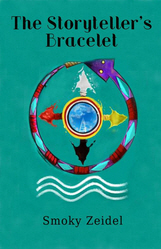
Thomas-Jacob Publishing released a new edition of Smoky Zeidel’s The Storyteller’s Bracelet today, bringing the novel back into print after a twenty-two month absence. The book is available in e-book and Kindle editions. You can watch the novel’s trailer here.
From the Publisher
“It is the late 1800s, and the U.S. Government has mandated native tribes send their youth to Indian schools where they are stripped of their native heritage by the people they think of as The Others. Otter and Sun Song are deeply in love, but when they are sent East to school, Otter, renamed Gideon, tries to adapt, where Sun Song does not, enduring brutal attacks from the school headmaster because of her refusal to so much as speak. Gideon, thinking Sun Song has spurned him, turns for comfort to Wendy Thatcher, the daughter of a wealthy school patron, beginning a forbidden affair of the heart.
“But the Spirits have different plans for Gideon and Sun Song. They speak to Gideon through his magical storyteller’s bracelet, showing him both his past and his future. You are both child and mother of The Original People, Sun Song is told. When it is right, you will be safe once more. Will Gideon become Otter once again and return to Sun Song and his tribal roots, or attempt to remain with Wendy, with whom he can have no future?”
Smoky’s Description of the Cover’s Symbolism
“I’ve gotten a lot of questions about the meaning behind the symbols on the new edition of The Storyteller’s Bracelet. The wavy lines at the bottom represent water, which plays a life-changing role for my male protagonist, Otter/Gideon. The stairway through the clouds represents the gateway to the 5th World in Hopi mythology. The arrows point to the four cardinal directions and their colors represent the direction people of color scattered at creation. (These colors can vary from one tradition to another; these are the colors the Hopi use.) Finally, the rattlesnake is a symbol of new life, of transformation. Rattlesnake sheds her skin and begins life anew.”
You May Also Like
Smoky also released a companion short story on Kindle called Why the Hummingbird is So Small, “the enchanting story of Sun Song, a storyteller for her tribe, as she visits Fuss, her hummingbird friend, on the day before she is to leave for Indian School in the East.” You can visit Smoky’s website here.
Thomas-Jacob Publishing has released Conjure Woman’s Cat, a novella by Malcolm R. Campbell (“The Sun Singer”), set in the 1950s Florida Panhandle world of blues, turpentine camps, root doctors, the KKK and a region of the state so far away from everywhere else that it’s often called “the other Florida” and “the forgotten coast.”
Lena, a shamanistic cat, and her conjure woman Eulalie live in a small town near the Apalachicola River in Florida’s lightly populated Liberty County where longleaf pines own the world. Black women look after white children in the homes of white families and are respected, even loved as individuals, but distrusted and kept separated and other as a group.
A palpable gloss, sweeter than the state’s prized tupelo honey, holds the spiritual and temporal components of the Blacks’ and Whites’ worlds firmly in the stasis of their separate places. When that gloss fails, the Klan restores the unnatural disorder of ideas and people that have fallen out of favor.
Click her to see the trailer.
Lena and Eulalie know the Klan. When the same white boys who once treated Eulalie as a surrogate parent rape and murder a black girl named Mattie near the saw mill, the police have no suspects and don’t intend to find any. Eulalie, who sees conjure as a way of helping the good Lord work His will, intends to set things right by “laying tricks.”
Eulalie believes that when you do a thing, you don’t look back to check on it because that shows the good Lord one’s not certain about what she did. It’s hard, though, not to look back on her own life and ponder how the decisions she made while drinking and singing at the local juke were, perhaps, the beginning of Mattie’s ending.
All that’s too broke to fix, but beneath the sweet sugar that covers crimes against Blacks, Eulalie’s pragmatic, no-nonsense otherness is the best mojo for righting wrongs against both the world and the heart.
“‘The ancient world was full of magic,’ writes novelist C.J. Cherryh. ‘Most everyone north and northwest of the Mediterranean believed that standing barefoot on the earth gave you special knowledge, that the prickling feeling at the back of your neck meant watchers in the wood, and that running water cleansed supernatural flaws.'”
Since we, as a world, have grown up, most people no longer believe this; or, if they do, they don’t admit it.
Ignorant superstition or pagan religion: that’s how such ideas are often categorized.
In one of my novels, I said that we’d exchanged magic and wonder for science and technology. Goodness knows, there have been benefits to some of that. But it seems a little skewed to me.
Too little magic. Too much technology. Some say, that our technology will one day rule us (literally, not figuratively as it does now) and will become so self-aware that it (the computers and machines) will decide that humans are no longer needed. Kind of like the Terminator movies.
I’m subversive when it comes to magic. I put it in my fantasy novels where it seems almost natural enough to be real. I hope some readers think it’s real by the time they finish the books. If not that, I hope they are willing top ponder the question of its reality with open minds.
Perhaps we’ve most too much of the magic because we never believed enough in ourselves as individuals. Did we assume scientists, inventors, governments and corporations knew more about everything than we did? Did we see ourselves as too small to trust what our hearts suggested to us?
Hard to say. The magic discussion can get very circular because it’s often said, you won’t find magic if you don’t believe in it. That may be true, but it’s also convenient because it’s a false method of trying to prove a point.
Maybe we don’t have to believe in magic to find it. Maybe all we have to do is entertain the possibility that it’s there. It’s not too difficult to walk barefoot across a field or a beach and see what happens. Naturally, doing that with our arms crossed and our minds cynical isn’t going to help. Better to play. To dance there or enjoy the scenery with all of our logic on hold.
In my stories, I suggest magic is there waiting for characters to see it. Some do, some don’t. Maybe those who see it are crazy fools, but what if they’re not? If we dismiss things out of hand, we’ll never know.
–Malcolm
Malcolm R. Campbell is the author of the upcoming folk magic novella “Conjure Woman’s Cat.”
Man is a thinker. He is that what he thinks. When he thinks fire he is fire. When he thinks war, he will create war. Everything depends if his entire imagination will be an entire sun, that is, that he will imagine himself completely that what he wants. — Paracelsus
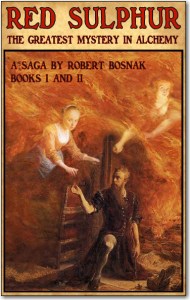
Red Sulphur: The Greatest Mystery in Alchemy [Kindle Edition], by Robert Bosnak, Red Sulphur Publications (December 8, 2014), 508pp
As I read this book, I cannot help but think of author Katherine Neville (The Eight, The Fire) who popularized the magical saga long before Dan Brown took the form to even larger audiences. I also cannot help but note that Robert Bosnak is a long-time Jungian analyst with widely-read nonfiction books to his credit who has studied alchemy for years. Jung was also a student of alchemy, seeing it as widely applicable to the understanding and development of the self. The heritage behind Red Sulphur brings great promise to this novel.
From the Publisher: It is 1666, the Year of the Beast, seen by many as the moment the Devil will appear on earth.
Science is in ascendance, crowding out other systems of thought. The ancient art of alchemy is in retreat. No one has been able to make the Philosophers’ Stone for over a hundred years, but many of the best minds of the age are still in a desperate search for it. Stories vividly abound how alchemists of yore had created a powerful stone of sorcery, rejuvenating all it touches — turning decrepit old lead into precious fresh gold. A universal medicine known to the alchemists by its true name: Red Sulphur.
From the Novel’s Epigraph: “This saga is based on the last verified historical reports by credible withesses about a mysterious transmutation. It follows the lives of a great alchemist and the two extraordinary women he loves. The last in the world in possession of the miraculous Red Sulphur, the source of all creative powers, they are pursued by dark forces and powerful world leaders. This is a visionary tale spanning two generations in the last days when magic was strong. It is the story of the final embers of the long gone days when the Magi could still do what we, children of science, hold to be impossible.”
Editorial Reviewer Comment: “A book both compelling and haunting. Robert Bosnak’s saga Red Sulphur traces the history of the split between alchemy and science in a tale of lust, greed and abiding passion.” – Penny Busetto:
Bosnak
From the author’s Amazon Page: “ROBERT BOSNAK grew up in Holland, trained in Switzerland, and has studied alchemy for over 40 years. He is a noted Jungian psychoanalyst specialized in dreaming with a practice in Los Angeles, and is the author and editor of 7 books of non-fiction in the fields of dreams, health, and creative imagination. His bestselling A Little Course in Dreams was translated into a dozen languages. He developed a method called ’embodied imagination’ used widely in psychotherapy and applied worldwide to a variety of creative endeavors. The Red Sulphur saga is his first published work of fiction. He lives in the mountains of Santa Barbara.”
You have to be an alchemist, a Jungian or a mystic to love this book. That’s the beauty of it as a saga. You don’t need footnotes; instead, you need simply to love a story. The story might change you in ways you don’t expect, but then reading always has that kind of power over those who resonate with the characters, plots and themes.
Yes, because unless you’re writing stories for your children, for your own amusement, or for small, non-paying newsletters and magazines, full-time fiction writers consider their career a business even if they are partially supporting themselves as teachers, researchers and other jobs.
No, because focusing on money–for most writers–gets in the way of developing and telling a story. This is not to say that we’re unaware of the realities regarding salable novels and short stories by writers at one stage of their career or another. One reality is that, without a strong platform or a lot of friends in the business, most unknown writers will not be able to sell novels as long as those written by Diana Gabaldon, Eleanor Catton and Donna Tartt. Another reality is that, if we’re writing in a genre, we know what’s more or less acceptable within that genre and what isn’t.
So, while we can choose to stray outside the “rules” of genres, especially as defined by the mainstream of out intended readers and we can choose to write 500,000-word first novels, most choices about characters, plots, settings, dialogue and themes are (or should be) divorced from the question: will this make me more money or less money?
I dislike the trite phrase that “writers must wear multiple hats.” But it’s short, sweet and true. At some point–and perhaps this usually comes from experience–we learn how to compartmentalize our writing business. While those compartments–marketing, sales, research, writing, editing–obviously interact with each other, having such divisions in our work allows us to concentrate on one or the other without being distracted by concerns that don’t relate to the task of the moment.
Worrying About Work That’s Already Completed
New writers worry a lot about rejection slips and why it’s taking publishers or agents so long to respond to manuscripts and queries. Quite often, they’re spending so much time checking the mail and e-mail for a yes/no response about the last story they sent out, they find themselves unwilling or unable to work on the next story. Then, if the response they’ve been waiting for finally comes in as a NO, they’re in the worst possible place to be thinking up something new when, if they had something new already in progress, they could go back to it.
Writers also learn–and maybe this is another experience thing–to separate the kinds of writing they do. Those of us who have partially supported ourselves by writing feature articles, grant requests, news releases, computer help files, and training materials can step from one to the other without having to re-learn approaches and styles. The same is true when fiction’s involved. We can transition from writing news releases during the day to writing a Gothic novel at night without getting mixed up about what we’re writing any more than a tennis player worries about using different techniques and equipment when s/he plays a round of golf.
Compartmentalizing our work not only helps us organize the work week rather than trying to run a business by randomly jumping from one task to another, it helps us tell stories without thinking about money. If we write commercial fiction as well as literary fiction, we learn to step into the needs of the story and genre we’re dealing with. We know before we start what the rules are and we know that the commercial fiction is probably more salable, but then we put that knowledge aside and tell the story.
If money’s a concern while we’re writing the story, the story will probably suffer for it.
–Malcolm
Malcolm R. Campbell is the author of contemporary fantasy, satire and paranormal stories and novels, including “The Sailor.” The novel tells the story of a pacifist who ends up serving aboard and aircraft carrier during the Vietnam War. Truth be told, friends and family cause more trials and tribulations than most of the demands of shipboard life.
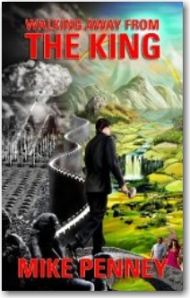
As I read this book on Kindle, I cannot ignore the fact that we need more page-turners like this that speak to the values in the current debate about ecology and our changing world. Mike Penney’s novel, released in March, is both entertainment and education. And, at present, the price is right if you’re of a mind to sample the story: it’s currently free on Kindle.
From the Publisher
The time has arrived to “walk away from the king.” The change necessary to save the human species and salvage the planet from impending ecological disaster cannot come from the powers that be, who only perpetuate their own ill-fated system.
A swell of diverse grassroots movements has arisen to create a very different culture than our contemporary world controlled by corporations and plutocrats. Rather than the status quo with its patriarchal, domineering, and exploitative culture of Empire, these groups favor a truly democratic Global Community, centered on bottom-up ecological revival, gender equality, cooperative action and individual responsibility. Collectively, they have determined they must “walk away from the king,” in preparation for a Grand Transition from contemporary self-destruction to a world of resilience and sustainability.
A prominent co-partner in the struggle is an organization calling itself Gaia/Universe. Many have galvanized behind its spokesperson, Bruno Panoka. A charismatic third generation televangelist that has turned from the “Heavenly Father” to “Mother Earth,” Panoka steps over the line and enrages the powers that be when he espouses the use of psychedelic mushrooms to expand consciousness, so as to jumpstart massive cultural change, and in turn economic and political change.
–
The book has some great reviews on Amazon with a 4.7 overall rating.
In How to be doomed as a writer, I mentioned that author Stephen King prefers to look at story possibilities as situations rather than plots.
Over time, a writer becomes attracted to certain kinds of settings and the kinds of situations that might occur there. I’m attracted to natural wonders, especially mountains, as well as old buildings. My novels The Sun Singer and The Seeker both arise from a natural wonders setting, Glacier National Park. When I contemplated writing about the park, my first thoughts were about the kinds of things (situations) that might happen there. My Kindle short story “Moonlight and Ghosts” came to mind when I looked at an abandoned building near the house where I grew up.
Suppose you’re in a writing class and the instructor shows you the following picture obtained from the Florida Division of Historical Resources. All you’re told is that it’s an old and restored opera house in a small north Florida town.
Perhaps the instructor has influenced your brainstorming about this picture by showing you the building on a sunny afternoon with cars along the street. If s/he had shown you a photograph of the same structure as it sat on a moonlit night with the trees missing leaves during December, you’d come up with a different set of situations.
If you’re a fan of TV police shows, perhaps this looks like a place where a crime is committed.
If you’re drawn to opera and/or to theater, maybe you’ll think of stars, set designers, directors, little theater groups, professional “theater people” or amateurs coming together to put on a play that somebody hopes will fail.
Maybe there’s a secret about the building, some old legend or a will uncovered in a dusty attic that describes how, when the building was constructed, several hundred bars of gold were hidden beneath the box seats.
This picture gives you a very different feeling about the building. – Florida Division of Historical Resources.
Okay, I’ve withheld some information, so with a few more facts, are your prospective story situations the same or do you change them?
The Opera House, which consists of a large second-floor theater and first floor shops, was built in 1880.
Traveling productions, including vaudeville groups, put on shows at this theater for a number of years. But then, when the railroads re-routed their lines and there was no easy way for out-of-town visitors to get to town, the theater fell into disuse.
Ghost hunters claim the owner died of a broken heart and still haunts the now-restored building. Purportedly, the former owner has been “seen” by the ghost hunters and a glowing orb of light.
The building is now used as a venue for weddings, local-area stage productions, and other functions where a seating capacity of 600 is desired.
If your instructor asked you to write a short story about this building, would you see it as just a building where anything might happen, a setting for a theater-oriented tale filled with clashing egos and temperamental stars, or would you try to link the local legends and the history of the building into your story? The only catch is, the instructor will expect you to convey–one way or another–a sense of the building. So, it can’t be a generic structure.
Well, unless you know the building already and/or are a historic preservation specialist, you’rre at a disadvantage when you try to describe it. If I were the instructor, I’d have several information sheets prepared as handouts.
Those who wanted to use the building as a place setting would get a general description of the interior and some architectural information about the architectural style of the building, it’s size, etc.
Those who wanted to use the location for a theater-oriented story, would receive information about the stage, the seating, the lighting, and the dressing rooms.
Those who didn’t know yet what was going to happen but wanted real background, would be told about the building’s history and the ghostly legends.
What do you see here?
Interior as it looks now. – The Florida Center for Instructional Technology, University of South Florida photo.
In a classroom exercise, you’re “research”–if you think any is needed–is limited by what you see in the photograph and what the instructor will tell you either in a lecture, a question and answer session, or via handouts. Since I am attracted by legends, especially paranormal stories, I’m going to see this as a place where something ghostly will happen.
How you tend to view real locations, whether they’re lakes, mountains, buildings, or city streets, will influence what “your muse” draws you to consider. Your inclinations may suggest that the instructor should have had several more handouts about the building. One might be how the building is used today. Another might be the kinds of businesses on the first floor and on adjacent streets.
As writers, we look at locations as places where something might happen or where something did happen. Whether you like tying in real history and legends or whether you see locations in terms of what’s happening there in the present day, once you’re attracted to a setting for who knows what reason, story situations may come to mind as you Google (or go to) the setting.
When I first saw pictures of this building, my first thought was, “Good, here’s a cool old building in the Florida Panhandle where I’ve been placing many of my recent stories.”
As I learned about the building–its history, its ghosts, its restoration–ideas began to float around for prospective stories. As this process unfolds, we may never write a story…unless we’re in a classroom and have no choice. If a story comes out of it, the setting was the catalyst and the result was a marriage of the real and the writer’s imagination.
 Prudence is a student who isn’t always prudent. Let us point to the night before her school book report is due. She hasn’t finished reading the book. Time to panic?










 Malcolm's Round Table