From road and campground status, to park interpretation, fire, and search and rescue updates; learn the realm of communication possibilities through social media in Glacier National Park. On Tuesday, April 6th, from 12 – 12:45 pm at the West Glacier Community Building, Dave Restivo will present how Glacier National Park is joining in on social networking sites and how you can join in on the conversation.
There is no substitute for experiencing the park first hand, but with the ever increasing popularity of social networking media, thousands of visitors are having a virtual experience that can be very rewarding. With more than 375 million Facebook users to-date, Glacier‘s staff are actively finding new visitors “where they are at, and where they expect us to be.”
David Restivo is a Visual Information Specialist with time split between Glacier National Park and the Intermountain Regional Office developing new media interpretive products. He is the recipient of several 1st place awards from the National Association for Interpretation in Interpretive Media and was awarded the National Freeman Tilden Award from the NPS for excellence in Interpretation.
Create your own bannersThe public library is a valuable and popular community resource—in most communities, it is the most visited and used public resource.
Did you know there are more library visits per year than movie tickets sold in the U.S.? In fact, American libraries reported 1.4 billion visits.
More relevant than ever In addition to traditional services, such as books and children’s programs, all libraries offer their communities Internet access and online opportunities, and educational programs such as homework help for teens and financial planning classes for adults. And for many Americans experiencing economic challenges and career needs, the library is more relevant than ever.
Access to information technology The public library’s core mission is to provide free and open access—more and more, that means access to the Internet. Over 70 percent of public libraries—over 80 percent of rural community libraries—report that they are the only source of free public access to computers and the Internet in their communities.
Library return on investment to the community Public libraries support both personal and economic development. They can influence job creation and community expansion that supports increased property values and commercial tax revenues, as well as improved quality of life. Studies report that dollars spent on libraries provide solid economic returns to the community.
Usage is up, funding is down While millions of Americans enjoy the library and understand its vital role for individuals and communities, many people aren’t aware of the critical funding issues libraries face. Most library funding comes from local sources and local budgets are decreasing.
Local dollars pay most for libraries Nationwide, the average per capita operating revenue for public libraries is pproximately
$37—of that, over $31 comes from local sources.
Here’s the reality
As Americans look for support during this economic downturn, more and more are turning to local libraries for entertainment, educational opportunities and job searching resources. But while demand increases, most libraries are experiencing shrinking budgets.
• Libraries across the country are cutting hours, staff and even closing locations.
• Most libraries report that they don’t have enough Internet access computers to keep up with demand and waiting lines are commonplace.
• Many libraries are understaffed and are unable to provide the support users need to find and utilize resources to improve their lives.
—
Note to librarians
I worked my way through college as a student assistant at the library. This was an education itself, partly as an opportunity to learn how libraries work, and partly as an opportunity to discover hundreds of books I never otherwise would have found. As a way of giving something back, I donated a fair number of copies of the 2004 first edition of “The Sun Singer” to public libraries and to the libraries where I worked.
If you are a librarian and would like to include a copy of the new second edition of “The Sun Singer” as part of your on-the-shelves collection, I do have a limited number of copies available for donation. If interested, please contact me via e-mail from your library’s e-mail account to: thesunsinger@yahoo.com
“What such a figure represents is the benign, protecting power of destiny.” –Joseph Campbell in “The Hero With a Thousand Faces”
When a mythic hero begins his or her journey into the unknown, s/he often receives help from a magical helper or mentor in the form of advice or amulets to ward off or lessen the impact of the dragons and other horrific forces and entities along the hero’s path.
Crones, wise men, elves and other faerie folk, gods and goddesses, totem animals and spirit guides are among the forms of supernatural aid that providence (or the universe) provides.
Campbell writes that no matter how dangerous the evil forces are on the far side of the threshold or portal into the unknown (dark forest, wine-red sea, unconscious), that “protective power is always and ever present within the sanctuary of the heart and even immanent within, or just behind, the unfamiliar features of the world.”
Considering the journey as a spiritual undertaking, the hero–as we learn from mythology–is wise to trust himself and his guardians. In “Harry Potter and the Sorcerer’s Stone” for example, young Harry is called to his journey via mysterious letters arriving from Hogwarts School of Wizardry and Witchcraft; however the nasty Dursley family won’t allow him to read them, much less respond.
But the journey will not be denied. Hagrid, a half giant from the school appears, and rescues Harry via supernatural means. Likewise in “Star Wars,” Obi-Wan Kenobi uses supernatural means (paranormal skills) to extract Luke Skywalker from the planet where he’s been living and then serves as Luke’s mentor as the journey begins.
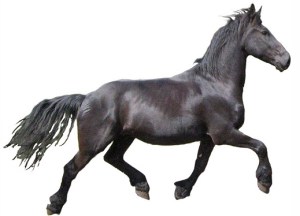
Friesian Horse – Walraven on Flickr
In my novel “The Sun Singer,” young Robert Adams encounters several magical helpers including a large, black horse named Sikimí. In everyday terms, the horse is a Friesian like the one in the picture. Yet, when Robert meets the horse for the first time, he–and the reader as well–are tipped off that Sikimí is somehow more than a horse:
The horse was excessively here in the present tense as though accentuated by the angle of the light into being more now than now and more visible than normally visible.
And then David Ward–a mentor character in the novel–tells Robert that Sikimí describes himself as “night in the shape of a horse.”
The journey, though, belongs to the hero alone. In “The Sun Singer,” neither Sikimí nor David Ward remain with Robert. He says goodbye to them and is on his way. He must trust that they–or whatever he has learned from them–will serve him well when the need arises.
Each mythic hero must merge the magical powers, amulets, advice of the magical helpers or mentors with his or her own willpower and faith to carry out the quest to its conclusion. The amulets cannot be all powerful nor the mentor always present, for then the “hero” would simply be along for the ride with no risks to face nor crucial decisions to make.
Hero’s path myths–and fiction based on the steps of the hero’s journey–are intended (in addition to their storytelling value) as catalysts for readers and their own life’s journeys. The translation of the mentors concept into daily life can be rather straightforward, for there are teachers everywhere as well as books, workshops and courses everyday heroes can use to their advantage.
Most of us do not expect a wide variety of gods to help us in the manner in which they directly helped (or hindered) Odysseus in Homer’s epic poem “The Odyssey.” Depending on one’s belief system, prayer can serve as supernatural help; so, too, the messages of totem animals and spirit guides in dreams and meditation. For others, the magical helpers of myths transform into the positive synchronicity and “good luck” that seemingly appear out of nowhere as a result of one’s positive thinking, trust in himself or herself, and dedication to a course of action in harmony with the universe (or one’s spiritual views).
The prospective hero hears “the call to adventure” and makes the decision to undertake the journey without guarantees. He does not ask to see the mentor or the magical helpers in advance. He walks out the door of everyday life without a script that shows precisely what will happen and how s/he will survive the tasks ahead and make it safely home.
Writer’s Note
As Ted Andrews notes in his book “Animal-Speak: The Spiritual & Magical Powers of Creatures Great and Small,” horse symbolism is complex. His keynotes for the horse are travel, power and freedom. These fit my needs for the book since my protagonist is concerned with all of these things.
The black horse appears in my own dreams and meditations often enough to be considered a totem animal: my own magical helper, so to speak. This means that I “know” a lot more about this particular horse than I need for the book, always a plus for an author.
If horses, wise old men, or other magical helpers and guides appear in your dreams, then they are playing the same role as the supernatural powers of classic myths as well as novels and movies that are structured along the lines of Joseph Campbell’s hero’s journey theme.
–Malcolm
Malcolm R. Campbell is the author of the contemporary fantasy “The Sun Singer,” a hero’s journey novel.
“Far away in Montana, hidden from view by clustering mountain-peaks, lies an unmapped northwestern corner- the Crown of the Continent. The water from the crusted snowdrift which caps the peak of a lofty mountain there trickles into tiny rills, which hurry along north, south, east and west, and growing to rivers, at last pour their currents into three seas. From this mountain-peak the Pacific and the Arctic oceans and the Gulf of Mexico receive each its tribute. Here is a land of striking scenery.” — George Bird Grinnell, “The Crown of the Continent” in The Century Magazine, 1901
Fish and Wilflife Service Archive PhotoDr. George Bird Grinnell (1849 – 1938) was a hunter, anthropologist, naturalist, publisher, Audubon Society founder, and Indian rights advocate who has been called the Father of Glacier National Park and the Father of American Conservation. While he specialized in studies of the plains Indians, visitors to Glacier National Park during this centennial year will hear of his association with the Crown of the Continent and will see his name linked to a lake, mountain, point and glacier in the Swiftcurrent Valley.
When George was seven, the Grinnell family moved into Manhattan’s Audubon Park neighborhood, the estate of John James Audubon (1785-1851) managed by the ornithologist’s widow Lucy. George was fascinated by the specimens of birds stored in the barn and was lucky enough to become one of the children tutored by Madam Audubon.
In his 1939 tribute to Grinnell in “The Auk – A Quarterly Journal of Ornithology,” Albert Fisher wrote that “Madam Audubon gave Grinnell his first conscious lesson about birds. One of his early recollections was being called from the breakfast table one morning to look at a large flock of Passenger Pigeons that was feeding in a dogwood tree twenty-five or thirty feet from the house. There were so many of the birds that all could not alight in it, and many kept fluttering about while others fed on the ground, eating berries knocked off by those above.”
Speculating about the workings of fortune and fate, one can only wonder how the future of conservation and Montana’s Rocky Mountains were impacted by the pivotal moment encompassed by pigeons and a dogwood.
Also pivotal in Grinnell’s life were his volunteer experiences at 21 on a paleontology expedition to Nebraska. In his 2004 article in Bugle Magazine “George Bird Grinnell: The Father of American Conservation,” Shane Mahoney wrote: “His writings from this time also reflect his deep love of the hunt and his capacity to appreciate the sheer beauty and grandeur of wild and unspoiled lands. His memories of fireside gatherings after a vigorous day afield are testimony to his love of the land and the cultures of men who made it their obsession and home. While his keen scientific eye was always turned to gathering new insights, his soul and heart were expanding in the western frontier, beginning to form in him a fevered commitment to the preservation of wildlife and the hunt.”
Grinnell served as a naturalist on an 1874 Black Hills expedition led by General Custer and on an 1875 expedition to Yellowstone. He found himself drawn west not only as a hunter of big game, but as a man impressed by the natural wonders he saw and by the lives and stories of the Pawnee, Blackfeet and other tribes he encountered and befriended. President Grover Cleveland would later appoint Grinnell as a commissioner to liaison with the Blackfeet and the Belknap Indians.
Grinnell’s articles about his experiences began appearing in “Forest and Stream,” a magazine he would later edit and then publish. He wrote not only of hunting but of the need to curtail the wholesale slaughter of animals for market purposes. His report of conditions in Yellowstone showed that game and timber were being stolen away by commercial interests.
As Mahoney noted, “Grinnell returned from the [Yellowstone] expedition determined to provide better protection for the park and to set before the American people a platform of discussion regarding just what a national park should represent. In so doing he was to lay the foundation for the national park system we have today.”
Century Magazine SketchGrinnell coined the phrase “Crown of the Continent” in his 1901 article in The Century Magazine. He included a sketch of the area that would ultimately bear a very close resemblance to the park that would be created nine years later. Luckily, the geologists and promoters who swarmed through mountains seeking gold, copper and oil found no viable deposits.
While Grinnell, with his high-level contacts and his reputation as an advocate for conservation, had been pushing for protected status for the Montana mountains for almost 20 years, he would say later that the Great Northern Railroad deserved most of the credit. Taking little or no credit for his accomplishments was a long-time Grinnell attitude that, even now, causes him to be overlooked in many assessments of early conservation activities.
At the time, Grinnell spoke to “Empire Builder” James J. Hill of the Great Northern about the benefits of a park. Hill, whose views leaned more toward the kind of playground the railroad might develop there than toward conservation, pressured Montana’s Congressional delegation to support the park. Ultimately, the legislation passed with little debate, and President Taft signed the legislation in May, 1910.
According to historian C. W. Buchholtz in Man in Glacier, George Bird Grinnell wrote that “the people of the Great Northern were entirely responsible for the creation of Glacier. In 1929, Grinnell stated: ‘Important men in control of the Great Northern Rail road were made to see the possibilities of the region and after nearly twenty years of effort, a bill setting aside the park was passed.'” In the years that followed, Grinnell would wonder if Glacier Park was truly safe, for he saw more commercialization there than he thought was proper.
Without the railroad as the final powerful catalyst, Glacier National Park might never have been created; the railroad saw a tourist destination where the natural resources could be managed and used. Grinnell had greater vision, one developed over the long term and one that has sustained us well for the last 100 years.
Copyright (c) 2010 by Malcolm R. Campbell, author of “The Sun Singer,” a mythic adventure novel set in Glacier National Park.
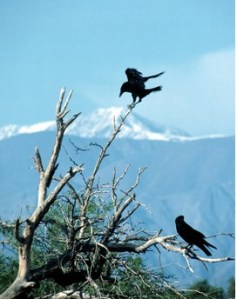
from Jupiter Images“Robert, Maistó (Raven) has reminded me that you must not confuse him with common crows. They are greedy, self-serving birds that eat too fast. According to Maistó, the ‘caw’ sound we associate with crows is more of a belch than a call.” — David Ward in “The Sun Singer”
“I have fled in the shape of a raven of prophetic speech.” — Taliesin
“They slept until the black raven, the blithe hearted proclaimed the joy of heaven.” –Beowulf
When you fly with Raven and/or imagine flying with Raven you must have a sense of humor. Prepare to be mocked, mimicked and satirized in every possible way. Accept this, for it shifts your consciousness rather like getting hit in the face with a feather pillow and refocuses your attention on your inner journey. When you pretend to be flying with Raven, you are flying with Raven.
Synchronize your flight with Raven’s flight and you will go within, dying to the exterior world so that dreams and magic are paramount. Alchemists call this stage of the great work “blackening” and often represent it in a variety of morbid death’s head and graveyard drawings. While flying with tricksters, you will in time see the humor in this.
To synchronize your flying with Raven, resist the urge to fly like a common crow and shout “caw caw” at the people in the world below. Observe and you will see that crows soar with bent wings and that ravens fly like hawks, flapping and then soaring on horizontal wings. Keep your hands straight and, if you must say anything, shout “crrrruck crrrruck.”
Ravens are keepers of secrets and they will escort you into the void where the mysteries are contained or they will bring you messages from the spirits of darkness with knowledge to impart. Sometimes, to emphasize your re-focused attention, Ravens will change into something else and expect you to follow suit.
While your encounter with Ravens stops the world as you know, it can be confusing. In terms of mythology and animal totems, Ravens are fun loving and fast moving and it’s best to be adaptable. However, flattery will get you everywhere. Inform them that you know that even mainstream science believes Ravens have more intelligence and insight than crows or, for heaven’s sakes, magpies. Figuratively speaking, the diverse Corvidae family has its share of black sheep.
When you see Raven in your dreams, magic is afoot–or, actually, awing–and it’s best to fly wherever it takes you. Whether you are a garden-variety author, a seeker, or a shaman, an open-ended, nonjudgemental experience with Raven is the key to power and mystery from (depending on your belief system) the astral, inner, or spirit world.
Meditations and magical flights with Raven can turn into a carnival of colors and changing seasons and laughter out of which–when you fear all is lost in the great chaos of the moment–meanings begin to appear clear and cold as black ice. Smile, laugh, and go with the flow; otherwise insanity is a risk–and that’s no joking matter.
Truth be told, Ravens have done their best to drive me crazy. They see it as a benefit–part of the initiation, so to speak–and a prelude to greater mysteries. I’ve told them they are quite full of themselves and their only defense is to laugh and tell me I fly like a baboon in heat. (I really don’t know what that means and haven’t wanted to ask.)
My rating: 4 of 5 stars
“Ghost Mountain” by Nichole R. Bennett features a reluctant seer who becomes the prime suspect in a murder case because she knows only what the killer could know.
When Cerri and her family move to western South Dakota, her attention is drawn to a murder at the Devils Tower across the border in Wyoming before all the moving boxes are unpacked and the family is settled into their new home. The site, also known as Bears Lodge, is sacred to many Native American nations. Because of this, Cerri’s spirit guide tells her that the murder has profaned the site and she must help the police bring the killer to justice.
Making Cerri the prime suspect in the case is a nice touch, for it’s the very thing many of us think would happen if we suddenly had a psychic impression or a visitation from a spirit guide with detailed information about a murder that hadn’t been released to the public. Cerri–named for the Celtic Goddess Cerridwen by a mother who’s made “hocus-pocus” a way of life–doesn’t want to be drawn into a spiritual, paranormal mission. But she can’t seem to extricate herself from it. Her spirit guide He Who Waits is stubborn; so is Special Agent Joseph Oliver who thinks Cerri belongs in jail.
Bennett has given Cerri a fine mystery to solve, and while she would like to avoid being a special person with a sacred mission, staying out of jail is motivation enough for clearing up the case to she can get on with her life. While the novel could have been made a little stronger if Cerri had grown more into her talents during the book’s 164 pages, the story is well told and engaging.
The SS United States Conservancy has learned that America’s national flagship, the SS United States, may soon be destroyed. The ship’s current owners, Genting Hong Kong (formerly Star Cruises Limited), through its subsidiary, Norwegian Cruise Line (NCL), are currently collecting bids from scrappers.
The SS United States was a powerful Cold War weapon disguised as a luxury liner. This great passenger ship transported many Americans to and from Europe and other destinations between 1952 and 1969. She carried four U.S. presidents and countless military, diplomatic, and business leaders, celebrities and artists, and foreign heads of state, not to mention thousands of ordinary citizens and immigrants. She still holds the world’s speed record, set on her maiden voyage in 1952.
The ship’s current owners listed the vessel for sale in February, 2009. While NCL graciously offered the Conservancy first right of refusal on the vessel’s sale, the Conservancy has not been in a financial position to purchase the ship outright. However, the Conservancy has been working diligently to lay the groundwork for a public-private partnership to save and sustain the ship for generations to come.
The Conservancy understands that Genting and NCL are reluctant to continue covering the significant costs associated with maintaining the vessel in its current berth in Philadelphia and appreciates the good care the vessel has received since its purchase in 2003 with the stated intention of returning the ship to seagoing service. The Conservancy has maintained a positive working relationship with NCL over the past seven years and looks forward to ongoing collaboration during this critical period.
The Conservancy has begun discussions with NCL with the intent of covering some of the fees associated with maintaining the ship in Philadelphia so it can finalize plans for repurposing the ship as a stationary attraction at a large metropolitan waterfront.
“This is both a patriotic and a practical effort,” said Conservancy Executive Director Dan McSweeney, whose father emigrated from Scotland to America to serve as a crewmember aboard the vessel. “We’re absolutely committed to saving one of the most important symbols of America in the 20th century, but we’re also talking about creating hundreds, if not thousands, of jobs when this ship is refurbished and becomes a stationary attraction in a large U.S. city. We must save this irreplaceable American icon and continue the process of establishing a public-private partnership to re-purpose her.”
The Conservancy’s new national campaign is titled “Save Our Ship” (SOS) and offers a “Plank Owner” certificate for tax-deductible donations of at least $25 via its new donor website: www.ssusplankowner.org.
“We’re all natural storytellers, sharing our stories every time we communicate with someone — whether it’s a casual water-cooler chat or deep conversations with a close friend.” — Mark David Gerson in “When Was the Last Time You Told Your Story?“
I read Mark David’s post about our natural inclination for sharing our stories with each other right after getting home from a weekend trip for visits with friends and family. Family visits often include updates about what people we used to know are doing now, leading often to “remember the time when” accounts of things that happened a quarter of a century ago.
Visits with friends begin with “what’s been going on lately?” and, as the evening gets late, morph into childhood stories that come forth as one topic leads to another topic through a myriad of diverse pathways. Saturday night, we ended up talking about pivotal moments, events that had a large impact on our life’s work and our points of view. We learned, among other things that our good friend Gordon had had near brushes with death as a child: these were stories we’d never heard even though we’ve known him and his wife Joyce since the 1970s. It just never came up before.
When I was going to graduate school at Syracuse University, my father quite naturally began thinking about his work as the acting dean of the journalism school there when I was several years old. As I haunted the streets he used to know, he began to think of old stories, things that just never came up during dinner table conversations back home. Every week or so, I received a typewritten letter of several pages not only relating tall tales about Syracuse in the old days, but incidents in his life in Quincy, Washington, Ft. Collins, Colorado and the Colorado Rockies, and the San Francisco Bay Area.
These letters painted a picture of what my father’s life was like as a child and also as a young man the same age I was at the time I read them. Unfortunately, during the summer term, we had to vacate the graduate student apartment building to provide living space for summer session students, and this meant storing a lot of stuff in the locked units in the basement. When I came back to Syracuse that fall, I discovered that in spite of the locks, many of the units had been broken into and the contents had been stolen.
I lost a good pair of “roper’s boots” purchased several years earlier in Browning, Montana, and I lost a briefcase where I had stored my father’s letters. Some scum–in my estimation of the people who committed the burglary–was wearing my boots and maybe even attending classes in the same buildings I was using my briefcase. The letters were, no doubt, tossed in the trash.
Today, those letters would be sitting in a computer and could be printed out again. As it was, there was no way to replace them or even to remember the stories they contained.
I thought of this last night when Gordon spoke of putting some of his stories into a book. No doubt, they would mean a great deal to his sons even in e-mail form. But they would have a wider audience for they’re not only interesting–simply as good storytelling–but they contain details about another time and place…what it was like to work in a steel mill or for the long-gone Nickel Plate Railroad.
As a writer, I see Gordon’s stories and my late father’s stories first as the way they might appear as written accounts–prospective essays, articles short stories and novels. But there’s more to them. For a family, they’re history and legacy; for friends, they’re a sharing of experiences.
Our stories not only make good conversation, they forge deeper friendships. So I ask, as Mark David asked in his post, when was the last time you told your story?
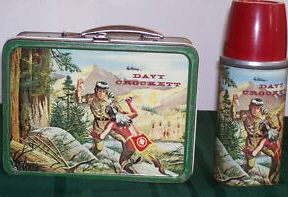
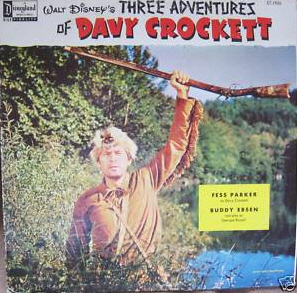
Available on eBayThe Davy Crockett craze began just before Christmas in 1954. Soon thereafter, it swept the country as Disney’s popular television series starring Fess Parker as Crockett and Buddy Ebsen as sidekick George Russell converted everyday kids into kings of the wild frontier.
With the news that actor Fess Parker died at 85, it is hard not to think back some fifty five years past his more current activities in real estate and wine making, and remember his TV roles as Crockett and as Daniel Boone and his movie roles in such films as “The Great Locomotive Chase” and “Old Yeller.”
While today’s kids eat the latest cell phones and MP3 players and designer running shoes like candy, Crockett fans could not only sing the “The Ballad of Davy Crockett” with the annoying frequency a later generation would sing “It’s a Small World Isn’t It,” we had our own (rather low-tech) memorabilia. We not only knew that Crockett was born on a table top in Tennessee, we carried our Davy lunch boxes to schools and parks and ate our peanut butter and jelly sandwiches on our 1950s table tops dreaming of heading west and doing great deeds.
The lucky kids not only carried a Davy Crockett rifle, they boasted of the whole shooting match: bag, bandanna, bank, bathrobe, bead spread, belt, billfold, books, boots, bowls, buttons, caps, cap pistol, cards, China, clothes rack, cookie jar, coonskin cap, cuff links, cup, drums, flashlight, guitar, handcuffs, jacket, knife, lamp, moccasin kit, mug, nightlight, pajamas, pitcher, powder horn, puzzle, records (vinyl), ring, spurs, thermos, tie and wristwatch.
The faux coonskin caps were a must and we wore them bravely because there was danger in the back yard and the park, and in the dark rooms of the house after we went bed with our Davy Crockett flashlights and nightlights. We were not, however, allowed to wear the caps to school or to church, a risk that didn’t make any sense at the time. My brothers and I looking for bad guys
Parker was tall, rugged, and seemingly pulled into Disney’s TV shows and films straight from 19th century days when the world needed a man, as the song reminded us, who “when Now, Injun fightin’ is somethin’ he knows, so he shoulders his rifle an’ off he goes.”
When I saw Parker as Daniel Boon in the 1964-1970 TV series, Jim Coats in “Old Yeller” with Dorothy McGuire and Tommy Kirk, and as James Andrews in “The Great Locomotive Chase” with Jeffrey Hunter and Slim Pickens, it was always the same guy; no, not a one-dimensional actor, but a dramatic, justice-seeking hero with or without his coonskin cap who “made hisself a legend for evermore.”
My rating: 5 of 5 stars
Like many fans of the “Outlander” series, I “met” author Diana Gabaldon on an online literary forum in the days of yore when CompuServe was the Internet service provider. At the time, Diana was posting what she referred to as “chunks” of her work-in-progress and garnering very enthusiastic comments and a fair amount of interesting discussion. The excerpts were so fluid and natural, I fair thought we might all end up speaking either Highland English or Gàidhlig before the manuscript was complete. In 1991, the writing chunks became “Outlander.”
In the years that followed, we traveled with Sassenach (English people and Lowlanders) Claire Beauchamp Randall through multiple countries in time lines beginning in 1945 and 1743. In 1945, she’s married to Frank Randall. In 1743, she’s in love with Highlander James Fraser.
As “Outlander” led to a sequel and then another sequel, I thought it rather presumptuous to review any of the installments of a series (heading toward 17 million copies sold in 21 languages and 24 countries) written by the very gracious mentor for the writers on the CompuServe Literary (now Books & Authors) Forum.
But 19 years and seven books have passed since I read the opening line “It wasn’t a very likely place for disappearances, at least not at first glance” as former combat nurse Claire Randall surveyed a 1945 Inverness bed and breakfast with “fading floral wallpaper” where she was celebrating a second honeymoon with Frank. Surely Diana would say “dinna fash” if I told her I was mustering up the grit to say a wee word or two.
Were I to distill this wordy review down to basics and say only a wee word or two, it would be this. “An Echo in the Bone” is the best book in the series since the first one.
Some readers have criticized the novel’s episodic presentation and multiple story lines. On the contrary, I view this approach as one of the novel’s many strengths, others being the evolving characterizations of individuals series readers have known for years, the exceptional detail and historical accuracy, and the author’s clear focus on the tension, danger and humor that make a darned fine story.
With “An Echo in the Bone,” we have regained the tension and tight plotting that we lost to come extent in “The Fiery Cross” and and “A Breath of Snow and Ashes” which spent too much time with everyday affairs at the expense of the stories’ primary thrusts. Well after “Outlander,” it was almost as though the uniqueness of a modern and highly skilled medical practitioner living two centuries before her own time was being asked to carry too much of the books’ weight.
“An Echo in the Bone,” however, is exceptionally strong. Multiple characters grow in multiple times and places, and the episodic approach strengthens the drama of the strong doses of harm’s way in each lifeline we’re following. Drama is not contained by linear time, a fact Diana has proven many times over, and this time out, she has honed her writer’s scalpel to a fine edge indeed.
The use Fort Ticonderoga and the September and October 1777 Battles of Saratoga as a major focal point anchors the novel in historic time and provides a memorable counterpane for compelling action sequences and character development without losing the series hallmark (often earthy and humorous) interactions between a feisty Sassenach and a volatile Highlander.
No one need try to read “An Echo in the Bone” as a standalone novel, for the characters have too much history for that and there’s no way to catch up with it short of, say, adding some distracting and/or helpful footnotes. And then there’s the cliffhanger ending, or–more accurately–the multiple cliffhanger endings. Some readers are saying (basically), “Diana, how can you do this to us?”
My last wee world or two is: How can she not, for storytelling doesn’t get better than this.
With each purchase of my novel “The Sun Singer” in any format, Vanilla Heart Publishing makes a donation to Glacier National Park in support of this year’s centennial celebration. It’s only $5.99 on Kindle.
“The Sun Singer,” an adventure novel that also bends time, is set in Glacier National Park’s Swiftcurrent Valley.



 Grinnell served as a naturalist on an 1874 Black Hills expedition led by General Custer and on an 1875 expedition to Yellowstone. He found himself drawn west not only as a hunter of big game, but as a man impressed by the natural wonders he saw and by the lives and stories of the Pawnee, Blackfeet and other tribes he encountered and befriended. President Grover Cleveland would later appoint Grinnell as a commissioner to liaison with the Blackfeet and the Belknap Indians.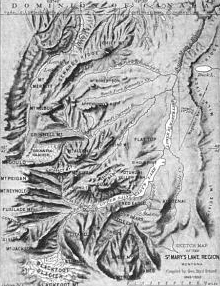



 The lucky kids not only carried a Davy Crockett rifle, they boasted of the whole shooting match: bag, bandanna, bank, bathrobe, bead spread, belt, billfold, books, boots, bowls, buttons, caps, cap pistol, cards, China, clothes rack, cookie jar, coonskin cap, cuff links, cup, drums, flashlight, guitar, handcuffs, jacket, knife, lamp, moccasin kit, mug, nightlight, pajamas, pitcher, powder horn, puzzle, records (vinyl), ring, spurs, thermos, tie and wristwatch.


 Malcolm's Round Table