Why I review the books I review

Truth be told, if my name were James Patterson and/or if I worked for the New York Times, a fair number of readers might be waiting to see what I (or my newspaper) had to say about “The Girl Who Kicked the Hornet’s Nest” or “Frankenstein: Lost Souls.”

But I’m not and I don’t.

I’ll probably read “The Girl Who Kicked the Hornet’s Nest” because I enjoyed the late Stieg Larsson’s “The Girl with the Dragon Tattoo.” I probably won’t review it, though, because by the time I get around to reading it adding one more review to a slough of them on Amazon or GoodReads just isn’t going to matter.

More importantly, though, is the fact that Stieg Larsson’s books don’t need any help, nor do they need any cautionary words or warnings. But small-press and self-published authors do need publicity, so I’m going to focus on novels from those sources when I find books I like.

I have no delusions of grandeur about this. My review isn’t going to catapult an unknown author onto the New York Times bestseller list. The book world runs on publicity. The trouble is, those who don’t need it keep getting more of it. Those who do need it get very little of it because they’re not already famous.

This is one of those paradoxes that drives authors nuts. “Why,” they ask, “is there a million dollar marketing budget for a book that’s going to become a bestseller with no marketing at all?” And, “Why are a hundred reviewers lining up to review the last James Patterson book when, really, everything that could be said about it has already been said?”

Mob instinct, I would say.

I would much rather offer my humble opinion about a book you might not hear about at all unless you chance upon my blog review or my GoodReads review. Perhaps you will find a title you like and you’ll buy a copy. After you read it, you might tell your friends about it.

The authors of the books I review may have worked for a year or two writing their books. In some cases, they struggled with their manuscripts off and on for decades. I think they deserve a chance to be read. That’s why I review them.

Malcolm

Review: ‘The Long Night Moon’

The Long Night Moon The Long Night Moon by Elizabeth Towles

My rating: 4 of 5 stars
Sassy, high-spirited and boy crazy, seventeen-year-old Darcie Edglon is abruptly taken away from the Charlotte, North Carolina world she knows three weeks after her parents are killed in an automobile accident. Responsible for her now, her older brother Ian orders her to pack her things without discussion or questions and prepare herself for an extended stay in the family’s mountain house near the Nantahala National Forest in Western North Carolina.

While the house is spacious and mountains near Franklin, Dillsboro and Cherokee are beautiful, this is hardly recompense for being wrenched away from her friends and activities in Charlotte. Her opinion begins to change, however, when she meets a recently widowed young Cherokee man named Wa’si.

“The Long Night Moon” is a magically told story about a teenager woman with a secret on the cusp of womanhood. The Cherokee and high-country themes run through the novel like pure mountain water, and are a compelling counterpoint to the rebellious, city-wise Darcie. With her attraction to Wa’si–whom her brother Ian has told her to leave alone–Darcie cannot help but be drawn into a culture and a place that will support her during the trials to come.

Darcie is a strong-willed, inventive and intelligent young woman. When the person she is becoming is severely tested, these traits will serve her well. While Darcie’s final test is wrapped up somewhat abruptly and the novel’s concluding chapter could have been more expansive, Elizabeth Towles’ novel is a very satisfying story.

View all my reviews >>

On a personal note, I was drawn to this book partly because my family has made dozens of vacation trips over the last 50 years to the Western North Carolina mountains where the story is set. We owned property in the area, found lasting friendships and–of course–explored the Nantahala and Pisgah national forests, the Great Smoky Mountains National Park, and the trails along the Blue Ridge Parkway to Mt. Mitchell. Elizabeth Towles really makes this land come alive in “The Long Night Moon.” If we had a time machine, I believe the Cherokee ancestor in my wife’s family would agree.

Malcolm R. Campbell is the author of Garden of Heaven, The Sun Singer and Jock Stewart and the Missing Sea of Fire.

Ask not for whom the Minotaur waits

In the classic Greek myth, Theseus enters King Minos’ labyrinth at Crete, finds and slays the dangerous Minotaur at its center, and finds his way back out by following a linen thread he laid down to mark his path on his way in.

16th Century Engraving - Wikipedia Commons
The story is symbolic. Labyrinths, writes Jodi Lorimer in her book Dancing at the Edge of Death: The Origins of the Labyrinth in the Paleolithic represent both order and chaos. It depends on one’s ever-changing point of view.

They also represent the unconscious and an individual’s self. Until one knows himself, part of it is unconscious and filled with fears, demons and the basic energies of primal needs. The Minotaur is an apt symbol for these and slaying it is an apt symbol for facing one’s fears and subsequently becoming more whole and more aware.

The silken thread, a gift of King Minos’ daughter Ariadne in the original myth, represents the hero’s intuition, his present (though possibly faint) connection to his higher self, a self the Greeks personified as one god or another.

The hero’s journey, as described in Joseph Campbell’s The Hero With a Thousand Faces has been used as a template for understanding classic myths, exploring the depths of oneself, and creating compelling novels and screen plays.

In fiction, as in myth, the purpose of the story is always the hero’s transformation or his failure to achieve it. He undertakes a dangerous physical or psychological journey and in the process of doing that finds and slays his inner demons. The physical journey, complete with friends, enemies, demons, angels, trials, and tribulations is–in fiction and myth–the catalyst for the hero’s growth.

While the hero’s journey as a template is often the most obvious in epic films such as Star Wars, The Lord of the Rings and The Matrix, it also serves as a structure for stories involving characters we might consider to be “every day people.” These stories always contain conflict, a conflict that typically cannot be successfully resolved until the main character comes to grips with his or her own failings, fears, phobias, blind spots and prejudices. If one can’t personally identify with the journey and the minotaurs in Titanic and Spiderman, then Dirty Dancing and Annie Hall may be easier to vicariously experience.

The twists and turns of the action-packed physical trek, battle or other conflict mirror the main character’s inner journey through the labyrinth of self. At the conclusion of the novel or film, we not only expect to see that the battle has been won or the crime has been solved, but that the protagonist has changed in the process.

Without facing a Minotaur of one kind or another, the hero cannot grow. None of us can. Most heroes don’t set out to consciously change themselves. Harry Potter, for example, didn’t vow to confront his worst fears. Instead, he went to school to learn magic, he ended up fighting the evil Lord Voldemort, encountered his worst fears in the process and triumphed over them, ending up as quite a different person.

Whether he’s overtly conscious of his inner journey or not, no hero in fiction or myth asks for whom the Minotaur waits because he knows it waits for him. Every good story has one and perhaps every good life has one as well.


As a personal note, when I watch Hollywood films, read novels, or consider stories I might want to write, I don’t envision the storyline and ask “Where’s Waldo?” I ask “Where’s the Minotaur?”

Then, at the conclusion of the novel or feature film, I don’t just want to see that the Luke Skywalker has destroyed the death star, that Indiana Jones has gotten the lost ark away from the Nazis, or that Erin Brockovich has defeated a corporation that’s been dumping hazardous materials into the groundwater. I want to see that Luke, Indiana and Erin have personally changed, for that change is they axis on which the ultimate story ultimately turns.


Malcolm R. Campbell is the author of two hero’s journey novels (complete with figurative labyrinths and minotaurs), Garden of Heaven and The Sun Singer.

For the Florida connection in this novel, see my post Tate’s Hell about a wild swamp in the panhandle near where I grew up that made a perfect counterpart in the novel to Glacier’s Garden of Heaven valley.

Journalism Association Asks Members to Help Endow Research Award

Campbell - Quill & Scroll photo
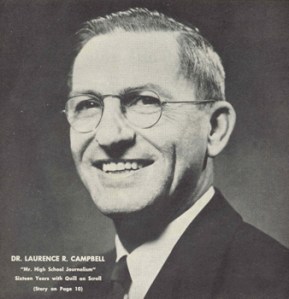
My father, Laurence R. Campbell (1903-1987), was a long-time journalism educator and author who focused on student publications and the training of publications advisers. In 1984, the Scholastic Journalism Division of the Association for Education in Journalism and Mass Communication (AEJMC) honored him by establishing the Laurence R. Campbell Research Award.

The annual award recognizes scholarship in the field of journalism research. Now, the AEJMC hopes to further support the award by increasing the level of its funding to the point where it can be endowed. This would ensure the award’s long-term continuation.

Writing in the March issue of Scholastic Source, division director Vanessa Shelton appealed to AEJMC members to add the research award to their list of charitable donations for the year.

“Mr. High School Journalism, as Campbell was called, left an amazing legacy of information generated through his prolific writing and research agenda,” said Shelton. This included 32 articles for Quill & Scroll Magazine, 50 research projects, 200 articles for student journalists, and over eleven journalism textbooks and pamphlets.

As Shelton noted, Campbell “also judged thousands of newspapers and yearbooks for scholastic press associations influencing (as author Bruce Konkle said) ‘the quality of student publications for more than 25 years.'”

I hope the AEJMC members and others who support high school journalism courses and student publications will help raise the award’s funding to the endowment level.

Donations earmarked for the Laurence R. Campbell Research Award can be sent to Vanessa Shelton, Quill and Scroll, University of Iowa, E346 Adler Building, Iowa City, IA 52242. Checks should be made payable to the AEJMC with a notation for the Campbell Award fund.

If I Owned a Bookstore

In his novel “If On a Winter’s Night a Traveler,” Italo Calvino divides a book store into some amusing sections:

    Books You Haven’t Read

    Books That If You Had More Than One Life You Would Certainly Also Read But Unfortunately Your Days Are Numbered

    Books You Mean To Read But There Are Others You Must Read First

    Books Too Expensive Now And You’ll Wait Till They’re Remaindered

    Books That Everybody’s Read So It’s As If You Had Read Them, Too

If I owned a bookstore I would probably already be broke and/or insane, but assuming I wasn’t, I would look to Calvino (figuratively, since he’s dead) for guidance in arranging my store.

Near the front of the store, there would be: Books Most People are Too Embarrassed to Pick Up. In-store video would display people sneaking up to this section and making sure they’re alone before hurriedly shuffling through the titles and centerfolds.

In the center of the store, I’m thinking of a section enclosed in barbed wire (to keep the kids out) called Books That Know Where You Live and Will Come to Your House if You Don’t Buy Them. I think a lot of people will look at these books, put them down, and then go home and see what happens. Once something does happen, I’ll start raising prices because people will have to buy the books then.

To prove that my store had a heart of gold, I would have sections called Books Your Friends Keep Borrowing and Never Give Back (with a bulletin board for posting names of your forgetful friends), Books You Need to Keep the FEDs From Hassling You (obviously, a section for those who think we have too much government already), and Books That Are, Frankly, Pretty Damn Stupid (these will sell as beach reads).

There would be smaller sections with tasteful signs like:

PURE SMUT

IMPURE THOUGHTS

DISEASES YOU DON’T WANT YOUR SPOUSE TO KNOW ABOUT

FAKE EMPOWERMENT SECRETS

SELF-HELP FOR THE ENTITLEMENT GENERATION

As for ambiance, it needs to be threatening. People like danger. They want to be able to say, “I went to BAD ASS books and got out without spending more than $250.” A biker-bar motif might work with complimentary booze for anyone who can prove they’re not already drunk.

Even so, I’d probably need a section of my store called Books You Would Buy if You Weren’t Too Hammered to Stand Up Straight. (The shelves in this section would be low to the floor so you could see the titles while crawling.)

Needless to say, we’d require folks to check their guns at the front door.

Garden of Heaven – A new novel with action and vision quests in Glacier National Park.

A sweeping mythic novel of magic and quantum entanglements that fractures time and tangles the today and yesterday of a family’s lies, a lover’s secrets, a seeker’s journey, and reality itself.

E-book only $5.99 at OmniLit

Happy Father’s Day

For Father’s Day, here’s another poem written by my father that was once posted on our refrigerator door:

Yet I Can Live

I cannot pierce the veil that hides
The unreal from the real
Nor penetrate the curtains
Which the Infinite conceal;

I cannot well define the Deity
Nor His eternal plan,
Explain the miracle of life,
The mystery of man;

I cannot with this finite mind
In true perspective view,
Yet I can live, yet love, yet serve,
See beauty, seek the true.

–Copyright (c) by Laurence R. Campbell


SATIRE: If your thoughts turn to humor on Father’s Day, I invite you to read Jock Stewart’s latest column called “Father’s Day is No Laughing Matter”

HERO’S JOURNEY: For thought’s about the shadows in the hero’s path, I invite you to read “The Shadow Knows”

Malcolm

Your perfect world

“Our Fortunes and Lives seem Chaotic when they are looked at as facts. There is order and meaning only in the great truths believed by everybody in that older and wiser time of the world when things were less well known but better understood.” — Roderick MacLeish

The psychiatrist Eric Berne (“Games People Play”) wrote in one of his books that when confronted with a troubled patient, he would ask himself what one would have to do to a person while they were a child to make them turn out the way they did, needing the help of an analyst. Answering that question was often the beginning of treatment.

Berne’s statement had a great impact on me, especially while I was working at state facility for the developmentally disabled. We could see, in many of the residents’ histories, the effects of abusive, inept and often criminal events in their “upbringing.”

When we compared our residents’ current behaviors to their case histories, we knew the answer to Berne’s question.

Unfortunately, asking Berne’s question outside the world of psychology and mental health has led us all down some bad roads. They are roads of blame and excuses. Ask anyone why his dreams for his own perfect world never materialized, and more often than not, he will have a list of people and events from his past that “created” the world he is now experiencing.

He may have, filed away inside his mind, a mental dossier complete with facts, eye witnesses and the testimony of experts that proves he would be happy/rich today, if his parents hadn’t thrown his bike in the trash when he was 15…or if his former spouse had let him finish college…or if his boss hadn’t fired him at a financially precarious moment.

We take great comfort in such blame and in the fact we are using pure reason when we gather the facts that prove we are totally innocent when it comes to the slings and arrows that comprise our current lot in life. However, these facts seem to obscure the real truths, those we’re afraid to consider.

How odd that the very truth that presumably should empower us to fix everything that we claim is broken in what could have been our perfect worlds, is the one truth left off the table. If we could walk into a courtroom and sue everyone on our list of nasty people responsible for how we ended up, a wise judge might explain to us the meaning of such terms as contributory negligence, co-conspirator, and accessory.

Hearing such explanations might show us how to fix what we don’t like. Yet, ask anyone if he played a role in the way he’s ended up. Ask if he believes he created his present reality in any way, shape or form, and he will laugh off such ideas. It’s less personally devastating that way.

It’s far past time, I think, to stop asking Eric Berne’s question. While it’s a helpful question to ask, it’s skewed our thinking away from essential truths about why things are as they are. These days, I’m more inclined to ask questions based on James Allen (“As a Man Thinketh”) approach:

The aphorism, “As a man thinketh in his heart so is he,” not only embraces the whole of a man’s being, but is so comprehensive as to reach out to every condition and circumstance of his life. A man is literally what he thinks, his character being the complete sum of all his thoughts.

That leads to a far different question: “What have I done with my life so far to end up in the place I am now?”

Malcolm

Malcolm R. Campbell is the author of the Florida Folk Magic Series.

Glacier Centennial: Many Stories Virtual Tour

from NPS Glacier National Park

WEST GLACIER, MONT. – A Glacier National Park Centennial exhibit entitled Land of Many Stories is currently on display at the Montana Historical Society Museum in Helena, Mont., and now a virtual tour of the exhibit is just a mouse click away. The exhibit represents the rich history of the park and features a wide diversity of tangible artifacts from the early 1900s to today.

Montana Historical Society Exhibit - NPS Photo


The exhibit explores the many ways people have used and enjoyed the area now known as Glacier National Park from pre-European contact to present day and illustrates how, although much has changed over the years, a great deal remains the same for today’s visitor. There is also a traveling exhibit which parallels the theme and content of the major exhibition currently on display at the Montana Historical Society. The traveling exhibit is comprised of reproductions of historic photographs, graphics and accompanying interpretive text. The traveling exhibit is currently at the Central School Museum in Kalispell, Mont., through August 31 and then moves to the Museum of the Beartooths in Columbus, Mont. from September 1 through October 30.

The virtual Land of Many Stories exhibit is a collaboration to help make the exhibit accessible to more people. Deirdre Shaw, Glacier National Park Museum Curator and Jennifer Bottomly-O’Looney, Montana Historical Society Curator of Collections developed the content for the virtual exhibit; Glacier Interpretive Specialist David Restivo designed the on-line tour. Not every artifact is highlighted but the virtual tour gives viewers a taste of the exhibit through the use still photography to create the online experience.

Website visitors are able to get an overview of the exhibit and then take a closer look at items of interest. Virtual visitors can experience a wide variety of exhibits including ornate Glacier Park Hotel Company china, Native American tools and arrowheads, park ranger equipment and initials carved in a tree carved by one of Glacier’s first rangers.

Funded through a donation by the Burlington Northern Sante Fe Foundation (to the Glacier National Park Fund) the exhibit is the product of a partnership between Glacier National Park, the Montana Historical Society, Glacier National Park Fund.

The Land of Many Stories and virtual tours of the Going-to-the-Sun Road construction and a few popular park hikes are viewable here.


Garden of Heaven – A new novel with action and vision quests in Glacier National Park.

A sweeping mythic novel of magic and quantum entanglements that fractures time and tangles the today and yesterday of a family’s lies, a lover’s secrets, and a seeker’s journey.

E-book only $5.99 at OmniLit

Review: ‘Awakening of the Dream Riders’

Awakening of the Dream Riders Awakening of the Dream Riders by Lynda Louise Mangoro

My rating: 5 of 5 stars
Kyra has discovered how to fly.

As Lynda Louise Mangoro’s magical novel “Awakening of the Dream Riders” begins, fourteen-year-old Kyra is trying out her new talent: “Her favorite unicorn poster suddenly loomed directly ahead. Pulling back, she slowed just in time to avoid a collision with the wall and sent herself tumbling backward through the air, rolling head over heels in a clumsy display of aero-gymnastics.”

Before Kyra discovers what she’s doing, veteran readers of paranormal fiction will guess that her joyful and liberating flight is astral projection. But she’s too elated to concern herself about technical terms. She can’t wait to share her stunning discovery with her best friend at school.

This well-told story moves at light speed, as fast as a person flying in their “light body” can soar across town in the blink of a thought. Soon, Kyra and her friends, Ray, Lauren, Crystal, and even the science-minded Noah are talking about “dream riding.”

On the back cover of “Awakening of the Dream Riders,” Mangoro describes Kyra’s world as “a quiet street in a picturesque English seaside town.” As Kyra and her friends discover, that’s only one reality, and it’s heavy and dense when compared to dream riding.

But unknown shadows await them within the infinite scope of the bright reality that knowing how to fly has offered them. Kyra and her friends will discover their unique dream riding talents, talents they must develop quickly in order to survive a tragedy their freshly opened eyes do not yet see.

“Awakening of the Dream Riders” plunges the reader into an inventive paranormal adventure. The high-energy magic of the story arises out of the fact that Kyra’s world on the ground and in the air appears very real. And there’s more to come: Mangoro’s debut novel is the first in a projected series of open-your-mind fantasy adventures for young adults and adults.

View all my reviews >>

Malcolm R. Campbell is the author of two magical realism novels, “Garden of Heaven” and “The Sun Singer.”

The Refrigerator Door Publishing Company, Ltd.

In a recent writer’s blog post “Helping Your Child Find the ‘Inner Writer,'” author Misha Crews (Homesong) suggests ways parents can encourage children to discover and develop their writing talents. It’s wonderful reading if you’re a parent with a prospective young writer in the house.

One of her points is never criticize. “There are few things on earth more fragile than the creative spirit,” she says. “You’d be amazed at how easy it is to crush a burgeoning artistic impulse. A well-intentioned but careless comment from you could easily put your children off writing for quite some time.”

As I read that wonderful advice, I remembered how nurturing my parents were when they read the poems and other writing experiments my two brothers and I posted on the refrigerator door. Like the pristine refrigerator doors all over town, our’s soon became covered with recipes, notes from friends, doctor’s appointment cards and other memorabilia. At some point, my father began posting poems there. Many were short and humorous like:

Some poems diamonds are
That nothing can surpass,
But the jingles that I write
Are only broken glass.

Others were seasonal, focused on birthdays and anniversaries and current events.

Soon, my brothers and I were doing this, too. We often wrote poems about nature, including the large national forest south of town and the beaches of the north Florida Gulf coast. Even though our efforts didn’t always obey the laws of poetry–to the extent we understood them–they were praised. To our embarrassment, our parents started pointing out the publishing nature of the refrigerator door to friends, family coming through town, and even the TV repairman and others making service calls.

Initially, I think some readers were drawn to the output of The Refrigerator Door Publishing Company, Ltd. by the humorous quatrains of my father.

Like a postage stamp
On the wrong letter,
He married badly,
Knowing no better.

(I’m sure the fact that my mother was a good cook and kept the refrigerator well stocked with quality eating materials probably played in to the door’s high ratings.)

When my brothers and I weren’t feeling especially creative, we transcribed well-known poems from famous poets and posted them on sheets of paper with titles like POEM OF THE WEEK or WEEKLY VERSE or SONNETS FROM OLD BOOKS IN THE HOUSE.

The door was a blank slate, a continuing opportunity, an exciting playground for word games, and–when it came down to it–our first publishing house. Everyone read it and talked about it, and some people even remembered what they read there, especially when my father’s latest humor appeared:

His wife may lack brains,
Her beauty may dim,
But like good glue she’ll
Stick always to him.

The kitchen was a very encouraging environment: it was almost like a writer’s club or round table. The poems on the that door were a constant dance of words for over 30 years. When Crews speaks about a child developing his or her inner writer, she says “There are few things in life more gratifying than helping a child to achieve satisfaction and gain a sense of accomplishment and of his or her own self-worth.”

She could have been talking about my parents and the smiles and kind words that greeted each new work disseminated to the readers of the Betton Hills subdivision–and from there, Tallahassee and the world. Without The Refrigerator Door Publishing Company, Ltd., I might have ended up as a grave digger, street sweeper or a pickpocket.

Poems in this post Copyright (c) by Laurence R. Campbell.

Danger and Magic in the Montana Mountains