Glacier Centennial: Several Favorite Books

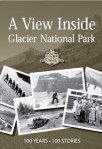
With the 2010 Glacier National Park Centennial, some great new books have appeared, including “100 Years – 100 Stories” from the National Park Service and Carol Guthrie’s beautiful large-format book “Glacier National Park: The First Hundred Years” from Farcountry Press.

If you’ve been lucky, you’ve been able to catch one of Guthrie’s book signings in Montana during the past six months.

I have two old favorites by the late Warren L. Hanna I would like to mention for your consideration for your reference shelf. The first is is “Montana’s Many Splendored Glacier Land” that provides an overview of the park from the early explorers up into modern times.


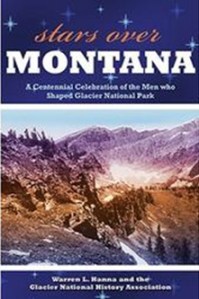
The other, which for reasons I don’t understand, is no longer sold by the Glacier Association. It’s “Stars Over Montana: A Centennial Celebration of the Men Who Shaped the Park.” Originally published in 1988, the book provides mini-biographies of the major players during the days when the shining mountains were discovered, including Hugh Monroe, Father DeSmet, William Jackson, James Willard Schultz, and Walter McClintock.

It’s still available here and there on the Internet in a reprint by TWODOT.

This book has served as an excellent reference for some of my earlier posts about the park and its early advocates. Hanna also wrote “The Grizzlies of Glacier.”

An adventure set in Glacier National Park

A car chase with meaning

On my writer’s website, I refer to my “Garden of Heaven” (coming soon to print) and “The Sun Singer” novels as adventures for the spirit. I often call them mythic, though that sometimes causes people’s eyes to glaze over when they think back to their boring high school mythology class.

Last year a friend and I talked about how odd it was that we both watched the exploits of Jack Bauer on the popular TV series “24.” It was odd because both of us are non-violent and–in real life–would never sanction more than a fraction of the stuff Bauer got away with as a government operative on that show.

So why did we watch a show where people were getting shot, knifed, kicked, blown up, or crushed during one of the many car chases? Because it was fun seeing somebody getting results in a world where there are so many shades of grey, it’s often hard to make any project move forward. Jack brought out the dark and dangerous hero in us–while we were watching the show.

Weeks later, we had little memory of one episode of “24” or another because it was all rather like pure sex, a string of one-night stands, an orgy of sensation that–while hot and thrilling at the moment–didn’t mean anything, didn’t help anyone, and didn’t leave anyone with any food for thought.

An adventure of the spirit is rather like a car chase with meaning. “Star Wars,” “Lord of the Rings,” “The Matrix” “The Golden Compass” and similar feature films have their share of high-pitched action, but they are also mythic. They address universal themes, show characters struggling against great odds (including their personal demons) to improve themselves and the world around them.

In the process, mythic books and films also leave the reader with food for thought, something to ponder and talk about after the thrill of the car chase or the gun fight in the lobby or the battle is over. If an author is lucky, some readers find ways to improve their own lives after seeing how the fictional characters did it.

If you’ve seen one Hollywood car chase down a busy street and through a crowded parking garage, you’ve seen them all. Each new car chase sequence has to show larger explosions, more cars flipping over or careening through plate glass windows, or we’ll all be bored. That’s how it is with one-night stands and drugs: without a higher peak experience, there’s nothing there.

Neither “The Sun Singer” nor “Garden of Heaven” have a car chase in them. But each has elements of grief, mystery and danger. I hope readers will find meaning in the way my characters resolve their challenges. One is caught in a battle, and the other is kidnapped. Both discover their lives are at in danger.

Unlike so many of the lives in a non-stop-action car chase movie, I want you to come away from “The Sun Singer” and “Garden of Heaven” thinking “these lives matter.” I want you to care what happens to Robert Adams and to David Ward. I want you to feel that they’re more than one of the innocent people along the street Jack Bauer runs over them en route to catching a world-class criminal.

That’s an adventure of the spirit, a car chase or a plane crash or a battlefield scene that stays with you–perhaps even bothers you–long after you’ve read the book.

Malcolm R. Campbell is the author of “Garden of Heaven,” “The Sun Singer” and “Jock Stewart and the Missing Sea of Fire.”

Review: ‘The Hellraiser of the Hollywood Hills’

When some low-life malware from the wrong side of the Internet comes after your fancy laptop, you call for McAfee antivirus software. When some Tinsel town ne’re-to-wells hassle your hot teen recording artist, you call for Kerry and Terry, the McAfee twins.

They have red hair, a pink Harley and a street-wise attitude seasoned with more wisecracks and putdowns than the law allows. At 25, they’ve already been around the block a few times (when it comes to crime fighting) because they run Double Indemnity Investigations of West Los Angeles.

When Bethany (aka “the gum-pop phenom”) walks in front of their camera in disguise during a routine stakeout of an apartment in the bad part of town, she jumps to the conclusion the twins are “stinking paparazzi.” Just moments earlier, Kerry had been thinking how well they blended into the neighborhood in their trashed rental car, just a couple of “harmless crackheads or hookers making an honest living.”

A fight ensues—and without giving away why the three women end up at a no-tell motel that smells “like the place where mildew goes to die”—the story is soon racing like a Harley out of hell through a plot jam-packed with twists, turns and hijinks. It’s a plot to die for.

And people are dying, mostly around Bethany, and as a discerning reader, you might ask if “psychopathic killer” ought to be added to the rich and spoiled singer’s long list of issues. Bethany’s on the run and while the twins are chasing her the cops—who don’t see the humor in this caper—are trying to pin the murders on Kerry and/or Terry.

The snap, crackle and pop you hear while reading “The Hellraiser of the Hollywood Hills” is not your breakfast cereal, it’s Jennifer Colt’s smart, high-energy writing. The characters, while a bit over the top at times in a good way, are memorable even though they aren’t the kind of people you’ll have over to dinner, and there’s plenty of snappy dialogue for everyone.

It’s nice to see the McAfee Twins back in their fourth very enjoyable novel that will keep you guessing until the last page.

View all my reviews >>

Malcolm R. Campbell is the author of “Garden of Heaven,” “The Sun Singer,” and “Jock Stewart and the Missing Sea of Fire.”

Glacier Centennial: Mountains and Rock

Glacier National Park’s Chief Mountain “(Nináistuko) was formed 100 million years ago when forces of incomprehensible power and magnitude slammed two slabs of the world together thrusting the older proterozoic rock 50 miles eastward up and over the younger cretaceous rock. Many said the great rocks that formed the backbone of the world were piled one upon the other and sculpted into shining mountains by Nápi, the Old Man who created the world from a ball of mud fetched up from the depths of the dark primordial waters by Muskrat.” – Malcolm R. Campbell in Garden of Heaven.

After Old Man and/or the Lewis Overthrust left older rock sitting on top of newer rock, the resulting mountains along Glacier’s eastern side were rootless. That’s how David Rockwell describes the Montana portion of the Rocky Mountain Front. These mountains, he writes in A Natural History Guide: Glacier National Park, are “not anchored, not sunk into the earth like most mountains. Rather they perch on top of it, unconnected except by juxtaposition to the rock beneath.”

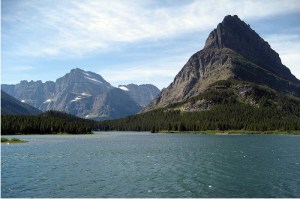
The red Grinnell Formation can be seen in Grinnell Point on Swiftcurrent Lake in this brianandjaclyn photo
The plucking action and abrasion of ancient glaciers created a world of stone throughout the park characterized by cirque lakes , stair-step valleys, moraine lakes, and rock formations known as horns and arêtes. While mountain climbers used to the lofty Colorado summits or the substantial granite of Yosemite may find Glacier’s well-weathered sedimentary rock a bit fractious—especially for technical climbers—the mountains that comprise the Crown of the Continent are nonetheless a rich feast for the tourist’s eye.

As you hike, notice the rock strata and the colors. Starting from the tops of the peaks and working down, you’ll find the following formations: Shephard, Snowslip, the Diorite Sill, Helena (formerly called Siyeh), Empire, Grinnell, Appekuny, Altyn and Prichard. The oldest rocks in the Park are the light-colored limestone and dolomite of the Altyn formation and the dark argillite of the Prichard formation.

When you drive between Babb, Montana and Waterton, Alberta, you’ll notice that Chief Mountain is an exposed remnant, or “outlier,” of the usually buried Altyn limestone. Contrast this rock with the somewhat greenish silture and argillite of the Appekuny formation which you can see, for example, at Dead Horse Point on Sun Road.

The red rocks of the Grinnell Formation are among the most striking in the park. The oxidation of iron-bearing minerals when the rock was formed created the distinctive color. The Grinnell Formation, with its ripple marks, is especially obvious near the St. Mary Falls trailhead on Sun Road and in the mountains around Many Glacier Hotel.

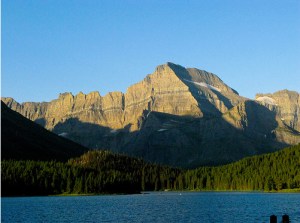
The diorite sill stands out on Mt. Gould in this Dave Sizer photo.
A black diorite sill within the grey Helena Formation is clearly visible on Mt. Cleveland as seen from Waterton Lake, and on Mt. Gould, the Garden Wall and Mt. Wilbur in Swiftcurrent Valley. This is lava that pushed into the limestone, essentially cooking the rock above and below it. The resulting transformation of limestone into marble is an effect called contact metamorphism.

If you would like to learn more about the rock formations within the park, pick up a copy of the self-guided motorist’s tour Geology Along Going-to-the-Sun Road, Glacier National Park, Montana from the Glacier Association. See also, David Rockwell’s Glacier National Park natural history guide. Mountain climbers will find summit routes and other vital details in Gordon Edwards’ A Climber’s Guide to Glacier National Park.

Magic and adventure in Glacier National Park

Book Review: ‘We Hear the Dead’

Rap twice for “yes.” Rap once for “no.”

If spirits weren’t talking through raps, taps and other assorted sounds in the darkened rooms, how were the girls doing it? Some said Maggie and Kate Fox were frauds when they first claimed to hear the dead in Hydesville, New York in 1848.

Perhaps Maggie, the protagonist, had a gift for counseling and perhaps her more adventurous sister Kate truly had the evolving abilities of a medium, even though the whole thing began as a prank. Their mother believed more than they believed. Their older sister Leah saw that if “spirit circles” were properly presented, there was money to be made.

Welcome to the world presented in living color through the well-focused lens of Dianne K. Salerni’s very readable novel “We Hear the Dead.”

While the dashing military hero and Arctic explorer Elisha Kent Kane, who had his eyes on Maggie, did not believe the rapping came from the spirit world, many of the rich and famous did. The Fox sisters, who were born on the wrong side of the tracks, became sought after by high society. One of the strong points of this novel is the dynamic interplay between historical and fictional characters in believable settings as the sisters travel and attract press attention and large audiences.

Before you begin reading “We Hear the Dead,” you will know that the story is true. As you read, you’ll quickly discover that the Salerni’s wonderful historical novel not only brings the Fox sisters to life, but the dead with whom they spoke as well.

“We Hear the Dead” is real because Salerni knows how to weave solid research and meaningful historical details into a novel that begins with two confessions, moves on to the haunting, and remains strong and vital throughout.

Malcolm R. Campbell is the author of “Garden of Heaven,” “The Sun Singer” and “Jock Stewart and the Missing Sea of Fire.”

Moving on after the announcement

Writers, I think, are often at a loss about what they should do next after they announce the release of a new book. Obviously, we do what we can to promote it; that can keep an author very busy. But that’s not the kind of moving on I’m talking about here. Quite simply, whether it’s blogs or friends, we become tongue-tied after the initial “Hey, my book got published today,” and all the WOW and CONGRATS and WHERE CAN I BUY IT and HOW SOON WILL HOLLYWOOD CALL comments have run their course.

Friends are ready to move on, and I don’t blame them. They don’t want the book to come up in every conversation any more than they want to rehash the same movie every time they meet for dinner or a drink. Unless the friend is exceptionally close, the book discussion pretty much runs its course after the first time it comes up. Yet, from the writer’s point of view, the book is a continuing presence, much more like having a baby or getting married than a topic to be squeezed in while waiting for the waitress to refill the coffee cups.

The book has not only been a large part of the author’s life prior to publication, it remains part of his life forever. It’s not just the job of promoting it that consumes time and energy; nor is it handling the reviews, good and bad, or figuring out whether to set up a book signing three states away, or gearing up to write a sequel. The writing of the book has changed the author: and for better or worse, he will always be dealing with who he has become and whether he’s happy with that. Don’t even suggest that he ought to take a bill to get over it.

There are times when I wish the art and craft of writing weren’t viewed by the general public as a weird process done by weird people. “Yeah, I already heard about your new book,” we hear when we bring it up again. I want to reply, “well, I already heard about your sales job, but that hasn’t stopped you from telling me about your boss and your co-workers and your trips and the breakroom chatter for the last 15 years.”

I think about saying that, but I don’t, because writing–in the eyes of others–is just too different to fit well into dangling conversations on the carpool ride home or while waiting for the movie to begin. I know my writing caMalcolm R. Campbell is the author of “Garden if Heaven,” “The Sun Singer,” and “Jock Stewart and the Missing Sea of Firereer will never get equal time with selling cars or driving trucks because non-writers just don’t know how to give it.

But I think it’s only fair to remind people once and a while: like a new wife and a new baby, the book is part of my life now. Get used to it.

Malcolm R. Campbell is the author of “Garden of Heaven,” “The Sun Singer,” and “Jock Stewart and the Missing Sea of Fire.”

Glacier Centennial: Celebrate Tamarack Lodge

Help celebrate 100 Years of Community in the Canyon at Tamarack Lodge in Hungry Horse, June 5, 7:30 pm to 9:00 pm.

The Historic Tamarack Lodge was built in 1907 and served in its original location as the Visitors Center for Glacier National Park. The public is invited to celebrate the lodge’s heritage with an evening of entertainment and discovery as part of Glacier National Park’s 2010 Centennial.

Relax in the original lodgepole pine architecture of the Lodge as local historian Bill Dakin brings to life the small communities that surrounded it in its early days, then sit back and enjoy the soothing sounds of Brad Lee, as the Grammy-nominated musician and local resident sings songs inspired by the beauty of the mountains.

Built in 1907, the lodge was moved to its current location in 1948 and completely renovated in 2003.

Each e-book sold benefits Glacier National Park

Glacier Centennial: James Willard Schultz

“As a resort for the sportsman the Chief Mountain country cannot be excelled. The scenery is grand, game plenty, the fishing unexcelled.” — James Willard Schultz, as quoted in Man in Glacier

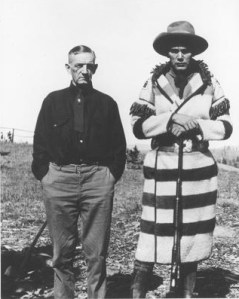
Schultz and his son (right) Hart - MSU Archives
James Willard Schultz (1859 – 1947) was explorer, hunter, mountain guide and author who came to the Backbone of the World before Glacier National Park was established, and then popularized the area through his books about the Blackfeet and the mountains.

Schultz is responsible for calling magazine editor George Bird Grinnell’s attention to the region and to the plight of the Blackfeet. Schultz served as Grinnell’s guide when the “Forest and Stream” editor came west. Grinnell, who would later become known as The Father of Glacier National Park, used his influence to gain the mountains’ national park status.

Schultz lived among the Blackfeet, marrying Matzi-awotan (Fine Shield), whom he referred to as Natahki. She had been badly injured during the notorious Baker massacre in 1870 and would remain partially crippled the rest of her life. Schultz, known as Apikuni (Spotted Robe) by the Blackfeet, and Natahki had one son, Hart Merriam Schultz (Lone Wolf). Hart (1882 – 1970) became a noted artist and illustrated his father’s books.

In addition to Grinnell, Schultz was a contemporary of scout and explorer Joe Kipp and explorer Hugh Monroe. While his books helped popularize the area, he later lamented about the rules and regulations that came with the area’s status as a park. He also wondered where some of the new place names were coming from:

“In 1915, the last time James Willard Schultz traveled into the (Swiftcurrent) valley, the Piegans with him asked about the place names. Who is this McDermott? The lake should be named Jealous Woman after the old story. Are the men behind these names powerful chiefs? Schultz confessed that he had never heard of most of them. The party thought even the wild animals looked changed, domesticated for the visitors in some way. McDermott Lake would later be given the long-time local name of Swiftcurrent.” (Malcolm R. Campbell, “Bears, Where They Fought” in Nature’s Gifts.)

Today in Glacier National Park, you will find Lake Natahki by following Apikuni Creek from the shore of Lake Sherburne. Geographical features in the park named by Schultz include Grinnell Glacier, Going-to-the-Sun Mountain and Singleshot Mountain. Apikuni Mountain (spelled “Appekuny” on older maps and trail guides) carries Schultz’s Blackfeet (Piegan) name.

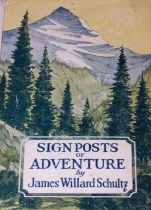
Books by Schultz, some of which are available today in reprint, include his autobiography My Life As an Indian, his account of a Missouri River trip with Natahki, Floating on the Missouri, and Sign Posts of Adventure:Glacier National Park as the Indians Know It.

Like Grinnell, Schultz documented much of the early history of the shining mountains that would one day become Glacier National Park. Like others who wrote about the region over a period of time, Schultz occasionally appeared to have memory lapses about people and events wherein one published account didn’t quite match another. As the late historian Jack Holterman wrote in Who Was Who in Glacier Land, “Many persons have been lured to Glacier by the fictions of James Willard Schultz, wondering where to draw the line between fiction and fact.”

A novel set in the park's Swiftcurrent Valley

Fine storytelling: ‘Above the Fray, Part II’

Above the Fray Part Two Above the Fray Part Two by Kris Jackson

My rating: 5 of 5 stars
Part I of “Above the Fray” (CraigsPress, May 2009) follows the exploits of protagonist Nathaniel Curry, a fifteen-year-old telegraph operator from Richmond, with the Union Army Balloon Corps from the Peninsula Campaign during the spring and summer of 1862 through the Battle of Antietam that September.

Part II begins as General Ambrose Burnside, who was placed in command of the Army of the Potomac in November 1862, is pushing into Virginia with the objective of capturing the Confederate capital at Richmond. En route, the Union Army will suffer a costly defeat at Fredericksburg in December with a battle plan that Nathaniel sees as “simple to the point of folly.”

Richmond will not fall until the spring of 1865, two years after Chief Aeronaut Thaddeus Lowe has resigned from the balloon corps due to pay and logistics disputes. The Union Army Balloon Corps, a civilian contract organization, disbands in August 1863.

Curry, however, is not out of the war. There’s no precise way to say just how he stays in the war without giving away the inventive plot. Both the Union and the Confederacy want him to spy for them, for he is either an exceptionally streetwise chameleon or a man protected by the gods. He is equally at home with generals and prostitutes, with Southern slaves and northern infantrymen, and with soaring above the fray of a battlefield and with slogging it out under fire on both sides of the lines.

Taken together, parts I and II of “Above the Fray” give the reader a balloonist’s view of the Civil War from Atlanta to Richmond to Washington, D.C. Jackson’s research is broad and impeccable, his ear for dialogue is well-tuned, and his rendering of the war from multiple theaters and perspectives is stunning.

One evening Curry and his friend Vogler are sitting in camp with several of the many historical characters, Thaddeus Lowe, James Allen and Ezra Allen reading mail.

“‘Solly,’ Nathaniel Curry said, ‘you get more mail than the rest of us together.’

“‘Vogler looked over his glasses at him and smiled.

“‘What are you reading now? What language is that?’

“‘It’s German. This is the journal of the Royal Society of Prussia.’

“‘Wouldn’t they speak Prussian?’

“‘No. You’re thinking of Russia where they speak Russian.’
“‘Oh. The letters aren’t the same as ours.’”

Vogler then tells his fellow aeronauts he’s reading an account of several record-setting balloon ascents by aerialists Henry Coxwell and James Glaisher in England who reached a height of over 37,000 feet. The second flight occurred about the same time the balloon corps was at Antietam. The aeronauts are excited about the record, and they discuss the impact of the cold temperatures and thinner atmosphere on both the aerialists and their balloon.

Such accounts expand the reach of the novel to events far from the field of battle, greatly adding to the perspective of both the characters and the reader. Similarly, events Nathaniel observes at the Second Battle of Bull Run in “Above the Fray, Part I,” bring him to the attention of those conducting the controversial court-martial of Union General Fitz-John Porter in Part II where the issues of politics, command competency and scapegoats intertwine.

Is it likely that a young telegraph operator from Richmond would be on speaking terms with President Abraham Lincoln, Confederate President Jefferson Davis, General Robert E. Lee, and multiple officers in both the northern and southern chains of command? Perhaps not.

But Kris Jackson makes it credible and entertaining. “Above the Fray, Part II” is fine storytelling by an author who knows the territory. When Nathaniel Curry approaches Appomattox Court House in the spring of 1865, he has come a very long way from that long ago day when he inadvertently rode a balloon into the sky with Professor Thaddeus Lowe, that day when Lowe said, “The sun’ll not rise today, Nathaniel. You and I shall have to rise to meet it.”

View all my reviews >>

Note: The trade paperback cover of Part II looks slightly different than the one displayed here by GoodReads.

Copyright (c) 2010 by Malcolm R. Campbell, author of “The Sun Singer” and “Jock Stewart and the Missing Sea of Fire.”

Glacier Centennial: Team Receives Hartzog Award

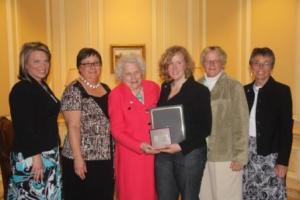
Glacier National Park’s Centennial Program Committee received the 2009 George and Helen Hartzog Volunteer Group Award for its efforts in promoting the park’s 2010 centennial.

Recipients of the 2009 Hartzog Awards for outstanding volunteer service were honored by the National Park Service and the National Park Foundation at a May 13 ceremony in Washington, DC.

Accepting the Hartzog Volunteer Award for the Glacier National Park Centennial Program - Alicia Thompson, Stephanie Dubois , Helen Hartzog, Kass Hardy, Nancy Hartzog, and Jan Metzmaker. NPS PHOTO
Coordinating Glacier National Park’s 100th anniversary activities through a community-driven Centennial Program, volunteers invested more than 1,000 hours of service and embraced the mission of celebrating the park’s rich history and inspiring personal connections.

Representing the Glacier Centennial Program were Glacier National Park Deputy Superintendent Stephanie Dubois, Glacier Centennial Coordinator Kassandra Hardy, volunteer Jan Metzmaker, and volunteer Alicia Thompson.

The group facilitated 108 centennial activities with 58 various organizations. They also helped 61 local businesses reduce their carbon footprint, developed 184 centennial products with 47 vendors, sponsored an art contest with 113 artists, and produced a book of selected stories with contributions from 240 authors.

National Park Service Deputy Director Mickey Fearn congratulated the recipients and recognized the contributions made by all park volunteers. “Volunteers increase the energy of the National Park Service and allow us to continue to do what needs to be done, including all things that could not be done without them.”
Centennial Book

Honoring Outstanding Service

The George and Helen Hartzog Awards for Outstanding Volunteer Service were started eight years ago to recognize the time, talent, innovation, and hard work contributed to national parks through the Volunteers-In-Parks (VIP) Program. Last year, 196,000 volunteers spent 5.9 million hours assisting the National Park Service.

George B. Hartzog, Jr., (1930-2008) served as the director of the National Park Service from 1964 to 1972 and created the VIP Program in 1970. In retirement, he and his wife established a fund to support the program and honor the efforts of volunteers. His widow, Helen, and children attended the awards ceremony and congratulated each recipient.