Hearing voices and writing stuff down

Stewart
While waiting for my first appointment with psychiatrist Dr Henry Jekyll, I couldn’t help but notice one wall in the waiting room was plastered with inspirational signs.

PAYMENT IS EXPECTED WHEN SERVICE IS RENDERED

IF I CAN’T CURE YOU, YOU BELONG IN AN ASYLUM

PRIMAL SCREAMS, $150 EACH, TWO FOR $275

IT’S LATER THAN YOU THINK, DO YOU KNOW WHERE YOUR DREAMS ARE?

I was about to tell the receptionist, a nurse Ratched look-alike that I had to go see a shaman about an evil spirit, when the cuckoo clock above the door to the inner sanctum squawked high noon and a pale little man came out and said “Mr. Campbell, please follow me.”

He sat in the comfy chair next to a bottle of Jim Beam and I sat in the straight-back chair next to a dirty glass of tap water. Before he said anything, I counted 13 mangled sock puppets on the shelf next to his collection of Freud bobble-head dolls.

“First things first,” he said. “Did you bring the money.”

I slid a briefcase of sorted, well-laundered $100 bills across the glossy hardwood floor. He counted the money, moving his lips as he did so.

“Second things second,” he said. “Are you here for our primal scream therapy or do you want to pursue a 15-year Freudian analysis.”

“I scream at home for free,” I said.

He nodded sagely, with a hint of oregano on his breath. “You shouldn’t self-medicate,” he said. “Be that as it may, I understand from Nurse Wretched’s pre-therapy interview with you that you hear voices. Are they mean and nasty or are they sweat and vapid?”

“The last voice I heard was yours,” I said, “and so far it sounds rather expedient. But far be it from me to judge, I hear what I hear and write the stuff down.”

“How do you feel about that?” Jekyll asks.

“Humorous,” I said, “because I know that at night you turn into Mr. Hyde and careen about the neighborhood doing vile acts that drive people so crazy they have to come here and gnaw on sock puppets.”

He maintained a dour expression and wrote something down on a yellow pad. “Not counting my voice or my nurse’s voice or any other real voices like Bob who runs the parking deck, what other voices have you heard?”

“Jock Stewart’s voice.”

“Who is he?”

“The protagonist in my satirical novel.”

“So, you’re a writer?”

“Yes.”

“That tells me a lot. It tells me you probably belong in an asylum. It tells me you’re probably incurable. It tells me you’re going to be here for years and that I’m going to make a boat load of money writing up your case for HarperCollins weird psychology series.”

“You are wise beyond your years,” I said. “Jock tells me that he likes you.”

Jekyll looked around the room with alarm as though he expected to see ghosts. “Is he here now?”

“Sure.”

Jekyll’s face went white. Of course, it already was white, but suddenly it had a bleached out look.

“What does he want.”

“He wants you to continue acting in a way that invites satire,” I said. “He’s a master at it. He talks, I write it down, and then I send it to the publisher.”

“Holy superego, Stewart doesn’t use real names, does he?”

“But of course.”

“Then he’s crazier than you are, and you are definitely certifiable.”

“Thank you.”

“If I were to slide this suitcase of money back over to you, would Mr. Stewart see his way clear not to use my real name?” asked the quivering shrink.

“Perhaps.”

“Oh thank you. Here’s an extra $150. I really do need to scream now.”

And he did, like a banshee in heat, like a blind man falling into a volcano, like a woman looking out an open window in an old movie seeing a killer trying to get inside while she sits at her dressing table.

I felt cured, I really did. And so did Jock.

Malcolm R. Campbell is the author of the comedy satire, “Jock Stewart and the Missing Sea of Fire,” a novel you can find in multiple e-book formats for only $5.99 at Smashwords and Kindle.

“Armed with a sharp wit and a (secretly) soft heart, Jock sets out to investigate the theft of the mayor’s missing horse, Sea of Fire. For readers, arriving at the solution to the crime is secondary to simply enjoying as the colorful (and aptly named) characters become embroiled in a multitude of small-town hi-jinks.” — Nancy Whitney-Reiter, “Unplugged: How to Disconnect from the Rat Race, Have an Existential Crisis, and Find Meaning and Fulfillment “

How does your kid get to school?

“As cash-strapped school districts cut back on bus service, more students will walk, bicycle, or carpool to class this year.” — Sierra Club Back to School Page

I hope a lot of people on Facebook find the Green Works Walk to School Challenge. If enough people take the challenge, the winning school gets a Green Grant.

It’s about time we got rid of that afternoon line of cars in front of the school as parents pick up kids who, seriously folks, really do live close enough to walk or ride their bikes.

My walk or bike ride to and from school
My parents, like your parents, probably told you that when they went to school, they had to walk, either clawing their way through mile-high snow drifts or sprinting through varmint-infested scab land. That said, I still wonder why so many kids are being driven to school or are taking school buses when, just a few years ago almost everyone was expected to walk.

I didn’t have to fight my way through rogue coyotes or lurking rattlesnakes, but–like a good horse–my bicycle knew the way from my house to the school house some 2.18 miles away. When it was raining, my mother drove me to school or I got wet.

We were lucky in those days. We didn’t have MP3 players or cell phones, so our walks to and from school got us away from the far-away parts of the world and gave us time to concentrate on the people, houses, dogs, cats and birds along the way. There was plenty of time to think, too, without being wired in to a massive Internet and phone system of unceasing input.

But, I digress. Walking or biking to school was good for us. It can be good for your kid, too. The green aspects of the equation are icing on the cake.


Malcolm R. Campbell’s work has appeared in “A View Inside Glacier National Park” and the 2010 “Nature’s Gifts Anthology.”

NPCA offers Park Field Guide Application

from the National Parks Conservation Association:

Washington, D.C.— A new mobile app field guide featuring national parks across the country was released October 8th by the National Parks Conservation Association (NPCA) and is available free to iPhone, iPad, and iPod Touch users.

The most versatile and interactive mobile field guide app available, NPCA’s new National Park Field Guide provides a complete view of park wildlife, as well as a comprehensive ecosystem review of 50 national parks. Unlike any other mobile app on the market today, the guide includes bird portraits, call recordings, information about endangered and poisonous species, range maps, and wildlife. Users will also find current news about featured parks, access and reservation information, and directions to park visitor centers.

“We are pleased to offer this innovative and informative mobile field guide free of charge to national park visitors,” stated Megan Cantrell, NPCA Senior Coordinator of Member Engagement. “The new guide will enhance the experience of park visitors by providing a fun, educational companion for families and nature-lovers to learn about the many natural treasures that parks have to offer.”

From seashores and recreational areas to scenic riverways and historic sites, the field guide mobile app features 50 national parks across the country that support critical wildlife habitats. Among the many national parks featured include: Yellowstone, the Grand Canyon, Yosemite, Cape Cod National Seashore, and Gettysburg National Military Park. To view a complete list, click here.

“With more than 300 million national parks visitors annually, our new field guide will help engage and educate a new generation of advocates for our national parks,” said Cantrell. “The more people who understand that our national parks are America’s legacy to our children and in urgent need of care and repair, the better chance we have at protecting them for the future.”

The field guide was developed for the National Parks Conservation Association by eNature.com. At the heart of this mobile app is eNature’s comprehensive, geographically segmentable database of U.S. wildlife, both animals and plants.

eNature.com’s core content of wildlife information includes almost 6,000 individual species and is the same data set used to create the printed Audubon Field Guides. Data has been carefully reviewed and vetted by leading biologists, zoologists and other natural history specialists. eNature.com has consistently been one of the Internet’s most-visited sites for nature and wildlife information and has won numerous awards and accolades.

“With eNature’s unsurpassed wildlife content base, we are able to create a mobile app guide uniquely capable of targeting specific parks so users can quickly identify and enjoy the wildlife they come across,” stated Tom McGuire, eNature’s President.

The National Park Field Guide is available here or visit the Apple App Store from your iPhone and search Park Guides.

Hero's Journey Story Set in Glacier Park

Book Review: ‘The Last Templar’

The Last TemplarThe Last Templar by Raymond Khoury
My rating: 3 of 5 stars

Raymond Khoury’s “The Last Templar” (2006) is part of a deluge of novels and nonfiction to step outside mainstream history to explore the real, prospective and imagined secrets about alchemy, the Knights Templar, and the origins of Christianity.

One cannot help but think of Katherine Neville’s “The Eight” (1997) which focused on present-day people fighting over and/or guarding the secrets of the Philosopher’s Stone and Dan Brown’s “The Da Vinci Code” (2003) which speculated about the true meaning of the Holy Grail and the bloodline of Christ. Many of Neville’s, Brown’s and Khoury’s fans were also attracted to such nonfiction as “Holy Blood, Holy Grail” (Baigent, Leigh and Lincoln, 1982) and Lynn Picknett’s “The Templar Revelation” (1997).

It is difficult to read, much less discuss, Neville, Brown and Khoury without acknowledging the fact that fact that they are part of a rather unique genre of spiritual conspiracy fiction that seemed to fill a need in the public psyche for truths thought to be missing from the tenets of Catholic and Protestant theology.

Neville’s “The Eight” was, perhaps, the first to popularize this “genre’s” style and focus: hidden wisdom, long-time conspiracies, compelling present-day mystery/thriller action, and numerous (and lengthy) history lessons. Since her focus was alchemy, Neville’s “The Eight” didn’t ignite the kind of controversy generated by Brown’s “The Da Vinci Code” which, some might say, hit us where we lived if not where we worshipped.

Like Neville, Khoury tells his story with a modern-day and a historical timeline. “The Last Templar” begins with what Booklist called “one of the most gripping opening scenes among recent thrillers.” Four horsemen dressed in Knights Templar regalia steal artifacts from a Metropolitan Museum of Art show of Vatican treasures, including a “decoder.” The other story line focuses on the last days of the Knights Templar as the Holy Land is “lost” with the fall of Acre in 1291 and the subsequent pilgrimage of a few surviving knights to safeguard the Templars’ treasure.

Publisher’s Weekly was less kind than Booklist, saying that the “war between the Catholic Church and the Gnostic insurgency drags on in this ponderous ‘Da Vinci Code’ knockoff.” Many readers criticized Dan Brown in “The Da Vinci Code” for constantly stopping the otherwise full-speed action of the book while one character filled in another character about the secrets of Mary Magdalene, the Grail, the actions of the Catholic Church, and Jesus’ bloodline.

In my view, “The Last Templar” carries such backstory diversions to an extreme. Picture, if you will, whether it’s plausible that FBI operatives investigating the raid on the museum, the stolen treasurers, and the continuing deaths would spend hours discussing Templar history in great detail.

The greatest fault with “The Eight,” “The Da Vinci Code,” and “The Last Templar,” is the fact that some characters must provide other characters with long-winded and unrealistic diversions into history, philosophy and theology because general readers are not likely to know the facts and the latest theories involved. The authors have felt that without these history lessons, the plots wouldn’t make sense.

I liked “The Last Templar” better than Publisher’s Weekly, but not as much as Booklist. The history was interesting, though I’d seen it all before. The plot was imaginative and included some page-turner action scenes involving the church, the thieves, the FBI and protagonist Tess Chaykin, an archeologist who witnesses the raid. The ending, while not wholly unreasonable was, I think, unsatisfactory, especially for those readers who not only want to know what the Templars’ secret but are angry that a real or a fictionalized church would deem it necessary to suppress the truth at all costs.

The romantic feelings between Tess and the head FBI agent add a variety of complications to the story, some of which lead into exciting action scenes even though the relationship within the book is rather forced and tedious.

For readers who have enjoyed the fiction and nonfiction in this wave of spiritual conspiracy books, “The Last Templar” is interesting escapist reading even though those who have seen it all before may speed-read through some of the Templar history.

View all my reviews

Can’t get enough Cracker Jack

Take me out to the ball game,
Take me out with the crowd;
Buy me some peanuts and Cracker Jack,
I don’t care if I never get back.
Let me root, root, root for the home team,
If they don’t win, it’s a shame.
For it’s one, two, three strikes, you’re out,
At the old ball game.

–Take Me Out to The Ball Game

“Take Me Out to the Ball Game” was written in 1908 by a Vaudeville star who had never seen a baseball game. Jack Northworth, who wrote some 2,500 songs (including “Shine on Harvest Moon”) didn’t see his first ball game for another 32 years. Albert von Tizer–who wrote the music–didn’t see his first baseball game for another 20 years. Today, baseball fans know the song well.

I wonder if either Nortworth or von Tizer had ever eaten Cracker Jack, the caramel coated mix of peanuts and popcorn introduced by F. W. and Louis Rueckheim at the World Columbian Exposition in Chicago in 1893. The secret to Cracker Jack–which is still a secret today–is what keeps the peanuts and popcorn in a box or sack of Cracker Jack from all sticking together.

Cracker Jack was a success, but the song made it famous. While the song was first sung at a baseball game in 1934, Harry Caray made it a solid tradition when he started singing it in 1971 from his Chicago White Sox broadcast booth. Across the country, fans sing “Buy me some peanuts and Cracker Jack” during the seventh inning stretch at the ballpark no matter who is winning or losing.

Legend has it that a salesman for F. W. and Louis Rueckheim tasted a batch of the caramel coated popcorn and peanuts and exclaimed, “That’s Cracker Jack.” Suddenly a product name and a now-famous trademark were born, one that–under Borden and then Frito-Lay is lasting far longer that the term “cracker jack” is lasting in general English usage. In the late 1800s, the term was popular slang for what, today, we would call awesome!

“Cracker jack” meant high quality whether it referred to a person and event or a product. We still use the word “crack” in that way today, as in “she’s a crack shot” or “my crack staff will finish the project before lunch.” “Jack” was slang for a boy or man or a manual laborer, as in lumberjack or steeplejack, and often referred to a sailor. (The Sailor Jack and his dog Bingo trademark image still adorns Cracker Jack packages today.)

I like Cracker Jack, and the chance purchase of a couple of sacks at the grocery store this morning when I was purportedly there to purchase fresh produce, got me to thinking about the ever-changing use of slang. I haven’t heard a phrase like “He is one cracker jack salesman” for a long time. In context, I suppose most people would figure out what it meant. I know what it means, but I never use the term–except when buying a sack of Cracker Jack, because it’s not in fashion any more.

As a writer, I like tracking down how word usage has changed as well as the original meanings of slang expressions that continue to be used long after their literal meanings are forgotten. Some day–and perhaps that day is already here–most people will think the word “Cracker Jack” has always applied to the candied popcorn and nuts, and nothing else.

But for the moment, we know better, don’t we?

Construction of New Dorm at Lake McDonald Begins

from NPS Glacier National Park

Lake McDonald Lodge - Lee Coursey photo
WEST GLACIER, MONT. – Construction has begun on a new dormitory near Lake McDonald Lodge in Glacier National Park. The dorm will include a new employee dining facility in the basement and dormitory rooms on the top two levels. Construction of this building near the new Lewis Dormitory is anticipated to be completed by May 2011. Construction started Tuesday, September 28 with excavation of the basement. As part of this project two abandoned dormitories (Hydro and Johnson) will be demolished and removed this fall.

This project is funded by Glacier Park, Inc.(GPI) and Swank Enterprises has been selected as the general contractor. The new employee dining facility will allow the transfer of that function away from its current location at the Lake McDonald Lodge making way for improvements to the working conditions in the main lodge kitchen and further separating guest and employee functions. Employees currently housed in Cobb House and Snyder dormitories will be relocated to this new facility allowing those historic buildings to be renovated as additional visitor lodging including some lower cost economy accommodations.

Park Superintendent Chas Cartwright says “Building this new dormitory will further implement the vision conceptualized and approved in the park’s 2004 Commercial Services Plan/Final Environmental Impact Statement (CSP/FEIS). This vision includes consolidating employee housing and moving employee housing away from the flood plain, upgrading housing conditions and improving separation of employee and guest functions. Visitor and employee parking will be addressed separately.”

The CSP/FEIS also planned for improving the range of visitor accommodations, improving the sense of arrival to the historic lodge and improving the visitor experience by providing a central, consolidated parking area away from the entry boulevard in the Lake McDonald developed area.

The new dorm is part of a larger concessioner-funded project begun in 2009 which relocated three dormitories from their former location near Snyder Creek to a site adjacent to the new Lewis Dormitory near the Lake McDonald Post Office and Going-to-the-Sun Road. The three buildings were improved to include new bathroom facilities and installation of fire suppression and alarm systems. A new water line and improved detention ponds for storm water were built to support the relocated buildings.

The Lake McDonald Historic District was listed in the National Register of Historic Places in 1978 and Lake McDonald Lodge was designated a National Historic Landmark in 1987.

Hero's journey novel set in Glacier

Siobhan – a ‘Garden of Heaven’ excerpt

E-Book only $5.99
“Garden of Heaven: an Odyssey” is the story of a man’s spiritual journey through the mountains of Pakistan, the swamps of North Florida, the beaches of Hawaii, the waters of the South China Sea and the ivy-covered halls of an Illinois college as he attempts to sort out the shattered puzzle of his life.

In this excerpt, David Ward’s significant other, a woman well-practiced in the old Huna magic of Hawai’i, is ready to discuss the clues, if any, she found in his journals about who has been trying to kill him.

David sits on a fence post, a comfortable, familiar spot, and looks across the creek to the house. The creek is the same; the house has shrunk with time. Too perfectly symmetrical when it was new, the structure’s roofline, doors and walls have aged randomly and grown more natural into the place.

Complacent while Siobhan keeps the Komondor puppy inside, the remaining Dominique chickens peck at the hard path between the kitchen door and the clothes line. The path turns west into a gravel road that leads to an old house lying down in weeds and ruin where his grandparents lived until one became too frail and the other became too psychotic to be left alone, where they said that his mother was born on a cold January night in 1914, where lies and truths were sown and bore hybrid fruit.

Along the road between the houses, grey sheds linked by fences lean into the earth. Dry and empty, like old nooks and crannies and secret places, they were always the first full focus of spring–humid and rich as sea fog, dripping with the juices of birth and new life. Jayee’s timing was as precise as nature allowed. Today he would be moving the last of the lambs from the jugs to the bunch pen if he was on schedule, or the first of them if nature wasn’t.

From this vantage point, David sees the pros and cons of dreams; he views his visions from the other side, and—remembering everything that has happened between then and now and then and now and then and now—must decide how much of history is too broke to fix. Siobhan refuses to tell him who tried to kill him and why because he’s not ready to hear it, much less re-live it; Sikimí will take them back to the scene of the crime soon enough.

She steps out the back door carrying old notebooks, an envelope labeled remnants, and grandmother’s blue-on-white eight-pointed star quilt. The door slams, stirring memories. She smiles and her pony tail dances when she nods at the circle of box elders where she heads at a brisk walk.

In her khaki cargo shorts and light blue sleeveless crew shirt, she radiates a well-toned athletic health that sings of perfectly managed energy conceived in Aries fire and transformed into infinite zest down through her well-developed shoulders and sun-browned legs. Siobhan is Wind’s daughter. Grandmother would love her for that alone. It’s a matter of breath control, he thinks. When Siobhan is open to the world, she inhales those she meets into her presence, pulling them in with her smoky eyes and the fluid caresses of her hands. At such times, she drags out the first syllable of her name in a shhhhhhhhhh of light breezes. David heard that endearing shhhhhhhhhh when she ran into him like a pro-football lineman on the day they met. When Siobhan is closed to the world, she exhales those she meets outward beyond the reach of her hands. At such times, when there is no still escape from her eyes, she clips off the first syllable of her name into a harsh shh that shushes even the most determined people into quiet.

She flips the quilt out into an even rectangle and sits in the centre of it surrounded by Blue Horses and Silver Bears, knowing Katoya stood on that very spot in the tall bluebunch wheatgrass 33 years ago and told him the secret of the universe before they watched the stars rise into the sky. When he stops at the northern boundary of the eight-pointed starry night lying across the grass, Siobhan looks up from an open composition book as though she’s surprised, but pleased, to see him there.

–I’ve finished reading almost all your journals.

As he takes off his boots, he’s enveloped by the scent of her lavender bath soap. He shrugs. What is there to say? He feels naked in spite of her smile which is so unwaveringly natural it seems to be borne up out of the grass.

–You know almost everything, then, and you’re free to run for the hills, he says.

Siobhan frowns and looks at him with her eyebrows raised about as high as she can get them. She waves an older Blue Horse in his face.

–Talk like that chased Anne Hill away, didn’t it?

–It seemed a logical thing to say at the time.

–How logical does it seem now? she asks.

He sits next to her and studies her face while she watches the noisy water of the creek bunching up at the base of the limestone bedrock.

–Hell, I was looking for reassurance.

She turned toward him now and her breath was warm and sweet on his face.

–No need and you know it, she says and kisses him. When he starts to speak, to say some inane self-deprecating thing, she kisses him again. Shhhhhhhhhh, she whispers, Anne is Anne, Siobhan is Siobhan, and you and I are the yin and the yang fitting precisely together.

She hugs him, wrapping him snugly in lavender.

–I see what you mean, he tells her. This hug could easily lead to more, much more, but I think you have things to say.

–I do.

My publisher, Vanilla Heart Publishing, interviewed me and posted the result in AUTHOR SPOTLIGHT – Malcolm R. Campbell.

Review: ‘Alchemy: An Introduction to the Symbolism and the Psychology’

Alchemy : An Introduction to the Symbolism and the Psychology (Studies in Jungian Psychology)Alchemy : An Introduction to the Symbolism and the Psychology by Marie-Louise von Franz
My rating: 4 of 5 stars

The late Marie-Louise von Franz (1915 -1998) was a Jungian analyst and colleague/student of Carl Jung. She is widely known for her penetrating treatises about seeker’s journey motifs, alchemical texts and fairy tales as well as an accessible biography of Jung.

Here again, her insights are profound and broad in scope. The book, published in 1980, is composed of lectures she presented in Zurich in 1959. The lectures contain excerpts from European, Arabic and Greek alchemical texts along with her explanation of the symbolism they contain. Her focus here is the relationship between alchemical process and Jungian analysis as discovered through an examination of the chosen texts.

The difficulty in the book comes not so much from the fact that the lecturers were intended for serious students of Jungian psychology rather than those outside the field, but from the format itself. First, it scatters terms and symbols throughout the book depending on where they appeared in one of the excerpted fragments. This is counter-intuitive to readers expecting an organized, one-to-one comparison of alchemical steps with the individuation process in or out of a therapy setting. This would make the book a true introduction as its subtitle implies.

Second, in as much as the lectures focus on what was to be found in the texts rather than on an orderly presentation of alchemy and individuation, the book suffers by dedicating more space to the excerpts than an introduction requires. That is, the text fragments are less interesting, informative and succinctly on point than von Franz’s material. One wishes for more of von Franz and less of the ancients here.

That said, readers who are familiar with Jungian psychology, inner alchemy and related philosophies will experience many “Eureka Moments” as the meaning behind long-puzzling symbols, archetypes, drawings, and processes suddenly clicks into place. Outside of the decision to use a series of already-completed lectures rather writing an introductory work from scratch, the information and insight found here are exceptional.

View all my reviews

A seeker's journey story.

What does a novelist actually do?

Like magicians, novelists are never supposed to reveal their true secrets. Instead, they dispense lame generalities like “show, don’t tell” and “don’t write in passive voice.” The good stuff is better than that!

Today’s Example

Did you read this news story?

MARSEILLE, France (Reuters) – European group Eurocopter showed off a revolutionary winged helicopter on Monday, in a bid to counter U.S. rival Sikorsky’s efforts to break the speed barrier by rewriting rotorcraft design rules.

A journalist wrote this lead paragraph, possibly after looking at a Eurocopter press release, talking to company spokespersons, calling rival manufacturers and expert sources for other opinions, and then distilling all that information through the reporter’s WHO WHAT WHEN WHY WHERE lens.

A novelist asks WHAT IF?

What if the design for X3 hybrid helicraft came from the devil. Hmm, let’s go with that. Why? Maybe he wants to fly people to hell faster than ever before. Maybe he wants to fly good people to bad places where they will do bad things and end up going to hell. Maybe he’s trying to straighten up and fly right.

OR

What if Sikorsky formed a secret subsidiary called Eurocopter and “accidentally” leaked some pictures and information about the X3? Okay, where might that lead? As the manufacturers of mass market name-brand products learned long ago, you can make more money by competing with yourself through the launching of additional products. Maybe the design for the X3 was transmitted telepathically to Eurocopter designers from an advanced civilization in a galaxy far far away because, frankly, after they infiltrated Sikorsky years ago, they were getting bored again.

OR

What if the whole thing is an illusion? Let’s say a bunch of guys started slamming down shooters one night and then simultaneously dreamt about the craziest looking helicopter the world has ever seen. When they woke up, they had hangovers, of course. Meanwhile, a trickster god convinced them they never had any shooters, never got drunk and invented the X3. Once the press got a hold of the story, the thing was out of control.

That is what a novelist actually does. S/he brainstorms the improbable and/or the unlikely and then convinces readers it happened or might have happened or could happen.

You might also like: “Lust in All the Best Places” by Jock Stewart from the Morning Satirical News.

One of the perks of being a writer

Most of us enjoy the world of our imagination even though many of our fantasies will forever be stamped CLASSIFIED.

As a writer, though, my job is spending large amounts of time with my imagination without having to admit to garden-variety daydreaming.

For example, I gave David Ward, my protagonist in Garden of Heaven some of my best and worst qualities. While people who really know me may debate which are which, those qualities include dreams I never fulfilled.

When I was younger, I wanted to work for the railroad, specifically the Great Northern, now a part of the Burlington Northern Sante Fe. The railroad was never hiring when I was looking. David Ward also wanted to work for the Great Northern. While it was not to be, he did get a chance to run a passenger locomotive for a few miles on the high line tracks east of Glacier National Park.

(Oddly enough, my wife and I were volunteers at a railway museum in the 1990s, and she turned out to be much better at running locomotives than I was, from a 44-ton yard goat to a mainline freight engine. Sigh.)

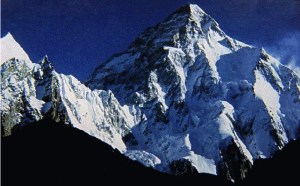
People who see my bad knees and ankles now can’t imagine that I used to climb mountains in Colorado and Montana, and (worse yet) that I actively wanted to climb Everest or K2. Unfortunately, such things were outside my budget.

But David Ward wasn’t cramped by his budget. So, I sent him off to climb K2, and (worse yet) to summit via the dangerous “magic line” route before it was called the “magic line.”

Pretending to run a diesel locomotive on the head end of a passenger train and to climb the most difficult mountain of the world are parts of my fantasy world. One of the perks of being a writer is using one’s active imagination and following through with such dreams in, perhaps, another reality or universe.