Author Melinda Clayton returns to Appalachia for her new novel

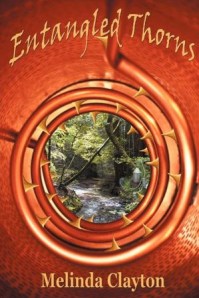
I’m pleased to welcome author Melinda Clayton (Appalachian Justice and Return to Crutcher Mountain) to the Round Table today to talk about her new novel Entangled Thorns. Once again, Clayton heads back to Appalachia for a compelling story about hard times and hard memories. Entangled Thorns, which tells the story of Beth Sloan and the “infamous Pritchett family of Cedar Hollow, West Virginia,” was released by Vanilla Heart Publishing June 27, 2012.

Malcolm: Like Appalachian Justice and Return to Crutcher Mountain, your new novel Entangled Thorns has an Appalachian setting. What draws a Florida author away from the orange groves and sunny beaches into the hills of West Virginia for her storytelling?

Melinda:  My mother’s family is from West Virginia, around the Charleston area.  My grandfather was retired from the mines.  Both of my maternal grandparents passed away when I was a teen, but up until that time we visited every summer.  I loved everything about it:  the people, the mountains, the wildlife.  My mother was born in a tiny place called Big Ugly Holler, which served as the inspiration for Cedar Hollow.  It doesn’t exist now, but we once hiked into the mountains to see what was left of it.  There was no road; by that time, there wasn’t even a trail.  When we finally reached our destination all that remained of Big Ugly Holler were a few foundations and chimneys covered in vines.

Malcolm: In Entangled Thorns, your protagonist Beth Sloan has been running from and/or repressing her troubled childhood until circumstances force her to confront it. Your protagonists in Appalachian Justice and Return to Crutcher Mountain were also wounded as children. Does this overarching theme of your work come out of your experience as a psychotherapist or the kinds of stories you’re drawn to on the nightly news?
Melinda:  I love this question, and the answer is, “both.”  I read a book when I was very young – I’d give anything to remember the title of it – but it was about a social worker who worked with troubled kids.  Ever since then I knew I wanted to work with troubled children and families in some capacity.  I’ve also always been drawn to true crime stories, as morbid as that might seem.  There is something about the workings of the human mind that absolutely fascinates me, particularly when it goes off-kilter in some way.

Malcolm: You recently completed a Ed.D. in Special Education Administration program which required a dissertation. How did you manage to jump back and forth between academic writing with its reliance on sources and a formal style to fiction with its emphasis on people, adventure and an accessible style?

Melinda:  That was a little challenging at times.  The act of writing fiction was a great stress reliever, but I had to work to keep the informal language (contractions, slang, etc.) from entering my academic writing.  It was tempting at times to put in something like, “This research will show that there ain’t no correlation…” for the pure fun of seeing my committees’ reaction.

Malcolm: How does the doctoral work fit into your professional goals?

Melinda:  My ultimate goal is to teach at a college level.  My doctorate sort of combined two fields of study, since my M.S. is in Community Agency Counseling, and my doctorate is in Special Education Administration.  I’d love to contribute to the field by demonstrating how the two fields often go hand-in-hand and should support each other and work together, instead of arguing over funding streams and services as so often happens.

Malcolm: For the general public, Appalachia conjures up such themes as isolated, subsistence living, hard-working and persevering people, coal mining and other environmental excesses, and pure, raw music unlike that from any other part of the country. How do your characters and plots mesh with or run counterpoint to these stereotypes? Does the lure of Appalachia for your storytelling ever translate into other areas, say, in tempting you to move there as a teacher or psychotherapist?

Melinda:  It’s a delicate line to walk.  I know from my own family that the manner in which Appalachia is often portrayed can be a sore point.  At the same time, I want the story to reflect what is, in some areas, true to life.  I relied heavily on not only my research, but also my own memories as well as my mother’s experiences.

I also know from my experiences that the poverty associated with Appalachia exists elsewhere.  There’s no need to travel to Appalachia to encounter it.  In the late 1980s, when I was fresh out of college with a B.A. in social work, my first job was as the coordinator of case management services for a rural mental health center in Tennessee.  My case workers and I were responsible for a three county area, working with the most impoverished of families. Many of our clients were without electricity or running water.  Many also lived in the most basic of housing structures, without floors or internal walls.  I think it’s difficult to believe there are still families living in such poverty in the U.S., but there are.

Malcolm: Thomas Wolfe brought the phrase “You Can’t Go Home Again” into general use. “Going home” can be awkward, embarrassing or frightening on so many levels even for those of us who had relatively normal childhoods. But your characters had strong reasons for avoiding home, yet all of them find that they must go home again. Does this theme grow out of the psychologist’s seemingly favorite “well me about your childhood” question or is it more that home is the only place where the issues of home can be fixed?

Melinda:  Again I have to smile, because it’s both.  My writing of home is a very transparent attempt to create the home I miss.  Until I was about twelve, we lived in my father’s hometown in TN surrounded by aunts, uncles, cousins, and grandparents.  We had fried chicken at Mawmaw’s house every Sunday after church, then spread blankets on the lawn under the pecan tree and visited well into the evening.  A rough couple of years ended all that.  One aunt died tragically in a car accident, another divorced, my grandparents lost their home to a fire, and my family moved away.  I’m sure it wasn’t as idyllic as I remember, but it’s pulled at me ever since.

But I also think it’s necessary to revisit the places that have scarred us, either symbolically (often for safety’s sake only symbolically) or physically.  We have to face our issues before we can resolve them.  Burying them doesn’t work; we have to excise them, examine them, and then choose to heal and move on.

Malcolm: Thank you, Melinda.

Where to Find Melinda on the Internet

Blogs on Xanga and WordPress

Facebook

Twitter

Amazon Author’s Page

Hotels in the National Parks – a sternly worded memo

Why we’re out there – NPS Photo

When many of today’s historic hotels in the National Parks first opened, America was a different kind of place, so people appreciated “rustic” and didn’t expect to have all the comforts of the city out in the woods because, well, if they preferred the comforts of the city they would stay in the city.

From time to time, I complain about the inconsiderate people who ruin camping experiences for everyone else by “serenading” the woods with loud music, loud TV sets, video game racket, and various other hobbies that have no place in a wilderness setting. Frankly, I’m there to get away from all that. Those who are addicted to racket can (a) wear earphones or (b) go away.

The same Internet that makes it possible for me to say a few kind words about old hotels gives others an opportunity to say nasty things about those hotels even though old buildings in a restricted environment can’t (and shouldn’t) compete with one’s favorite, modern resort. But, I can’t help but wonder why people complain about the very things they should have expected to find.

People, The Hotels are Really Old

I wonder why we can’t tolerate “rustic” these days as good sports rather than griping on line about things that are, quite frankly, to be expected in a hotel built 100 years ago in an environment that isn’t kind to structures and in a place that cannot be disturbed by the kinds of “improvements” we take for granted in big city hotels that operate year-around with full access to the best transportation, water, power, DSL and everything else anyone could possibly ask for in a hotel.

Old hotels are likely to have smaller rooms, older-style bathrooms, thinner walls, floors/ceilings that creak and groan, balcony doors and windows that might rattle in the wind, no television or hotel-wide WiFi or DSL. We used to call this kind of thing charming because going to a National Park was traditionally considered “roughing it” even if you didn’t sleep in a tent. Light sleepers can take white noise machines. WiFi addicts can: (a) find the designated WiFI areas (if any), (b) consider entering a 12-step program before staying in a historic hotel so that the lack of instant access to the world outside the park won’t be more important than enjoying what is there, (c) Go away.

When staying in a National Register listed hotel, it’s good to remember that preservation of historic structures always trumps restoration, much less renovation.  Buildings are updated to comply with codes. But updating them because people want modern bathrooms, TV sets in rooms with less insulation between rooms, and a five-star, New York City experience in a wilderness setting is not only destructive to the historic building, but down right lousy management. In the preservation business, we often talk about Paul Bunyan’s axe. If you keep using it, you have to tolerate its fragility and construction and chop accordingly; otherwise, when you replace the handle one year and replace the axe head another year, it might look like Paul Bunyan’s axe. But it isn’t. It’s now a replica and no longer a historical treasure.

You Don’t Expect Granny to Dance Like a Teenager

I don’t know, maybe fewer people are tolerating granny these days because she’s old and acts her age and cannot do this or that with the same efficiency and style as a much younger person. Yes, I know, science will probably figure out how to keep replacing granny’s parts so that one day granny will be a teenager again. Of course, she won’t be granny any more either.

Old buildings also act their age, especially when their age=history. We cannot have it both ways. If we want to stay in a historic hotel, then we need to love it for what it is rather than taking away all of its history by modernizing the original building away over time with “improvements.”

In many ways, the National Park Service is the ultimate steward of these properties, because NPS  controls what can be changed and what cannot, how the hotel must function within a pristine environment, and even how much you pay for a room. Suffice it to say, the hotels are old, expensive to maintain and difficult to operate.

We’re there for nature, not pampering; so it would be nice, I think, for some constructive reviews on sites like TripAdvisor rather than listing “faults” that really are the realities of rustic accommodations in century-old hotels.

Malcolm

For More Information

This and That, Mostly About Books

While Georgia’s heat wave continues, I’m doing just fine when I’m inside working on short stories. The A/C can hardly keep up with temps over 90, much less over 100. As long as I’m working on my story about a Florida river, I can imagine floating in its cool waters even though “in real life,” the river is a mess due to the recent flooding from Debby.

Lately, I’ve been wondering what’s going on in the world that’s causing so many people to search on the phrase “light conquers all.”  A year-old post here on Malcolm’s Round Table about author Pat Bertram’s novel Light Bringer has been getting dozens of hits per day for about two weeks now. If you’re one of the people searching for that phrase, leave a comment and tell me what’s happening.

After reading author and artist Terri Windling’s recent post about artistic inspiration, I felt inspired to use her words as a springboard and post a few words about where authors get their ideas on my Magic Moments blog. Stop by and tell me what inspires you to write, draw, compose music or make a quilt or create a new sculpture.

Long before I was born, my father’s family lived in Fort Collins, Colorado before moving to the California coast. Because my father loved the Colorado high country, I followed in his footsteps and climbed mountains there one summer before finishing school and being summoned by “my friends” at my local draft board to join the Navy. So it is, that I watch the news about the Colorado fires, the people who have been driven out of their homes and the heroic efforts of the fire fighters with horror and awe mixed together with memories of better times. The news from the fire lines seems better at the moment.

On July 9th, author Melinda Clayton will stop by for a chat about her third novel Entangled Thorns, including why a Florida author is lured to Appalachia again and again for her stories. I enjoyed the interview!

Publisher’s Description

Beth Sloan has spent the majority of her life trying to escape the memories of a difficult childhood. Born into the infamous Pritchett family of Cedar Hollow, West Virginia, she grew up hard, surrounded not only by homemade stills and corn liquor, but by an impoverished family that more often than not preferred life on the wrong side of the law.

After the mysterious death of her brother Luke at the age of thirteen, seventeen year old Beth and her younger sister Naomi ran away from home, never to return. As the years passed, Beth suppressed the painful memories and managed to create a comfortable, if troubled, life with her husband Mark and their two children in an upscale suburb outside of Memphis, Tennessee.

But the arrival of an unwelcome letter threatens to change all that.

Against her better judgment, and at the urging of her sister Naomi, Beth agrees to return to Cedar Hollow, to the memories she’s worked so hard to forget. When old resentments and family secrets are awakened, Beth must risk everything to face the truth about what really happened to Luke that long ago summer night.

With three out of four of my novels partly set in Glacier National Park, Montana, I’m usually distressed when I read about the continued absence of funding, especially for such mundane sounding line items as infrastructure and maintenance. The good news this summer is the Glacier National Park Fund’s plan to begin an adopt-a-trail program to help pay for the upkeep on the remaining 750 miles of trails (down 250 miles since I was first there). As a member of the Fund, I heard about the plan via a letter and a brochure. The details are not yet on the Fund’s web site, but I think they will be soon.

When I write my next Montana novel, I really don’t want to hear that more trails have been abandoned due to Congress’ continued lack of support. Maybe all of us can help pick up the slack.

Otherwise, I know newspapers, websites and magazines often feature the summer’s hot reads every year about this time. What with the heat wave, I’m ready for books about snow and ice.

Malcolm

Only $4.99 on Kindle

Books: Magic Between the Covers

“A well-composed book is a magic carpet on which we are wafted to a world that we cannot enter in any other way.” – Caroline Gordon

My parents orchestrated Christmas Eve and the following morning with skill, making it a time of magic and expectation even though the gifts beneath the gifts beneath the tree were saturated with love rather than money. More often that not, one or more of the carefully wrapped packages beneath the spruce tree contained a book.

More often than not, each book was inscribed with my name, the date, and the name of the person who found the book and thought I might like the story. Pirates, space ships, wild animals and detectives waited between the covers for me to turn the page and enter an alternate universe. I didn’t see stories as alternate universes at the time, but now when I think of books, I smile at the concept of being in two places at one time.

There I was following the Hardy Boys in their latest attempt to help their police detective father crack a dangerous case AND there I was sitting in a comfortable chair in the living room next to a lamp. According to reports, I often didn’t respond when my parents called me to dinner when I was more there than here within the pages of a book like The Twisted Claw.

Portals, Portkeys and Magic Carpets

Caroline Gordon saw books as magic carpets. Ever fascinated with portals, I see books as doorways to faraway lands like the famous wardrobe in C. S. Lewis Chronicles of Narnia. In today’s Harry Potter series terms, readers might well see a book as a portkey that whisks them away the minute they touch it.

While looking at the Amazon page for Mark Helprin’s upcoming novel In Sun Light and Shadow, I found the novel’s stunning 489-word prologue included there as part of the book’s description. The constraints of fair use don’t allow me to cut and paste the entire prologue into this blog as a shining example of an author’s invitation to his readers asking them to step through the door, touch the portkey or settle themselves onto a flying carpet. But, here’s a taste. . .

An Invitation

Helprin’s prologue begins with the line: If you were a spirit, and could fly and alight as you wished, and time did not bind you, and patience and love were all you knew, then you might rise to enter an open window high above the park, in the New York of almost a lifetime ago, early in November of 1947.

The prologue goes on to describe the view from that window, and then the room itself: full bookshelves, the Manet seascape above the fireplace, a telephone, a desk drawer containing a loaded pistol, and a “bracelet waiting for a wrist.” Then the prologue concludes with: And if you were a spirit, and time did not bind you, and patience and love were all you knew, then there you would wait for someone to return, and the story to unfold.

Even though I was, from the viewpoint of my three cats who were hovering around the den door waiting to be fed, sitting here at my desk, I had in fact stepped through a portal to an apartment in New York 65 years ago. I tell you this: I wasn’t ready to return when Katy, our large calico, rubbed against my leg with a no-nonsense purr because I was thoroughly enchanted by the magic between the covers.

Even though a small percentage of the books I read each year come into my hands as gifts, I approach every book with an interesting premise and a cover splashed with promises as a gift. Years ago, I watched a TV western called “Have Gun, Will Travel.” Today, I gravitate more toward Have Book, Will Travel. Each book is an invitation to adventure, lives hanging in the balance, twisted claws lurking in the dark, castles set high above green valleys, and frightened travelers walking down roads in sunlight and in shadow.

Books cast spells and carry us away and while we are gone, we are changed, writ larger by the experiences now living within our consciousness, and ready to see the word of here with the visions we had while we were there.

Malcolm

Travel to mountains and magic for $4.99. It’s cheaper than Amtrak and Delta Airlines.

and now a word from our fantasy sponsor

My book reviews, interviews and posts on Malcolm’s Round Table, Magic Moments and Literary Aficionado are brought to you by, er, me.

Speaking of myself now in the third person, Malcolm R. Campbell is the author of magical realism, contemporary fantasy and satire published by Vanilla Heart Publishing of Washington State. While my noir satire, Jock Stewart and the Missing Sea of Fire, is set in a fictional Texas town with a really screwed up fictional newspaper, my three other novels are set in Glacier National Park, Montana and other places where I have lived or visited.

Last summer brought the release of Sarabande, a harrowing heroine’s journey and contemporary fantasy about a young woman who is haunted by the ghost of her sister. Sarabande seeks the help of a young man who has, on one previous occasion, bent time to “raise the dead.” The solution to the problem is not without its nasty down side.

Satire for your Nook

In 2004, I came out with the first edition of my novel The Sun Singer, the story of a young man whose psychic dreams ultimately lead him into a dangerous mountain world where it will take all of his skills to survive. First things first: he had to figure out who the good guys are and who the bad guys are and, as it turns out, who exactly he is. The second edition of The Sun Singer was released in 2010. College students at Lone Star College, Texas, read and discussed the novel this past Spring as part of a Wayfaring Heroes course.

Garden of Heaven: an Odyssey (also released in 2010) is magical realism about a man who grows up on a Montana ranch who loses his way when a failed love affair sends him down dangerous roads along which is is betrayed multiple times by those he cares about the most. The book is also available as an $4.99 e-book from OmniLit.

Where To Find Malcolm R. Campbell on the Internet

Excerpt from Sarabande

Only $4.99 on Kindle

Gem pulled her hands away and stood up so quickly she knocked over her spinning wheel. She didn’t appear to notice. She walked to the window and leaned out as though making sure no one else would hear her words.

“I was shamed by the king.” Gem pulled up her left sleeve to reveal the letters SJ in a bold pink scar that contrasted with her walnut-colored skin.

“Your strike brand!”

“I bore Justine’s mark as well as his child. Both were conceived in pain in a dark cell covered with urine and rat droppings.” Sarabande went to her, but Gem rolled down the sleeve, covering the ugly mark that signified Sovereign Justine. “No, my friend, I cannot abide your seeing it close at hand. My daughter, though, this doting mother will speak of her at great length if allowed to do so.”

“Cinnabar has shown me her brand,” said Sarabande.

“Discretion is a lesson I was never able to teach her. But listen: on your journey to Osprey’s house, you won’t walk through the domains of kings.”

Sarabande gasped and sat down, suddenly lightheaded when she understood why Gem showed her the scar.

“If there are no kings, what dangers have you seen?”

Gem put her hands on Sarabande’s shoulders and kneaded out the growing knots. Her touch always felt like a touch of power, and she wondered if she shared Osprey’s way with healing magic.

“I have seen a dark creek beneath a bridge on a foggy night. I have heard screams and howls outside my comprehension. I don’t understand it,” said Gem, holding their eye contact as though she understood more than she would say. “Sarabande, you know without my lecturing at great length about the ways of the world. A a woman on a lonely road can be a target. Travel with a sharp knife.”

The impromptu massage felt good. The unclear warning did not. Vague predictions were worse than silence. They stirred up what did not need to be stirred up.

“Yes, I know that, Gem. I will carry a knife and take care to have it handy.”

“With due care, you can avoid your fate, but destiny is the way you’ve already written your life’s story.”

“I wanted to walk the sixteen hundred and fifty miles to Osprey’s house long before it occurred to me I would ever do so. If there is to be shame in it, then I will live or die with whatever I find on that lonely road.”

Thank you for stopping my Malcolm’s Round Table today!

–Malcolm

Smoky Zeidel and ‘The Storyteller’s Bracelet’

Smoky and Tufa

Today I’m happy to welcome back author Smoky Trudeau Zeidel (On the Choptank Shores, The Cabin). Her new novel, The Storyteller’s Bracelet (out this month from Vanilla Heart Publishing) is a historical romance set in the late 1800s during the period when the U. S. Government forced Indian youths into boarding schools where they would learn the “American way of life.” (See my preview of the book here.)

Malcolm: What is a storyteller’s bracelet, and what gave you the idea of using one as the centerpiece in your story about two young Indians from the southwest?

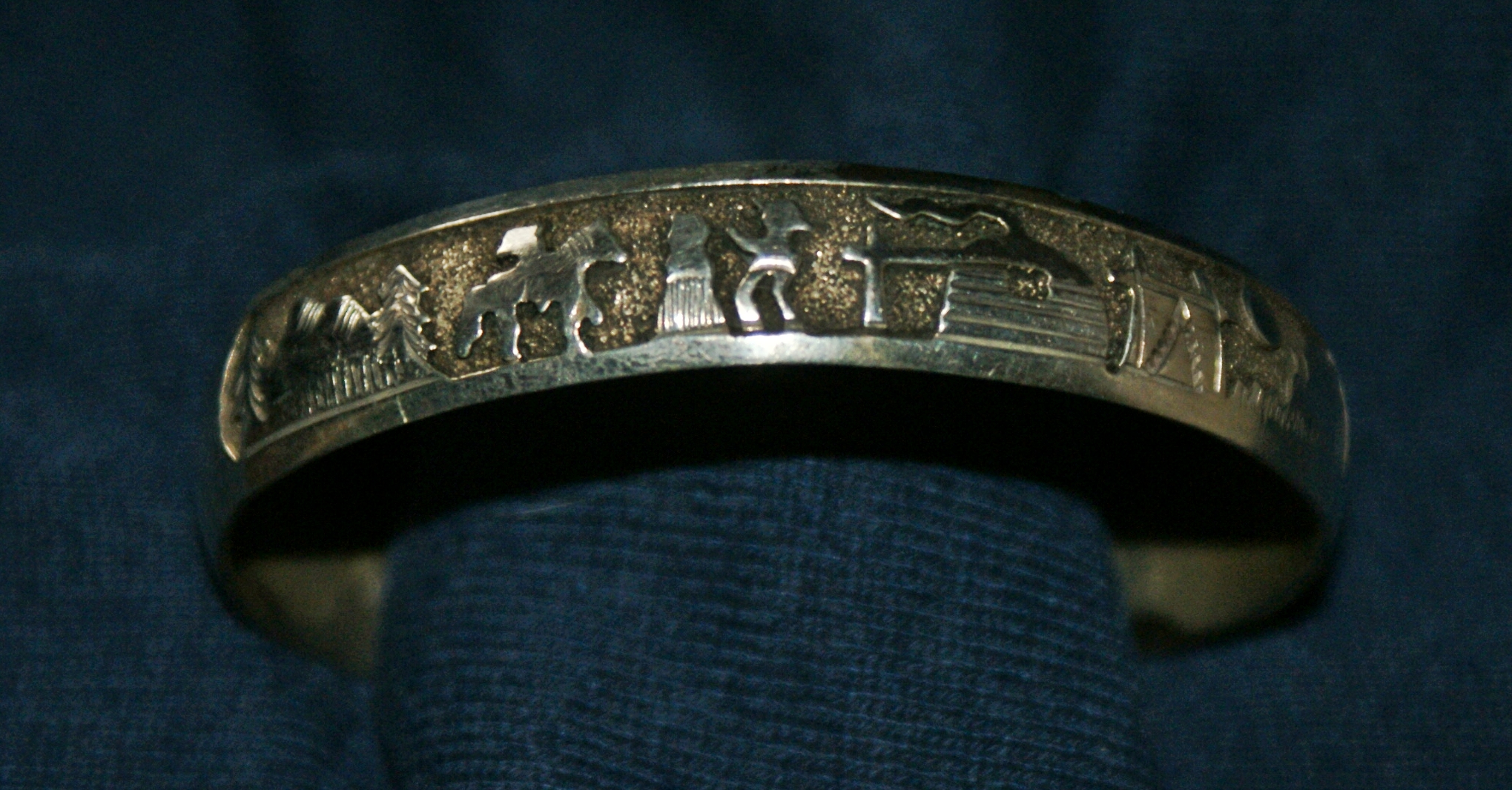
Smoky: A storyteller’s bracelet is a silver bracelet engraved with pictographs that tell some sort of story. My sister Bonnie gave me one as a gift about five years ago. I knew immediately I wanted to create a story about such a bracelet.

Malcolm: While the culture of Otter and Sun Song appears to influenced by the ways of the Tewa and Diné, your protagonists’ tribe isn’t identified in the novel. What led to your decision not to use a specific Indian nation for their background?

Smoky: You’re right about the Tewa and Diné/Navajo, but there also are Hopi influences in the story. I decided not to identify a specific tribe because I’m not Indian, and I didn’t want readers to presume that I am. I did not want to presume to know how a member of a specific tribe would act in any particular situation. Plus, I wanted to be able to pull aspects of different tribal lore into my story, especially when it came to telling the creation stories, because the different stories are beautiful. Also, by not identifying a particular tribe, I was able to bend the stories just a bit to fit the novel. I wouldn’t have felt right doing that if I had identified a particular tribe.

Malcolm: Like many young Indians, Otter and Sun Song were sent away to a white-run Indian school where the intent was to remove the students’ Indian language, beliefs, and culture and replace English, Christianity, and white clothing styles and laborer skills. Most of us didn’t hear about this in our high school history classes. It must have been difficult to place your characters into such an environment. How did you cope with this during the writing process?

Smoky’s Bracelet

Smoky: No, we didn’t hear about the Indian Schools in our history classes, just as we didn’t hear about the Japanese Interment camps. History often has overlooked the ugly things our culture has done, and these are just two examples of that. It was hard to place Sun Song and Otter in the school, but it was crucial to the plot. I also wanted to bring some awareness of what our government did to all the Indian Nations by ripping children and young people away from their tribes, their families, their culture. It was a shameful thing to do. Most of the time, when I was writing particularly tense scenes at the school, I raged at my computer. I felt really angry, even ashamed to have white skin. I guess, in a way, The Storyteller’s Bracelet is an apology to indigenous people everywhere for the way my birth tribe–white people of European descent–treated them.

Malcolm: The Storyteller’s Bracelet has a touch of magical realism in it, as does your earlier novel The Cabin. In both novels, the magic is a natural outgrowth of the places and the characters’ beliefs. Do you often wonder if such magic exists in “real life,” or do you approach it more as a viable storytelling technique?

Smoky: It is, of course, a viable storytelling technique, and is an integral part of the plot of The Storyteller’s Bracelet, as it was in my earlier novel, The Cabin. But yes, I do believe such magic exists in real life, at least for those of us who know how to tap into it. I’ve experienced it firsthand on several occasions. Does my body physically move from one plane to another in a different place and time, like in my books? No–at least, I don’t think so. But I have traveled to a cave in a faraway mountain range to converse with a Spirit Bear, and I have found myself transported to an island on a raft that is pushed by a great gray whale, with whom I also converse. Is it magic? Or is it imagination? I’m not sure there’s a difference.

Malcolm: Otter and Sun Song are in touch with their environment and treat wild creatures and special places there with respect.  This reminded me of your own approach to nature as you wrote about it in Observations of an Earth Mage. Did your own view of the natural world help you tell Otter’s and Sun Song’s story or did you have to “step away” from your own views to allow your characters’ views to be truly their own?

Smoky: No, I didn’t have to step away. Sun Song and Otter are like my own children–I created them, gave birth to them. It was critical to me that they shared my belief that we are all one with nature, neither above nor below every living creature, whether it be the smallest of insects or the powerful mountain lion or brown bear. We are nature. All of us. Intentionally harming any living thing is like harming a family member, for we are all the same, we are all one, to Mother Nature.

Malcolm: As a historical romance, The Storyteller’s Bracelet focuses on the feelings between Otter and Sun Song as well as the forbidden and dangerous feelings between Otter and the white girl Wendy whom he meets in the town where the Indian school is located. However, since these relationships unfold on a much broader canvas than the classic love triangle, were the two women a planned part of the plot from the outset or were you simply “following your characters” as you wrote when Wendy appeared on the scene?

Smoky: The two women were always in the planned plot, but they ended up being much feistier that I ever imagined. Sun Song, for example, in my initial story idea had a much smaller role than she ended up with. I ended up following her, because she made it clear this was to be her story as much as Otter’s. My planned original ending is nothing like how the actual novel turned out. Following Sun Song’s lead, I was able to work my way to these characters’ true story. And both I and the publisher, Kimberlee Williams of Vanilla Heart Publishing, think this story is much, much better than the one I originally planned.

Malcolm: Thank you, Smoky.

Where to find Smoky on the Internet

Website and Blogs

Author fan page on Facebook

Twitter

Amazon book listing

Montana’s Uncommon Critters Posters

Montana Fish, Wildlife & Parks has four great posters featuring the burrowing owl, paddlefish, cutthroat trout, and coeur d’alene salamander. As you can see from the salamander art shown here, artist Peter Grosshauer uses vivid colors to bring these critters alive for your PC’s wallpaper or as illustrations for your next nature talk or hike.

You can find these posters ready for download on the Glacier Park Fund’s “Just for Kids” page. (I hope it’s legal for adults to enjoy these posters as well.)

You May Also Like: Good Nature Stories Make Good Earth Stewards posted yesterday on Magic Moments.

Coming June 22: An interview with author Smoky Trudeau Zeidel, who will be talking about her new novel The Storyteller’s Bracelet.

Coming Soon: Author Melinda Clayton will stop by to talk about her new novel Entangled Thorns.

Malcolm

Book Review: ‘The Subversive Harry Potter’ by Vandana Saxena

Vandana Saxena has done a careful and credible job surveying themes of fantasy fiction and adolescence in The Subversive Harry Potter: Adolescent Rebellion and Containment in the J. K. Rowling Novels (McFarland, April 2012). Substantiated by the source materials, her approach views the years between childhood and adulthood as a time of testing, experimentation and rebellion that society allows and/or tolerates with the expectation that youth will ultimately enter “normal” adult society within the confines of generally accepted social and cultural values.

Saxena demonstrates that, paradoxically, young adult novels—such as the Potter series—not only facilitate the rebellious and experimental mindset of their expected readers (and protagonists), they also serve to contain it. J. K. Rowling, for example, leans heavily on the hero monomyth (hero’s journey) theme which, no matter how strange the journey, envisions the hero joining “normal society” once the quest is complete. Saxena correctly notes that the monomyth always arises on a foundation of the norms and beliefs of the culture or country where the story is set.

Rowling also draws heavily on the tradition of English Boarding School fiction that echoes what such schools were intended to do in society: mold raw, undisciplined youths into model citizens. Harry and the other students at Hogwarts are expected, by the powers that be at the Ministry of Magic, to play by the rules after they leave school in spite of their love of pranks and disobedience prior to graduation.

“The school story, as a narrative emerging from a specific cultural context and being situated in a socio-cultural institution like a school,” writes Saxena, “is doubly bound to the ideas and ideologies of its epoch.”

Hero, Schoolboy, Savior and Monsters

In addition to its focus on the literary and cultural traditions of hero and school themes, The Subversive Harry Potter explores Harry’s role as the savior of his magical world as well as that world’s marginalized monsters (giants, house-elves, werewolves) whom he and Hermione befriend out of their humanity and their defiance of societal norms.

Saxena points out that while Rowling’s books have often been criticized for their positive approach to magic and witchcraft, the series has two strong Christian themes. First, Harry becomes the savior who accepts death, not as a fearful end, but as a grace he receives while offering up his own life on behalf of his friends, fellow students and magical world. Second, love is called the strongest magic of all with a power so great that Lily Potter’s love for her son Harry lives on long after her sacrificial death on his behalf.

The hero, schoolboy and savior themes are not only skewed outside their normal linear evolution by the friendship and help of such outcasts as Hagrid, Dobby and Lupin, but by the presence of magic itself. Saxena’s study portrays adolescents—from the viewpoint adults—as “other,” that is to say, alien. However, within our consensual mainstream reality, magic, witchcraft and anything else regarded as supernatural, are much more alien.

The Subversive Harry Potter shows that, like Philip Pullman’s His Dark Materials trilogy, Rowling’s use of magic not only makes for exciting reading, but introduces elements that impact the protagonist’s expected evolution from adolescent/other to mainstream adult. It’s as though society is saying, “You can play with fantasy during your teenage years, but we expect you to grow out of it.” Yet, what if the supernatural is too strong and too compelling to leave behind? This is a “danger” society perceives in wildly popular fantasy literature as well as an interesting counterpoint to the hero, schoolboy and savior themes in the Potter series itself.

The Influence of “Queer Theory”

Saxena’s view of magic and fantasy within adolescent fiction is strongly influenced by her study’s reliance on “Queer Theory” as a means of exploring potentially discordant themes and values. As a post-structuralist critical theory that defines everything outside of society’s norms as “queer,” the theory would suggest that the hero/savior who exhibits a larger-than-life performance of his role is not exhibiting normal behaviors. The study suggests that magic further “queers” the functions of the monomyth, the boarding school theme, and the savior roles within the series.

While the words “queer” and “queer theory” in context within an academic study illustrate society’s view of everything different (including fantasy and magic), the tightly focused 1990s terminology is in my view unfortunate and out of date when extrapolated upon in 2012 for a wider research project.

“Queer analysis,” writes Saxena, “of the narrative of boyhood therefore reveals the essentially performative aspect of boy-to-man growth. The elements of fantasy and magic denaturalize this cultural project. The narrative of fantasy revolves around the power of magic, an illegitimate force whose presence in society has been characterized by simultaneous ubiquity and secrecy.”

The author’s role?

Unfortunately, the fantasy author’s role (if any) in either orchestrating or intuitively utilizing the hero, schoolboy, savior, monster and magical themes to facilitate/contain adolescent rebellion through instructional or inspirational storytelling was outside the parameters of the study. This leaves an open question about whether the themes explored in the study are overt elements of authorial intent or simply part and parcel of fantasy and hero’s journey fiction. Saxena shows that Rowling knew very well the traditions—within British society—of school fiction, the evolution of a hero, and of giant and elf folklore.  But she doesn’t explore whether Rowling intended for her fiction to impact adolescent needs within society in the manner viewed by theorists.

The Subversive Harry Potter grew out of a doctoral dissertation and, as such, is a formal academic study intended for literary theorists, psychologists, sociologists and other scholars. The retail price ($40 for a 218-page paperback) is within the realm of scholarly and professional publication pricing rather than that of general nonfiction.

For an academic audience, The Subversive Harry Potter meets its goals while providing fantasy authors and fans with some very interesting food for thought.

Malcolm

Malcolm R. Campbell is the author of magical realism and contemporary fantasy novels, including the hero”s journey “The Sun Singer” and the heroine’s journey “Sarabande.”

Briefly Noted: ‘The Armchair Birder Goes Coastal’

John Yow has followed up The Armchair Birder: Discovering the Secret Lives of Familiar Birds (Feb, 2012) with another handy bird book written in an anecdotal style called The Armchair Birder Goes Coastal: the Secret Lives of Birds of the Southeastern Shore (The University of North Carolina Press, May 1, 2012) which is a true wonder for birders, authors and others who want to know more about specific birds and their habits than the encyclopedic bird guidebooks present.

Yow writes with a lot of humor and insight. In the Anhinga entry, for example he starts off by saying, “Thought it’s seldom the most riveting aspect of bird study, I think in this case we better start with nomenclature. Nobody seems very happy with the name ‘anhinga.'”

He’s right about that. In Florida, we preferred calling them Snake Birds because they swam (or walked) under water with nothing but their long necks above the surface, looking like snakes with bills. Others called them Water Turkeys, though I have to agree with Yow in saying they look very little like turkeys.

In this book, we’re not talking mockingbirds and meadow larks. Think about what you saw on your last trip to a Southern beach or swamp: Black-Necked Stilts, Reddish Egrets, Wilson’s Plovers, Browm  Pelicans, Forster’s Terns and Black Skimmers. Illustrated with black and white drawings, this book is not for the vacationer with a short-term “what’s that” curiosity. The well-known photo-illustrated guidebooks will do for that. Yow writes for the reader who has time to sit a spell and watch and listen.

Author Janet Lembke is spot on when she writes,  “Infusing stories, observations, and musings, Yow makes it easy to learn about these fascinating birds. This book might well lead ‘armchair birders’ to become active birders, and eventually, conservationists.” There’s so much more to a bird than simply knowing what it is, and this book delivers the secrets that it usually takes a while to discover on your own.

Malcolm

contemporary fantasy for your Kindle

Inanna’s Heroine’s Journey – a drama for authors and seekers

“The world’s first love story, two thousand years older than the Bible—tender, erotic, shocking, and compassionate—is more than a momentary entertainment. It is a sacred story that has the intention of bringing its audience to a new spiritual place. With Inanna, we enter the place of exploration: the place where not all energies have been tamed or ordered.” – Diane Volkstein in “Inanna, the Queen of Heaven and Earth: her Stories and Hymns from Sumer”

Inanna, as envisioned by nikkirtw123 on Photobucket is strikingly close to my vision of Sarabande

As an author, I view my characters through a high-powered microscope and present the results of what I see as part of my stories. I will put you into the characters’ shoes if I can because—as Diana Volkstein writes—this is where the energies haven’t been tamed or ordered.

In my hero’s journey adventure Garden of Heaven: an Odyssey, I describe that place like this: “He knew him at the binary level where the line between matter and energy is barely discernible and often non-existent: Where urges pull at their chains, where drives push dumbly and drip sweat, where instincts race unchecked, where a horrifying sadness lies buried, where a raw pulse drums a cadence for the primitive rites of changing seasons, where white-hot impulses leap synapses in a shower of elemental fire.”

I wanted a similar, up-close focus in my heroine’s journey novel Sarabande. So, for the story of a woman seeking wisdom and wholeness, I could think of no better model than the myth of Inanna, a graphic dramatization of a woman’s inner journey to find herself outside the traps and trappings of a masculine world that has–as Sylvia Brinton Perera (“Descent to the Goddess”) wrote–forced the binary level of feminine power into dormancy for 5,000 years.

Or, as the late Adrienne Rich said, “The woman I needed to call my mother was silenced before I was born.”

Sarabande’s Heroine’s Journey

The journey in “real life”

In today’s terms, Sarabande was a tomboy. She was an expert with a knife, bow and arrow, a fishing pole, and everything she needed to know to survive in the wilderness. She learned all this from her father because her her mother believed women should only learn to keep a good home and not question society’s norms for women. However, Sarabande will never truly become herself as long as she is a disciple of either her late warrior father or her misguided, preachy mother. She is being taunted by a ghost that she must approach face to face in the ghost’s world.

Early on in her quest to rid herself of the ghost of her dead sister Dryad, Sarabande learns to see the world at a binary level: The lake, surrounding mountains and the cloud-draped sky broke apart into millions of colored specks. Sarabande leaned against Sikimí, even though he was no longer solid, and saw that her own light-pink hand was not solid either. In spite of her sudden dizziness, she did not fall. In fact, when her fingertips touched Sikimí’s side, a swarm of pink specks flew, like bees, into the permeable yellow gold of the horse, and when they did, their color changed to match the specks in their new environment.

But she doesn’t know what it means. So it is, that her quest to find and confront her sister follows the pattern of Inanna’s Heroine’s journey to confront her sister Eriskigal, Goddess of the Underworld. The underworld, in this case, is not the world of mobs and crime or “hell” in the Christian view, but the more dangerous world of the unconscious. Like Inanna, Sarabande will be broken, shamed and close to death before she learns who she is.

This is the heroine’s journey, to be buried in mother earth like a seed where she will be reborn with the spring into a new creation that finally has the freedom to follow the original injunctions of her destiny and her gender.

Malcolm