What if Harry Potter Bought the House Next Door to You?

WHAT IF?

Few questions are more important to a writer. So, what if Harry Potter bought the house next door and wasn’t shy about who he was and what he could do? Really, Harry Potter himself, not Daniel Radcliffe.

Of course, the real Harry Potter—if there is one—is part of a secret world that “in real life” we would never know anything about. There’s a reason for that: people who are different are usually shunned, persecuted or worse.

The first traditional rule for the adept—alchemist, psychic, shaman, wizard—is KEEP SILENT. If he lived next door to any of us, the real Harry Potter would probably appear as unassuming as Clark Kent in the Superman stories.

But, as long as we’re playing WHAT IF?, let’s say Harry is sick and tired of staying in his figurative closet. (Actually, he did stay in a closet at his foster parents’ house—what a nice touch of symbolism on Rowling’s part).

Time for the Welcome Wagon

When a new family moves into a neighborhood, people are curious. They drop by with pies and casseroles partly as a way of starting things off with a friendly “hello” and partly as a way of getting a look at the new folks to assess how they’re going to fit in. Times might be changing, but even today there are many neighborhoods in which the “welcome committee” will be displeased if a Black, Jew, Muslim, or Gay answers the door. In other neighborhoods, Whites, Catholics, and Japanese “don’t belong.”

In scholarly literature, those who don’t belong are often referred to as The Other. They are outside the mainstream. In the Harry Potter books, witches, elves, wizards and giants are outside the mainstream of English society. Even within the magical world itself, there’s a hierarchy about who’s “in” and who’s “out.”

Fantasy offers readers unlimited opportunities to come to terms with what’s different, what goes against the mainstream scheme of things, and to consider whether the consensus reality of “real life” must be engraved in stone or not. Fantasy lets us safely question “what is.” While reading a Harry Potter book or watching a Harry Potter movie, it’s easy to feel simpatico with Harry, Ron, Hermione,  and Dumbledore, and perhaps even to feel a bit sorry for the everyday people in London who don’t know anything about the magic in their midst. Just think of all they’re missing!

But What Happens When We Get to the End of the Book and the Last Movie?

Here come Harry’s friends!

Picture this. The moving van has pulled away and the new family—who looked normal enough while carrying boxes into the house—has gone inside. So, you put together your best cherry pie or your favorite Hamburger Helper meal (depending on your skill in the kitchen), and you go next door and ring the bell.

A dark-haired guy comes to the door. He’s wearing well-aged dungarees and a polo shirt. He smiles and says “Hello.” But, before you can introduce yourself, his son—whom you can see down the entry hall in the living room—shouts Avis! and a flock of pigeons appears out of nowhere and flies past you en route to the wide open sky.

What happens now?

  • The guy who answered the door says, “Hi, I’m Harry,” and acts like the thing with the birds didn’t happen.
  • You ask, “How did he do that” and Harry says, “No big deal, it’s just James Sirius having a bit of fun.”

It’s not quite like seeing it in the movie, is it? As I play with this WHAT IF question, I like to think that the world has progressed a lot between the time when TV viewers were watching Rob and Laura Petrie at 148 Bonnie Meadow Road in the Dick Van Dyke Show and all the Wisteria Lane families on Desperate Housewives. We are more likely to welcome Harry today than we were in the 1960s, aren’t we?

What do you think happens if Harry Potter moves in to your neighborhood and, along with his wife Ginny, makes no secret of his skill with spell casting and potions? Will the neighbors accept him with open arms the way they did while reading Rowling’s books, or will they stay away?

This is not a WHAT IF question I plan to use for the plot of my next novel. If I were Dan Brown, I might show that Rowling’s books weren’t fiction at all and that the guy next door is probably attracting the wrong kind of attention from, say, Homeland Security, the mob, and various terrorist groups. If I were Katherine Neville, I might show that in spite of his skills, Harry needs the help of my protagonist, say, Bill Smith, who has to go on a search for the real Nicholas Flamel to save the neighborhood. Or, if I were Tom Clancy, I’d probably have a couple of CIA operatives show up to assess “which side” Harry was planning to help “win” with his most powerful spells.

Do We Want the Fantasy Characters to Just Stay in Their Books Where They Belong?

We love fantasy whether it’s epic, contemporary, urban, steampunk, heroic or another sub-genre. In the books, Harry Potter was viewed as the hero who saved the magical world and (by readers) as one of the most-loved characters in fiction.

But WHAT IF Harry, Ginny and the kids moved into your neighborhood. Would it all become one happy family with baseball games on Saturdays and Quidditch matches on Sundays? Or, would Harry, Ginny, and their friends from Hogwarts and Diagon Alley remain separate in their house and yard as The Other?

What I think would happen and what I would like to see happen don’t match up here. Even so, I like asking the question WHAT IF?

Malcolm

Malcolm R. Campbell is the author of contemporary fantasy, including the 2011 novel Sarabande from Vanilla Heart Publishing.

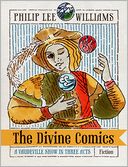
Review: ‘The Divine Comics’ by Philip Lee Williams

“In a great comedy, we are always made aware of the darkness in life, but the ending must be happy or it’s not a comedy. A man’s journey to wholeness is therefore most rightly named ‘The Comedy,’ for the end is the final awareness of that love which is the joy of the universe.” – Helen M. Luke in “Dark Wood to White Rose: Journey and Transformation in Dante’s ‘Divine Comedy’”

Philip Lee Williams’ magnificent “The Divine Comics: a Vaudeville Show in Three Acts” begins and ends with Whitman Bentley, a young man with gangly legs who’s been dreaming again, perhaps to escape the fact that among the eccentrics at The School of Music, he “may be the weakest, torn with every phobia in the catalogue.”

Since the novel’s back-cover informs readers that Williams’ novel reimagines and updates Dante’s “The Divine Comedy,” we know going in that Whitman Bentley will, to put it crudely, go to hell and back, after—as Dante might put it—the eccentric second-string symphony conductor awakes to find himself in a dark wood where the right road is wholly lost and gone.

En route to the ending of “The Divine Comics,” (which is pure poetry and white rose wonderment) the reader—as well as Williams’ huge cast of dysfunctional characters—may sense that that there is no right road and that the trickster gods (known as the Divine Comics, aka “The Lords of the Inner Kingdom”) are plagued with every manner of dark joke in the catalogue. Ah, but the chapters in “The Divine Comics” are called skits for a reason.

The novel’s three sections, “Fire,” “Earth” and “Air,” match Dante’s “Inferno,” “Purgatorio,” and “Paradiso.” “Fire” focuses on a school of music, “Earth” on the followers of a lady who takes her friends on a cruise to France where they will be well paid to treat her as their queen, and “Air” on a mixed group of artists, politicians and scientists who have been assembled as honored fellows at a rich man’s Rocky Mountain retreat.

Each troop of trekkers has its own farcical road of trials, puns, groaners, riffs, improvisations on every imaginable subject under heaven, and assorted terrors to follow, complete with a guide, until all the skits merge into one with the novel’s almost-overpowering crescendo of an ending. Like “The Divine Comedy,” Williams’ “The Divine Comics” has four levels of meaning: literal, allegorical, moral and mystical. While the novel has great depth and a near-infinite number of overt and covert references to music, popular culture, history and religion, it is a very readable and entertaining story.

At this point in the review, Dante purists may be wondering if any of the groups in the story is guided by Virgil. No, but there’s a good reason for that. Former used car salesman Al Carswell, who hosts Whitman Bentley’s group in the vestibule of hell, says that “the Big V” isn’t around much. “Last people he brought through was a bunch of Jaycees who died of ptomaine in Butte, Montana. After that, he turned sort of sour on things, don’t you know?”

Williams has done one hell of a job updating hell, purgatory and paradise for today’s savvy seekers of a great story and/or the white rose. Observers—such as the readers of this novel—left standing  in the dark wood for eternity will sooner or later shout, as James Joyce might put it, “Here Comes Everybody,” for Dante’s epic poem and Williams’ update some 690 years later are both masterpieces describing the human condition. This is not to say everybody must use “The Divine Comics” as a personal heaven and hell travel guide. After all, how will we know at any moment whether we’re in or out of Whitman Bentley’s dream? As Williams says many times in the novel as an author commenting on the story he’s telling, “It’s a question well worth our attention.”

“The Divine Comics” is, indeed a comedy. But rest assured that before you reach that happy ending, The Lords of the Inner Kingdom, will capture your attention and then leave you breathlessly rolling in the aisles at a Vaudeville show filled with enough black humor to last a lifetime, and then some.

Malcolm

Malcolm R. Campbell is the author of four novels, including the satire “Jock Stewart and the Missing Sea of Fire”

Briefly Noted: “The Storyteller’s Bracelet’ by Smoky Trudeau Zeidel

Available for pre-order on Amazon, “The Storyteller’s Bracelet” is a new historical romance from Smoky Trudeau Zeidel (“On the Choptank Shores,” “The Cabin”) with a June 22, 2012 release date from Vanilla Heart Publishing. Smoky will stop by Malcolm’s Round Table to discuss her book later this month. Meanwhile, you can learn more about Smoky in her interview with Shelly Bryant here.

Publisher’s Description: It is the late 1800s, and the U.S. Government has mandated native tribes send their youth to Indian schools where they are stripped of their native heritage by the people they think of as The Others. Otter and Sun Song are deeply in love, but when they are sent East to school, Otter, renamed Gideon, tries to adapt, where Sun Song does not, enduring brutal attacks from the school headmaster because of her refusal to so much as speak. Gideon, thinking Sun Song has spurned him, turns for comfort to Wendy Thatcher, the daughter of a wealthy school patron, beginning a forbidden affair of the heart.

But the Spirits have different plans for Gideon and Sun Song. They speak to Gideon through his magical storyteller’s bracelet, showing him both his past and his future. You are both child and mother of The Original People, Sun Song is told. When it is right, you will be safe once more. Will Gideon become Otter once again and return to Sun Song and his tribal roots, or attempt to remain with Wendy, with whom he can have no future?

Comment: Smoky and I share the same publisher, so in my view, it would be improper for me to review The Storyteller’s Bracelet. Yet, as I read an advance copy to prepare for our upcoming discussion, I couldn’t help but notice the great care Smoky has taken with her approach to the culture, beliefs and thoughts of her dual protagonists Otter and Sun Song. Since the title character in my novel Sarabande has an Indian heritage, I wrestled with the problem of accurately telling a story from an Indian’s point of view.  Smoky’s words ring true. What an absolutely wonderful book. This should be grabbed up as a classic.

Malcolm

contemporary fantasy for your Kindle

Review: ‘Should I Not Return’ by Jeffrey T. Babcock

“Denali, that Great Grail Castle in the Clouds continues to thrill and kill with each passing year. As of the fall of 2011, 133 climbers have perished on Denali, ever since Allen Carpe and Theodore Koven became the first to die on its icy slopes in 1932.” – Jeffrey T. Babcock in the dedication to “Should I Not Return”

When Jeffrey T. Babcock and his older brother Bill set out to climb the highest mountain in North America, Alaska’s 20,320-foot Denali (Mt. McKinley) in 1967, they knew before they reached “The Great One” that they would be tested in a dangerous world of rock, ice, snow and wind where every climber is at risk and may not return. They did stand on top of the continent on a cold and windy day that July, but en route to the summit, their Mountaineering Club of Alaska (MCA) team stared into the eyes of tragedy from an unexpected combination of events.

The MCA team was several days behind the twelve-person Wilcox-Snyder Expedition. A class-6 storm suddenly raged over Denali, separating the members into those who were able to retreat and those who were stranded high up on the mountain in the bitter cold blizzard conditions. Injured and greatly worried about the other members of their group, the descending Wilcox-Snyder team members met the advancing MCA team, made radio contact with the National Park Service to report their status, and then made their way off Denali. Due to its position on the mountain, the MCA team became the primary rescue group. Jeffrey and Bill Babcock found two of the dead; the others were never found.

The death of seven members of the Wilcox-Snyder group in one day has been called North America’s worst mountaineering tragedy. It has also generated a fair amount of controversy as the actions of leaders Joe Wilcox and Howard Snyder and the National Park Service have been scrutinized under multiple microscopes leading to multiple accusations of blame. Jeffrey T. Babcock, who went on to lead other climbing expeditions including another successful summiting of Denali, has spent a lifetime pondering whether or not the MCA team could have accomplished the impossible and saved any of the Wilcox-Snyder climbers. Now, most experts think not.  But nobody knew this during the summer of 1967.

Babcock has, to the extent it’s possible, come to terms with Denali in 1967 via his “non-fiction novel” Should I Not Return. While the novelization combines real life events from two climbs into protagonist Henry Locke’s coming-of-age climb of Denali on a team led by his brother Johnny, the book’s account of the tragedy and the rescue attempt is based on facts. The result is a compelling and accessible adventure story for a general audience as well as a riveting true-to-life account of a widely known mountaineering event for climbers familiar with techniques, routes and high-altitude weather conditions.

West Buttress of Denali – NPS Photo

Should I Not Return is richly illustrated with photographs from the MCA and other teams as well as sidebars containing historical information about earlier Denali ascents and the climbers involved. While the sidebars are nice time capsules for climbers and others interested in Alaska and its mountains, they can be skipped by those who prefer to stick with Henry and Johnny’s trial by wind and ice.

The emotional and practical need for young Henry—whom some of the other characters view as “Johnny’s baby brother”—to prove himself adds impact to the story. While Johnny and the other MCA team members know each other well, Henry is viewed as a neophyte easterner who will more than likely them back or put them at risk. The terror of the story is amplified because readers see events unfold through the eyes of the youngest team member rather than a veteran climber.

In addition to their geographical and historical value, the photographs serve the same purpose as the illustrations in adventure novels of an earlier era. For example, when Johnny falls through a snow bridge into a crevasse, an accompanying photograph of a Lower Ice Fall snow bridge on Muldrow Glacier demonstrates for non-climbing readers how precarious Johnny’s situation was. The inhospitable conditions Henry and the others face on that glacier is illustrated by a bleak photograph  (by the author) showing just how tiny a man is when he stands next to the sheer walls of Pioneer Ridge. While Babcock’s prose is strong enough to stand on its own, the pictures add greatly to the reading experience.

If Should I Not Return were the product of Jeffrey T. Babcock’s imagination, I would recommend it to everyone who loves compelling adventure stories. For mountaineers, the book adds immeasurably to the historical record of Denali from a very capable writer who was first on the scene of a controversial climbing tragedy.

Malcolm R. Campbell

Malcolm R.  Campbell is the author of four novels, including the 2011 contemporary fantasy adventure “Sarabande”

In praise of urban trees

I think that I shall never see

A billboard lovely as a tree.
Indeed, unless the billboards fall
I’ll never see a tree at all.

– Ogden Nash

If only billboards were the only threat to trees.

We’ve all seen it: the shady tree-lined street that’s ultimately widened at the trees’ expense to improve traffic flow; buildings placed so close to trees that ultimately the trees must be removed for fear they’ll fall on the buildings or ruin the foundations with roots; old farms and woods that are clear cut to make room for subdivisions and shopping malls.

Most of the old trees on my subdivision lot have fallen down during the ten years we’ve owned the house. Why? The contractor’s grading crews got too close to them or otherwise disturbed the lot’s water flow. Recent droughts in Georgia haven’t helped.

Fortunately, more and more people are getting tired of a world of hardscapes and tree canopy losses. Initially, people spoke only about sacred spaces, habitats, shade and ambiance, but in a practical world, those weren’t considered important enough reasons for conserving and maintaining urban trees. Now, like most things that should be saved simply for themselves, trees are standing a better chance of standing because we have found economic reasons for doing so.

Click here to learn more

In Virginia, Tree Fredericksburg is typical of the kind of local initiative that demonstrates the rationale behind saving trees, showing the day-to-day economic benefits of preservation (in addition to the ability to attract grant money).  The group’s WHY PLANT section on its website lists reasons that are (thankfully) becoming disseminated more widely these days.

  • Improve air quality
  • Protect air and water
  • Save Energy
  • Extend the life of paved spaces
  • Increase traffic safety
  • Sustain local economies
  • Increase real estate values
  • Increase the quality of life

For years many conservationists (including me) focused our efforts on habitats and quality of life, but few people cared. Perhaps we have become a little wiser by pointing out that while “quality of life” is usually the last on most lists of benefits (and habitat/ecosystem is often missing), we can influence people toward a praise-of-urban-trees stance with the other items in the mix.

Events such as this one in Jefferson, Georgia draw attention to the need for trees in urban settings.

Many organizations are willing to help you translate your love of trees into tree-canopies-favorably-impact-your-pocketbook facts that people will listen to. Among my favorites are the Arbor Day Foundation (including its Tree City USA program and standards) and the Trust For public Land* (with a focus that includes urban parks as well as wilderness).

Local groups, such as my town’s tree council, work with volunteers and local governments to assess tree canopies, recognize heritage trees, sponsor tree donation programs, and add tree-favorable provisions into land use management codes as well as historic district regulations.

Joyce Kilmer’s widely known poem “Trees” ends with the lines:

Poems are made by fools like me,
But only God can make a tree.

In the current century, we can still love Kilmer and ambiance and our fine feathered friends. But stronger tools are needed for effectively praising urban trees. Since money appears to speak louder than the gods and goddesses—at least in a voice we can hear and understand—then perhaps we must stop talking about the joys of shade and bird songs, and focus a bit more on real estate values and the preservation of pavement.

Malcolm

* The Trust for Public Land, in partnership with Cox Communications, announced May 23 that Anne Little has been selected as Virginia’s Cox Conserves Hero. As her nonprofit of choice, Tree Fredericksburg will receive $10,000.

Adventure fiction can be a strong advocate for the environment

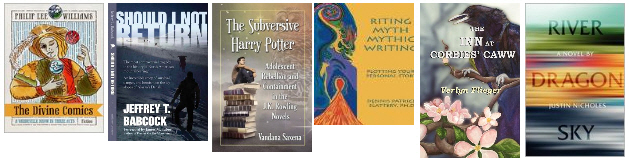
Upcoming Reviews: Williams, Babcock, Saxena, Slattery, Flieger and Nichols

I have a great list of books here on my desk to review, starting with The Divine Comics by Philip Lee Williams. Mr. Williams is somewhat responsible for the fact my reviews are running late, for his novel is a thousand pages long and, in spite of the fact it’s very readable, it’s taken me a while to finish. You’ll see a review of it next week after a break for a long holiday weekend.

JeffreyT. Babcock’s book based on the true story of a 1967 mountain climbing tragedy on Mt. McKinley will follow closely. I mentioned Should I Not Return in this morning’s post on Magic Moments, The Range of Light.

The Subversive Harry Potter: Adolescent Rebellion and Containment in the J.K. Rowling Novels by Vandana Saxena takes a look at teens, rebellion and the kinds of books that tend to support the rite of passage between childhood and adulthood as viewed through the lens of J. K. Rowling.

A fan of fantasy and folktales, I’m looking forward to reading Verlyn Flieger’s The Inn at Corbies’ Caww. A long-time Tolkien scholar, Flieger knows the territory and proves it with fine writing and a wonderful story. (I know this because I peeked into the book when it arrived.)

After mentioning Riting Myth, Mythic Writing: Plotting Your Personal Story by Dennis Patrick Slattery here on this blog on May 22, I decided that there was much more to be said. So, you’ll be seeing a review in the near future.

River Dragon Sky, Justin Nichols’ novel about a Taoist “street seer” in China has a noir feeling about it along with a lot of secrets. Nichols is also the author of Ash Dogs.

You May Also LikeMain Street Stories, by Phyllis LaPlante, reviewed by Smoky Zeidel on Smoky Talks Books. The author of The Cabin and On the Choptank Shores, Zeidel’s new novel The Storyteller’s Bracelet is coming out in June.

Malcolm

Briefly Noted: ‘Riting Myth, Mythic Writing: Plotting Your Personal Story’

“Myths are public dreams, dreams are private myths.” – Joseph Campbell

A new book by Dennis Patrick Slattery, a long-time researcher, teacher and author of mythology, depth and archetypal psychology, will help those interested in their own journeys and personal myths take a few more steps down the path.

New from Fisher King Press, Riting Myth, Mythic Writing: Plotting Your Personal Story uses 80 writing meditations to draw readers directly into the process rather than presenting facts and ideas in a lecture-style format. Those of us who write full time already know the power the writing itself has on the author during every writing moment. The book is the next best thing to a workshop in a sacred place with an experienced facilitator and other students of like mind.

In his introduction to the book, Michael Conforti writes, “Imagine sitting in an Irish pub, drinking ale and listening to the bard weave stories about so many different things, or perhaps captivated by the glow of an outdoor fire while listening to an elder telling stories about history, traditions, and ways to navigate the different life portals that each and every one of us will have to enter at some time. And then—there are stories about destiny, that illusive, mercurial something that catches hold of us at the beginning of life and never seems to want to let go. La forza di destino!! These are the experiences one has in knowing and working with Dr. Dennis Slattery. Whether sharing a pizza and beer or having the luxury of attending one of his lectures or classes, one is privileged to experience an authentic ‘elder’ who, in the tradition of all those wise ones who came before him, has the gift of bringing the world of myth and imagination to life and showing us that indeed these are as real as anything we can touch and hold in our hands.”

A pint of ale might go very well with this book.

Malcolm

The hero’s journey myth in a fantasy adventure

E. B. White and a swan named Louis

“Even today, White’s book continues to foster the conservation efforts he deeply believed in. Each year, the Red Rock Lakes National Wildlife Refuge receives numerous letters from young readers who inquire about Louis and seek information about the refuge and the trumpeter swans.” – Marcia Melton, in “E. B. White’s Montana and ‘The Trumpet of the Swan,'” Montana – The Magazine of Western History, Spring 2012

Most of us remember E. B. White (1899 – 1985) primarily for his children’s books Stuart Little (1945), Charlotte’s Web (1952) and as co-author (with William Strunk, Jr.) of The Elements of Style (1959). But a book that grew out of his 1922 trip to Montana in a Model T Ford when he was 22 is not only equally notable but demonstrates how well-told stories about the natural world can influence young readers to help protect the treasures they first discover in fiction.

“Montana made a lasting impression on White,” writes Marcia Melton in her feature article in the current issue of Montana – The Magazine of Western History. Fifty years later, that impression was still strong enough to lead to The Trumpet of the Swan about a young cygnet who had no voice. Even though White worked for a while on a Montana ranch and saw a lot of scenery, he never saw a swan and never visited the Red Rock Lakes National Wildlife Refuge where his story is set. (He knew how to do research.)

Red Rock Lakes NWR photo

Founded in 1935, the refuge is in the greater Yellowstone area near the Centennial Mountains and the headwaters of the Missouri River. According to the refuge’s website, “A very shy bird by nature, the trumpeter swan is the subject of intense study in an attempt to learn how to ensure their survival. Rescued from near extinction, trumpeters breeding in the Greater Yellowstone Ecosystem, including Red Rock Lakes, have grown in number from a low of only 200 birds in 1932, to a success of more than 500 in recent years.”

As Melton notes, the swans were heavily hunted in the 19th century and early 20th century for meat, quills, down, and feathers. Fortunately,  by the time White’s book was published inn 1970, the insanity of hunting wild creatures into extinction kept us from losing the swan. However, the bird still faces threats, as The Trumpeter Swan Society informs us, from illegal shooting, power lines, lead poisoning, and habitat loss. The Society, with the help of numerous volunteers, is one of the trumpeter’s strongest allies.

When White accepted the National Medal for Literature for The Trumpet and the Swan in 1971, he said “Only hope can carry us aloft, can keep us afloat. Only hope, and a certain faith that the incredible structure that has been fashioned for this most strange and ingenious of mamals cannot end in ruin and disaster.”

Reading Melton’s article about the man who wrote a story about a young swan named after Louis Armstrong who finds his voice in the form of a trumpet at a store in Billings, Montana, reminds me of the strength of a writer’s “act of faith,” as White calls it, and how that faith can be carried far and wide on the winds on white wings.

Malcolm

Contemporary fantasy set in Montana

Take a look at locations you know for your best stories

The possibilities for swamp stories are infinite

Like most starving authors, I can—on a bad day—be jealous of authors who have the money for multiple research trips to Scotland, Paris or Japan. On the other hand, I’m not writing global thrillers or looking to my highland ancestors for what if romances about Mary Queen of Scots. So, I return again and again to the places I’ve lived and worked for my fictional settings.

Writers often debate whether the old admonition “write what you know” makes sense or is foolish. Obviously, writers do a lot of research to fill in the gaps. Nonetheless, I think it’s much easier to write about a place where you’ve been or an occupation you’ve had or have been exposed to than to have to make everything up from scratch.

If you lived in a town for years, you know the streets, the ambiance, the trees and flowers to be found there, and perhaps some of the history. If you vacation at the same beach, resort or National Park every year or so, these are also prime examples of “what you know.”

In my contemporary fantasies “The Sun Singer” and “Sarabande,” I used Glacier National Park as a setting for the adventures because I worked there and later went back as a tourist. I placed some of the scenes in my magical realism novel “Garden of Heaven: an Odyssey” in Glacier, but also used the Philippines which I saw while in the Navy and the Florida Panhandle where I grew up. And this year, I’ve been writing short stories which have been set in Glacier, a north Florida swamp, and central Illinois where one side of my family came from.

My fiction always has a strong sense of place

To some extent, each of these stories could have unfolded in a dozen other places, but since I always have a strong “sense of location” in my fiction, it was easier to plunk down my characters in places I know well rather having to start from scratch. I know, for example, that you’re going to find chinkapin trees, titi thickets and scrub oak in the Florida Panhandle, and that there are several varieties of Indian Paintbrush flowers in the Montana mountains.

What I know about each location isn’t earth shaking, like state secrets, smuggling rings, or hair-raising stories from years gone by. But what I know does give me a jump start. I may well use Google to fill in a few facts, but knowing a location helps you know what to look for when you do your next Internet search. Yes, I still have dreams about going to the highlands of Scotland, but until then, I can be happy with East Glacier, Montana and Tate’s Hell Swamp on the Florida Coast.

Perhaps you can, too.

One of my favorite Glacier flowers gave me a new story idea – NPS Photo

I just saw a screen saver filled with Indian Paintbrush: ah, that leads me to another Montana short story. A week ago, I started thinking of the chuck-will’s-widow that sang all night in the woods behind the Florida house where I grew up. Oh, good, another story idea about those woods and my old neighborhood.

In many ways, I am probably always on the lookout for stories I can tell in my favorite settings because, well, I know the territory and the kinds of things that happen (or might happen) there. If the location settings in your fiction play a role, then where you’ve been is a lot easier to bring to life in words than a place you’ve always wanted to see.

Malcolm

You may also like: World of Wonder about nature as my primary inspiration as a writer. The post appears as part of an inspiration series running on author Smoky Zeidel’s weblog through June 27.

If you ask me what I’m reading, you’re on your own recognizance

A writer friend of mine once told me she looks at my book reviews here as prospective To Be Read books for her Kindle. “You have never steered me wrong, Malcolm,” she said. Perhaps he fingers were crossed behind her back.

Take a look at my current reading shelf. It should be a warning. I say that because I am probably the only person in the known universe who has these three books on his shelf at one time. Or at any time. My reading tastes are both wide-ranging and eccentric. (Not always because, hey, I can enjoy a good Nora Roberts or John Grisham novel like anyone else.)

People sometimes note that most of my reviews on GoodReads and Amazon end up with four or five stars and suggest that I’m just trying to be nice. No, I’m doing that because I usually only review books I like a lot—well, unless I read something that really ticks me off.

However, five stars from me doesn’t mean the book will get give stars from you.This was proven conclusively several years ago when I gave  Dow Mossman’s novel The Stones of Summer a glowing review. People told me I was crazy. Possibly so even though I was one of 30 people who felt that way.

Consider the Source

So, when I tell you what I’m reading, you need to consider the source (me) and remember that even though I often read mainstream bestsellers, I probably read them for the wrong reasons. The other books on my shelf are going to have a very strong flavor of magical realism, speculative fiction, fantasy, folktales, literary fiction, and stuff that—for the want of a better words—is just plain weird.

Now, my writer friend hasn’t told me directly that I inadvertently steered her wrong on a book last year, that one being The Tiger’s Wife by Téa Obreht,  but I noticed she gave it three stars on GoodReads. Sigh. After The Night Circus, that was my favorite novel of the year. I think both of these novels are Pulitzer Prize level novels, though I doubt either one was nominated (or seriously considered) since the rules say the novels must be truly American stories and neither of these books were.

Your Own Recognizance

As it turns out, this post is a disclaimer, meaning that I am often drawn to stories that mesh one way or another into my sense of wonder and my world view of real life and fiction. Before spending your money on anything on my To Be Read shelf, you better get a second opinion.

What’s on your shelf these days?

Malcolm