Shelly Bryant (Cyborg Chimera, Under the Ash) is a prolific poet whose work never fails to inspire readers with pointed and poignant images that rise from the earth on the wings of spare words. Her new collection Voices of the Elders from Sam’s Dot Publishing is startling in the risks taken, the variety of its forms and references and the scope of its vision.
The fifty-five poems in this 59-page volume, many of which have appeared in “Aoife’s Kiss,” “Scifaikuest,” “Sloth Jockey” and other publications, are grouped into four sections—seduction, obstruction, destruction and abduction.
Jason Gantenberg aptly describes Bryant’s scope in these groupings in the book’s introduction: “What I’ve always loved about Shelly’s writing is the breadth of genres and periods in which she embeds her thoughts. There are few writers who will quite so fearlessly juxtapose classical Anglo-Saxon fantasies about fairies and dragons with ruminations on supernovae, historical fiction with futurism, cynical politics with whimsy.”
In “Oort” Bryant writes of “a failed planet” that’s “denuded of destiny,” followed by “Styx” an “eternal river” with an “ever-changing flow,” followed by “Bargain Hunter” about a young man in a store who makes a five-dollar purchase out of books for “aficionados with loads of cash.” The poem ends with these lines:
producing pleasure properly pirated porn just like the real thing
“Keep it in the Family,” begins:
familiarity and its child contempt creep into familiar lines
And “Voice of the Elder” ends:
the elder dryad to the swirling storm raises his dying howl
I will return to “Memories Shared, Standing on Your Balcony,” the writer’s block in “Project,” “Men of Renown” with their Achilles heels and the other fresh-faced words in Voices of the Elders many times, for while they speak to me of today’s world in today’s language, they are, I think, penned by an old and very wise soul.
I fact check everything I put in my stories and feel very nervous about the things I can’t track down.
In my short story in progress, two college students explore a cave and find a fair number of bats. When they leave the cave, they discover that while they’ve been very dry inside, the world has gotten very wet outside.
I wanted one of my characters to say something like, “Holy deluge Batman, there’s been a change in the weather.”
My story is set in 1962. Guess why I can’t use that phrase.
As you can see on Robin’s Page, there are over 356 “holy something or other” phrases listed from the Boy Wonder. No, “holy deluge” isn’t there, but that’s not the problem. My character wanted to mimic Robin, not quote him.
The Batman television show where we heard “holy whatever” over and over aired on ABC between 1966 and 1968. So there it is. My character can’t mimic something that hasn’t started yet.
Sometimes research giveth and sometimes it taketh away.
There was a lot of pure country music on the radio when I was young, especially on the powerful clear channel AM stations that could be heard throughout large areas of the country after dark. I heard Ford a lot on the radio, along with everyone else who recorded a version of “Sixteen Tons.” I don’t hear the song much any more, but the words still resonate with me during these difficult economic times. One doesn’t have to be a coal miner stuck in the old country store and truck system (payment in goods rather than cash) to understand the feeling of “I owe my soul to the company store.”
These days, the company store is the mortgage company, the credit card company, the IRS, the county property taxes, and a host of other payments that keep a lot of people behind the 8 ball. As for the load sixteen tons, we could substitute “write sixteen novels” or “drive 1600 miles” or “work sixteen years” or whatever fits.
Oddly enough, though, I only think of that “another day older” line and start hearing Tennessee Ernie Ford’s voice on my birthdays. That’s good, I think, for it keeps industrial-strength worrying about finances to a minimum. That was yesterday. Today, I’m blogging about it and then moving on. As Smoky Zeidel said in today’s post, “I’m a True Writer: a writer who not only can write, but must write.”
Sometimes must write = curse. But most of the time, writing is a creative way to stop oneself from worrying about being deeper in debt or how long the drought’s going to last or why political campaigns bring so many clowns out of the woodwork. It seems a bit audacious to say that writers create worlds, so I’ll just suggest we’re creating cities, lakes and mountains. If I don’t like what I see, the backspace key comes in very handy. It won’t erase actual debt, but it will erase scenes in my short stories that aren’t turning out quite right.
On my birthday yesterday, I wrote a fair number of words of a new short story, saw a friend of mine stop by unannounced and mow my lawn with his riding mower, ate a plateful of spaghetti, talked to my brothers on the phone, had a glass of Biltmore Pinot Noir, got some reading done, and felt pretty good about things in spite of hearing “I picked up my shovel and I walked to the mine, I loaded sixteen tons of number nine coal.”
I also heard Ford’s radio/TV sign-off catch phrase: “Bless your pea-pickin’ heart!” and found it hard not to smile.
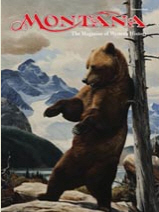
I have been a member of the Montana Historical Society for at least 25 years even though I live in Georgia. Why? I fell in love with the state after working two summers in Glacier National Park. Since the state’s history and environment fascinate me, I look forward to each new issue of the Society’s award winning Montana The Magazine of Western History.
The places where my novels are set always figure strongly into their plots and themes. Much has been written about the Rocky Mountains and Glacier National Park. I try to keep up so I can make my descriptions as accurate as possible and to ensure that my plots are viable within those settings. Even though I don’t write historical novels, I also feel that knowing the history of an area adds to my understanding of a state or region and enriches my storytelling.
Unlike many of our high school and college history classes that focused a great deal on remembering dates, reading the articles and reviews in a historical magazine is a joyful experience. There’s no pressure to take notes and/or to guess which five facts will be on a pop quiz or the final exam. In the Summer 2012 issue of Montana The Magazine of Western History, the lead article “The End of Freedom: The Military Removal of the Blackfeet and Reservation Confinement, 1880” by William E. Farr features the Indian reservation on the east side of Glacier National Park.
One can hardly visit Glacier without learning about the tribe’s association with the park. If you reach the park by car or train from the east, you’ll pass through the Blackfeet reservation. This well-written article definitely increases my sense of place and the people who are important there.
As a writer, I want to know what I’m writing about—in depth. Obscure facts come to mind long after I read an article and influence plot development in ways I can never predict when each issue of the magazine arrives. My membership in the Montana Historical Society has, I think, been an important component in shaping my three novels set partly within the state: The Sun Singer, Garden of Heaven: an Odyssey, and my recent contemporary fantasy, Sarabande. I always hope that readers, especially those who live in the places I write about, will think that I live there, once lived there, or have spent a great deal of time seeing the sights on multiple vacation trips.
Most states have state, county and local historical societies, tourism departments, and preservation groups that are worth their weight in gold for writers who see place almost like another character in each story.
Table of Contents – Current Issue
The End of Freedom: THE MILITARY REMOVAL OF THE BLACKFEET AND RESERVATION CONFINEMENT, 1880, by William E. Farr
Protest, Power, and the Pit: FIGHTING OPEN-PIT MINING IN BUTTE, MONTANA, by Brian Leech
Breaking Racial Barriers: ‘EVERYONE’S WELCOME’ AT THE OZARK CLUB, GREAT FALLS, MONTANA’S AFRICAN AMERICAN NIGHTCLUB, by Ken Robison
Building Permanent and Substantial Roads: PRISON LABOR ON MONTANA’S HIGHWAYS, 1910–1925, Jon Axline
Signs of the Times: THE MONTANA HISTORICAL SOCIETY’S NATIONAL REGISTER SIGN PROGRAM, by Ellen Baumler
REVIEWS: Jiusto and Brown, Hand Raised, reviewed by Jon T. Kilpinen / Hedren, After Custer, reviewed by James N. Leiker / Courtwright, Prairie Fire, reviewed by Sarah Keyes / Schackel, Working the Land, reviewed by Susanne George Bloomfield / Wood, Hunt Jr., and Williams, Fort Clark and Its Indian Neighbors, reviewed by Steven Reidburn / Pasco, Helen Ring Robinson, reviewed by Alexandra M. Nickliss / Flint and Flint, eds., The Latest Word from 1540, reviewed by Thomas Merlan / Harvey, Rainbow Bridge to Monument Valley, reviewed by Lawrence Culver
For me, such articles grab my attention like a page-turner novel. Since the reading is fun, I tend to remember it later on when I’m telling another story about the state.
“After political pressure, money and arm-twisting were applied, the Piegan (usually referred to as Blackfeet) sold the mountain portion of their land for $1,500,000 in 1895. It was half of what they wanted, but they were resigned to losing it anyway. This “ceded strip”represents all of today’s Glacier National Park east of the continental divide. The Blackfeet reservation abuts the park’s eastern boundary at the foot of Lake Sherburne.” – Malcolm R. Campbell in “Bears, Where They Fought”
Teepees in Glacier in 1933 as part of the railway’s publicity effort.
The historical lands of the tribes comprising the Blackfoot Confederacy (the term “Blackfeet” is also used) stretched from the continental divide in the Rocky Mountains in Glacier National Park eastward into present-day North Dakota, and on the north near present-day Edmonton, Alberta to the Yellowstone River in Montana. In the United States, this land would be reduced by the Lame Bull Treaty of 1855 to lands”
“. . .lying within lines drawn from the Hell Gate or Medicine Rock Passes in the main range of the Rocky Mountains, in an easterly direction to the nearest source of the Muscle Shell River, thence to the mouth of Twenty-five Yard Creek, thence up the Yellowstone River to its northern source, and thence along the main range of the Rocky Mountains, in a northerly direction, to the point of beginning, shall be a common hunting-ground for ninety-nine years, where all the nations, tribes and bands of Indians, parties to this treaty. . .”
Blackfeet Removal
William E. Farr writes in “The End of Freedom: The Military Removal of the Blackfeet and Reservation Confinement, 1880” in the Summer 2012 issue of “Montana The Magazine of Western History,” that the removal and confinement of tribes was facilitated in 1871 when Congress decided to no longer consider Indian Nations as sovereign. From that point on, landholdings were reduced by executive orders that required no negotiation or consent from the tribes involved.
To this end, President Grant reduced the size of Blackfeet lands by creating a southern boundary along the Missouri River through his orders of 1873 and 1874. The change in policy evolved with the discovery of gold and other minerals in present-day Glacier Park’s Swiftcurrent Valley and elsewhere, and the demands of frontier settlements and travelers on transcontinental migration routes.
Today, the Blackfeet (Southern Piegan) reservation lands begin at the eastern Edge of Glacier National Park. While the Blackfeet sold the eastern half of present-day Glacier to the U.S. in 1895, the enduring association of the tribe with the park (other than for periodic hunting trips) appears to be more a product of legend, imagination and publicity than recorded history.
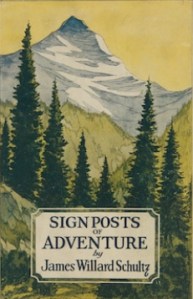
The Southern Piegan were plains oriented, as C. W. Buchholtz notes in Man in Glacier. In addition to the 1895 land sale, he believes that the association of the Tribe with the park as a whole was based on legends that could have arisen during numerous migrations over the course of time from any mountain range, the Blackfeet place names assigned to park rivers and mountains by James Willard Schultz (Signposts of Adventure), George Bird Grinnell and others, and by the Great Northern Railway’s “Glacier Park Tribe” publicity campaign in the 1930s. (The railway built, and originally managed, the park’s historic hotels up until 1960.)
Present-day programs within the park honor the legends as well as Glacier’s Blackfeet neighbors headquartered at Browning. Since park visitors, especially those at Glacier Park Lodge on U.S. Highway 2, are only a few miles away from Browning, it’s easy to include the Museum of the Plains Indian in vacation plans.
Malcolm R. Campbell is the author of two contemporary fantasies partially set in the park, Sarabande and The Sun Singer. He served as an editorial assistant for the publication of the original edition of “Place Names in Glacier National Park.”
Jane Yolen’s collected poems in The Last Selchie Child, from A Midsummer Night’s Press, are a celebration of storytelling. Part I, Story explores the craft itself; Part II, Stories takes us to the sea and elsewhere into the distant past when the world’s once-upon-a-times were more intangible than they are today; and Part III, Telling the True, gets to the heart of the matter, the veracity of the tales a storyteller tells.
In “The Storyteller,” in Part I, Yolen writes about the fundamental essence of the art of a tale:
It is the oldest feat of prestidigitation. What you saw, what you heard was equal to a new creation.
The title poem “The Last Selchie Child” begins Part II:
But I am the last selchie child, my blood runs cold in my veins like an onrushing tide.
In Part III, “Family Stories” reminds readers of the childhood stories they heard, but no longer recall:
My brother and I are pieced together like crazy quilts. We keep warm on winter evenings with the weight of all those tales.
Publisher’s Description:
Magical transformations, enchanted mirrors, talking animals, familiar tales in unfamiliar guises, all these and more are found in the pages of The Last Selchie Child.
Retellings of archetypal myths and fairy tales and the nature of storytelling itself are explored in this new collection of poems by Jane Yolen.
This tiny book of tales, published in a 6×4 format, grows larger and larger with each reading of its magical poems.
Sometimes I run out of new books to read. My official wish list is long, but my wallet isn’t full enough to keep the shelves stocked up with fresh reading. So, I re-read some of my favorites from the past such as “The Prince of Tides” and “The Great Gatsby.” Or, I turn to light reading.
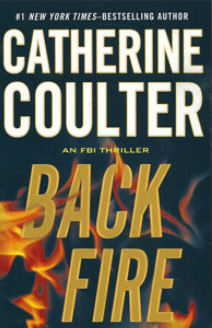
Catherine Coulter probably wouldn’t like to hear me referring to the 16 books in her FBI Series as light reading. Her latest is “Back Fire,” released this month. Here’s the publisher’s description:
San Francisco Judge Ramsey Hunt, longtime friend to FBI agents Lacey Sherlock and Dillon Savich, is presiding over the trial of Clive and Cindy Cahill – accused in a string of murders – when the proceedings take a radical turn. Federal prosecutor Mickey O’Rourke, known for his relentless style, becomes suddenly tentative in his opening statement, leading Hunt to suspect he’s been threatened – suspicions that are all but confirmed when Hunt is shot in the back.
Savich and Sherlock receive news of the attack as an ominous note is delivered to Savich at the Hoover Building: YOU DESERVE THIS FOR WHAT YOU DID. Security tapes fail to reveal who delivered the tapes. Who is behind the shooting of Judge Ramsey Hunt? Who sent the note to Savich? And what does it all mean? Savich and Sherlock race to San Francisco to find out…watching their backs all the while.
Savich and Sherlock are a husband and wife FBI team. They work well together. They solve cases. They’re fun to read about. Judge Hunt is also a great character. No, I’m not reading “Back Fire;” Judge Hunt also appears in “The Target” (1998) which I’m reading now. “The Target” is the third FBI Series book I’ve read in the past month, so Savich and Sherlock seem like neighbors now. (It’s also the third book in the series, though I’m not reading them in the same order they were released.)
For me, one appeal of books in a series such as Coulter’s and Elizabeth Peters’ Amelia Peabody books is the fact that the characters, genre, author’s style and general tone of the books are known going in to each new story. In addition to the familiar characters, the plots have enough mystery and action to keep my interest until the next shipment of official reading list books arrives from Barnes & Noble.
I’m guessing that a lot of avid readers have books and series they turn to when there’s suddenly nothing new waiting on the nightstand. They’re rather like old friends, the kind who stop by for a cold beer and easy conversation on a hot afternoon.
“The Twa Corbies”, Illustration by Arthur Rackham to Some British Ballads – Wikipedia
In Part 1, I suggested that magical animals in fantasy, magical realism and folktales should start out on your imaginary drawing board as factually accurate as possible. Real-world facts make your animal believable.
Whether your animal can perform overt acts of magic, such as my flying horse Sikimi in The Sun Singer and Sarabande, or mysteriously appears on the scene when important things happen to the characters, such as the crows in Verlyn Flieger’s The Inn at Corbies’ Caw, you can add great depth by linking it to traditional myths and superstitions, American Indian creation myths and real or imaginary local stories and beliefs. When you do this, you are building either on what the reader already believes (ravens hang out in grave yards and bring bad luck) or you are layering the story with information that, while probably new to the reader, helps make your magical animal three dimensional.
In a recent short story about the rare Florida panther, I noted that according to Seminole myth, the creator placed all the animals into a birthing shell from which they emerged when the time was right. The first animal to come into the world was the panther, and she had certain qualities that made her special. Since my story is set in a long-ago time period before humans arrived, the animals view the birthing shell as real. They mention it in an off hand way because my short story is not retelling the myth; the mythic backstory gives my panther a larger than life ambiance.
Many writers turn to Nature-Speak and/or to Animal-Speak: The Spiritual and Magical Powers of Creatures Great and Small by Ted Andrews for a comprehensive introduction to a large number of animals as they are seen in myth and folklore. The books are especially valid for stories set in the United States since they have an American Indian flavor. I prefer to find out about my prospective magical animals before I start writing so I can build their characterizations and actions around the myths and superstitions rather than pasting a “surface-level” set of qualities on top of an otherwise realistic creature.
The Internet is an amazing resource as long as one double checks everything from multiple sources to: (a) insure the myth or legend is widely known rather than being one writer’s imaginary story or religious belief, (b) locate enough detail to keep your account (including the adjectives and phrases you use) from sounding too much like the one source you located. When setting a story in a real location, a you can start with such online searches as creation myths of the Seminoles (insert appropriate tribe for the region) , panther (insert appropriate animal) myths and legends, and Florida (insert state, city, park, forest or resort) animal legends.
How Magic Do You Want Your Animal to Be?
Magic has to be used carefully, for if you make your main character (human or animal) all powerful, then you won’t have a way to build an exciting story. When your animal is all powerful, then you can build in understood “rules” that keep it from solving all the challenges in the story the minute it arrives. My flying horse, for example, is on the scene to transport my human characters from place to place. But he allows them to decide where they’re going and what they’re going to do when they get there. While he occasionally takes strong action, he generally doesn’t interfere in the fate, destiny or logical plan of the humans.
You can, of course, make all of the magic indirect. That is, if an character’s totem animal is the raven, the raven need not have Superman-like powers to play a role. He can appear in dreams and visions with cryptic messages, can be seen flying in a certain direction as a hint to the characters to go that way, and can be placed in trees or in flight overhead when things are beginning to get frightening. This approach works well in contemporary fantasy and magical realism where your magical animals generally don’t have the capabilities of science fiction and fantasy animals in other worlds where the rules are different.
In “real life,” an overtly magical animal would attract attention. Of course, if that attention and how the human and animal deal with it, is important to your story, then hiding the animal’s abilities wouldn’t be an issue. Otherwise, magical animals tend to be more overt when they appear in parallel worlds, spooky uncertain regions, and deserted places. You can also blur the level of reality by opening up the possibility that the magical things a character saw and/or took part in, might have been the stuff of his imagination and dreams. You will see when you do your research into animal superstitions and tales, that magic tends to happen in places where the whole world cannot see it. This not only makes the magic potentially more frightening (it happens at midnight where two roads cross, for example), but keeps it from getting out of control in your story.
If your protagonist is a human, the rules of storytelling (depending on the genre) generally call for him or her to have more control over the direction of the plot than the animal. When placed within a dangerous situation, you character—knowing or not knowing the magic that’s “available”— will make choices to run, to hide, to fight, to be heroic, to find hidden strengths, or perhaps to fail. The magical animal cannot run in out of nowhere and “fix” all of the character’s problems. If so, the story become very anticlimactic.
In most fantasy, there are various “rules in place” in the parallel universe and in adjoining or overlay worlds that contain or restrict all the magic. This also makes stories more suspenseful and mysterious and keeps them from ending on the first page. Even Superman can’t do everything and be everywhere at once: the fact that he can’t, is what makes the story a story. The same is true for your magical animals.
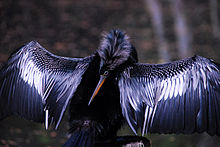
I grew up seeing Anhingas in Florida swamps. A bit of Internet research told me why they dry their wings before flying.
Animals in fantasy, folktales, faerie, and magical realism often have the ability to perform magic, change shapes, influence human events, know the future, or serve as guides between realms or worlds. While the needs of these genres are not the same, it helps to start off with as much knowledge as you can about real animals in their natural habitats. Once you know what an animal eats, how and where it sleeps, what its habits are, and what it looks like, you can branch off from there.
While most readers cannot recite the same specifics as a wildlife biologist, they do have a sense about how animals move around in their environments, and what kinds of animal habits in a work of fiction come across as true or apparently true, and what is blatantly impossible. If you’re writing faerie tales or folktales or creating animals “from scratch” like those we saw in the Harry Potter books, you have more latitude than you do in contemporary fantasy or magical realism.
My feelings about this are somewhat based on my own manner of writing, insisting on accuracy to a fault. For example, in a recent story my two main characters were driving between two real-life towns while listening to a real-life CD. My accuracy thing while writing this is to see how many miles the people will travel at normal speed and then look at the playing times of the cuts on the CD. It doesn’t have to be exact: but personally, I don’t want my characters to purportedly listen to 30 minutes of music during a ten-minute drive.
Likewise, even in fantasy and folktale, I don’t want my animals eating or sleeping in places they never eat or sleep in real life. Sure, magical powers can account for a lot of differences between real animals and fantasy or folktale animals. But the wider the gap you have between the animal in your story and the animal in real life, the less viable your story is and the greater the odds the readers won’t go along with it.
If I had the time and money, I would go into the field with a wildlife biologist and listen while s/he describes the animal behaviors and habitats we’re looking at. Like most writers, I can’t invest in $100 worth of highly specific books from Amazon just for a short story. This means relying on dozens of websites to find the foundation facts for my story.
I was trained as a journalist, yet as a novelist I believe in magic. That means I dislike and have trouble following stories or novels where everything is totally fabricated. If nothing in the story is real, it will probably not attract an audience.
I anchor my stories with verifiable facts about the animals and the settings. Perhaps you will anchor your stories in some other way. But when it comes to creating magical animals in fiction, it won’t hurt to know what your animals do and don’t do, eat and don’t eat, and are capable of and not capable of in “real life” before you start adding the fantasy elements, animal totem qualities, traditional myths and legends involving the animal, superstitions and the stuff you imagine as you put yourself in the animal’s self and walk around a bit.
If you place magical powers on top of a totally unrealistic animal, your story is going to be very difficult to write, much less keep a reader’s attention. A little careful research into your animal in nature will improve the magical animal in your story.
 Shelly Bryant (Cyborg Chimera, Under the Ash) is a prolific poet whose work never fails to inspire readers with pointed and poignant images that rise from the earth on the wings of spare words. Her new collection Voices of the Elders from Sam’s Dot Publishing is startling in the risks taken, the variety of its forms and references and the scope of its vision.









 Malcolm's Round Table