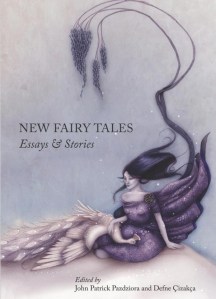
New Fairy Tales: Essays & Stories by John Patrick Pazdziora and Defne Çizakça (Unlocking Press – Sep 6, 2013), 456 pages
Is there a market for a book that mixes academic writing and stories? Normally, I wouldn’t think so outside the world of college textbooks. But this book works. Maybe it’s because so many of us who love reading fairy tales also like reading about what makes them tick.
In the introduction, the editors write,
“In New Fairy Tales, we have worked with both writers and academics, as well as with writers who are academic and academics who are writers. Fiction and critique appear within the same sections rather than separately. We hope the interplay between critical thought and aethetic practice will inspire even more new fairy tales to come to life.”
The stories an essays are divided up into five sections: Miniatures, Storytellers, Shadows and Reflections, Fairy Brides, and Fairy Tale Pedagogy. The book includes offerings from Claire Massey, Katherine Langrish, Christopher MacLachlan, Elizabeth Reeder, Joshua Richards and Kate Wolford. The thematic sections are supported with notes for readers who like following up on sources.
From the Publisher
New Fairy Tales unites critical research and creative retelling of the fairy tale tradition from the Early Modern period to the present day. Academic essays intersect with new fiction and poetry, to create a unique, polyvalent discourse. The essays discuss influential works from authors including Hans Christian Andersen, George MacDonald, Oscar Wilde, J. R .R Tolkien, J. K. Rowling, Neil Gaiman, and Tifli. Original literary fairy tales by Katherine Langrish, Elizabeth Reeder, and others, appear alongside, discovering and re-creating the art form while as is being discussed. The result is an audacious and innovative dialogue about fairy tales and storytelling.
Interview With the Book’s Editors
In a two part interview in “Enchanted Conversation: a Fairy Tale Magazine” (posted here and here), Çizakça says she hopes readers of the book will take away a “belief that fairy tales still contain endless possibilities for growth and innovation. That there are many different ways of writing a new fairy tale, and that there are many different traditions one can take inspiration from.”
According to Pazdziora. there’s been heightened interest in fairy tales in the English speaking world during the last two decades. “Of course there’s a long and distinguished tradition of folkloristics, and there’s been the German study, but looking at literary fairy tales both as a distinct genre and as a subgenre of children’s literature—and like it or not, it’s both those things—that’s fairly new, at least in the form it’s taking now.”
Perhaps this book will result in a follow-up anthology with an even wider representation of the world’s old and new fairy tales.
–Malcolm
Malcolm R. Campbell is the author of contemporary fantasy novels, including “The Betrayed,” and fantasy short stories including the three-story set for kids and adults, “Emily’s Stories.”
“Every story involves a problem or Central Dramatic Question that disrupts the Ordinary World. The Hero must enter the Special World to solve the problem, answer the dramatic question, and return balance. The Ordinary World allows the storyteller to contrast the Ordinary and Special worlds. The ordinary World is the Hero’s home, the safe haven upon which the Special World and the Journey’s outcome must be compared. Areas of contrast may include the Special World’s physical and emotional Version of characteristics, its rules and inhabitants, as well as the Hero’s actions and growth while traveling through this Special World.” – Stuart Voytilla in Myth and the Movies
“It is a very strong rule in drama, and in life, that people remain true to their basic natures. They change, and their change is essential for drama, but typically they only change a little, taking a single step towards integrating a forgotten or rejected quality into their natures.” – Christopher Vogler, The Writer’s Journey: Mythic Structure for Writers
“When a great adventure is offered, you don’t refuse it.” – Amelia Earhart.
In Hero’s Journey stories, the dynamic question that stirs up the everyday life of the protagonist is referred to as “The Call to Adventure.” The event that gets the hero’s attention also gets the reader’s attention. Sometimes the reader knows about the event before the protagonist. In The Cuckoo’s Calling, for example, a body falls off a balcony in the first sentence of the book. Cormoran Strike, a private investigator, reads about the event in the newspaper but doesn’t know he will be involved until he’s hired to investigate the crime. If the Call to Adventure is delayed in the story, authors must decide how to keep readers engaged until the dynamic event occurs. Sometimes the would-be hero will need a series of calls before s/he reacts.
Here are some events from popular movies that disrupted the day-to-day life of the main character and created the circumstances that pulled him or her into a journey:
Star Wars: Luke’s life is turned upside down when a droid with a message from Princes Leia arrives on his planet.
Harry Potter and the Sorcerer’s Stone: Owls bring letters from Hogwarts inviting Harry to enroll. Each of the subsequent films/books in the series introduced the action through a new call to adventure. Each film/book was a journey, and the series was an overarching odyssey of journeys.
High Noon: A villain arrives at the small town’s train station. Like Notorious, this movie followed a mythic structure long before the format became widely known through the works of Joseph Campbell. The general public became more aware of Joseph Campbell after his interviews with Bill Moyers on PBS in the 1980s. Hollywood executive Christopher Vogler adapted Campbell’s work for authors and scriptwriters in his The Writer’s Journey: Mythic Structure for Storytellers and Screenwriters released in 1992.
Notorious: The Cary Grant character, T.R. Devlin, asks the Ingrig Bergman character, Alicia Huberman, to infiltrate a spy ring.
The Matrix: A message on Neo’s computer screen tells him to follow the white rabbitt
You’ve Got Mail: A mega-book store opens around the corner from Kathleen’s small store forcing her to fight for her business
The Lion King: Mufasa tells Simba that one day the kingdom will be his.
Close Encounters of the Third Kind: After a UFO burns electrical lineman Roy Neary’s face and vehicle, he receives psychic images of Devil’s Tower. On the conscious level, a man wants to know more about a UFO; on the subconscious level, the story not only affects Roy, but has ramifications for all of human kind.
The Wizard of Oz: Toto runs away after being grabbed by Miss Gulch. The musical numbers an animated scenes in this movie often obscure the fact that it’s a journey film. Like Mary Poppins, this film shows that journey films and books need not be overtly dark, deep and inaccessible, and often attract wide audiences who are looking for “pure entertainment.”
Field of Dreams: Ray hears a voice say “If you build it, he will come.” Like many journey films, this one is a very personal story about a man and his father. Yet, the results of Ray’s baseball field impact a lot of other people as well.
The Hunger Games: Katniss Everdeen’s destiny is changed when her sister is randomly selected as a Hunger Games contestant. The resonance of this film with large audiences shows, I think, the inherent power of a mythic story even though most of those in the theater are viewing the story quite simply as an adventure.
The Call to Adventure may look random, but in a mythic sense–as Joseph Campbell saw it–the call was, in fact, the hero’s destiny. While that destiny may be personal, if often has ramifications for the protagonist’s family, town or nation.
Great myths–those many of us grew up hearing in school–tended to be about gods, national heroes and the destinies of peoples and nations. Fairytales, on the other hand, made similar things more personal and practical for everyday people. Both myths and fairytales have a lot to teach us about the human condition and its great themes as well as about how page-turning stories should be told.
Stories demand a certain amount of plausibility, so most protagonists–no matter how complacent they may seems–are more or less ready for the adventure. They live under dysfunctional, dissatisfying, static or dangerous conditions. The Call to Adventure is the spark that ignites the waiting combustible material. As authors, we start our stories by upsetting the status quo: that is what the Call to Adventure does in fiction.
Malcolm R. Campbell is the author of the Garden of Heaven Trilogy, a series of contemporary fantasy novels with many hero’s journey themes. They include “The Seeker,” “The Sailor” and “The Betrayed.” All three novels are available on Kindle, Nook, OmniLit, Smashwords and iTunes.
With all the high-energy buzz surrounding books like Donna Tartt’s The Goldfinch, Amy Tan’s The Valley of Amazement, and John Grisham’s Sycamore Row, I have to look a little harder to find new fantasy fiction, especially contemporary fantasy.
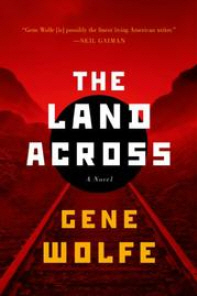
So, I’m happy to see that Gene Wolfe’s (“The Book of the New Sun” tetralogy) new release from Tor Books will appear a few days before Thanksgiving filled with corruption, supernatural powers and a Kafkaesque flavor. The Land Acrossunfolds in an imaginary Balkan country that’s difficult to visit and more difficult to leave–in part because of the secret police and in part because of a cult called the Unholy Way.
Teaser Excerpt from the Novel
Like most countries it is accessible by road or railroad, air or sea. Even though all those are possible, they are all tough. Visitors who try to drive get into a tangle of unmarked mountain roads, roads with zits and potholes and lots of landslides. Most drivers who make it through (I talked about it with two of them in New York and another one in London) get turned back at the border. There is something wrong with their passports, or their cars, or their luggage. They have not got visas, which everybody told them they would not need. Some are arrested and their cars impounded. A few of the ones who are arrested never get out. Or anyhow, that is how it seems.
Wolfe
Reviews
Kirkus Reviews says The Land Across “seamlessly blends mystery, travelogue, authoritarianism and the supernatural.”
Publishers Weekly says “Wolfe evokes Kafka, Bradbury, and The Twilight Zone in combining the implausible, creepy, and culturally alien to create a world where every action is motivated by its own internal logic, driving the story forward through the unexplored and incomprehensible.”
According to Library Journal’s starred review, “Wolfe, in masterful mood, builds his characters, explores the puzzles, links the elements together and contrives to render the backdrop both intriguingly attractive and creepily sinister. Sheer enjoyment.”
And Booklist writes, “Master fantasist Wolfe feeds into every tourist’s worst fears in this cleverly constructed travelogue though a country figuratively accessed through a looking glass. When an American travel writer, Grafton, sets out to document his experiences traversing a small, exceedingly obscure Eastern European country (the land across the mountains), he winds up in a nightmarish predicament from which there appears to be no escape.”
I like contemporary fantasy because, in blending magic into the real world, it brings us plots and characters that seem somewhat more plausible than swords and dragons on far-away planets. Almost everyone who has traveled has worried about being lost in an unfamiliar and unfriendly place. Wolfe’s protagonist is a travel writer who should know his way around the risks, but he’s nonetheless trapped in a place where mere unfriendliness would be a plus.
Malcolm R. Campbell is the author of contemporary fantasy novels, including “The Seeker,” “The Sailor and “The Betrayed.” Released this month, “The Betrayed” features a young English teacher at a small campus where lies and deceits take precedence over literature, history and science.
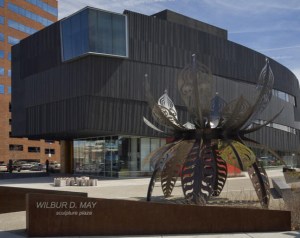
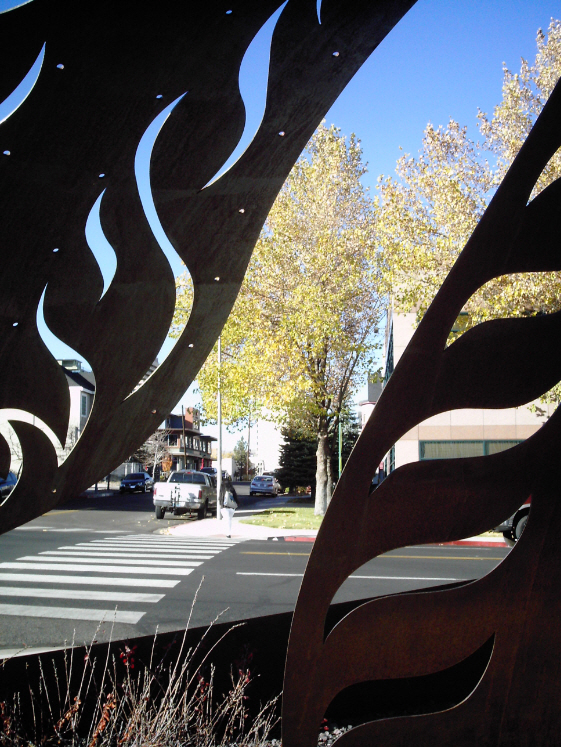
After a family visit to the Nevada Museum of Art in Reno, the adults rested on a stone wall while my two granddaughters burnt off energy racing around the adjoining Wilbur D May Sculpture Plaza.
They were fascinated by the 19-foot-wide, 12-petal lotus flower created by sculptor Kate Raudenbush.
Called the Guardian of Eden, the metal sculpture inspired Buddhist symbolism, Hindu and Egyptian creation myths, ancient Flower of Life symbol. Even though I was tired, I couldn’t resist seeing what my granddaughters saw while standing in the shade beneath the Guardian.
Stand in an unusual place and see the world anew.
The world looks very different from within the sculpture. My five-year-old granddaughter, Freya, liked standing close to the leaves and looking at the museum building and the others at that intersection through the holes. I can’t say what she saw, but I saw a world defined–created, perhaps–by the sculpture. The shade beneath the Guardian was part of it and so were the bits and pieces of West Liberty Street obscured by the petals.
That which was visible by my changed perspective beneath the sculpture was more important than that which was covered up. In many ways, the sensation is like staring at the spaces between the leaves of a tree rather than focusing on the leaves.
Children naturally explore their world and the, play with it–so to speak–by looking at it from slides and swings, by handing upside down on a jungle gym, peering at it through a stand of weeds, the hair of a doll or the holes in a colander.
As writers, we do this, too. When we do, what do we see? What do we imagine? And what new stories can we tell? It’s fun to speculate about such things and then go out and create one’s own adventures.
Malcolm R. Campbell is the author of contemporary fantasy, including the recently released “The Betrayed,” a story of lies, deceit and corruption on what appeared to be an Edenic college campus. Click on the banner to grab your Kindle copy today.
Once the barrage of lightweight summer books has come and gone, readers’ thoughts to turn fall reading and holiday gifts. To help us make our choices, the usual flurry of best books of the year articles and lists is showing up all over the Internet and in your favorite book stores. For this, you can always start with the list of 101 best books of the year on Publishers Weekly. (The feature has site errors in it, but click on OK and get past them.) Or you can look at USA Today’s list of fall books here.
Indie Bound publishes a “Next” list for upcoming books. Here are their favorites for November:
Likewise, Southern Independent Booksellers Alliance (SIBA) keeps up with bestsellers for bookstores in the southeast. Here’s the link to their hardbacks PDF. On the download, they’ve highlighted several books, including:
When people ask me about fiction and poetry, my answer depends on what (if anything) I know about the person. Do they like romance, fantasy, general fiction, crime? However, my three top picks of the year in fiction are:
And, for those who like poetry (I think Bryant’s latest book is only on Sams Dot Com):
I’m intrigued by these short stories, but they may not work for everyone:
In the crime category, I liked Robert Galbraith’s (J. K. Rowling) The Cuckoo’s Falling and Stephen King’s Joyland. In plays, I liked Elizabeth Clark-Sterne’s On the Doorstep of the Castle. Also, Tracy R. Franklin’s strong collection of poetry and essaysLooking for the Sun Door is a beautiful book. And, since a short story of mine appears in the anthology, I have to mention Spirits of St. Louis: Missouri Ghost Stories. Of course, I wouldn’t mind if you clicked on the banner below to take a look at my new contemporary fantasy The Betrayed.
I hope you find plenty out there for your to-be-read list and for the lists of your friends and family.
“We find them everywhere in fantasy fiction: the “orphaned heroes,” young men and women whose parents are dead, absent, or unknown, who turn out to be the heirs to the kingdom, the destined pullers of swords from stones, the keys to the riddles, the prophesies’ answers, the bearers of powerful magic.” – Terri Windling in Lost and Found: The Orphaned Hero in Myth, Folklore, and Fantasy
“The hero, Tristan, is a conventional orphan-hero. Mythic heroes are typically orphans and/orfoundlings of some sort. This symbolic convention was first discovered by psychoanalyst OttoRank (1914/1964), described in his classic work, ‘The Myth of the Birth of the Hero.'” – Ronald L. Boyer in “Key Archetypes in the Celtic Myth of Tristan and Isolde: A Brief Introduction”
Orphans in literature and in fact are portrayed as beginning life behind the figurative 8-ball. In novels and classic myths, they grow up in an uncertain world, often without love and often with cruel or other substandard conditions. Sometimes we find them in institutions, sometimes with relatives or foster families, and sometimes as street-smart children living on the fringes of society in major cities.
Variously, society often pities them, mistrusts them, intrudes into their lives purportedly in their best interests and views them as broken children who will have a long, hard climb back into the normal world of commerce, relationships and other traditional forms of success. We also see them as underdogs and, in spite of whatever else we may feel about their birth and circumstances, we root for them in literature and life.
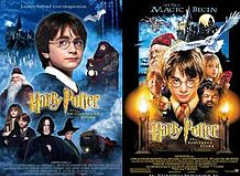
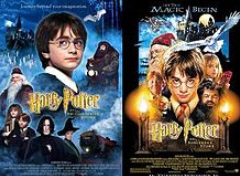
In J. K. Rowling’s series of Harry Potter books and movies, Harry is the unwanted orphan forced to live in a cupboard beneath the stairs. In Suzanne Collins The Hunger Games, the fatherless and –practically speaking–motherless Katniss Everdeen struggles to support the family in a coal mining district. Do they have an extra axe to grind? Has their childhood made them more suspicious and/or more resourceful than children in happy families? Perhaps.
The first real help they get comes from outside their families. Harry is mentored by Hagrid. Katniss is mentored by Haymitch Abernathy. Harry leaves his everyday world when he goes to Hogwarts and Katniss leaves her everyday world when she takes the train to the capital city.
In their stories, Katniss and Harry follow a long literary tradition. According to John Granger (aka, the Hogwarts Professor), their “hero’s journey — one in which the principal character plays the part of what the Bible calls ‘the heart’ and their story is about their apotheosis or spiritual illumination, something like divinization — has a tradition of its own in English literature we can call ‘literary alchemy.’” Twilight,The Hunger Games and Rowling’s series contain similar tropes and symbols.
Whether we consciously know what those themes and symbols are, we resonate to them when we read myths and modern fiction that contain them. One way or another we know what it takes to turn lead into gold and to turn an orphan into a heroic figure.
We have seen this story in many forms with many characters. As Windling writes:
“We can trace the archetype back from the popular fantasy books listed above to the literary orphans of the 19th century (Dickens’s ‘Oliver Twist’, Mark Twain’s ‘Huck Finn,’ Charlotte Bronte’s ‘Jane Eyre,’ to name just a few), and then further back through “foundling” stories such as Henry Fielding’s ‘The History of Tom Jones’ and William Shakespeare’s ‘The Winter’s Tale,’ to a world–wide body of folk tales and myths about children orphaned and abandoned. Alongside these stories is another deep cache of tales on the “stolen child” theme: children whisked away by fairies, trolls, djinn, gypsies, Baba Yaga. . .sometimes reappearing many years later and sometimes never seen again. We discussed changeling and stolen child stories in a previous article, so well leave these tales aside for the moment and focus on the orphan archetype.”
Stories about orphans in the storm can be powerful because of the authors’ art and craft in creating memorable plots and characters. They’re also powerful because such stories are part of a long literary tradition than rings a bell, subconsciously perhaps, when we pick up a book about an orphan on a larger-than-life journey.
Junction City, TX—Frank N. Stein, owner and operator of the Ghost-of-a-Chance Cemetery at 666 Deadline Road plans a Death by Chocolate Hallowe’en for kids trick-or-treating at “death’s door.”
“This year, we’ll be handing out our usual death bells, death watches, and door-nails to everyone who knocks at the Death’s Door entrance to the cemetery,” said Stein. “We’re especially excited about this year’s ASK NOT FOR WHOM THE OPEN GRAVE CALLS gala. I think we’re going to top last year’s BABY, CAN YOU HEAR DEATH’S RATTLE sing-along.”
Chief gravedigger T. Stone, who laughingly claims he’s the only one on the premises who knows where all the bodies are buried, said he almost worked himself into an early grave getting all the holes dug in time.
“I’m death-warmed-over exhausted,” he said, “but I’ll be cheating the grim reaper again by
Monday night.”
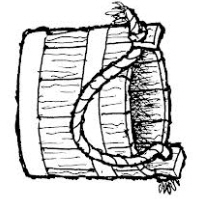
According to a dead letter posted at the cemetery door, every kid who successfully kicks a plastic bucket of dead men’s fingers into an open grave from six feet away will be presented with a “Dead Weight of Chocolate.”
“Most of them aren’t real dead men’s fingers,” said Stein. “We chopped up a bunch of old mannequins and littered the pieces around the place to scare the life out of the younger kids. We had enough dead hands left over to pretty much give everyone the finger.”
“I practiced kicking the bucket all afternoon,” Stone said, “and it’s not as easy as you think. Those kids will have to use a little dead reckoning to get it in the grave.”
Plans to offer vodka labeled as embalming fluid were deep-sixed once the Deadline Road Homeowners Association got wind of it and raised a stink.
“We don’t mind the spirits so much as the thought of hearing the words of that hideous old song ‘National Embalming School’ blasting away all night loud enough to wake the dead,” said association president Darla Norris. “We’re not teetotalers out here. After all, we snapped up our share of the icy sixpacks they gave away during the CRYING IN MY BIER festival three years ago.”
Ghost-of-a-Chance began inviting trick-or-treaters onto cemetery grounds 25 years ago when Stein’s father Charles announced that he could no longer afford to “buy enough deadlights and deadlocks to keep out the deadbeats who sneak in every year to knock over a tombstone or two after knocking up their girlfriends.”
Norris, who has lived on Deadline Road for 26 years, said that almost everyone in her neighborhood was conceived as a Hallowe’en trick in the years before “old Charlie Stein made vandalism a dead issue while making death and cemeteries a real treat again.”
The police department’s Dead-to-Rights Hallowe’en Task Force will work the graveyard shift again this year to provide security and to pick up anyone who is dead drunk. Doctors from Memorial Hospital will be on hand to assist anyone who gets one foot caught in the grave. Overflow parking will be available in Potter’s field.
“We’ll be dead to the world by the time the night’s over,” Stein said. “It’s worth it, though. We’re putting the boot back into boot hill to make life better for kids in the here and now while reminding their aging parents to consider us in their plans for the hereafter.”
# # #
A selection of the good, the weird, and the utterly insane of investigative reporter Jock Stewart’s news stories and Night Beat columns.
Available on Smashwords in multiple e-book formats for 99 cents.
The Decatur I knew from many childhood vacations to visit my grandparents on West Wood Street no longer exists. My grandparents house, featured in novels The Sun Singer and Sarabande, has been torn down for reasons unknown.
The interurban trains and the streetcars are long gone and the old transfer house where people changed trains and buses in Lincoln Square is now an heirloom in a city park. Since I haven’t been to Decatur for years, I don’t know whether the pungent odors from the Staleys plant still blanket the city when the wind is blowing the wrong direction.
Fairview Park is still there–minus the passing interurbans–and I see from maps and park brochures that it has evolved over the years. It still sits a few blocks away from the place my grandparents’ house once stood. It was perfect for day trips and–a half century later–equally perfect as a location setting in my novels. As children, my brothers and I hiked in nearby Spitler Woods.
Greenwood
I’ve heard that the notorious Hell Hollow has been cleaned up, but that on certain evenings one can still see ghostly lights in Greenwood Cemetery. The Haunted Decatur website claims that the dead still walk and, quite frankly, that is something I would like to see. A few miles down the road, the trails of the widely known Allerton Park echo in my memory as well as in my novel The Sun Singer which was named after the famous statue in the park.
Childhood’s Magic Calls Me Back
As an author of contemporary fantasy–that is to say, fantasy mixed into real locations as in the Harry Potter series–I have variously used Glacier Park, Florida’s Tate’s Hell Swamp, Decatur and other locations as story settings. I have mixed the old and the new by tangling up personal memories and the histories of these locations in my work.
Robert Adams in The Sun Singer visits Allerton Park and has a psychic experience–as I once did–beneath the Sun Singer statue. In my upcoming short story “The Lady of the Blue Hour” for “Aoife’s Kiss Magazine,” I blend myths and history from the days when Illinois was a French Province with a young man who lives on West Wood Street next to my grandparents’ house. And, in my soon-to-be-released novel The Betrayed, I set much of the action at a fictional college and tangle that up with the streets and houses in Decatur’s West End Historic District (not too far from where the Transfer House once stood).
While I enjoy mixing contemporary fantasy, location setting history and personal memories together in my stories, I don’t necessarily advise other writers to do it. It makes it difficult at times to separate real memories from one’s fiction. The real location settings make fantasy more believable, I think. The real-life experiences–readers don’t know which events those are in the story–make fantasy more dear to the author during the writing process.
Sun Singer at Allerton Park in nearby Monticello
This quote from author P. L. Travers (author of the Mary Poppins books and a primary character in the new feature film Saving Mr. Banks) closely approximates my beliefs about the stories I set in Decatur: “We cannot have the extraordinary without the ordinary. Just as the supernatural is hidden in the natural. In order to fly, you need something solid to take off from. It’s not the sky that interests me but the ground. . . . When I was in Hollywood the [script] writers said, surely Mary Poppins symbolizes the magic that lies behind everyday life. I said no, of course not, she is everyday life, which is composed of the concrete and the magic.”
Naturally, my stories about ghosts, flying horses, magic avatars’ staffs and alternate realities and universes cannot be published under the banner of realism or mainstream fiction. So, while much of what I write about Decatur and Glacier Park and Florida Panhandle swamps is real, I’m officially a contemporary fantasy author. I don’t mind: I read a lot of fantasy.
And, when I read fantasy, I wonder how much of the magic is real and how much of it is truly fiction. However, since this is another of my “on location” posts, I assure you that Decatur, Illinois is real–or mostly real, depending on who you ask.
–Malcolm
Malcolm R. Campbell is the author of Conjure Woman’s Cat
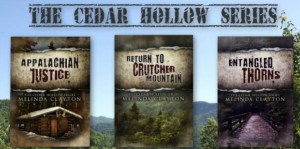
Today’s guest is author Melinda Clayton (“The Cedar Hollow Series”). Her new novel, a stunning tale about a family in the midst of self-destruction Blessed Are the Wholly Broken, was released October 16. Clayton, who has published numerous articles and short stories in print and online magazines, is a licensed psychotherapist in the states of Florida and Colorado. She holds an Ed.D. in Special Education Administration. She recently founded Thomas-Jacob Publishing described as a “unique family-owned publishing company.”
Clayton previously visited Malcolm’s Round Table in July of 2012 when her novel Entangled Thorns was released as the third book in “The Cedar Hollow Series.”
Malcolm: Welcome back! In your new novel Blessed Are the Wholly Broken, you move away from the Appalachian Mountain families in “The Cedar Hollow Series” to Phillip and Anna Lewinsky, a modern-day urban couple, living in Memphis. As an author, how difficult was it to shift away from the prospective “comfort zone” of an on-going series with known characters and established settings to a new environment featuring students graduating from college who are ready for careers and family life?
Melinda: Thanks for having me back, Malcolm. It was difficult, but I also felt it was time. There may be other Cedar Hollow stories, but the story of Phillip and Anna Lewinsky had been rattling around in my head for some time. I had also wanted to write a story set in the area of Tennessee in which I grew up, so that was fun. It was also fun to revisit the University of Memphis on Memphis’ rainiest day of 1989. I remember that day well. I was really tired of the rain, of being cold, and of getting soaked on my walks to both class and work.
Malcolm: At the beginning of the book, you quote a line from “In Place of a Curse,” a signature poem by John Ciardi: “They who are wholly broken, and they in whom mercy is understanding, I shall embrace at once and lead to pillows in heaven.” In addition to suggesting a unique title for your novel, how does this sentiment set the stage for the story to come?
Melinda: I think of Phillip as being “wholly broken.” This is a man who in his early twenties felt he had everything he needed to be happy. In his words, “I felt like the luckiest guy in the world. First job, first apartment, first girlfriend, best friend. What more could I have possibly wanted?” But by his mid-forties, when we first meet him in the Prologue, he feels he has nothing at all. “Life imprisonment or death; that is the question. And while the outcome matters immensely to the other players in this drama of my life, it matters not at all to me. I am dead either way.”
I wanted to explore that dynamic, the path one might travel that could lead from euphoria to despair, from hopeful to hopeless.
Malcolm: Asking a therapist why s/he writes about characters with deeply rooted psychological problems probably makes as much sense as asking a composer why s/he writes about characters who are struggling with a symphony. Yet, as I think about both “The Cedar Hollow Series” and Blessed Are the Wholly Broken, I can’t help but see the books’ characters as almost being—as we say in the South—“too broke to fix.” In addition to the page-turning read we all look for, do you think these novels will also help provide closure for readers who know people who seem wholly broken and/or who often feel they might be wholly broken?
Melinda: Wow, I might have to think about that for a minute! I think the “broken” characters in the Cedar Hollow Series have within them some spark of hope, enough, at least, to compel them to continue moving forward. One reviewer remarked that she loved it that those books all ended on a hopeful note, a type of new beginning for the characters. If there’s a message to those books, it might be something along the lines of each cloud having a silver lining, or there being a light at the end of the tunnel. Never give up; this too shall pass, etc.
I think Blessed Are the Wholly Broken is different in that within the first page, we know Phillip Lewinsky has been found guilty of the murder of his wife. One of the beta-readers called me midway through reading and said, “But he’s going to get out, right?” She found him to be a sympathetic, likable character and wanted a happy ending for him. I suppose a philosophical argument could be made that in a paradoxical sort of way, he was happy with the ending and he did find the closure he was looking for, but the writing of Wholly Broken was more about an examination of the unraveling of a life than it was about reaching closure.
Malcolm: How do prospective wholly broken people/characters impact the therapist/novelist?
Melinda: In some ways, the impact is the same for both the therapist and the novelist, in that I’ve always been fascinated by trying to discover what makes us all tick. Behavioral theory would say we don’t engage in a behavior unless we’re getting something out of that behavior. Maybe we’re being positively reinforced in some way, or maybe we’re trying to avoid something uncomfortable. That’s overly simplistic, but I think for the most part, it’s true.
As a therapist, part of finding the solution lies in finding the why of the behavior. Once a person recognizes and understands the purpose behind their behavior, they can choose whether or not they want to change it.
As a novelist, it’s fun to work to tie together a character’s motivations, choices, and decisions with their ultimate outcome.
Malcolm: After readers learn on the first page of Blessed Are the Wholly Broken that a crime has been committed, the novel moves about quickly from one time to another and from one place to another rather like a “whodunit.” I felt like I was reading a detective story. How did you approach your research for this, especially that involving medical, police, prison and courtroom procedures?
The dorms at Memphis State University (now U of M) where Phillip and Anna meet.
Melinda: This novel, by far, required more research than all three of my previous novels put together. I spent time both talking with and emailing medical and legal experts as well as making several phone calls to the Lauderdale County Jail to make sure I accurately portrayed not only procedures, but physical components of the building.
I sent hardcopies of the chapters dealing with medical issues to an expert in the field of microbiology, and chapters dealing with legal and courtroom procedures to the founder of a law firm in New York.
I wanted the book to be as true to the regions as possible, so I also researched weather patterns in that area during that time to make sure if it was raining in the novel, it really had rained on that particular day. I pulled up calendars from that time to make sure if court was held on a specific day in the novel, it would have really been held on that day in Ripley, Tennessee.
I think I probably spent more time on research than I did on writing. Everyone was incredibly helpful; if there are mistakes, they’re completely my own.
Malcolm: While Blessed Are the Wholly Broken was still a work in progress, you formed your own publishing company. How did the becoming a publisher change your perspective about what it takes to prepare and format manuscripts, and to publish and market a book? How did it change your viewpoint as a writer? Did becoming a publisher change your writing habits or approach or were you able to keep your publisher’s hat in the closet until the manuscript was done?
Melinda: Becoming a publisher in the middle of the writing process taught me that publishing is a lot of work! In some ways it stifled me as a writer because as I typed, I couldn’t help thinking, “Ugh, once I get done with this manuscript, I have to reformat it three different ways….” On the flip side, I loved having the ability to review and proof the finalized manuscripts before hitting “publish.” It was nice to have one last chance to check for any typos or formatting errors before going “live.”
Malcolm: Best of luck with Thomas-Jacob Publishing and Blessed Are the Wholly Broken. Where can prospective readers find you your novels on the Internet?
Melinda: Thanks, Malcolm! And thanks for the wonderful interview.
All of my books can be found through major retailers such as Amazon and Barnes & Noble. They’re also available through Smashwords, Apple, Sony, and Kobo.
Domestic house cats are like often water, opting for slow and silent pressure rather than overt fire and brimstone approach of other pets when food time is approaching (and possibly forgotten by the two-leggeds in the house).
Our three house cats noticeably become more friendly as regular mealtimes approach. They lean against our legs when we walk through the house. They make little murping noises and rub against doorjambs and table legs in our presence.
But mostly, I can tell how close it is to their next meal by how close they are to my desk. When mealtime is 45 minutes away, they’re in the hallways. When it’s 20 minutes away, they’re outside my den door–or just inside it. When mealtime is imminent (or late) they’re right next to my desk. Sometimes I say, “Why are y’all going around in a pack” and they look at me with a variety of expressions of pity and disdain–their way of saying, “the old duffer doesn’t know how to tell time any more” and “Sure, when he wants something to eat, he just goes out to the refrigerator and gets it, but we have to wait because the Creator screwed up and didn’t give us the thumbs we need to open stuff.”
If cats could speak English, I’m sure they’d say, “Raccoons got thumbs and we didn’t. What kind of sense does that make?”
My answer would be, “They wash their food and you don’t. You don’t need thumbs.”
“If we had thumbs, we’d wash our food.”
Far be it from me to question why cats don’t have thumbs. If they did, food time for them would probably be 24/7 because (unlike what some cat books say), cats do overeat if the food is available.
But since it isn’t, I can set my watch by how close they are to my desk. Since they just got fed 25 minutes ago, they’re nowhere to be seen. Once they have their food, they have no use for me any more until 11 p.m. approaches. Then, I’m suddenly their best friend, the best thing since slice bread, or even a minor god (though not a smart god due to their lack of thumbs).
The cats who–as we know–move around on little cat feet like fog know how to use silence to exert pressure. Like the water that slowly erodes rock over time, they erode my concentration over time. I could be in the middle of writing the last line of the great American novel. But I can’t, because I can’t come up with the right words due to the sound of silence all around my desk.
Malcolm R. Campbell is the author of contemporary fantasy, paranormal short stories, and the three folktales about animals in “The Land Between the Rivers.”
 Is there a market for a book that mixes academic writing and stories? Normally, I wouldn’t think so outside the world of college textbooks. But this book works. Maybe it’s because so many of us who love reading fairy tales also like reading about what makes them tick.
 Malcolm R. Campbell is the author of contemporary fantasy novels, including “The Betrayed,” and fantasy short stories including the three-story set for kids and adults, “Emily’s Stories.”





 In their stories, Katniss and Harry follow a long literary tradition. According to John Granger (aka, the Hogwarts Professor), their “hero’s journey — one in which the principal character plays the part of what the Bible calls ‘the heart’ and their story is about their apotheosis or spiritual illumination, something like divinization — has a tradition of its own in English literature we can call ‘literary alchemy.’” Twilight, The Hunger Games and Rowling’s series contain similar tropes and symbols.