Jock Stewart Strikes Back by Malcolm R. Campbell –Now Available Audio, Print and All Ebook Editions!
Jock Stewart Strikes Back
by Malcolm E. Campbell
Since modern-day journalism is going to hell in a hand basket and/or nowhere fast, Jock Stewart strikes back by categorizing news events as satirical, outlandish, strange or political. Nonetheless, according to informed sources, the use of this volume as a journalism textbook has not been authorized anywhere the world is right as rain.
The fictional news stories and “Night Beat” editorial columns in this collection began as posts on the “Morning Satirical News” weblog and subsequently appeared in the Worst of Jock Stewart and/or the “Jock Talks” series of e-books. Jock Talks…Politics was a 2013 Pushcart Prize nominee.
Stewart, who served diligently as the protagonist in Jock Stewart and the Missing Sea of Fire, refutes charges that he was raised by alligators or hyenas. When he was a young boy, his dear old daddy said, “Jock, everyone but you and me is scum and I’m not sure about you.”
That proverb opened Jock’s eyes to the realities of the world, primarily that everything is worse than it seems: the small-town newspaper, the Star-Gazer, is allegedly run by fools and buffoons; the Junction City, Texas, government is allegedly corrupt and inept.
Production Notes
Jock Stewart Strikes Back is narrated and produced by Barry Newman, Florida. Barry’s career in media and journalism, including voice work in radio and TV commercials, lends a unique ‘Jock-ness’ to the production, and we look forward to working with him again in the future.
FRIDAY FINDS, hosted Should Be Reading, showcases the books you ‘found’ and added to your To Be Read (TBR) list… whether you found them online, or in a bookstore, or in the library — wherever! (they aren’t necessarily books you purchased).
I’ve been reading Diana Gabaldon’s “Outlander Series” since it began in 1991. The latest novel in the series, An Echo in the Bone, was released in 2009, with Written in My Own Heart’s Blood expected this June.
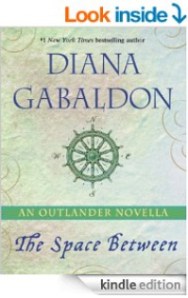
While waiting for the June release, I was happy to find Gabaldon’s novella, The Space Between, which came out last month.
From the Publisher
Joan MacKimmie is on her way to Paris to take up her vocation as a nun. Yet her decision is less a matter of faith than fear, for Joan is plagued by mysterious voices that speak of the future, and by visions that mark those about to die. The sanctuary of the nunnery promises respite from these unwanted visitations . . . or so she prays. Her chaperone is Michael Murray, a young widower who, though he still mourns the death of his wife, finds himself powerfully drawn to his charge. But when the time-traveling Comte St. Germain learns of Joan’s presence in Paris, and of her link to Claire Fraser—La Dame Blanche—Murray is drawn into a battle whose stakes are not merely the life but the very soul of the Scotswoman who, without even trying, has won his heart.
–
While this book, like A Leaf on the Wind of All Hallows (2012), is outside the mainstream series, it’s an interesting look at related characters and themes.
Malcolm R. Campbell is the author of the Garden of Heaven Series, a three-book fantasy and magical realism saga, including “The Seeker,” “The Sailor” and “The Betrayed.”
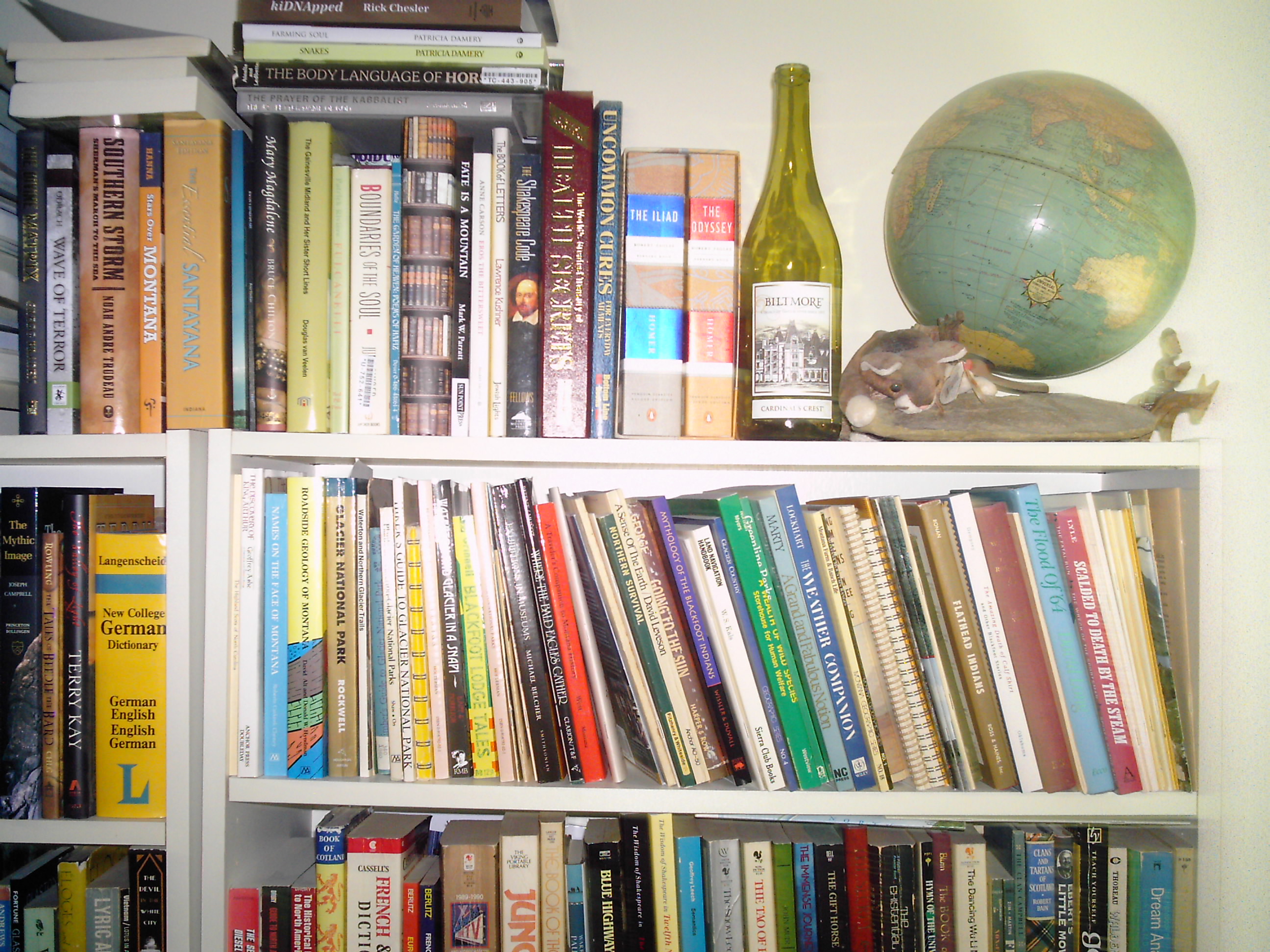
Some of us who grew up before e-books, kept the hardbacks and paperbacks we accumulated. One shelf became two, two became three and so on until the house and garage no longer had any wall space for new shelves or boxes of books.
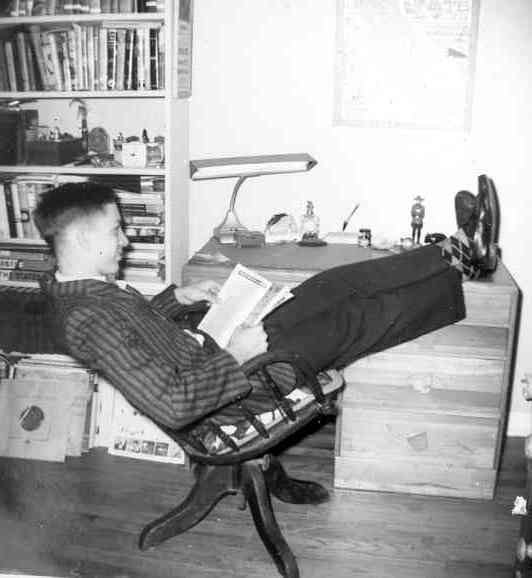
My father also collected books–for reading and reference–not rare editions destined to sell for a fortune years down the road like rare paintings, stamps and coins. In his later years, I believe he probably gave away 10,000+ books to university libraries. In that regard, he was lucky in that so many of his books focused on journalism, he had more than enough to help some fledgling college programs get their libary collections started.
I probably still have many of the books on this shelf from my high school days.
He knew also that his three sons, with their multiple interests, were likely to enjoy reading most of the other books after he was gone. With that in mind, my brothers and I were invited to go through all the books on all the shelves and place our first initial on the inside front covers of our favorites. I still have many of my father’s books on my shelves with an “M” in a circle.
While I don’t like all the rank and privilege associated with the kinds of families we see on programs like Upstairs, Downstairs and Downton Abbey, I like the family continuity especially when it comes to an association with the home place for multiple generations and for the maintenance over the years of collections of books. The personal library lived on and was added to even though some of the heirs had different tastes in books or, perhaps, never went in the library.
As generations, tastes and styles change, leftover books are expected to disappear at subdivision garage sales for pennies on the dollar. Some of my father’s things disappeared that way, too, because his house was larger than my town home and–while we absorbed a lot–my brothers and I had no room for the collected furniture, appliances and books my parents gathered for a lifetime.
Such things seem far less dear to people today. New pots and pans are deemed better than mom’s pots and pans; new tools from Home Depot are seen as better than what grandpa and dad left behind on their work benches. That’s a shame, really, especially when old things still work. Today, people want everything now, so they go out with credit cards and buy things in their 20s that their parents didn’t have until their 30s or 40s and that their grandparents didn’t have until their 50s or 60s.
So, by the time people inherit the old stuff, their houses are filled with new stuff, and just how many old hammers, plates, coffee pots, and even books does a young family need?
Yep “Downton Abbey” has the kind of space I need.
Unlike my father and mother who lived in the same house for the last 50 years of their lives, I’m doing what a lot of others my age are doing: downsizing. When you plan to move to a new place that, for one reason or another, will have 20% less space, a lot of old stuff will have to go. Much of it’s junk: copies of books and magazines and brochures and catalogues that were important during one hobby or career phase or another. They’re easy to pitch.
But the books are hard to get rid of, partly out of fondness and partly because it’s difficult for those of us who love books to throw them in the trash when no library or relative wants them and the prospective buyers on eBay and Amazon expect me to sell them for mere pennies.
I see the paradox in this: by the time one gets his or her library into a worthwhile collection, it’s time to get rid of it. On the other hand, without a Downton Abbey family of multiple branches and generations, I no longer have the “luxury” of keeping books I look at once every few years.
A new National Park Service report shows that approximately 2.2 million visitors to Glacier National Park in 2012 spent $172 million in communities near the park. That spending supported 2,754 jobs in the local area.
“We are honored and proud to welcome visitors from across the country and around the world to Glacier National Park,” said Park Superintendent Jeff Mow. “Glacier is a special place and many times visitors travel to Montana specifically to visit Glacier, and are introduced to the many other wonderful amenities that Montana, and Northwest Montana have to offer.”
National park tourism is a significant driver in the national economy – returning $10 for every $1 invested in the National Park Service. National park tourism is a large factor in the local economy as well. Mow said, “We are fortunate at Glacier National Park to be greatly supported by our partners, neighbors and local communities. We appreciate this partnership and support, and believe the presence of the park helps sustain local communities.”
The peer-reviewed visitor spending analysis was conducted by U.S. Geological Survey economists Catherine Cullinane Thomas and Christopher Huber and Lynne Koontz for the National Park Service. The report shows $14.7 billion of direct spending by 283 million park visitors in communities within 60 miles of a national park. This spending supported 243,000 jobs nationally, with 201,000 jobs found in these gateway communities, and had a cumulative benefit to the United States’ economy of $26.75 billion.
According to the report, most visitor spending supports jobs in restaurants, grocery and convenience stores (39 percent), hotels, motels and bed-and-breakfast locations (27 percent), and other amusement and recreation (20 percent).
To learn more about national parks in Montana and how the National Park Service works with Montana communities to help preserve local history, conserve the environment, and provide
outdoor recreation, visit http://www.nps.gov/state/mt.
I’m a disorganized writer. My den, and especially my book shelves, is a mess. When my publisher sends me free author’s copies of my books and/or I order books for gifts, reviewers and book signings, I often order more copies without checking to see how many I already have. Extra copies are everywhere.
Here’s my solution. The following is a list of extra copies of some of the books I’ve written. All of them are available on Amazon, Smashwords and OmniLit so you can check them out. If you decide you would like a copy mailed to you (continental U.S.), you can have one at no charge. Limit is one per person on a first-come, first served basis.
With the exception of the last item on the list, all of these are from Vanilla Heart Publishing.
If you would like a copy, send me an e-mail with the title of the book you want, your mailing address and whether or not you want the copy signed. If you have a second or third choice, include those titles in case somebody else gets to your first choice before you do.
Send the e-mails to me at malcolmrcampbell [at] yahoo [dot] com.
Offer expires May 30, 2014
Titles and Copies Available
Emily’s Stories (three short stories set in north Florida) – 1 copy
The Seeker (magical realism with fantasy elements) – 4 copies
The Sailor (magical realism with fantasy elements) – 3 copies
Jock Stewart and the Missing Sea of Fire (comedy/mystery, original cover) – 2 copies
The Sun Singer (fantasy) – 3 copies
The Sun Singer (fantasy, iUniverse edition; same as VHP edition except that it blurs the real locations used in the story) – 2 copies
If you find anything that sounds like your cup of tea, e-mail me and I’ll send it to you. There’s no obligation, but if you love it, an Amazon review would be nice.
On Connectedness: Music of Sacred Lakes, A Redemptive Ghost Story
“I don’t belong anywhere.”
For some people, especially in the western world today, this is a common and nagging feeling, sometimes even with catastrophic results for a life. And this is the problem that, even while striking him as trivial and self-centered, is wrecking the life of Peter Sanskevicz, the young protagonist of. He can’t accept the sixth-generation family farm from his parents, can’t continue serving “fudgies,” tourists in Northern Michigan who feel more at home than he does–and then, Peter accidentally kills a girl. Seeing his life is at risk, Peter’s friend takes him to his uncle, a pipe carrier of the Odawa tribe, who tells him he has lost his connection with the land and must live by the shores of Lake Michigan until the lake speaks to him.
But what does that mean? How does a lake speak? What is this connection Peter, and many people in the modern world today, have lost? Why does it matter?
Connectedness & Belonging
When I started researching Music of Sacred Lakes, I had just come through a very difficult time in my life, in which religion still seemed very important but I was realizing the shortcomings of the faith of my upbringing. There was a big disconnect between what the people who raised me in church had said and what they did to help the world. There was an even bigger disconnect between what they said God thought of them and how they seemed to really feel about their place in the world.
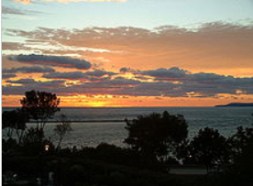
Novel’s Lake Michigan Setting
I set out to find out if I could live a life that honored God’s good creation and that left a place for me in that world. Surely people couldn’t really believe that the world was a beautiful creation of God and then fill it with trash and let it be destroyed by greedy corporations.
Surely I could find a way to live my faith that didn’t leave me miserable and condemned, being told simultaneously that I was saved by grace and that I had to have the exact right ideas about God in order to get to heaven (Pope Francis has a few things to say about that, I’ve discovered since). And even more importantly, I was discovering that this 20th-century idea of man being separate from the world–standing outside it and looking in—didn’t make any sense.
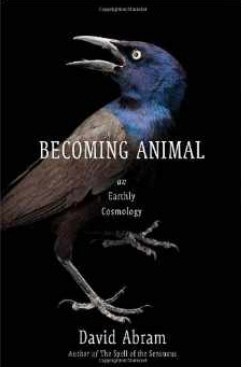
I was seeing statements everywhere as I researched this novel of belonging that really hooked me. To paraphrase from the book Becoming Animal, I stand in the earth, not on top of it. I am within the biosphere, the atmosphere, and am breathing this air in and out. How then can I say I am set apart from this creation? If this atmosphere disappears, I die instantly. As I breathe in and out, exchanging matter with this world around me, I am a part of it, and it is a part of me.
That, and all the wisdom texts and physics books I was reading on the nature of matter and energy and the universe, which stated that matter is best understood as notes on a scale that vibrate at different frequencies to manifest as different kinds of substance (superstring theory) and that all these strings are connected across a vast network through the universe so that everything is connected to everything else (M Field Theory)—really clinched it for me. This modernist idea of man being separate, objective, different from the rest of the universe–it wasn’t true at all. And that had big implications–HUGE–for my faith, for the way I viewed the world, for the way I approached my faith.
To top it off, the mystics all agreed. The Oglala Lakota Sioux chief Black Elk once said that he had a vision of the mountain (The Black Hills) and the mountain was the center of the world, and the mountain was everywhere. This kind of statement has a way of cropping up in multiple religions, throughout the history of spiritual thought. It’s in Buddhism. It’s in Christianity, too, believe it or not. It even pops up in the Sufi streams of Islam.
Odawa Website
I followed the rabbit hole down to postmodernism, to the wisdom traditions of the past that never lost connection with the world, to spiritual paths that honored the earth, and discovered that my own western modern iteration of faith had simply lost this important piece of wisdom, but that there were other cultures, Odawa and Ojibwe Native American being one in my own back yard, that had held on to this wisdom to bring it back to my generation. To say I was humbled, and in awe, and blessed by this, would be an understatement. And all this without ever leaving my own religion, Christianity. Mind boggling.
So what is it to discover that you can be a Christian and honor the wisdom of other people, without blending anyone’s faiths? What is it to discover that you belong in the world, and that, to finally quote a Christian mystic for once, “All will be well and all will be well and all manner of things will be well”? If you want to know what it is to discover that this question of belonging and the way we treat the earth are connected, read this story. I think if any of this post resonates with you, that ache that says there must me something more to life that you’re missing, something to your life that makes more sense than the daily grind, you will like Music of Sacred Lakes a great deal. You will discover connectedness, and as usual in life, this can come through the most unexpected of places: a story, a ghost, and a boy reconnecting with his faith through Lake Michigan.
–
In addition to her website, you can connect with Laura K. Cowan, The Dreaming Novelist, on Twitter or on Facebook.
This paper is a hastily prepared primer on bog construction. It’s not meant for the serious student of biogeography, but for the outdoor hobbyest who wants to have fun while creating something worthwhile.
Preparing the Landscape
Bering Glacier – Wikipedia Photo
Using water and cold weather, prepare a glacier such as those that were lying around during the Pleistocene Era. The transport of glaciers is likely to be a mammoth undertaking and is not recommended. Veteran glacier workers often recount the sad fate of two novices who attempted to hijack Alaska’s Bering Glacier and place it on a ship waiting off Cape Yakataga. Their midnight icecapade ended in failure when the two men became frozen to their work.
Allow your glacier to work for a long time. Then, melt it carefully so that a small pond remains. The pond–which is often called an undrained depression–should be free of fresh water springs, brooks, rivers, streams or creeks. This undrained depression will become the focal point of your bog.
Obtaining the Plants
Assuming you have chosen the right environment, your pond could turn into a bog all by itself. But, this could take years and, frankly, how long do you want to wait around?
Secure a truck–or a fleet of trucks–and haul the following to your bog site: water lilies, bogbeans, sphagnum moss, tamarack and spruce trees. Please obtain your plants from legal bog plant nurseries rather than taking them from national parks, forests or the bogs of other aficionados.
Orchids, bog myrtles, pitcher plants, and huckleberries will add a nice finishing touch to your bog if you can afford them.
Establishing the Plants
Tamarack in Autumn – Wikipedia photo.
Plants tents do grow outward in concentric bands or zones from the center of a bog. With this in mind, wade or swim out to the center of your pond and establish the water lilies and other floating plants that friends have donated to this project. (Perhaps you can raise funds via a Kickstarter project rather than nagging all the master gardeners in your neighborhood).
Proceed toward the edge of your pond and plant the bogbeans and, perhaps, some sedges (e.g.: Yellow Sedge, Northern Long Sedge, Few Flower Sedge).
Next, you’ll want to take a large quantity of sphagnum–one of the 300 varieties of peat moss–and weave it into a floating mat in the shallow water. Step out of this mess of moss and plant your tamaracks and spruces.
Bog Research
Mer Bleue Bog, a typical peat bog, in Ontario – Wikipedia photo
Some hobbyists get bogged down with books and scientific journals. However, a high-class bog can’t be built in a day, and it can’t be built without research. Primary, or on-site, research is required for first class results. Neighbors who are likely to look askance at your bog building will turn their criticism into approval when you’re able to stare them down and say, “I know what I’m doing.” And, without filing an environmental impact statement, you’re likely to be arrested for disturbing the noise of the city with the relative quiet of the natural habitat.
Buy a one-way ticket to your state’s largest bog. Make sure you are not sent to a swamp because swamps and bogs differ. Please travel via a non-stop flight; otherwise, your bog may turn into a coniferous forest before you arrive. On-site, study precipitation, drainage, evaporation, humidity, oxygen and nitrogen levels in the water and soil, and the stratification, foodstuff interchanges and periodicity potentials. Take a sack lunch. This will take a while.
Some people can create a bog without even trying. For others, it’s a lifelong struggle. Research is only for the brave; the shortcut methodology in this report is for the fast-track individual. Whichever you prefer, your bog can be a thing of great beauty, the envy of all your fair weather friends and a hobby guaranteed to give you many happy hours of peace in this noisy old world of yours.
Jock Stewart Strikes Back, Collected Stories, by Malcolm R. Campbell, Vanilla Heart Publishing (March 6, 2014), 122 pp, paperback ($9.46) and Kindle ($3.99).
The book contains farcical and satirical news stories written by “Jock Stewart,” a reporter for the Junction City, Texas Star-Gazer. Here’s an excerpt:
Literary Investigators Discover Jane Austen Actually Wrote ‘Prude and Prejudice’
Pinnacle, MT—Forensic literary sleuths digging through the long lost ashes of a Jane Austen notebook have discovered that a publisher’s typography error forever changed the title of the witty satire incorrectly known as Pride and Prejudice.
Dr. Horace Wickam, chairman of the department of forensic literature at Slippery Slope College, told reporters that correcting Austen’s body of work will most likely be the pinnacle of his career.
“The novel we have known and loved as Pride and Prejudice was initially called First Impressions,” Wickam said. “But according to Jane’s reassembled ashes, a typographer inadvertently changed the word in the new title from ‘prude’ to ‘pride.’”
Graduate assistant Judy Netherfield said that while foul play was not yet suspected it was not yet ruled out.
According to Wickam, the error in the title was compounded, and therefore obscured, by the fact that a crucial line of dialogue was omitted from a conversation in chapter four between protagonist
Elizabeth Bennet and her sister Jane.
Elizabeth’s reassembled comment reads as, “Dear Jane, you see, don’t you, that prudes are the most prejudiced creatures in the world because they are so afraid the next person they see will say the very thing they’re most afraid of hearing.”
Mainstream literary sources said Wickam and Netherfield’s preposterous speculations were “highly prejudicial.”
Professor Darcy, chairman of the Slippery Slope department of psychic psychology, told reporters that two students working with a digital Ouija board contacted Ms. Austen who confirmed the veracity of the discovery.
“Ms. Austen, who always thought prudes to be disagreeable, remains perturbed to this day about the errors in Prude and Prejudice,” said Darcy. “Austen admitted, via the Ouija board, ‘I to not want people to be very agreeable, as it saves me from liking them a great deal.’”
London scholar Edward Bingley, who has been working for 20 years on his epic What Jane Really Meant, said that since he continues to be denied access to the digital Ouija board at Slippery Slope, he doesn’t yet know what Jane really meant.
Wickam said, “as the novel illustrates in matters of love, when you have an empty-headed mother trying to expediently marry off her five daughters, prude goeth before the fall.”
Future projects on the department of forensic literature department’s 2006 schedule include investigations of The Clown of the Baskervilles, The Adventures of Blackberry Finn and The Ruby Yacht of Omar Khayyam.
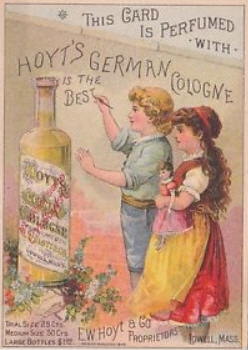
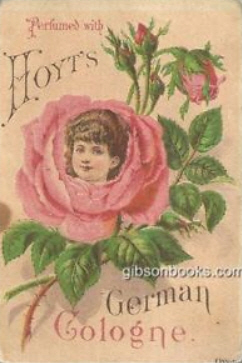
While researching folk magic for a new book, I stumbled across numerous references to Hoyt’s Cologne, an old-style toilet water that was supposed to bring people good luck, especially when gambling.
Originally called Hoyt’s German Cologne (until World War I made the name less optimal), the cologne was developed in 1868 by apothecary Eli Waite Hoyt. Usually described as floral in scent–and very strong–the cologne became so successful that Hoyt sold his apothecary shop seven years later to devote his time to the product.
The product is still available today, including on Amazon. One reviewer stated that it’s definite not subtle. Another described it as “very manly.” Wisdom Products describes it this way:
Hoyt’s Cologne developed in 1868 is truly an old fashioned fragrance reminiscent of early American colognes. A clean and refreshing scent with fragrance notes of citrus and floral. Hoyt’s is widely believed to bring good luck. Splash on your hands and body before playing games of chance.
OEDUSA suggests splashing it on before and after shaving, adding that:
Though the company will never reveal the full formula some of the essences used to create the scent are: bergamot and neroli to add a citrusy note; orange blossom for a warm floral undertone with an element of dry orange; and lavender for a hint of refreshing herbal. In our opinion this is a delightful cologne that will pleasantly surpirse the uninitiated.
Today, E. F. Hoyt & Company’s beautiful advertising cards and signs are sought after by collectors of vintage designs. Developed by Freeman Ballard Shedd, the cards were originally soaked in the cologne when handing out sample bottles became too expensive.
Catherine Yronwode, who operates the Lucky Mojo Curio Company, with its extensive hoodoo information site, mentions interviewing a man who worked for many years for Lucky Heart, a company that featured African American cosmetics and spiritual supplies.
He told her that a lady once came into the drug store where he worked as a child, bought a bottle of Hoyt’s, emptied the contents on her hair, and left the bottle on the counter, and saying, “I’m gonna get lucky tonight!”
I don’t know yet whether I’ll mention Hoyt’s Cologne in the book, but with my love of magic as well as vintage advertising, discovering Hoyt’s Cologne was an interesting “research trip.”
The current owner of Hoyt’s and the Hoyt’s trademark is Indio Products.
Malcolm R. Campbell is the author of the Florida Folk Magic Series, including the newly released “Fate’s Arrows.” These “conjure and crime” novels are set in the Florida Panhandle of the 1950s.
When we see stories on the news, most recently including the disappearance of the Malaysian passenger plane, the Fort Hood Shooting, the landslide in Washington State, and the stabbings at the Murrysville, Pennsylvania school, our first reactions most likely include horror, shock and compassion.
Then we start asking “why?” Fixing blame on somebody or something is probably a natural human reaction; it’s certainly a part of criminal and civil law.
But the “why” goes further than that. Whether we’re logical in our thinking or inclined, as writers are, to ask “what if?” the “why” behind major news stories creates order out of chaos while solving the puzzles events present to us.
When I worked at a police training institute some years ago, a typical test question for those in accident investigation courses showed the placement of vehicles on a highway after an accident. We often included details about weather, time of day, damage to the vehicles, and the length of the skid marks (if any) and asked students what kind of accident would lead to the vehicles ending up where they are. Eye witness testimony being unreliable and drivers having reasons to skew their own comments, the police often have to use turn their skills into a time machine to figure out what really happened.
The Nature of News
Traditionally, reporters try to answer the standard who, what, when, why, where and how. While 24-hour news channels love gathering panels of experts together to speculate on what might have happened before we know what actually did happen, many of us–in our own ways–ponder events that (apparently) don’t make sense.
We ask why would anyone for any reason go into a school or a military base and start killing people? Or, why were people living in an area where there was a risk of a landslide? And how could a plane seemingly vanish without a trace?
Of course, conspiracy theories seem to excite people, so–as one might expect–those reporting on the search for the Boeing 777 that apparently crashed into the Indian Ocean without a trace have heard quite a list of theories. Maybe it’s part of our nature to say that when things aren’t what they seem, something really strange happened.
I must admit that, after hearing how only a skilled pilot could fly an aircraft the way Flight 370 appears to have been flown, I wondered what sense it makes to go to all that trouble to avoid detection only to ditch the plane in the ocean. What kind of mindset would cause somebody to do that. Initially, it made more sense ot me that the plane had been skillfully flown and had landed in a hostile country that would cover up the whole thing. Maybe the CIA did it or a disgruntled pilot. But carefully crashing into the ocean in a way that creates a mystery makes no sense to me.
Others focus on the Fort Hood shooting and ask what kind of person, whether unstable, discounted by others, or angry would see a “solution” to their problems in the killing of a large number of people?
Fiction
Even if you love the movie and the book, you don’t want to live it.
As writers, we ask “what if?” questions like this all the time because we’re looking for plots that keep people turning pages until the final scene. It’s our nature to provide multiple probable solutions and then work the story down to the only one that makes sense (and is possible) once everything becomes known.
In novels and short stories, we don’t want the reader to know “why” early on in the story because then s/he will stop reading. In “real life,” we want answers ASAP if not sooner. That which makes for good fiction often creates chaos, anguish and lack of closure when we’re living through it.
Ultimately, we want stuff to make sense. Until it does, we feel rather unsettled about it. What we crave in our reading, we deplore in our lives. Most of us don’t want to feel like we’re in our favorite novels when we’re watching the news or coping with accidents and other tragedies in our own neighborhoods.
As a journalist, I ask “why?” As a novelist, I ask “what if?” There are days when I feel like I’m wearing two hats.