Synchronicity and our Stories

Walk into the woods with an open mind. You'll be surprised at what you find there and how much it meets the needs of the stories you're telling.
Walk into the woods with an open mind. You’ll be surprised at what you find there and how much it meets the needs of the stories you’re telling.

We often notice how many things come in threes and how often seeing and noticing a thing (car make, idea, book) leads us to seeing it again soon.

I’ve often thought that where we focus our attention seems to enhance whatever it is we’re looking at and thinking about. So it is that whenever we begin to casually think about a story idea, we find ourselves stumbling over the ideas for scenes that will enhance the plot and characters that will be memorable after readers get to the last line.

Passion seems to fuel an interesting synchronicity throughout the research as well. One thing leads to another thing which leads to marvels that truly fit the story that we weren’t even looking for. The Internet and its links plays into this unfolding scavenger hunt for relevant facts, prospective locations, and the little details that can make or break a story.

Recently, a writer friend of mine told me about a call for submissions from an upcoming anthology of ghost stories about a city many miles away from there I live. The publisher wanted new paranormal stories that fit the city and its attractions and culture or new takes on legends and haunted places.

My first thought was to dismiss the idea out of hand. There was no way could fly or drive to that city and soak up its ambiance and turn my impressions into a story. But, if you’ll pardon the pun, the idea haunted me. An Internet search turned up a few ghostly legends that might possibly be brought forward into a current-day story. One legend kept drawing me into the facts and suppositions people had about it at the time it happened over a hundred years ago.

I kept saying I was just dabbling with the idea because, really, the anthology seemed best suited to people who lived in the city and who knew it well. Okay, maybe I could use Google’s maps and street view to see what the place looked like. Hmm, spooky. Then I stumbled across an author who’d written a book about the incident and who had been inside the house where it happened.

Oops, I just got hooked into submitting something. I have no idea whether the publisher will like it.* Either way, I had a good time watching characters, real-life facts, ghostly musings and plot ideas unfold before my eyes as though they had a mind of their own. Did the ghost herself lead me into her lair? Naah, stuff like that doesn’t happen. But the synchronicity behind the things an author becomes interested in is typical.

Another author recently said that whenever we choose to involve ourselves in a story, the universe aligns itself with us to help us tell the tale. I like that idea, and I find it works best if I don’t begin my dabbling with either an outline or a preliminary list of prospective characters.

These approaches may or may not be helpful later, but if they’re used too soon, they tend to restrict the incoming flow of information. How? Because the outline tends to limit the synchronicity to that which you include in the outline, leaving out the better ideas a writer could have used if s/he hadn’t made arbitrary decisions before the universe showed him what was possible.

I love discovering stories while I’m writing them.

spiritsanthologyUpdate: That story, “Patience, I Presume,” was accepted for publication in the Rocking Horse Publishing anthology Spirits of St. Louis: Missouri Ghost Stories.

This post, written last summer, is from the Magic Moments blog archive. Before I remove that blog from WordPress, I wanted to share a few of the entries.


Malcolm

If I were J. D. Salinger, I could sell all this stuff for millions

“Actually, this is just a place for my stuff, ya know? That’s all; a little place for my stuff. That’s all I want, that’s all you need in life, is a little place for your stuff, ya know? I can see it on your table, everybody’s got a little place for their stuff. This is my stuff, that’s your stuff, that’ll be his stuff over there.” – George Karlin, A Place for My Stuff Lyrics

paperstuffWriters tend to save paper stuff – books, magazines, newspapers, clippings, letters, certificates, notes, business cards, programs, photographs, greeting cards, postcards, legal papers, vintage business forms, brochures and guidebooks, old highway maps, maps of the world the way it was when they were born, grade school drawings and fake Confederate money from old Cheerios boxes.

I even saved my deed for an inch of land in the Klondike from out of a Quaker Oats box long after the Big Inch Land Company went out of business. I had big plans for that square inch.

There’s an unwritten rule about paper stuff: once you throw it away, you’ll need it.

I’ve thrown away a lot of stuff and then regretted in some years later when I needed it for a book or article I was writing.

Brainwashing, Bad Genes, Or Bad Karma

The Karma train is at least 100 cars long.

I probably threw out somebody’s stuff in a previous life and now the karma train has dropped it off at my house in this life. Otherwise, all this stuff is my parents’ fault. Here’s why: brainwashing. Before I could walk or talk, I knew that stuff was the be-all and end-all of a writer’s life no matter how many rooms of the house it took up, and even if you didn’t know what it was and never looked at it.

When my wife, brothers and their wives and I cleaned out my parents’ house in the 1980s, the place was filled with paper stuff. If they had been famous people, this  would have been the kind of stuff that ended up in the basement of a historical society where online references would refer to it as X number of linear feet of unsorted papers: please contact the archivist for an appointment. Hourly research fees to find what may or may not be in one of the boxes are $150.

I threw away a lot of the stuff. We got rid of a lot of the larger stuff in a garage sale and got roundly criticized by my parents’ friends got getting rid of the stuff. We explained that we lived in small apartments and houses and had no room for a giant household full of stuff that wouldn’t even fit in a moving van.

Time being short to get out of that house, we moved some of the stuff with us. My wife and I have moved several times since then, usually bringing along the boxes, still labelled as they were in the mid-1980s without looking in them.

Time to See What The Hell All this Stuff Is

Well, now I have to look into them. We no longer have room for it. So, I’ve been throwing away stuff for the past several months. I hated to see some of it go because, well, it must have been important stuff at one time or another, the kind of stuff I could sell for millions if I had the fame of Salinger or Rowling.

They have room for some of my book-type stuff

I have a tip for you: if you save paperwork from several generations back in time, eBay doesn’t want it. I’ve dumped (donated) 15 boxes of books to the local library for their yearly garage sale and I think I’ve just about worn out my welcome. The recycling center knows my name because they’ve seen me dump some 50-60 grocery bags of magazines and “office paper” into the recycling bins.

Throwing away stuff would be easy if I could tent a backhoe and a dumpster and clear the “treasures” out of the house during a long afternoon. Even though my parents never hid $100 bills in old books and papers, I keep thinking, “But the time I don’t check, that’s when it will be there.”

But then I would never know, so it would be the same as it not being there.

I should have listened more closely to George Karlin’s “A Place for My Stuff” the first time I heard it. I guess I thought it only applied to non-writers.

So far, nobody’s called and said, “Malcolm, you know that crap you threw out two months ago? I was going to give you $100000000000 for it, but you weren’t answering your phone that week.”

For years, I thought, I’ll wait one more week to see if I need this stuff or somebody calls and wants to buy it. You see how it goes and why there’s so much of it.

You may also like: You Should Spend Money on Experiences, Not Things: Anticipation of a new experience is the best part, new data shows “It’s been over a decade since American psychologists Leaf Van Boven and Thomas Gilovich concluded that doing things makes people happier than having things.”

Malcolm

TSScover2014Malcolm R. Campbell is the author of contemporary fantasy adventure novels including “The Sailor” and “The Sun Singer.”

On Location: Glacier National Park

Lobby of Many Glacier Hotel, built in 1915.

Those who have followed this blog for years know that I worked as a hotel bellman at Glacier National Park’s Many Glacier Hotel while in college and that I’ve returned to the park when finances permit.

I suppose many people have a favorite beach, romantic city, mountain range or scenic highway they call my favorite place, and that for reasons they may not be able to explain, are drawn to it time and again.

Glacier is my favorite place, though it hasn’t been easy falling in love with it inasmuch as I live in the Southeast and travel to and from the park in northwestern Montana takes time and/or money. The historic hotels, many of which were constructed by the Great Northern Railway many years ago, are only open between June and September. This means the primary park season is short and room rates are high.

Most people reach the park by car via U. S. Highway 2 or by air via Kalispell which is near the west entrance to the park. Some people fly in via Calgary, Alberta and then visit Jasper, Banff, and Waterton parks in Alberta before driving south past Chief Mountain into Montana to tour Glacier. Glacier is named for its glacier-carved mountains with a geography featuring horn-shaped peaks, narrow aretes, cirque lakes and stair-step valleys. Existing glaciers add glacial flour (finely ground rock) to the water and that makes for turquoise colored lakes.

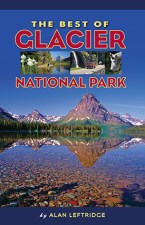
BoGlacier cover flat r1.inddDue to an ancient thrust-fault, there are places where you’ll see older rock on top of younger rock. Many rock strata are visible throughout the park. If you take a launch trip on Swiftcurrent Lake, Lake Josephine, St. Mary Lake, Lake McDonald or Two Medicine lake, the guides will point out the rock strata along with glaciers (slowly melting away), waterfalls (a lot, especially early in the summer), primary peaks, wildlife (including grizzly bears), and other points of interest.

If you like hiking, there are 700 miles of trails for you to choose from. My favorite is the Highline Trail which you can use to go from Logan pass on Sun Road to Granite Park Chalet to Many Glacier Hotel on the east side. Many trails remain closed due to snow throughout June, so check with the park service about trail closures if you go early in the summer.

If you have time, take a red bus trip on Sun Road or up to Waterton. These 1936 restored tour buses are fun to ride in and, when the convertible tops are rolled back, give you a great view of the mountains. If your time in the park is short, consider including one bus tour, a launch trip, and scheduling in some time for short hikes around the hotel where you’re staying. Alan Leftridge’s book (shown here) lists the best places to see, grouped by category. It’s a valuable guide for people who only have a day or so for a quick trip.

TSScover2014If you have problems with stairs, you should know that while Many Glacier Hotel has an elevator in the main section, the four floors of rooms in the annex are accessible only by steep stairs. Glacier Park Lodge has no elevators, so try to get a room at ground level. I found the foods served in the main dining rooms of the hotels to be tasty, but overly rich. (Be sure to try at least one of the deserts, drinks or ice creams made with Huckleberries.) If you’re there for a few days, you can venture out to Swiftcurrent if you’re staying at Many Glacier, multiple private restaurants at East Glacier if you’re staying at Glacier Park Lodge, several restaurants at St. Mary if you’re staying at Rising Sun, and a variety of restaurants at Apgar and Kalispell if you’re staying at McDonald Lodge. Bison Creek Ranch a few miles for East Glacier is a favorite of mine for steaks and chicken.

If you’re a light sleeper, take a white noise machine. The walls of these old hotels are thin and the doorways are not tight fitting–you won’t want to hear people talking or snoring in adjoining rooms. WiFi in the hotels is only available in a few areas and is overloaded by multiple guests trying to log on. Cell phone reception is spotty or not available. Take multiple layers of clothes. You may need a jacket at night in August and the wind in the higher elevations can be chilly all through the summer. If you have a small umbrella or a fold-up poncho, take it: rain comes out of nowhere.

Yes, the 2014 season only has about a half a month left to go. Had you been at the park a few days ago, you would have seen a great display of the northern lights. The wind at Logan Pass and elsewhere will be getting noticeably colder. You may see some snow in the higher elevations. If you like to ski or hike with snow shoes, the park is open throughout the Winter.

Glacier is on my mind this month with the release of the new paperback* edition my contemporary fantasy adventure novel which is set in and around Many Glacier Hotel. The reality comes from faithfully including what I remember about the Swiftcurrent Valley, Lake Josephine and the Ptarmigan Tunnel. The fantasy comes from a look-alike universe reached via a portal (which you won’t see from the Lake Josephine Launch) hidden near a shelter lean-to used by hikers. If they only knew how close they were to a very dangerous world–as my young protagonist discovers. He’ll have to learn how to use magic if he wants to make it back to the world of Glacier National Park.

Malcolm

* Please be patient if you prefer to read e-books. While posted on bookseller sites, there are formatting issues yet to be resolved.

Sky, from the toes up

“I thank you God for this most amazing day, for the leaping greenly spirits of trees, and for the blue dream of sky and for everything which is natural, which is infinite, which is yes.” – e. e. cummings

When I was in the first or second grade and learned that the earth revolves, I wondered why the ground did not move beneath my feet when I jumped. How perplexing; I come down just where I started, I thought.

My dad explained that the atmosphere moves with the earth and, in fact, if it didn’t, there would be a substantial windstorm blowing us down around the clock.

For years, I viewed the sky as something far way, especially on clear nights when the stars—according to my observations—moved on flight paths much more distant that clouds, airplanes, or the helium balloons that escaped our grasp at the county fair.

I supposed at an early age that an ant’s view of the sky includes everything from my toes up. My feet are shadows and my hands are clouds and my head is a far planet. I believed they were misinformed and/or had poor eyesight because the sky was miles away.

Dog Island (marked with an “A”) is three and a half miles off the coast.

Early on a Saturday morning when I was in high school, I went to Alligator Bay on the Gulf Coast south of Tallahassee, Florida, with Tommy and Jonathan for a boat ride over to Dog Island. Jonathan’s family had a speed boat anchored just off the beach near his family’s summer cottage. The faraway sky was blue and cloudless, and the water was tranquil.

After a day of swimming, snorkeling and sand-dune exploring, we headed back just as a storm began developing farther to the west. The sky grew very dark before we reached the bay sheltered by Alligator Point. The high chop of the waves slowed our progress, so the afternoon was winding down before we set the anchor and waded ashore. We were quite relieved we hadn’t swamped the boat, something we hadn’t done for a year or two.

As we stood watching the storm pass by outside the bay, the setting sun appeared low on the western horizon with one of the most spectacular golden sunsets I have ever seen. The beach, the boat, and the surf were bright orange and glowing with light. Meanwhile, the lightning from the passing storm to the south of us, was also bright orange, and it hissed as it snaked across the sky over our heads and shook the world with its hollow thunder.

We stood without saying a word, and to this day, I think those moments still represent one of the most mystical experiences I have ever had. On that golden beach just out of the storm’s reach, everything was possible and yes and hopeful and connected. “The sky is everywhere, it begins at your feet,” wrote Jandy Nelson in her young adult novel. Yes it is, and on that afternoon, it was clear to me that I stood within the sky and not below it.

–Malcolm

This post originally appeared on my Magic Moments weblog. As I get ready to shut down that blog, I thought I’d run a few of my favorite posts from the archive. Looking back on that day on the beach made it easier for me to understand a quote from “Seth” in the books by Jane Roberts: “There is no place where consciousness stops and the environment begins, or vice versa.”

Is a copy of the publication suitable payment for your work?

This is the inside joke of creative writing programs in America. We know creative writing doesn’t make money, and yet we continue to graduate talented writers with no business acumen. At best, it is misguided. At worst, it is fraudulent. –  Nick Ripatrazone in his essay in The Millions, Practical Art: On Teaching the Business of Creative Writing

The short answer: can you use that copy to pay the rent, buy a Happy Meal or a new toner cartridge for your printer? If not, why would any writer want to work for a copy of a magazine or anthology while the publishers make money off his/her work?

Another short answer: or, maybe you can legitimately view writing for payment in copies as similar to blogging which–unless you have a highly popular, monetized blog–isn’t paying the rent either. Blogging is part of an author’s platform. That’s how we justify doing it. In both cases, free blogging and unpaid publication in anthologies and little magazines sooner or later have to lead to a money making business or they are not doing what they’re supposed to be doing: improving your craft and moving you from a hobby writer to a professional writer.

The Longer Answer: When mainstream fiction magazines were more prevalent, writers were told that writing stories for “little magazines” and for non-paying anthologies for free was a necessary part of building up a list of writing credits. If BIG MAGAZINE ABC saw that you had been published in MEDIUM MAGAZINE YXZ, you supposedly had a better chance of acceptance. The practice still has value and, perhaps, may be even more important for those in publish or perish careers. This view has many ramifications to it depending on the kind of paid writing you ultimately want to do and how valuable those at the top of that ladder view publication in one place or another as a prudent step.

“What does it mean,” asks Ripatrazone, “that we, in the literary community, have accepted lack of monetary payment as commonplace?”

While I’m old school enough to impractically view college as a place heavy with liberal arts that teaches students how to think rather than providing then with a certificate that allows them to move right into a job like a technical school, I see the need that Ripatrazone sees when he says writing programs often do little or nothing to prepare graduates for the business side of their chosen profession. Likewise, many writers groups online and offline, though self-publishing has brought marketing and PR more heavily into the discussions and seminars.

As he puts it, the art of writing is sometimes taught as though it’s a spiritual process in which long-term practical, positive results are viewed as an unnecessary luxury. According to the disciples of this approach, finding yourself and telling your story are the important things even if nobody pays a dime to read what you write.

The odds of making that dime are long odds. That’s reality. But saying that dime doesn’t matter sounds like a lot of self-effacing denial to me. “Payment for little old me? Golly, writing the story is what counts.”

Maybe so if you plan to live with your parents into your 40s or find a spouse that makes enough money to support you while you find yourself or you win the lottery or you work at a day job and stay up all night writing.

Look at the Business Side in Addition to the Art of Writing

Ripatrazon’s essay includes a handy checklist of ideas for bringing students more into the mainstream of what their chosen profession is all about, from demystifying publishing to an introduction to freelance writing and how it works to what editors want and how they want to see it presented to them.

Writing nonfiction can become a viable means of supporting oneself while working on fiction after hours. Taking a look at such magazines as the Atlantic and the National Geographic is proof enough that nonfiction isn’t a secondary kind of writing. Becoming good at it, helps improve a writer’s art and craft while building a list of credits. Writing for low rates of payment at first and working up to higher rates of payments seems to me to be a much better route than writing for copies of publications.

That’s not a hard and fast rule, especially if you’re making money some other way to pay the rent. And who knows, getting accepted by a prestigious publication might help your career. It’s hard to say, because no matter how much all of us study the business side of writing fiction, making money from novels and short stories is always a gamble. The number of writers who live off fiction writing is a very small number.

When we write, we can’t be like our non-writer friends who go to a 9-5 job that pays them to work their craft in a cubicle or assembly line without having to worry exactly how customers are found and products are marketed. Even if we’re lucky enough to find helpful publishers’ editors, agents or even business managers, we’re still–as novelists–both the CEO of the whole process as well as the craftsman down in the shop.

We need two mindsets, one that sees the dollars and sense in practical terms and one that sees the beauty of a well-told tale coming together on the page. As Ripatrazone says, “I need my students to know that they will likely struggle every step of this way in this business. They must be shrewd and determined and aware. But when they close the door and go to their writing desk, they must be generous, sensitive, and open to the mystery of this art.”

Being too willing to write for copies may be a sign that we’re not really looking at the practical side of the profession. Or maybe for a while it’s an expediency.

Malcolm


“Should” and “Ought” – two words I distrust

“I think that word “should” in our internal narratives is very toxic—this notion of, ‘what should I be doing?’ and it’s always pegged to some sort of expectation, whether it’s self-imposed or external or a combination of the two. It’s hard to balance those expectations of what you should be doing with what you want to be doing. I feel very fortunate in that to a large extent what I do is exactly what I want to be doing for myself, and I still write for an audience of one. I read things that stimulate me and inspire me and help me figure out how to live and then I write about them. The fact that there are other people who enjoy it is nice, but it’s just a byproduct.” – Maria Popova in an interview with Jocelyn K. Glei

gamespeopleDuring the 1960s and 1970s when Eric Berne, Thomas Harris and others were popularizing the role of psychological games in our lives while suggesting transactional analysis as a way to escape them, the words “should” and “ought” were singled out as parental words. That is, they appeared in the daily string of DOs and DON’Ts we heard from our parents, teachers and other authority figures when we were young.

These parental injunctions, as they were called, were often heard time and time again by children until the rules within them became–for better or worse–so much a part of our view of the world, they were hard to separate from facts. Simplistically, this happened because we were too young to know the difference between fact and opinion and–as some said–became brainwashed into believing things that weren’t totally true and/or didn’t need to become a long term mantra for our lives.

Berne, when he took his theory of games into script theory, told us that combinations of “shoulds” and “oughts” and attitudes and coping mechanisms would often become engraved in stone as scripted ways of approaching various situations (or life itself) that worked more like canned computer programs rather than dynamic and authentic behavior.

Human Relations Training

When I wrote training materials in corporate settings in those days, transactional analysis was adapted by many as viable model in human relations and supervision/management courses, resulting in seminars, courses and newsletters. My exposure to all this–as a writer and not as a psychologist–influenced my view of human interactions.

IOKYOKConsequently, I am sensitized to any rule, prescription or sermon that sounds like a parental injunction being imparted to others who are supposed to accept it without question because it comes from an authority figure (parent, grandparent, doctor, minister, boss, “expert,” givernment agency). I automatically want to know why SHOULD I do ABC or why OUHGT I believe XYZ.

Sometimes, the SHOULDs and OUGHTs are correct. “You should look both ways before crossing a street.” “You ought to avoid bullying other people with fists or words.” “You should not put metal in a microwave or sugar in a gas tanke or text with your cell phone while driving.”

Since we can think of so many good examples of such rules, we often assume all of the SHOULDs and OUGHTs we hear are valid. That’s where the danger lies. A lot of our prejudices arise this way. So do a lot of our assumptions about what we can do or become in our lives.

Yes, I Always Question Authority

I would rather question what some say should never be questioned than blindly accept every SHOULD and OUGHT as gospel. My training in journalism trained me to check and double-check facts. My creating of supervisory and management courses using game and script theory concepts trained me to look carefully at everything every authority figure says.

Perhaps I’ve over-thought a lot that could have been accepted without question. Likewise, being wary of the SHOULDs and OUGHTs also frees up the imagination and unchains ones thinking when it comes to their ongoing life experience.

  • You can learn more about Eric Berne and transactional analysis here.
  • The International Transactional Analysis Association has a website here.

–Malcolm


RHP—New Division, New Imprints!

Robin French's avatarRobin Writes

Some of you may have heard, via social media, that RHP is expanding. Yay, us! We just brought out two new imprints, and added staff!

First, we will now be listing all of our literary fiction under the imprint Equidae. Oh, it’s still Rocking Horse Publishing, never fear, but we’re at the point now where we can specialize a bit. The release of The Fires of Waterland gives us two lit-fic titles, as Danny’s Grace will be moved to Equidae as well.

What the heck does that even mean? Glad you asked. “Equidae” is the Latin term, as in taxonomy, for “a family of perissodactyl ungulate mammals including the horses, asses, zebras, and various extinct related mammals,” as per Webster’s.

Second, since we have had such success with Spirits of St. Louis: Missouri Ghost Stories, we’ve opened up a new division/imprint for anthologies.

Our intent is to publish…

View original post 472 more words

Sometimes Doves Think Like Hawks

During the 1960s, the so-called “flower children” suggested that we sit down with our worst enemies and sing songs, share a meal, have a few beers or maybe some pot, and “give peace a chance.” While I was (and still am) a pacifist, that approach sounded naive and unworkable.

It’s easy when a war is far away to say, that’s a civil war and should be decided by the people who live there. It’s harder to say that when the war is on your doorstep or the news is broadcasting a steady stream of information about the kinds of atrocities now being perpetrated by ISIS in northern Iraq in the name of their religious and cultural views.

Like most doves, I have a few hot buttons that make me think more like a hawk. I have no patience when it comes to crimes against women (stoning, mutilation, honor killings) or crimes against peoples (such as the Yazidi) based on the absurd, stone-age belief that one’s god wants them to do such things. It’s especially sad for a dove whose beliefs are based on a spiritual foundation, to see the horror committed by others in the name of a religion.

Generally, I’m tolerant of other religions and really feel no missionary zeal whatsoever to tell people who are worshiping their god to stop doing it and come worship my god. I don’t know why so many people care about the spiritual practices of others.

I grow intolerant, though, when anyone says their god is telling them to kill me or torture me. I see no spiritual component whatsoever in such attitudes and as an angry dove, I quickly think “those people are worshiping a misguided tradition rather than a god.” And, as a dove who is being pushed by circumstance to think like a hawk, I think that if I were flying a drone over a bunch of men about to kill women and chidren for purportedly religious reasons, I would fire a Hellfire missile.

The issues, of course, are larger than one band of religious thugs, and one or two Hellfire missiles. We cannot kill every ISIS thug. And right now, we don’t know how to change their minds. Perhaps some day we will figure out what makes them tick and how to stop it. Until then, the atrocities are mounting up in real time and they require us, I think, to take a pragmatic look at how we should respond as civilized and sympathetic people.

Doing little or nothing should not be the default answer to ethnic cleansing against entire peoples or faith-based crimes against women.

–Malcolm


Lame author’s questions and answers

Stewart
Stewart

Our guest today is Jock Stewart of Junction City, Texas. He’s the star of Jock Stewart and the Missing Sea of Fire, a loose biographical tail, and the author of Jock Stewart Strikes Back.

Stewart: Before you start asking me questions, I want to know where the hell your copy editor is. Look at the title. Makes me look like I’m lame. The questions and answers are lame. “Sea of Fire” isn’t a loose biographical tail, it’s a loosely biographical tale.

MRT: Thank you for acting like a grammar nazi before we hit the questions your readers came here to read. So, tell us about yourself?

Stewart: That’s not a bloody question, it’s an order and I don’t like it. What it shows me is this: you didn’t do your homework before starting this interview. If you had, you’d be asking me questions like, “Were you really raised by alligators in a Florida swamp?” and “Why did you ditch gossip columnist Monique Starnes in favor of shacking up with the mayor’s wife.” But I’m not talking about that. As for me, I’m a newspaper reporter of the old school. Old school reporters smoke cigarettes, drink, shack up with women and do their homework before interviewing people.

MRT: Where do you get your ideas?

Stewart: God help us from questions like that. I get them from the editor. He says, “Stewart, get your ass in here.” Here is is office which is filled with cigarette smoke. There’s usually a gun on the desk. Then he says, “A source told me somebody got killed behind the windmill at the miniature golf course. Go out there and find out who’s dead, how they died, and whether the windmill was damaged in any way.”

MRT: Does “any way” mean blood stains or bullet holes?

Stewart's Boss
Stewart’s Boss

Stewart: It means anything that shuts down the golf course so the kids can’t stop by an drop a few grand playing the links. Last year, the victim was left out there on the 9th hole for a couple of days and he just became another hazard. Business picked up for a while.

MRT: So, when did you first know you wanted to be a writer?

Stewart: That day still hasn’t arrived. But, if you want to know why I work for a newspaper, it’s because I think people need to know what’s happening. That requires writers. My dear old daddy once told me that I wasn’t going to amount to squat and, looking at my career, you can see that he was right. I tried too prove him wrong by going into the gigolo business, but things didn’t work out.

MRT: Where can people find you on the web?

Stewart: They can’t.

MRT: Where can they find you.

Snowden - NSA sketch artist drawing
Snowden – NSA sketch artist drawing

Stewart: If it’s Saturday night, I’m sleeping it off in the slammer. If it’s lunch time, I’m eating lunch. If it’s bedtime, I’m in somebody’s bed. Seriously, I really don’t want to see the kind of people who are usually looking for me.

MRT: What are you working on now?

Stewart: I’m working on getting the hell out of this lame interview as soon as possible. Interviews like this are a dime a dozen. That’s why you see this same list of questions on so many blogs. If you’re talking books, which I guess you must be, my work in progress is called What Edward Snowden Does When He’s Not Taking a Leak.

MRT: I hope you did your homework before you interviewed him and didn’t start out with something lame like “Tell us about yourself.”

Stewart: You’ve got that right. Before I got to Putin’s bedroom, I knew more about Snowden than all the other reporters in the free world.

MRT: Putin’s bedroom?

Putin - Predator drone imagery
Putin – Predator drone imagery

Stewart: People said they were probably in bed together. He wasn’t there, but what with all the Ukrainian separatists, the place was kind of crowded. Snowden has a rich, full life–to the extent that’s possible in a country that was filled with commies a couple of years ago and is trying to revert back to a police state mentality.

MRT: I’m looking forward to the book?

Stewart: Want to be a beta reader?

MRT: No.

Stewart: Good, because real writers don’t need beta readers to tell them how to write. God help us from people who write by committee, it you know what I mean.

MRT: I think I know, but I need to check with my blogging team here to see how to best respond to that question.

Stewart: Figures.

This interview first appeared on the Junction City (TX) Star-Gazer where people found it worked much better than the comics for lining parrot and hamster cages.


It’s all in what you’re used to…

…when it comes to hot weather.

todaysweatherMy wife and I lived in houses without air conditioning when we were growing up. Her north Georgia house finally go A/C after she had long-since moved out; my north Florida house got A/C when I was in college. When hot weather came, we turned on the fans, sat on the front porch and drank iced tea, hers with sugar and mine with lemon.

Our A/C unit was limping along at the end of last week and finally quit on Sunday. Sunday’s the most popular day of the week for stuff breaking down. Fortunately, the temperature got down into the high 60s last night, so we were finally able to get some cooler air in the house.

Nonetheless, our cats acted like the A/C breakdown was our fault.

Okay, I know people are living in places where the daily temps are always over 100. I don’t want to hear about it. They’re used to it. Plus, my DNA was probably altered by the fact I was born across the bay from foggy and usually cool San Francisco. When I was a kid, 88 wasn’t too bad.

But, years of soft living with A/C, have conditioning me to need ten degrees cooler–if not more. I’m a winter person in spite of growing up in the land of hurricanes, alligators and hot weather.  So, until the repairman arrives this afternoon with a replacement part for the unit, I’m not a happy camper even though I’m not actually camping. To add insult to injury, iced tea now gives me heartburn.

Maybe we’re all just getting older. (You may want to write that down.) Maybe 88 degrees is hotter now than it was fifty years ago. Maybe it’s global warming and the weathermen have inflated the temps to keep up and it’s really 120 in the shade outside.

If worse comes to worse, I suppose we could go sit in the car with the A/C up on high.

TSStitleTo segue to another sun-related subject, Second Wind Publishing will be releasing my novel The Sun Singer this week in e-book and paperback editions. That’s cool news after the novel has been out of print for a year. I’m looking forward to the new edition.

Malcolm