Spackle, Mop, Molding, Caulk, etc.

If you’re a writer, you know this already: sometimes one has to stop writing and clean up the house.

mopThis summer, my wife and I have been more ambitious than cleaning up, though goodness knows we let that slide for way too long.

The first word of the summer is downsizing. That means getting rid of stuff we’ve been saving for years and really don’t need. Some of the stuff never came out of the boxes from the day we moved into this house in 2002. I guess if we didn’t open it in 12 years, chances are we don’t need it.

And all those extra books. Fifteen boxes were donated to the library for their annual sale. I feel better about that than putting them in the trash.

When the House Settles, Get Out Your Spackle and Caulk

Spackle has gone up on cracks that showed up as the house settled. New molding has gone down where (more house settling) created a gap between the original molding and the linoleum. The carpets were washed last night with our spray-and-vac, and look much better this morning.

I can’t count how many tubes of caulk we’ve gone through, how many sponges, paper towels, and brushes that have been used up, or how many times the ladder has come in front the garage. (Don’t ask about the garage yet, though it’s gotten better.)

You can probably say, “been there, done that, got the tee shirt.” It’s amazing how little time it takes for a new house or a new car to lose that “new” look and get to the point where washing things as often as you did on the first day loses its appeal.

While cleaning and fixing, I’ve been thinking of the next ghost story. I wish I could say that some Disney Elves or friendly spirits had stopped by to help out. Now THAT would be a story!

Today my hands smell like bleach. Yesterday they smelled like Windex. Tomorrow, maybe my hands–along with the house–will smell clean and look neat.

I hope you’re having a productive weekend as well.

Malcolm

Fiction writing: is it about the money?

Yes and no.

moneyYes, because unless you’re writing stories for your children, for your own amusement, or for small, non-paying newsletters and magazines, full-time fiction writers consider their career a business even if they are partially supporting themselves as teachers, researchers and other jobs.

No, because focusing on money–for most writers–gets in the way of developing and telling a story. This is not to say that we’re unaware of the realities regarding salable novels and short stories by writers at one stage of their career or another. One reality is that, without a strong platform or a lot of friends in the business, most unknown writers will not be able to sell novels as long as those written by Diana Gabaldon, Eleanor Catton and Donna Tartt. Another reality is that, if we’re writing in a genre, we know what’s more or less acceptable within that genre and what isn’t.

So, while we can choose to stray outside the “rules” of genres, especially as defined by the mainstream of out intended readers and we can choose to write 500,000-word first novels, most choices about characters, plots, settings, dialogue and themes are (or should be) divorced from the question: will this make me more money or less money?

I dislike the trite phrase that “writers must wear multiple hats.” But it’s short, sweet and true. At some point–and perhaps this usually comes from experience–we learn how to compartmentalize our writing business. While those compartments–marketing, sales, research, writing, editing–obviously interact with each other, having such divisions in our work allows us to concentrate on one or the other without being distracted by concerns that don’t relate to the task of the moment.

Worrying About Work That’s Already Completed

New writers worry a lot about rejection slips and why it’s taking publishers or agents so long to respond to manuscripts and queries. Quite often, they’re spending so much time checking the mail and e-mail for a yes/no response about the last story they sent out, they find themselves unwilling or unable to work on the next story. Then, if the response they’ve been waiting for finally comes in as a NO, they’re in the worst possible place to be thinking up something new when, if they had something new already in progress, they could go back to it.

Writers also learn–and maybe this is another experience thing–to separate the kinds of writing they do. Those of us who have partially supported ourselves by writing feature articles, grant requests, news releases, computer help files, and training materials can step from one to the other without having to re-learn approaches and styles. The same is true when fiction’s involved. We can transition from writing news releases during the day to writing a Gothic novel at night without getting mixed up about what we’re writing any more than a tennis player worries about using different techniques and equipment when s/he plays a round of golf.

Compartmentalizing our work not only helps us organize the work week rather than trying to run a business by randomly jumping from one task to another, it helps us tell stories without thinking about money. If we write commercial fiction as well as literary fiction, we learn to step into the needs of the story and genre we’re dealing with. We know before we start what the rules are and we know that the commercial fiction is probably more salable, but then we put that knowledge aside and tell the story.

If money’s a concern while we’re writing the story, the story will probably suffer for it.

–Malcolm

thesailorcoverMalcolm R. Campbell is the author of contemporary fantasy, satire and paranormal stories and novels, including “The Sailor.” The novel tells the story of a pacifist who ends up serving aboard and aircraft carrier during the Vietnam War. Truth be told, friends and family cause more trials and tribulations than most of the demands of shipboard life.


Briefly Noted: ‘ Burning Down the House’

burningdownhouseA September 16 2014 interview with author Nell Bernstein in The Awl (“The Case for Abolishing Juvenile Prisons”) begins with this overview:

“Last month, archaeologists identified the first of the fifty-five human bodies recently exhumed at Florida’s Dozier School for Boys—a now-shuttered juvenile prison where, for decades, guards abused children, sometimes to death, despite cyclical scandals and calls for reform spanning almost a hundred years. Dozier represents an atrocious extreme, but the failures of America’s juvenile justice system are widespread. Whether labeled ‘boot camps,’ ‘training schools,’ ‘reformatories,’ or other euphemisms, juvenile prisons have long harbored pervasive physical and sexual abuse. In one survey, twelve percent of incarcerated youth reported being sexually abused in the previous year—a figure that likely understates the problem.”

Since so-called juvenile delinquents from my north Florida high school were purportedly sent to this school, I reported on several books about “The White House Boys” in an earlier post. I found the interview with the author of Burning Down the House perceptive, compassionate and fascinating, and wanted to mention her book here for those who wonder about how we handle juvenile offenders, especially those charged with relatively minor misdeeds.

From the Interview: “I tried to come in with a reporter’s open mind. But I have known kids who’ve been in this system for decades, so I did come in believing, from my own experience, that prison was a consistently damaging intervention that tended to make things worse for kids rather than better.”

Bernstein - click on the photo to see the author's website
Bernstein – click on the photo to see the author’s website

From the Publisher When teenagers scuffle during a basketball game, they are typically benched. But when Will got into it on the court, he and his rival were sprayed in the face at close range by a chemical similar to Mace, denied a shower for twenty-four hours, and then locked in solitary confinement for a month.

One in three American children will be arrested by the time they are twenty-three, and many will spend time locked inside horrific detention centers that defy everything we know about how to rehabilitate young offenders. In a clear-eyed indictment of the juvenile justice system run amok, award-winning journalist Nell Bernstein shows that there is no right way to lock up a child. The very act of isolation denies delinquent children the thing that is most essential to their growth and rehabilitation: positive relationships with caring adults.

Bernstein introduces us to youth across the nation who have suffered violence and psychological torture at the hands of the state. She presents these youths all as fully realized people, not victims. As they describe in their own voices their fight to maintain their humanity and protect their individuality in environments that would deny both, these young people offer a hopeful alternative to the doomed effort to reform a system that should only be dismantled.

For those who know about The White House boys, and other young people sent to abusive camps and schools, the interview and the book are haunting. If only such things had been said 50 to 100 years ago.

–Malcolm


When you write, are you happy?

“I believe that half the trouble in the world comes from people asking ‘What have I achieved?’ rather than ‘What have I enjoyed?’ I’ve been writing about a subject I love as long as I can remember — horses and the people associated with them, anyplace, anywhere, anytime. I couldn’t be happier knowing that young people are reading my books. But even more important to me is that I’ve enjoyed so much the writing of them.”   – Walter Farley (author of The Black Stallion)

writerAt book signings, I see long lines of readers waiting for one widely known author or another to arrive, and this is good, of course, because the people love books and want to meet the bestselling authors they usually only see on TV. Of course, I’m there, too, in the same line waiting for my 30 seconds with the author where s/he is signing books so quickly, it seems like his or her tired hand will need a lot of Aspercreme at the end of the evening.

To many people, an author is the name on the book, the name they trust for the kind of reading they like, somebody who shows up on a talk show or who’s interviewed by Kirkus or Publishers Weekly. If you’re not a writer, you probably don’t think about what your favorite authors are like while they’re writing. I often wonder if those thinking about becoming authors are skewed off the road to reality by seeing authors as celebrities showing up with a lot of fanfare at a bookstore or a studio.

A favorite line of mine out of an old writing book went something like this: Most people don’t want to write, they want to have written. They’re looking only at what comes when the book is done; that’s only the tip of the iceberg in most authors’ lives. Most of the time, they’re alone with a pencil, pen, typewriter or computer. They’re wearing jeans and a tee shirt and look like they haven’t gotten enough sleep for years. It’s hard work, writing, and I think that people who imagine seeing their books on the bestseller lists don’t always think about exactly what they’ll have to do to make that happen.

Is the work fun?

booksartSince most of a author’s life is spent researching and writing, enjoying this part of the process seems to me to be an important prerequisite to considering poetry, short stories, novels and plays as part of one’s career. The writer at work, should be the picture of bliss and contentment. Okay, there’s frustration and profanity, too, and on the bad days, an extra glass of Scotch. But most of the time, authors who like being authors are happy while they’re writing.

In fact, writing is like drugs. Once an author finishes a book, s/he will variously be tired, excited, joyful, elated and (sometimes) relieved. But soon, s/he will have to be writing again because nothing else compares with it. Perhaps it’s a meaningful addiction or perhaps it’s a variation of the kind of high a runner often feels or a tennis player or a musician. Doing the work is the author’s focal point.

So, my two cents for today is to suggest that if the writing itself doesn’t make a person happy, perhaps they’re in the wrong career. At her sarcastic best, Dorothy Parker once said, “If you have any young friends who aspire to become writers, the second greatest favor you can do them is to present them with copies of The Elements of Style. The first greatest, of course, is to shoot them now, while they’re happy.”

It’s not an easy life and, when it comes down to it, most people really don’t like writing all that much, Reading, yes, but writing: forget it. They’re thinking about going on a talk show and having dinner with Jo Rowling, but not about the work.

If the work isn’t making a person happy, then it seems pointless to me to be writing fiction with big dreams but no sense of the day to day way most of one’s time will be spent. On the other hand, if it makes you happy, your friends and family make consider you a lost cause since–quite clearly–your addiction to your art is almost more important than anything else.

–Malcolm

Malcolm R. Campbell is the author of Emily’s Stories, The Seeker, Jock Stewart and the Missing See of Fire and other books that were a real hoot to write.


MCampbellEmilysStoriesRevised

Glacier September 19 Update: Access to Logan Pass Changes This Weekend

from NPS Glacier National Park


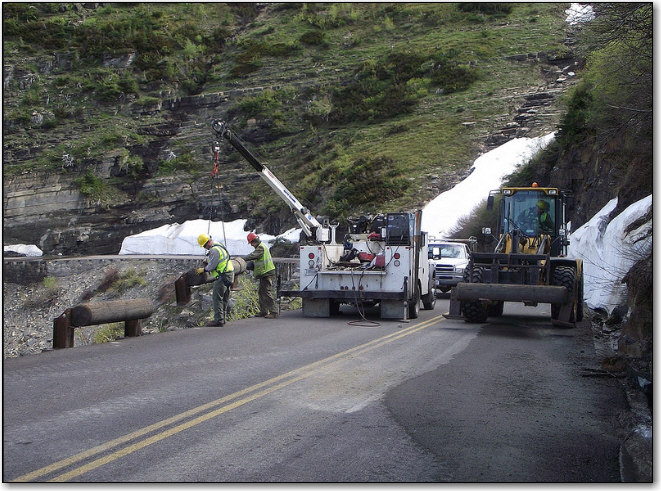
Guard rail replacement in June - NPS Photo on Flickr
Guard rail replacement in June – NPS Photo on Flickr

The last day to access Logan Pass by vehicle from the east side of Glacier National Park will be Sunday, September 21, allowing accelerated fall season rehabilitation on the Going-to-the-Sun Road. Vehicle traffic will be restricted on the east side near the St. Mary Campground beginning Monday, September 22. Vehicle access to Logan Pass will be available from the west side of the park through Sunday, October 19, weather permitting.

Fall access to east-side hiking trails between the St. Mary Campground and Logan Pass will be limited during road rehabilitation activity beginning Monday, September 22. Hikers wanting to hike any of the trails that are accessed, or may be an exit point, along the east side of the Going-to-the-Sun Road, are highly encouraged to contact the park at 406-888-7800 before departing. The trails that are affected include Siyeh Pass, Baring Basin, Piegan Pass, Otokomi, St. Mary Falls/Baring Falls/Virginia Falls, Gunsight and Sperry Trails. For more information on status of trails and access, please contact the park or visit http://www.nps.gov/glac/planyourvisit/trailstatusreports.htm.

Access to some backcountry campsites on the east side of the park will also be affected. All backcountry campers are required to have a permit from the park’s backcountry office for overnight stays. All backcountry permits must be obtained from the Apgar Permit Center at this time of the year. For more information on backcountry camping and trail access, please contact the park at 888-7800 or visit http://www.nps.gov/glac.

Times and locations for boat inspections for boats launching in Glacier National Park are changing. Inspections for the west side of the park will be conducted at the Apgar Backcountry Office, 8:00 a.m. to 4:00 p.m. daily through the end of October. Boat inspections for the east side of the park, Many Glacier and Two Medicine areas, are by appointment only. Appointments are available by contacting the park at 406-888-7800.

The Logan Pass Visitor Center will be open through this Sunday, September 21, 9:30 a.m. to 4:00 p.m. The Apgar Visitor Center and the St. Mary Visitor Center are open through October 5, 8:00 a.m. – 5:00 p.m. daily.

Many Glacier Bridge Replacement

Swiftcurrent Bridge, which provides access to Many Glacier Hotel, was losing its structural integrity, had a cracked deck, and could no longer handle high water.  - NPS photo from the park planning document
Swiftcurrent Bridge, which provides access to Many Glacier Hotel, was losing its structural integrity, had a cracked deck, and could no longer handle high water. – NPS photo from the park planning document

Visitors to the Many Glacier area of the park should be aware that the replacement of the Swiftcurrent Bridge will begin shortly after the Many Glacier Hotel closes for the season on Sunday, September 21.  Visitors can expect short delays beginning September 26. As of September 29 there will be no vehicle or pedestrian traffic as the bridge is replaced. It is anticipated that the work to replace the bridge will continue through mid-November.

Access to Cracker Lake and the Piegan Trail will be through the Grinnell Picnic Area, at the Grinnell Trailhead. The Swiftcurrent Bridge is located at the foot of Swiftcurrent Lake and provides vehicle and pedestrian access to the Many Glacier Hotel Historic District, and the Many Glacier Hotel.

Autumn visitors to Glacier National Park will find less crowds, cooler temperatures, and changing vegetation colors. Area residents and visitors are reminded that the park is open year-round and park recreational opportunities can be found during all seasons.

Nice to see infrastructure work going forward.

–Malcolm

Seeker for promo 1Malcolm R. Campbell is the author of three novels partially set in Glacier National Park, “The Sun Singer” (paperback) “Sarabande” (out of print) and “The Seeker” (on Amazon and Smashwords in paperback and e-book).

Will Earth last forever in spite of the damage?

“The eyes of the future are looking back at us and they are praying for us to see beyond our own time. They are kneeling with hands clasped that we might act with restraint, that we might leave room for the life that is destined to come. To protect what is wild is to protect what is gentle. Perhaps the wilderness we fear is the pause between our own heartbeats, the silent space that says we live only by grace. Wilderness lives by this same grace. Wild mercy is in our hands.” – Terry Tempest Williams in “Red”

Some claim that no matter what foolishness we bring to our planet, Earth abides. Do you agree?

I hope that claim is more than wishful thinking. For years I thought an ever abiding Earth was a certainty and that even in the worst-case nuclear winter we can imagine, the planet could shake off the damage. Now, I think we’ve done too much for that certainty.

Author George R. Stewart certainly took that view in his famous 1949 science fiction novel called Earth Abides. While this book, which is among the best novels I’ve ever read, is a eulogy for civilization as we know it, it’s not a story about the end of the Earth. This book is somewhat responsible for my thinking that when all is said and done, the planet will one day be reborn without us.

Plenty of Time?

For years, people have said that no matter how badly we treat the environment, the ultimate destruction of the planet is so many years into the future that we still have time to change what we are doing. In that vein, saying that global warming or dying oceans or dangerously high population growth will one day do us in, is about like telling a teenager he needs to save some of his summer job money for retirement or he’ll starve some day.

As an author, I have absolutely no interest in writing post-apocalyptic fiction. Nonetheless, I often play the what-if game inside my head about all sorts of things that will never evolve into my books.

One game involves walking down a long highway into the future and seeing alongside the road a timeline of positive and negative news events, discoveries, storms, political decisions, and other critical moments. How far can I walk and still find mankind here? Are there actually multiple roads? Perhaps a frightening event leads us to make positive changes and one prospective road gets longer. Perhaps something else lures us into a false sense of security and we begin to think Earth will abide forever. At that point, all the roads get shorter.

If we knew how long the Earth would abide at our present rate of destroying it, what would we do? Would we keep on keeping on or would we finally realize that the world’s wild mercy really is in our hands?

This post first appeared on my now-discontinued Magic Moments blog in 2012.

–Malcolm


Sick cat = sleepless night

KatyInChairOur large calico cat named Katy is, in her estimation, queen of the household, ruling the other two cats.

She spends a lot of the day squeezed in behind me on my large swivel desk chair.

A week or so ago, my wife had a roller pan filled with blue paint for a hallway touch-up project. Katy participated in this project by jumping into the paint and then running throughout the house on the light-colored carpet.

Clean-up consisted of applying many cleaners, potions, traditional spot removers and elbow grease to the blue cat prints that adorned the hall and living room.

The noisier part of clean-up, that included my getting scratched up and listening to howling, consisted of scrubbing the blue paint off her feet in the sink before she licked it off and got sick.

Time went by until a night ago when she either had one heck of a hairball, was finally reacting to the paint she got too before we did, or somehow got into one of the other fix-up the house products such as the spackle. (She seemed more interested in the spackle than necessary.)

She is the hairball queen, but after a little too much throwing up and a refusal to east, we filled her mouth with the gooey anti-hairball product we call gat goop. Katy doesn’t like cat goop and resents people prying open her mouth and putting dollops in there in such a way that she can spit them back out.

The paint looked worse on the carpet than it does in this quick photo

She did in the dark afterwards behind a rocker after that, always a sign that a cat is either spooked or sick. She was still hiding the next day and turned up her nose at food. I kept checking on her until 3:30 a.m., after which my wife checked on her. A hairball is one thing, a blockage or something acting on her like a poison is another. Can’t ignore that and hope for the best for long.

Finally, yesterday, she at a little food again, became responsive instead of zoned out, and sat in my lap while we were watching “Master Chef.”  (Anything to do with food or that can be turned into food gets her attention.) Today, she’s squeezed in behind me again in my desk chair.

It’s nice to see her back to her old self even though she’s also back to trying to hog food and tell the other two cats (as well as us) what to do.

–Malcolm

With three cats in the house, and many before them, I’ve had plenty of models for writing my novella in progress called “Conjure Woman’s Cat.”

Review: ‘Summer of the Long Knives’ by L. S. Bassen

summeroflongknivesL. S. Bassen, a 2011 Flannery O’Connor Award finalist, has written a strong alternative history novel with her Signal 8 Press (July 22, 2014) release of Summer of the Long Knives.  “Night of the Long Knives” is an old German phrase used to describe acts of revenge, most famously German Chancellor Adolf Hitler’s murderous purge of his political opponents in the summer of 1934.

The novel begins its “alternity” approach with the first sentence: “Very little from a personal perspective has been written about the assassination of German Chancellor Adolf Hitler on July 1, 1934, following the so-called Night of the Long Knives.” Summer of the Long Knives is a haunting story about who killed an imaginary Adolph Hitler in his Chancellery gardens and why.

The fictional Dr. Anne Frank-Koestler is quoted in this mix of well-researched history and intuitive “what ifs?” as saying that as the journalist concerns himself with facts, the historian is an artist who concerns himself with the art of creating pictures of meaningful events and periods of human affairs that while not factually accurate, might just be a “truer” version than the account of the past that we know.

This “truer” account in Bassen’s story isn’t a denial of German history, but an exploration of the real summer of 1934 by merging it with “what if?” in the same spirit that authors create alternative ends to America’s critical Civil War battles and ask readers to imagine the resulting version of history. Bassen provides a backdrop so real that her characters’ lives–phantoms though they may be–seem equally real. Artist Albert Entrater, model Lisel Gantz and Catholic priest Konrad Hoeffer are involved in an assassination plot that the reader hopes will succeed as though the world might in fact change by the end of the novel.

The real is clarified by the imaginary in Bassen's novel.
The real is clarified by the imaginary in Bassen’s novel.

Imagined headlines bring us the news: HITLER KILLED A DAY AFTER CRUSHING NAZI RADICAL REVOLT: RÖHM A SUICIDE: VON PAPEN, VON BLOMBERG RESTORE ORDER

The imaginary Albert Entrater survives. Anne Frank survives. Hitler does not.  Those who believe in the furthest reaches of quantum theory tell us that whatever can happen does happen–somewhere, in another universe perhaps, or at the very least, in our minds after we read alternative histories.

The world we know is the world we know, but in another universe, Abraham Lincoln wasn’t assassinated at Ford Theater and Adolph Hitler was assassinated via one plot or another. And just maybe a young girl named Lisel Gantz, who was assaulted by brownshirt Stormtroopers and subsequently sought her revenge, pulled the trigger.

In the “what if?” world of an alternative history, The Summer of the Long Knives is at once a fictional thriller and a chilling exploration of the German summer of 1934.

Briefly Noted: ‘Gatherings: Friends and Recipes from Montana’s Mustang Kitchen’

gatheringsSpecial guests at Mustang Cafe and Catering  in Livingston, Montana include Oprah Winfrey, Diane Sawyer, John Turturro, Anthony Bourdain, Tom Brokaw, Ivon Chaniard, Sandra Day O’Connor, Walter Kirn, Tom McGuane, Jim Harrison, Margot Kidder, Carl Haissan, and John Heard. When folks who can afford to eat anywhere in the world stop by for a meal, that’s a good sign.

And, it suggests that a recipe book based on the best from Mustang’s kitchen, might just bring that great food to your home.

From the Publisher: Featuring more than 100 original recipes from Mustang Fresh Food and Catering, Gatherings: Friends and Recipes from Montana’s Mustang Kitchen brings the magic of Chef Carole Sullivan’s personalized and authentic catering to your home kitchen. From Livingston, Montana Carole Sullivan has prepared meals for tough customers such as Martha Stewart and President Barack Obama. Each chapter is organized into custom menus that Sullivan has served to her loyal clientele, and accompanied by mouthwatering photographs by photographer Lynn Donaldson. Together the team brings us menus designed for every occasion, from streamside picnics to formal holiday dinners, with all the recipes adapted for simple and savory home cooking. Try Jeff and Susan Bridges’ Thanksgiving feast or sample Michael Keaton’s annual July 4th barbecue. This is real food for real people.

Book Signing: Carol Sullivan will be signing books at Costco in Bozeman this Saturday, September 13, 2914) from 12-2 pm.

Malcolm


Day of Rest

“Every person needs to take one day away.  A day in which one consciously separates the past from the future.  Jobs, family, employers, and friends can exist one day without any one of us, and if our egos permit us to confess, they could exist eternally in our absence.  Each person deserves a day away in which no problems are confronted, no solutions searched for.  Each of us needs to withdraw from the cares which will not withdraw from us.” –  Maya Angelou  (Wouldn’t Take Nothing for My Journey Now)

relaxationWhen I saw this quotation on Terri Windling’s Myth and Moor blog, I started thinking that while a writer’s life must appear serene to those who work in more active jobs, it’s very hard to allow oneself to get that day of rest.

If one is actively writing a story, the characters seldom take a day off. They’re always jabbering away inside the writer’s head. Or, s/he is thinking of facts to check or scenes that require another look. If one is not actively writing a story, then it’s easy to feel the need to be posting something on a blog like this one or on a Facebook page.

Case in point: before I saw that quote about taking a day off, I was thinking of writing a post in response to a writer/reviewer who doesn’t think Rowling’s adult books are all that good. I don’t agree and was going to say why–not that it matters one way or another in the scheme of things what I think about Rowling’s books.

But in thinking about a day of rest–after I’ve already gone to the store and cleaned out the gutters over the front door—going through that reviewer’s negative Rowling points one by one, seemed very in-restful. So, I’m letting that go in favor of reading more of her latest “Robert Galbraith” detective story The Silkworm.

Growing up, I never looked forward to Sunday because–in that era and in that town–Sunday afternoons were reserved for calling on other people. My two brothers and I were ordered to stay in our Sunday clothes, keep our rooms clean, and not to get involved in any games that messed up the house. It was not a day of rest.

Traditionally, I think of Sunday as a day of rest even though a fair number of people are working at the restaurants, movie theaters, malls and other places where many people go to rest. Folks are still working their yards, though possibly not starting up their lawn mowers quite as early as they do on Saturday.

There’s always football and beer, and whether one slumps on the couch with a six pack or has friends over for grilling, that’s probably better than heading off to the office to catch up on paperwork or clearing the thicket of privet out of the backyard. There’s always taking a nap. For some, there are hobbies that provide some of the best relaxation on the planet. Perhaps one can also call it rest.

We need more than we’re getting even if we have to trick ourselves into resting rather than thinking of all the stuff we ought to be doing. Thank goodness, the era of people dropping by to call on Sunday afternoons is long gone. For a kid or a writer, boring conversation is hell rather than rest.

Now, time to pick up my copy of The Silkworm in spite of what that reviewer said about it, and get some well-deserved rest after yesterday afternoon’s yard work. Later this afternoon, there’s a U. S. Open Tennis game I want to watch, er, with a glass of wine rather than a six pack of anything

–Malcolm

P.S. Thank you, Mel Mathews for your kind words about The Sun Singer in ‘The Sun Singer’ – The Hero’s Journey par Excellence