Brief Review: ‘The Girl on the Train’

The Girl on the TrainThe Girl on the Train by Paula Hawkins
My rating: 3 of 5 stars

This mystery, narrated by three London-area women, is tightly written with multiple who-dunnit style twists and turns. Rachael takes the train into London every day and has gotten into the habit of fantasizing about the lives of two people she’s never met in a house near the tracks several doors down from the house where she used to live. She builds a perfect life for the unknown couple in the house and almost comes to believe she knows them–until the woman who lives there ends up missing.

The interesting plot is dulled to some extent due to the fact that Rachael, Anna and Megan seem some hopelessly inept in maintaining any order and purpose in their lives other than, perhaps, a focus on their relationships with men.

The author brings a nice touch to Rachael’s chapters because her excessive drinking makes her an unreliable narrator. The police–and the readers, as well–won’t be sure until near the end of the book what she saw and what she did during a black-period on the night “it happened.”

The train imagery is pitch perfect and the ending is satisfying.

View all my reviews


–Malcolm

Will Ferrell, you have stepped out of bounds from comedy to cruel

ferrell“The family of Ronald Reagan has slammed Will Ferrell for signing on to star in and produce a comedy about the president’s agonizing battle with Alzheimer’s.” – New York Post

“Penned by Mike Rosolio, the story begins at the start of the then-president’s second term when he falls into dementia and an ambitious intern is tasked with convincing the commander-in-chief that he is an actor playing the president in a movie.” – Variety

“I saw the news bulletin — as did everyone — that you intend to portray my father in the throes of Alzheimer’s for a comedy that you are also producing. Perhaps you have managed to retain some ignorance about Alzheimer’s and other versions of dementia. Perhaps if you knew more, you would not find the subject humorous.” – Patti Davis, in Open Letter to Will Ferrell

Hollywood is famous for taking oafs, clowns and unintelligent people and poking fun at them. Perhaps we laugh our gallows humor laughs, thinking “there by the grace of God go I.” But dementia? That’s out of bounds.

Will Ferrell’s movie may never be made, some say, due to the firestorm of protest the concept has already created. Let’s hope the soothsayers are right: Alzheimer’s is not comedy and to make it so for a movie, especially one about a real person, is without any redeeming value whatsoever. What’s next, Mr. Ferrell? The hi-jinks of a cancer ward or accident victims dying in the E. R. on a Saturday night?

In her open letter, Davis writes, “Alzheimer’s is the ultimate pirate, pillaging a person’s life and leaving an empty landscape behind.” Mr Ferrell, what do you find funny about this?

I hope you’re better than this, Will Ferrell, but I’m beginning to have my doubts.

–Malcolm

UPDATE: (April 29, 2016) Will Ferrell Walks Away From Controversial Reagan Project

Writing Grants: Better than that cabin in the woods

cabinretreatWriters often dream about mountain and seaside cabins as places to escape daily life and concentrate on on their writing. Some lease vacation rentals while others create their own hide-ways on their own property. Others take advantage of writing retreats and writers-in residence programs.  For examples of retreats, check here: 25 Incredible Writing Retreats to Attend in 2016.

All of these are ways to get away from it all and concentrate on the writing and research needed to complete, say, a novel or a collection of short stories. In some cases, wishing for that cabin in the woods might simply be an excuse; for others the time away is desperately needed.

In the current issue of Poets & Writers Magazine, “Arts Organizations Offering Prizes More Valuable than Cash'” suggests that grants–for which there will be more competition–offer strong support than a hide-way and and a suitcase full of money.

“As mainstream publishing becomes more fixated on finding the next best-seller and arts funders begin to understand that for many talented poets and literary authors success requires more than simply finding time to write,” says Michael Bourne. “A small number of arts organizations are taking a more hand-on approach–including, in some cases, arranging meetings between their winning writers and publishers who might be interested inn taking on their books.”

Many widely known authors have followed versions of the grant approach, including Karen Russell and Aracelis Girmay. If you can find a copy of the magazine, read the full article for details. Otherwise, here are three grant-awarding organizations you may wish to explore:

–Malcolm

Helping everything come out in the wash

When Thomas Wolfe published Look Homeward, Angel in 1929, there was a fair amount of grumbling in his home city of Asheville, NC due to similarities between the book’s characters and people in the community. To use a modern term, I’ve always assumed his writing of the book with such strong autobiographical ties was his way of processing parts of his life he wanted to exorcise or better understand.

Time heals, some say. It’ll all come out in the wash, others say. Perhaps so.

outinthewashI’ve never felt the need to write a torrid tell-all book loosely based on people I know, though every few years or so novels come out that reveal old secrets and/or that live up to that writer’s tee shirt gag, “Don’t piss me off or I’ll kill you in my next book.”

I do tend to help things in my own life come out in the wash by writing about them, often long after the fact, and seldom in any way that links the fictionalized version to me.

For example, the last post on this blog Again and Again Throughout the Long Night is a short story based on events in my own experience that occurred in the 1980s. Yet they always bothered me, so finally my way of helping them come out in the wash is writing a fictionalized version of them using characters and locales vastly different from those in the true story.

A lot of people process their stuff by journaling or writing memoirs. I’m not famous, so I fail to see the need–much less the practicality–of writing a memoir. So I dribble the process stuff out into stories and novels over time and it really seems to help.

My doctor confirmed today that I have kidney cancer, but that it was caught early enough–in a cat scan the hospital did while diagnosing appendicitis last week–that two hours of surgery in a couple of weeks should completely remove it without any likelihood of recurrence or chemo/radiation. Sooner or later, this will show up in a story because what I have not yet processed is the fact that had I not had appendicitis, the kidney cancer wouldn’t have been caught until things were already potentially hopeless. The doctor called my appendicitis “the bellyache that saved your life.”

I have no clue how I’m going to fictionalize that. But like everything else in life that I’ve had to ponder or mull over looking for the inherent meanings, this will have to come out in the wash one way or another.

I always hope that those who don’t consider themselves to be writers will at least put their “out in the wash” kinds of thoughts into diaries, and potentially even experiment with creating fictional versions of them. Writing, for me, as been the best therapy I know. (And I say this as somebody who worked briefly in the mental health field and strongly considered becoming a psychologist.)

Writing just seems to help things settle.

–Malcolm

I appreciate those of you who have gone out to Kindle to download a free copy of my short story “Waking Plain.” It will be free for a few more days.


Feds close cat boot camp

from the archives;

Albino County, October 20, 2009–Drill Instructor Boots Anderson slips quietly into barracks #3724 five minutes before Reveille on a cool Texas morning. The humidity is 68%, the pressure is 30.05 inches, the dew point is 56 degrees, and the 100 felines at the Albino County Rat Army Boot Camp are blissfully sleeping in the calm before the storm.

Anderson scowls at the mess, the random hairballs, the shredded up bunks, the tipped over litter boxes, the complete lack of military grade standards of cleanliness and ambiance, “as though a tornado hit the freaking place during the long hours between taps and dawn,” he muses poetically.
catsAnd then it hits. Anderson slings the open, CinchSak (R) 39-gallon lawn and leaf bag of empty cat food cans against the wall. Two hundred eyes pop open, one hundred pairs of ears go back, growls, snarls echo throughout the austere structure. Manx cats comprise company 816, so the denizens can’t turn tail and run, opting for caterwauling instead, the kind that makes Anderson’s skin crawl as though he’s covered in fire ants, the nasty buggers.

“Atten-HUH,” bellows Anderson, though it does little good. He hates himself when he resorts to trickery, but the corps demands it or Manx Company is not going to be wearing cat’s pajamas on graduation day. So, he puts a smile in his voice when he utters the disgusting words, “Food Time! Would my pretty little kitties like an itty bitty ditty bad of treats?”

The cats assemble smartly in the long center aisle between the rows of bunks. Their bearing is is straight and true like those perfectly posed goddess-style cats in art from ancient Egypt.

“So you’re not a lost cause after all, you lousy, good-for-nothing curs, you miserable excuses for ratters, you sloppy-as-dogs critters, you alleyway varmints. You Siamese.” He adds that for good measure, knowing it’s a low thing to say to a Manx.

At this moment (05:25 central), the emergency doors at the far end of the building are kicked open and the Feds, damn their lousy timing, crash into the room with assault rifles, mace, snarling dogs straining on leashes, and enough spotlights to make the cats’ eyes look like his chaotic collection of old marbles before his brother lost them to Dexter Smith in the school yard before the cat got his tongue.

“General Mark Sirius, Homeland Security SWAT Tsar,” shouts the dog-eared fat officer who rolls into the room like like a basset on a acid.

“Are you serious?” yells Anderson.

“If you don’t believe me, read my name tag, you wussie cat lover. We’re shutting down this operation until we sort through the litter and totally understand what kind of shit you people are into in this county.”

“Do you have a warrant?”

“Warrant, why would I need a warrant when I’ve got guns, dogs, mace and the Patriot Act backing me up? Stand down, I say, for Mark Sirius is sitting in the cat bird seat today.”

“It’s a little late for that, General, the cats bugged out when you busted in,” says Anderson.

“What the hell?” Sirius doesn’t look like a cute doggy in the window now. “How did they manage that?”

“Training, General, plus they got those little cat feet; they slipped out like fog.”

“Cats or no cats, we’re shutting you down. For one thing, it just ain’t right, even in Texas. I know what you’re thinking, Anderson. You’re thinking all we do at Homeland Security is make life difficult for honest, everyday people. Not by a long shot. We’ve been studying cats, from cat dancing to catamounts to catacombs.”

“So what,” says Anderson, grinning like a Cheshire cat that’s starting to fade into the woodwork.

“I’ll tell you what, mister smiley face, you organize cats, you gotta a catastrophe. You think you can control them, but you can’t. You whistle and they keep on disobeying your commands, telling secrets, spying, sneaking in under the radar. That’s just anarchy, the kind of cat’s cradle trap our enemies are waiting for us to get our fat paws stuck in while our pants are down.”

Sirius is stoked like a cat on a hot tin roof, but he’s not wagging his tail now because Anderson has faded away into the Texas morning, a morning when the winds are gusting to 23 mph, a morning when the old general should head to the dog house early and hang his head while his masters tell him Sirius is a bad puppy for not putting all those cats in a great big hat and bringing in for questioning.

Anderson laughs from a nearby tree. Once the FEDs leave, it will be back to business as usual. All he has to do is open a can of tuna and the troops will pass in review, soon, if not smartly, the sorry flea-bitten strays.

-30-

NPS to proceed with ill-advised restoration of Many Glacier Hotel Staircase

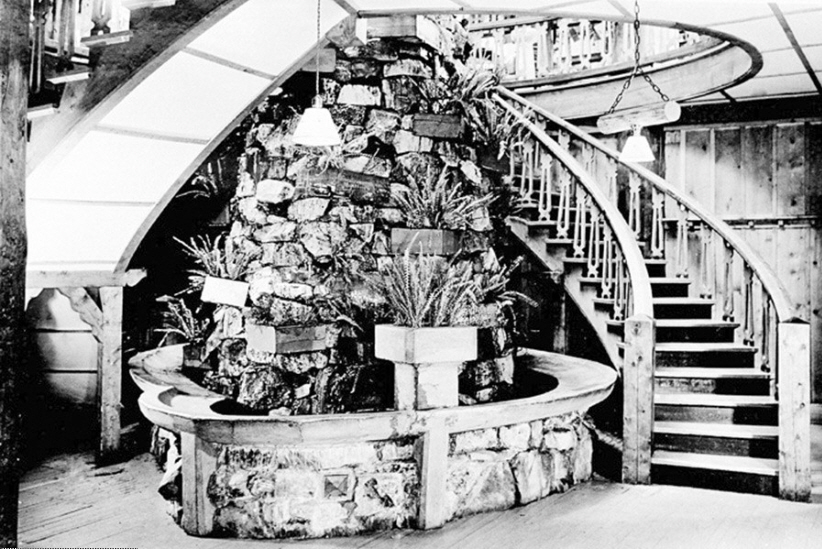
Today’s news release from NPS Glacier National Park notes that restoration work on Many Glacier Hotel is continuing, especially in the annex (officially annex 2) where many rooms will be refurbished; the kind of structural, safety and stabilization that were done in the main annex of the hotel will also be carried out in annex 2. This coming summer, half of the hotel’s rooms will be closed during the project’s completion.Original double-helix staircase - NPS photo

In a separately funded project, the long-removed spiral staircase will be returned (rebuilt) in the hotel’s lobby connecting the main floor with the lake level rooms below.

As I’ve written in my blogs previously, I would have opposed the removal of the staircase in 1957 had I been working there at the time. While many old timers have (rightfully) mourned the loss of that staircase which had been in place in 1915, I firmly believe restoring the staircase now is not only a huge mistake by violates one of the preservation standards of the NPS’ parent Department of Interior.

Why This is a Mistake

  • The NPS is not removing this porte cochere to make the front of the hotel look like it once did.
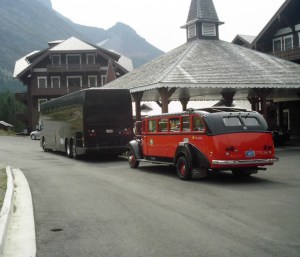
    The NPS is not removing this porte cochere to make the front of the hotel look like it once did.

    The Department of Interior’s preservation standards state that “Changes to a property that have acquired historic significance in their own right will be retained and preserved.” This means that you cannot, within preservation best practices, convert a structure to the way it was in an earlier time since it’s ambiance, usage and looks have evolved over time. Buildings evolve, and the lobby without the staircase has more years of history than the lobby with the staircase.

  • The rebuilt staircase will alter the rooms below. The St. Moritz room stage will be removed, making it impossible to set up musical groups, much less return to the historic summer musical productions that were a long-time and historically significant offering by hotel employees. Ranger Naturalist talks will also be removed from the hotel, because the lake level renovations will remove their Lucerne Room venue when the gift shop is moved from the lobby downstairs.
  • The gift shop will probably not fare as well in the lake level where it will be out of sight and out of mind.
  • Others have complained that the staircase will be an open vertical “corridor” that will carry noise and cooking odors from the lake level up into the lobby.
  • To be consistent with the logic replacing the “historic” staircase, the NPS would also have to replace the former Many Glacier swimming bool and remove the added-on  porte cochère at the main lobby entrance that protects car and bus passengers from rain upon arrival. Other smaller-order changes have been made to the hotel since I worked there: I note that the NPS isn’t advocating returning those areas to their original as-built configurations. While I understand the urgent need several years ago to stabilize the hotel’s foundation, taking the historic “kinks” out of the lake-level “stagger alley” hallway was a very non-preservationist in approach. Does NPS plan to restore these kinks?

My comments to the Department of Interior and NPS-Glacier National Park about the park service’s justification for the violation of the standard prohibiting the return of buildings to earlier configurations have received no response. It appears that the NPS has overlooked its own standards in favor of sentimentality.

As a former Many Glacier Hotel employee, I’m done with the hotel because the new eyesore in the lobby will be nothing I want to see. As a former Historic Preservation Commission chairperson and preservation grant writer, I dislike the precedent of this violation of standards. Once the staircase is returned, anything can be returned and that’s a mess I don’t want to contemplate at Glacier National Park or any other unit in the system.

Malcolm

Trick Falls wonders: ‘Is trailer trash talk the new normal?’

There’s a certain reality show (I won’t say which one because I don’t want to get sued by anybody) that I believe intentionally recruits contestants that use a lot of in-your-face -profanity, are arrogant and full of themselves, and generally behave like the worst trailer trash on the planet.

Ratings, ya think?

Wikipedia photo
Wikipedia photo

Even so, I assume these people act on the show the way they do in real life. If so and if this is the new normal, then our country’s in worse shape than I thought.

This comes to mind today because a Facebook discussion got started on a friend’s thread about whether people hanging out on the social media should simply expect to the discounted about anything and everything. My answer was no. I thought it was out of line for people to come out of nowhere and randomly criticize people’s clothes, hair, eyes, career choices, and various other personal attributes because (hopefully) they wouldn’t do that kind of thing in person and remain friends.

Others said that if you do anything (or are anything) on the social media, people are going to comment. I think personal attacks there are out of line, but agree that if one posts something about politics, religion, current events, and a variety of other issues, there will be a lot of commenting. That’s why those posts are put there unless people think they’re just preaching to the choir and that everyone who sees the post will click LIKE or say AMEN and move on.

I see a lot of libelous material on Facebook and often wonder why that’s necessary to “win” an argument about whether ABC is better than XYZ. Many of the comments sound like they’re from people who talk like those on the reality show I’m thinking about. But God help us, these are (I assume) regular people. Those of us on Facebook weren’t selected by central casting to come out there and stir things up to increase Facebook’s ratings.

Of course, trash talk is easy. If somebody makes a political point, it’s easier for somebody to say, “well, you’re an asshole” than to come up with anything factual and relevant to say in response. And, should anybody ask where you got your information, it’s easier to say, “those bitches at that place are all f_cked up.” I’ll wondering, of course, when it became okay to use the word “bitches” as a synonym for women and if the people that do think they’re winning any points in the discussion with the “F” word as well.

Sounds like a lot of high school posturing to me. But it’s coming from adults who, somewhere along the line, decided that talking like an immature juvenile in the middle of a temper tantrum was good for their jobs, their friends, their lives and their country.

By the way, if you happen to live in a trailer and don’t talk and act like the people on that reality show, you’re in the clear. If you call me an asshole on Facebook because I’ve just found a factual flaw in your political argument, you’re not in the clear.

My dear old daddy used to say, “trailer trash ain’t never going nowhere no matter how they strut around the block because they end up back where they started.”

I used to agree with him. Now I’m thinking times have changed.

–Trick

A resident of Two Egg, Florida, Trick Falls made a killing in the gigolo business before going into the philosophy business.


Haints, Plate-Eyes and Demons, oh my

Frankly, I don’t like reading specific directions for summoning evil spirits because I’m afraid I’ll accidentally think them or recite them and suddenly a hideous monster will appear.

demonFrom hoodoo to witchcraft to high magic, the lore is filled with cautions about the dangers of summoning bad stuff because unless you know what you’re doing, the bad stuff will come after you. This would be kind of like purchasing a rabid dog to keep traveling salesmen away from your door. The odds seem high that the dog will attack you first.

Another reason I don’t like reading specific directions for summoning evil spirits is the feds. They probably track this stuff and the last thing I need is the NSA telling the FBI that I used the search terms “black arts conjure oil” or “hoodoo demon-calling spell” enough times for it “to be a problem” as opposed to looking for crossword clues.

Writers often talk about stuff like this. We worry about doing research about how to kill people, make bombs, mix deadly and untraceable poisons, and making pacts with the devil. The people who have that kind of history on their computers usually tern out to be serial killers or the kind of nut cases who join ISIS and saying “I’m just writing a book” probably won’t cut it when the cops arrive.

I didn’t worry about this when I was writing Conjure Woman’s Cat because for that book, I was looking up good spells, good charms, and how to reverse jinxes. But in the sequel, my good conjure woman is combating a black arts root doctor and so I have to know more about that side of the business for her to be able to speculate about what he’s doing and how.

Since I try to make the spells and uses of herbs as realistic as possible within the world of conjure, I don’t feel right just making it up. Suffice it to say, the curses I’ve found aren’t going into the sequel verbatim. For one thing, I have to find a spell or recipe in multiple places before I’ll trust that it’s more than the imaginings of one resource. For another, what if the thing works as advertised? I don’t need to see on CNN that people are using my book to summon demons to go after their spouses’ lovers or to disrupt law-abiding governments (if any). So, everything has to be blurred around the edges: exact enough to make a real conjure woman nod in agreement but inexact enough to your child, spouse or neighborhood crook can’t use it.

By the way, plate-eyes aren’t seen very much any more, but generally they’re unpleasant, what with their glowing eyes the size of plates. If one bothers you, you can get rid of it with anything that smells bad. I’m pretty sure I’m not going to use any plate-eyes in the sequel to Conjure Woman’s Cat because nobody seems to know how to contact one of them. Haints, well, they’re okay, but they usually have their own agendas.

Demons, though, they’re looking pretty good, figuratively speaking, because they’re easier to summon that most people think and fewer people are going to question whether the author has used the right technique or the wrong technique to call them.

When the book comes out, I promise it won’t contain the exact technique for calling a demon. It will be close enough to make the book slightly dangerous. But that’s what readers want.

–Malcolm

KIndle cover 200x300(1)Malcolm R. Campbell is the author of “Conjure Woman’s Cat” and a batch of paranormal Kindle short stories.

Stop by my website.


Words you never publish might change the world

Those words that might change the world: perhaps you don’t know you’ve written them. You wrote them in a letter that changed another person’s life, and then others and countless others, and you never knew.

cloud2Those words that might change the world: perhaps you wrote them in your diary. You didn’t know what they meant until you wrote them and when you knew, you were changed and the ways you changed impacted what you wrote and published after that.


Those words that might change the world: perhaps they’re within a poem, a short story or a novel that never found a publisher. Even if none of your heirs find and publish those words and change the world long after you’re gone, they exist now and are part of your life, a life that would have gone down different roads without those words hidden away in a drawer.

You draw strength from the words you write because every word you write changes you into a person who is different than the one who sat down to write. Your strengths ripple outward and impact people who never see the words that served as a catalyst. Who you are now is always partly determined by the growth you achieved through writing words you may never publish.

The words you write are never wasted even if you throw them away. They are never quite gone from you even if your conscious mind cannot recall them. They are like a continuing breath, unseen but life altering and life giving.

You have cast a spell on yourself, enchanted yourself, discovered heretofore unknown dimensions of yourself, and from such things, there’s no return.

Since you cannot return, you will write other words that are impacted by your older words, you will say something wondrous to a stranger that you meet because the you who wrote those words walks down different streets with influences you may never see, you will wave to a man or woman on the street who will be changed, perhaps ever so slightly, by that wave or the smile behind it even though s/he will never know of the long lost words that brought about that moment.

This is the power of words that exist but remain hidden while their energy turns the world on its axis and casts devils into the sea.

–Malcolm

Inanna’s mythic heroine’s journey

from the archives

“The world’s first love story, two thousand years older than the Bible—tender, erotic, shocking, and compassionate—is more than a momentary entertainment. It is a sacred story that has the intention of bringing its audience to a new spiritual place. With Inanna, we enter the place of exploration: the place where not all energies have been tamed or ordered.” – Diane Volkstein in “Inanna, the Queen of Heaven and Earth: her Stories and Hymns from Sumer”

Inanna, as envisioned by nikkirtw123 on Photobucket is strikingly close to my vision of Sarabande as I wrote the novel.

As an author, I view my characters through a high-powered microscope and present the results of what I see as part of my stories. I will put you into the characters’ shoes if I can because—as Diana Volkstein writes—this is where the energies haven’t been tamed or ordered.

In an older novel, I described that place like this: “He knew him at the binary level where the line between matter and energy is barely discernible and often non-existent: Where urges pull at their chains, where drives push dumbly and drip sweat, where instincts race unchecked, where a horrifying sadness lies buried, where a raw pulse drums a cadence for the primitive rites of changing seasons, where white-hot impulses leap synapses in a shower of elemental fire.”

I wanted a similar, up-close focus in my heroine’s journey novel Sarabande. So, for the story of a woman seeking wisdom and wholeness, I could think of no better model than the myth of Inanna, a graphic dramatization of a woman’s inner journey to find herself outside the traps and trappings of a masculine world that has–as Sylvia Brinton Perera (“Descent to the Goddess”) wrote–forced the binary level of feminine power into dormancy for 5,000 years.

Or, as the late Adrienne Rich said, “The woman I needed to call my mother was silenced before I was born.”

Sarabande’s Heroine’s Journey

The journey in “real life”

In today’s terms, Sarabande was a tomboy. She was an expert with a knife, bow and arrow, a fishing pole, and everything she needed to know to survive in the wilderness. She learned all this from her father because her mother believed women should only learn to keep a good home and not question society’s norms for women. However, Sarabande will never truly become herself as long as she is a disciple of either her late warrior father or her misguided, preachy mother. She is being taunted by a ghost that she must approach face to face in the ghost’s world.

Early on in her quest to rid herself of the ghost of her dead sister Dryad, Sarabande learns to see the world at a binary level: The lake, surrounding mountains and the cloud-draped sky broke apart into millions of colored specks. Sarabande leaned against Sikimí, even though he was no longer solid, and saw that her own light-pink hand was not solid either. In spite of her sudden dizziness, she did not fall. In fact, when her fingertips touched Sikimí’s side, a swarm of pink specks flew, like bees, into the permeable yellow gold of the horse, and when they did, their color changed to match the specks in their new environment.


But she doesn’t know what it means. So it is, that her quest to find and confront her sister follows the pattern of Inanna’s Heroine’s journey to confront her sister Eriskigal, Goddess of the Underworld. The underworld, in this case, is not the world of mobs and crime or “hell” in the Christian view, but the more dangerous world of the unconscious. Like Inanna, Sarabande will be broken, shamed, and close to death before she learns who she is.

This is the heroine’s journey, to be buried in mother earth like a seed where she will be reborn with the spring into a new creation that finally has the freedom to follow the original injunctions of her destiny and her gender.

Malcolm

Malcolm R. Campbell’s heroine’s journey novel, “Sarabande,” is the sequel to his hero’s journey novel “The Sun Singer.”