Is writer-to-writer networking just another way to avoid actually writing?

Writers spend a lot of time not writing. Not writing includes marketing, promotional stuff, platform building, blog posts and other ways of establishing a writer’s online presence and calling attention to the books. It also includes book signings, readings, appearing on panels and running a booth at a book fair.

Maybe this works for screen writing teams, but it doesn't look good for novelists/
Maybe this works for screen writing teams, but it doesn’t look good for novelists.

The headline for this posts tells you I’m skeptical about, say, slumber parties for writers or retreats where writers show each other what they’re going and discuss it and the whole concept of write-ins.

A write-in, as I learned in an Indies Unlimited post (Do You Need to Be Closer to More Writers?) this morning is (basically) a bunch of writers with laptops assembled around a big table all typing diligently into a DOCX file some meaningful scenes in their work in progress.

WTF

Okay, for those who love these things and come home with some work accomplished, go for it. But this sounds more like an excuse to sit around and shoot the breeze and have a few beers rather than doing serious work. As far as I know the whole shebang isn’t like synchronized swimming and other similar events at the Olympics. To work, this is going to require discipline. Every time one of the writers sighs, laughs, or utters a string of profanity, everything’s going to stop and people will talk about that.

In my world, a writer goes into a cave, works on his or her book, and when it’s done, s/he comes out and gives it to an editor who cleans up the parts of it that are a mess. The whole concept of having beta readers looking over a writer’s shoulder during this process gives me the willies. Next thing, there will be focus groups to decide whether, say, allowing Bob to have sex with Jane will lose readers or gain readers.

Hemingway once told writers to be careful about talking their novel/story away. By this he meant, sitting down with another writer and telling them the plot of a story-to-be, getting into a discussion about it, and then suddenly losing the whole thing. That fits my concept of writing: nobody sees anything until it’s done. No write-ins, no beta readers, no family inputs, not posting scenes on bulletin boards for critiques, no sharing.

All that stuff leads me away from the process of creating a story. It sounds too much like a committee approach or maybe a screwing-around-drinking-coffee-rather-than-actually-writing approach.

That’s my two cents for today.

–Malcolm

Malcolm R. Campbell is the author of various things which are available in various places for various prices.

 

Crank down in Florida thinks he can make ice as good as God Almighty

gorriemanumentDr. John Gorrie of Apalachicola Florida was a pioneer in the development of mechanical refrigeration in the 1840s. He saw cool air, whether from ice or from the lowering of the temperature in a room, as a medical means of combating such diseases as yellow fever and malaria. However, as a “Smithsonian” article about him suggests, he received a chilly reception, lost backers, and was never able to pursue the equipment’s development based on his early patent.

I first saw the John Gorrie museum, a Florida State Park, in Apalachicola when it opened in 1958. It is one of the treasures of visiting the “other Florida” or “the forgotten coast” in the panhandle by following U.S. Highway 98. Now, we take the creation of ice for granted and–except for days when we’re waiting for the repairman–we rely our window air conditioners and central HVAC systems.

However, the creation of ice by man was thought by some during Gorrie’s time as an affront to nature as “Smithsonian” noted in its July 2002 article: “Gorrie, who used air as the working gas in his machine, took his idea north to the Cincinnati Iron Works, which created a model for public demonstration. But the notion that humans could create ice bordered on blasphemy. In the New York Globe, one writer complained of a ‘crank’ down in Florida ‘that thinks he can make ice by his machine as good as God Almighty.'”

gorriemuseumAn opposing view appears on the state park’s website: “Not long after the death of Dr. Gorrie in 1855, famed botanist and physician Alvan Wentworth Chapman commented to celebrated botanist Asa Gray, ‘Gray, there is the grave of a man we recognize as superior to all of us.’ The technology needed to discover the cure for yellow fever still does not exist. Gorrie’s valiant attempt inadvertently created a machine and theory that changed the world forever. The John Gorrie Museum State Park reveals this remarkable and compassionate man and shows the amazing machine he created.”


While the original Gorrie ice making machine is in the Smithsonian Institution, you can see a replica of it while visiting the Gorrie Museum on 6th Street in Apalachicola, one block off U.S. Highway 98.

For more information on Dr. Gorrie, see: Explore Southern History

–Malcolm

Malcolm R. Campbell grew up in the Florida Panhandle and has written fiction such as “Conjure Woman’s Cat” set in the areas he explored many years ago.


Faerie tale in a mirror

Once upon a time—when time was more speculative than it is today—a king and queen had no children. The lords and ladies at court watched the night skies for signs and the townspeople from shipwright to innkeeper offered prayers and charms to the realm’s gods because the court and castle were dour, grey and unhappy indeed.

The king and queen seldom ventured outside the castle walls because nature’s cycles were rich and profligate. Across the parklands and throughout the forests, bluebells, roe deer, and red kites were blessed with young past human understanding.

The royal couple consulted astrologers, crossroads spirits, and the legendary faerie in the great forest. They carried talismans, drank teas, and chanted strange combinations of awkward incantations during the blue hours and holy days. Yet no answers came.

The queen considered herself sorely lacking as the barren years grew in number like stacked-up like rushes grown foul with use. The king felt cursed for the frivolities of his youth. Desperate, the couple went to a solitary goodwife and upon the winter solstice they drank together her bitter coction of herbs prepared over an unnatural fire.


So it begins. You’ve been there before…a girl child is born…she’s a fetching one…but a faerie is inadvertently slighted…a curse is pronounced…ultimately she sleeps for one hundred years waiting for the kiss that will wake her up into the world.

What handsome prince wouldn’t want to kiss a young woman so beautiful, so pure. . .

WakingPlainFB

But wait!

In “Waking Plain,” my new Kindle faerie tale, the sleeper is a young prince.

They say he’s as dull as dishwater, and that is kind.

The castle is a wonderment as always. So, too, the faeries and their magic. Even the great forest surrounding the wonderment of a castle is enchanted with four-legged animals and winged creatures and flowers and trees and sunshine that are grand beyond the understanding of everyday men and women.

But if the sleeper isn’t beautiful, who will kiss him? Perhaps it’s kinder to the young man–not to mention, the world itself–to let him sleep.

I don’t mean to imply that the classic tale of “Sleeping Beauty” is sexist, only to say that it’s more realistic to ponder how it would be for an everyday kind of guy–you know, the one who would be the last one chosen for a team during recess–to wait for eternity, if not longer, for the woman of his nightmares to kiss him and re-awaken him for all to see.

They would prefer not to see him, of course, but they might, just maybe, in this faerie tale in a mirror.

–Malcolm

WakingPlainCoverInasmuch as “Waking Plain” is a Kindle faerie tale (or as Amazon calls it, a “fairy tale”), that is where you will find it, and not for a who’s-fooling-whom 99¢ but for an entire $1.00. That extra penny is your payment to the faerie world for allowing this story to be told.


Springtime means trying to start the lawn mower

During the cold, wet, seemingly endless winter when more people than not are discontent, dreams focus on springtime and sitting in the sun and leaving the windows open.

First sign of lawn mowing season.

I think about the lawn mower.

Later on I think about hot Georgia afternoons and start looking for the first signs of autumn’s more civilized weather. After my wife and I finished planting six more flowering trees, we wandered over to the riding mower out of curiosity.

It started on the first try, bless its heart.

Now that we’ve started the lawn mower, the grass has suddenly gotten the idea that it should grow like there’s no tomorrow. I know there’s going to be a tomorrow: I saw it in the weather forecast which said, “Warmer temps just perfect for lawn mowing.”

Now the grass looks like we’ve never bothered to mow it and in a rural area where people often use combines to cut trim their front yards, it gets kind of hard to go outside during the day time in the grass is tall enough to bale.

Naturally all the gasoline cans were empty. They’re full now and the car smells like the BP station.

I’m almost ready to sit on my riding mower with an ice bold beer in the cup holder and dream of snow and old man winter.

–Malcolm

AtSeaBookCoverMalcolm R. Campbell’s navy novel “At Sea” is free on Kindle March 18, 19 and 20.

Vietnam Navy Novel Free on Kindle for Three Days

My Vietnam War navy novel At Sea will be free on Kindle March 18-20, 2016.

AtSeaBookCoverDescriptionEven though he wanted to dodge the draft in Canada or Sweden, David Ward joined the navy during the Vietnam War. He ended up on an aircraft carrier. Unlike the pilots, he couldn’t say he went in harm’s way unless he counted the baggage he carried with him. As it turned out, those back home were more dangerous than enemy fire.

Here’s a short excerpt to tempt you out to Amazon. . .

David stood on the back porch on a spring evening listening to the slow sweet rising and falling howl of a wolf calling her pups while the wind stilled and the dark lavender lupine flowers disappeared into the gathering twilight. Behind him, the house was empty, his dinner long gone cold on the kitchen table along with the passionate Sparrow singing his chanson favorite “La Vie en Rose” again and again, and rather than stare at the letter in the silent company of canisters and chrome appliances, he brought the telephone and pinot noir outside where the world was less closed in on itself.

At the end of the long cord, he dialed her number, wondering—while the wolf pups yipped back at their mother—if her hello would still sound like her hello.

“Davey, how nice to hear your voice. I also hear wolves. Where are you?”

“On the porch looking down toward the box elders and the creek.”

“Don’t remind me. It hurts too much.”

“How are you?”

The book was inspired by my time on board the the USS Ranger.

“Fine. I knew you would call. While practicing my flute this morning, I found myself playing a song we once knew.”

“I’ve lost myself to the war,” he said. “The letter arrived today. I report in July.”

“Davey, no. What do your parents say?”

“Not to rock the boat.”

“I hoped you went to Sweden with Brita. Then I heard the wolves.”

“I could never come home from Sweden.”

“If you die in Vietnam, I’ll forget you. If you survive, you’ll forget yourself. Either way, the vine may kill the elm.”

“You’re cold,” he said, “and dragging out old symbolism of fruitful grapes smothering their supporting tree.”

“Then stand quiet with me again.”

The wolves were silent. He heard her breath and her heart. The first stars were out. When she was at the ranch four years ago, she said, “Night is liquid magic; we’re stirred together. You’ve taken me beyond myself, higher than the wolf trail stars, and what we have of each other, we own.”

In the great quiet, he wept for the parts of himself that were no longer his.

“David, the baby’s crying. I’ve got to go.”

“Unfair! But I love you, Anne.”

USS Ranger at sea in 1968 - US Navy Photo, cleared for publication
USS Ranger at sea in 1968 – US Navy Photo, cleared for publication

“No doubt,” she said, hanging up and extinguishing the moon’s pure light.

He carried the wine bottle up to the chokecherry tree, sat beneath white flowers and watched the night where he once watched it with her.

She knows I’m here, he thought, because she knows me well. She despises me, too, because she believes some places are sacred.

He got an axe and chopped down the tree. It was neither the best thing nor the worst thing he’d ever done, but it was close.

If you’re a Kindle Unlimited subscriber, you can always read the book for free through Amazon’s program. If you’re not a KU subscriber, now is a great time to download a novel about sailors and bar girls and mountain climbing and a young man wrestling with his conscience about military service.

I hope you enjoy the story.

–Malcolm


Two organizations helping conscientious objectors

When I became a conscientious objector during the Vietnam War, the primary issue was conscription. The secondary issue was the concept of an unjust or unnecessary war. The draft ended in 1973, but the concept of needless wars did not.

CCWlogoToday, many who are willing to join the military to protect the country, become uncomfortable–as many did during the Vietnam War–with combat and casualties which appear to serve no viable purpose. In recent years, people have asked the same kinds of questions about Iraq and Afghanistan that were once asked about Vietnam: should we be there?

In the 1960s, many of us sought practical help from the Central Committee for Conscientious Objectors (CCCO) and their handbook which outlined how to apply for a CO status and outlined the kinds of questions one would be asked if they did. This group is more or less no longer active.

Today, if one is against all wars and rejects even non-combatant participation, then (if you’re a man) you still have to register with the Selective Service Commission. However, as long as enlistment is voluntary, there are fewer issues to face unless you disagree with the concept of registration.

AFCSlogoIf you join the military and consider conscientious objection due to the role you’re being asked to play, two organizations can help you sort through what (if anything) you can legally do. You will see on their sites routes you can take along with information about such issues as the so-called endless war, the morality of drone strikes, and even the militarization of police forces.

  • The Center on Conscience & War is a non-profit organization that advocates for the rights of conscience, opposes military conscription, and serves all conscientious objectors to war.  Founded in 1940 as the National Interreligious Service Board for Conscientious Objectors, CCW can help you find alternative service to the military and/or help you through the maze of regulations should you wish yo file as a CO.
  • The American Friends Service Committee, where many of us also went for help during the Vietnam War, is an active organization today with multiple programs. Their programs seem more extensive than those of CCW, because they address such things as the refugee problem and the military budget.

Today’s conscientious objectors hope to see rights and procedures codified into law rather than remaining dependent on the regulations of military branches where they can be and have been suspended for various reasons. Larger issues, such as the demilitarization of police forces, the legality of drone attacks, and solving refugee problems by addressing basic issues causing conflict rather than looking at refugees as charity cases are in my view outside the conscientious objector framework. (That is not to say that we shouldn’t address them.)

I wrestled with the problems–and stigma–of becoming a CO during the 1960s and think that many of the same issues are with us today even without the draft.

The issue is by no means settled and the stigma is by no means gone.

–Malcolm

AtSeaBookCoverMalcolm R. Campbell is the author of “At Sea,” a novel about a conscientious objector during the Vietnam War.  


Facebook Suffering Typewriter Infestation

It begins subtly.

There’s a small ad in the right-hand column from a nostalgia stock photo agency showing a guy with a pipe writing the great American novel on an ancient Underwood typeriter.

typewriterclipartA few days later, a woman is shown in a sponsored post typing her memoir, or perhaps journaling, via a somewhat more modern (but non-electric) portable.

Few people notice.

The following week, typewriters begin to appear in book promotion posts, inspirational status updates about the myth of writer’s block, and in pleas from publishers asking us to send them our best work (albeit in a DOCX file).

So far, the Centers for Disease Control appears not to have noticed the infestation.

Speculation from conspiracy fans is rife: (a) Those who distrust writers want to hypnotize us into using outmoded equipment, (b) there’s been a security breach at an Area-51 lab experimenting with sending hexed typewriters to third-world planets, (c) Somebody found an abandoned warehouse filled with typewriters and is trying to unload them on aspiring writers before they (the writers) learn there’s no place to buy typewriter ribbon.

Is Facebook’s typewriter infestation innocent nostalgia, an on-gong “Throw Back Thursday” of yesteryear images, or just a lot of overworked copywriters copying each other?

Perhaps.

I don’t have any proof yet, but I suspect the glut of typewriters appearing on Facebook is more nefarious than we can imagine and that if you look closely at any of Nostradamus’ more obscure prophecies, you’ll see that he said this was going to happen.

If you’re a writer, run for your life.

–Malcolm


Publishers Weekly Leads Petition Drive to End Cuba Book Embargo

Cubans and Americans haven’t had much access to each other’s literature for fifty years. Even though relations are becoming more normalized between the two countries, the overall embargo remains in place.

PWlogoPersonally, I don’t think an embargo on consumer products ever made sense, much less now.


According to the Publishers Weekly article A Letter from PW on the Cuba Book Embargo, “The Cuban people’s desire, and need, for American books was evident during the February U.S. publishing mission to Cuba, organized by PW and Combined Book Exhibit, in close cooperation with Cuban government officials.”

Click on the link in the paragraph above to see why PW thinks the embargo should be lifted. Or, if you already believe it should be lifted, you can read the petition here.

The embargo can only be lifted through Congressional action.

–Malcolm


Rolled Carpet: Dead Body Not Included

Several of us were “talking” on Facebook this morning about the fact we can’t see a rolled up carpet alongside the road without thinking there’s a dead body in it.

If any organized crime enforcers are reading this blog, I have a question: Do real killers roll bodies up in carpets?

If a cop or a nosy neighbor sees a couple of guys putting a roll of carpet in the trunk of a car at night, you’d think the scene would be a dead give-away.

This picture probably causes nightmares.

Perhaps we’ve seen too much TV where bodies are lamely rolled up in carpets. A popular show last year showed a bunch of college students moving a body that way. Gosh, if that’s the disposal method of choice for students, just think about older people who’ve seen a thousand crime shows where carpets and the dead always went out in the trash together.

When I see ads for rolled up carpet, I expect a disclaimer at the bottom that says: Dead Body Not Included.

There must be a better way of removing the dead from our presence that doesn’t attract attention. The wood chipper in Fargo had possibilities until a lot of people saw the movie and assumed that if they heard a wood chipper at night, somebody was going to be reported missing in the morning.

The TV series Bones finds interesting (and usually gross) ways of disposing of bodies at the beginning of each show. They seem to like the “high yuck” factor to attract the disturbed segment of the population.

As an author, I speculate about this kind of thing for research purposes.  However, what with the feds spying on us, it’s become harder and harder to do Google searches like “How Can I Hide Uncle Ned’s Body” without some web crawler bot finding it and flagging the query at one of the alphabet soup agencies that claims it isn’t watching for key words like “body” and “rolled up carpet.”

We hear on TV and the Internet that cops think cop shows are unrealistic. They could help. All it would take would be a web page with information like this:

  • How to put granny on an ice floe without getting caught.
  • How to poison your husband/wife so that even Abby on NCIS won’t figure out how it happened.
  • How to dispose of a body without getting caught by the police.
  • How to successfully launder money, hire a hit man, move weapons around the country, and get away with running a numbers racket out of your kitchen.

Frankly, all of us would benefit from this kind of information: (a) authors would make books and screen plays more realistic, (b) readers/viewers would have higher quality entertainment, (c) kids would stop getting scared when they see rolls of carpet in the ditch because nobody would be using carpet improperly any more.

Those of us who have been scarred for life worrying about what’s in rolls of carpet would finally know that carpets are safe.  The country would save billions of dollars that go to therapists who are helping patients cope with this problem. (My guess is that most health insurance companies don’t over “Carpet Phobia.)

Personally, when I see a roll of carpet, I want to visualize how beautiful it will look in the living room rather than thinking, “hmm, I have seen Dad for a couple of days.”

–Malcolm

AtSeaBookCoverMalcolm R. Campbell is the author of “At Sea,” “Conjure Woman’s Cat,” “Sarabande,” and other books in which no dead guys have been rolled up in a carpet.

Amazon Author’s Page

Creating a Book Cover on the Cheap

Since the release of my Vietnam novel At Sea is a relatively modest Kindle production, I didn’t want to spend money for a cover photograph, artist or a cover designer. It’s a hard choice. The expense might produce a cover that increases sales or it might run the whole project in the red.

I wanted a cover that showed readers At Sea is set on an aircraft carrier. When I was in the navy, the pictures I took as a navy journalist belonged to the navy. There are many stock images of aircraft carriers on navy sites, but they cannot be used without permission for a book cover or advertising.

Many self-published books end up with little or no art work on them and rely on print, color, and a few simple graphic shapes. I don’t think these attract attention or help sell the book. Plus, they give prospective readers little to no idea what the book might be about. I definitely needed an aircraft carrier on my book’s cover.

Finally, I found an old color slide of the USS Ranger’s flight deck I took when I was part of the crew:

flightdeckA

Several issues come to mind. Although a lot of people are doing a lot of things, the picture doesn’t have the dynamic punch it would have if it showed the ship navigating a stormy sea or a plane taking off.

Even though the color was muted due to the age of the Ektachrome slide, it still brings out detail, potentially leading some readers to infer this book is nonfiction. Also, it’s a landscape rather than a portrait photo. The first thing I did was get rid of the color:

AtSeaCoverPhoto

Now it’s less busy and the black and white photo rather lends itself to older times such as a book about a war that happened in the 1960s. Whether or not this picture would “work” depended on how it was cropped, how the title displayed, and how dramatic color might be added to the resulting book cover:

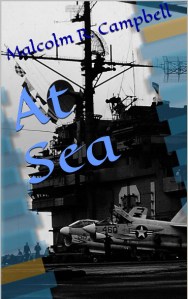
AtSeaBookCover

First, the detail has been downplayed via black and white and cropping. The cropping provided a portrait format and the added color framed the image of the two planes and the ship’s superstructure. To keep the author’s name and title from looking static, I have them displayed at an angle.

I like the two planes displayed on the cover because the main character works in the ship’s aircraft maintenance department and is best friends with one of the air wing’s pilots.

The result works for me because it came together without my having to hire an artist and/or pay for an expensive stock photo. Perhaps you would have approached it differently.

Doing a cover on the cheap won’t work if it looks cheap. Perhaps my ideas here from rough photo to finished cover will give you some ideas for your next cover.

–Malcolm

Note: Another version of this story was originally published as “The Sailor,” a book that’s now out of print.