Sample Hoodoo Spell: Opportunity, Life Change and Good Luck

“Let’s face it, sometimes the basic dressed candle spell just doesn’t cut it. When I needed some serious road opening, I devised this extra powerful Road Opener spellcast. It uses some additional products, not just Road Opener/Abre Camino formulas, in order to provide some much needed oompf.”

Source: The Spellcaster’s Source Hoodoo and Voodoo Witchcraft Blog

If you ever wondered what the directions for a hoodoo spell look like, this post is a good example, one that tells you the spell’s purpose, the ingredients you need, and provides a how-to-do-it narrative. While researching the novels in my Florida Folk Magic Series, I relied strongly on sites like this, comparing and contrasting the ideas I found to see which ones had the best fit to traditional Southern conjure.

Malcolm

I expect book editors to catch the over-use of a pet word or phrase

I just finished reading a novel by a “global bestselling author.” It was published by an imprint of a major publisher. Since it was a mystery/crime novel rather than a satire, I wonder why the publisher’s editors didn’t catch the fact that the author kept using the word “curtly” over and over again, as in, “It’s not my fault,” she said, curtly.

The first time I saw the adverb, it worked even though writing teachers generally don’t like adverbs because they tell the reader something rather than show the reader something. However, in a fast-paced dialogue sequence made up of short sentences, the adverb seemed justified. The second time I saw “curtly,” it was used appropriately, but I wondered why the author didn’t use something else rather than re-using “curtly.”

I didn’t count how many times he used this word. However, its use was excessive, noticeable, distracting, and lazy. His editor should have caught it.

Sometimes when I use a word, I think it’s the first time I’ve used it in a story. But then I notice it a few more times. In Word, I can see how often I’ve written it and where with the “find” function. It tells me how many times I chosen the word and highlights its occurrences. This makes it easy to change some instances of the word with synonyms or to rewrite the passages.

Now, perhaps the author in question is powerful enough to overrule his editor. Okay, the editor’s off the hook. But in this case, the author appeared to take the lazy way out.

–Malcolm

Malcolm R. Campbell is the author of the Florida Folk Magic Series of crime and conjure novels.


Can an author quote from a review?

“I heard a rumor that some authors were wondering about the rules regarding quoting reviews of their books. Whether you’re doing this in a tweet, a post on Facebook or your blog, or using the quote as a blurb in an advertisement or on the back cover of a paper book, the same basic rules apply. The considerations fall into two groups: those that are legal issues and those that are more a matter of etiquette.”

Source: Book Reviews: Can You Quote Me on That? – Indies Unlimited

I liked seeing this article because it helps clarify points about quoting and copying that have gotten rather fuzzy with our online world. Most people, including authors, don’t seem to grasp the fact that there are rules and those rules really don’t allow somebody on Facebook (for example) to copy an entire article or poem and then say “infringement not intended.”

That makes about a much sense as busting into a store and claiming “breaking an entering not intended.”

A good review is a godsend, so as authors we really don’t need to step over the line when deciding how to use them or cite them. This article will help keep us out of trouble.

–Malcolm

Florida in Pictures – Tallahassee’s oldest church

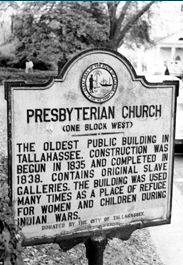
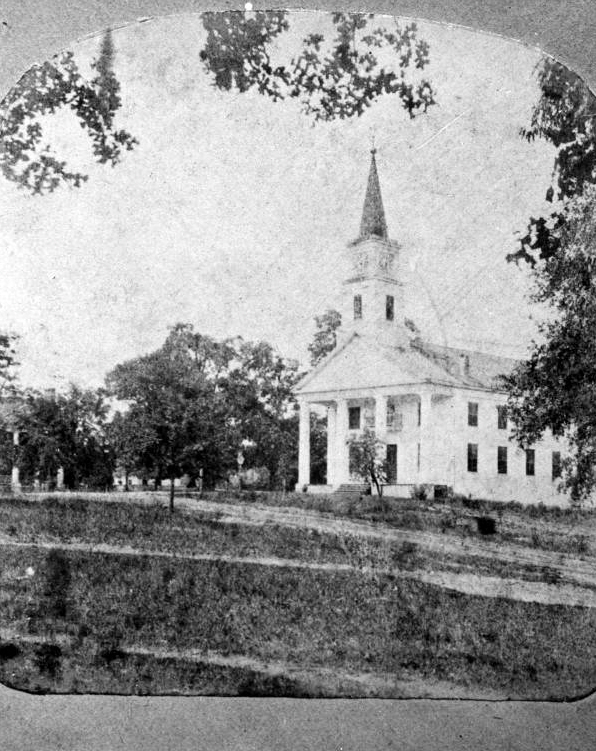
The First Presbyterian Church in Tallahassee is the capital’s oldest building in continual use. It was dedicated in 1838. Atypical in the South, the church accepted slaves as members who sat in a balcony that runs along three sides of the sanctuary’s “second floor.” Earlier, the church served as a refuge during the Seminole Wars and then, in the 1960s, as a leader in the civil rights movement.

I was a member of this church during my K-12 years in Tallahassee. My brothers and I were also members of Boy Scout Troop 101 sponsored by the church during those years. All three of us became Eagle Scouts, so it saddens me that the church at some point ended its association with scouting. It also saddened me when a large number of members who disagreed with the church’s civil rights stance split off during the mid-1960s and formed a new church.

The church is on the National Register of Historic Places where its Gothic Revival architecture is noted. The foundation included rifle slots that, by now, have probably been covered over. In contrast, solar panels now provide a portion of the church’s power and were–in 2010–considered the county’s second-largest solar panel array.

My father, Laurence, wrote the church’s sesquicentennial booklet of poems called “The Future of Old First in 1982.” He had, in earlier years, been a deacon, elder, Cub Scout pack leader, and explorer post leader.

The photograph shown here was taken sometime in the 1800s:

Florida Memory Photo

The church as it appears today, with the Methodist Church in the background and the church’s education building on the right hand side of the picture:


I don’t know if the church ever rings the bell in the steeple these days. At some point, the steeple was renovated and those of us attending Sunday school classes were allowed to ring the bell on Sunday mornings. The bellrope was accessed through a trap door above the balcony pews just above the church’s narthex. Everyone wanted to ring the bell! We loved it for its old fashioned sound, a sound out of history.

Malcolm

Malcolm R. Campbell’s Florida Folk Magic novels are set in the panhandle west of Tallahassee.


Breaking up is hard to do

Some say that a writer begins a book and a reader finishes it. That is after the book has been written and published, readers either like it or they don’t and see in it one thing or another because it’s time for the writer to move on.

For the writer, it’s like breaking up with a lover.

S/he has to begin writing the next book. Not too quickly, though, or the next book will turn into a rebound kind of thing, ill-conceived and overly filled with everything the newly released book didn’t have.

Some writers have book projects stacked up in notebooks, each waiting to capture the writer’s time and heart. I don’t. Not that I go to bars looking for them or sign up with online dating outfits: “meet beautiful Russian ideas just waiting to please” or “sexy singles in your town hoping for marriage.”

No writer wants people to say s/he’s on the make. That seems, somehow trashy as though s/he’s going to turn to a beach read or the kinds of books you find in airports or worse yet a book on a street corner that might really be a vice cop waiting to grab the writer in a hurry.

It’s sad when a writer gets so desperate to move on from the break-up from his most recent book, that s/he picks up a bereaved idea from an accident scene or a funeral like a cheap lawyer chasing a client, any client. And then, too, there some writers apparently get drunk or go nuts and pick up an idea that’s young enough to be their son or daughter or, at best, arm candy that will lead nowhere good.

Then there are the matchmakers. They have an idea or know somebody at their church with an idea or play duplicate bridge in a group with a lot of sweet young ideas all of whom are God’s gift to the right writer. Some are desperate, while others are bitter and resigned to never making it into marriage, much less into print. Others are a little rough, but I’m told they’ll “clean up nice.”

If all this is drifting into the kind of post that sounds sexist, I should tell you that an author’s relationship with a book idea is in many ways like a love affair and has similar hopes and jealousies and wrong things said (or written) at the worst possible moments. If one rushes into the right book idea too quickly, it will burst into flames and later when you chance to meet in some gin joint at a fated moment, you can say, “we always had Paris” and think sadly about the book that might have been if you hadn’t acted to crass with the delicate possibilities before the idea was fully formed in your heart and soul.

Sure, if my writer’s life was a movie, some well-meaning colleague who’s already going steady with a book idea would tell me to shave, put on a clean set of clothes and go with him or her to a nearby barn dance or USO canteen where the camera shots, dialogue, and music would clue in the audience before I knew what hit me that “this is the one.” I wish it were that easy.

Lord knows I can’t go looking for ideas at Walmart because we all know what kinds of ideas hang out there.

So, with the release of Lena, I’m sitting here alone at a silent keyboard, ashtray full of cigarette butts, a wastebasket overflowing with empty Scotch bottles, vicariously reading other people’s books.

Whatever you do, please don’t try to “help.”

Malcolm


Florida in Pictures – Sea Oats and Sand

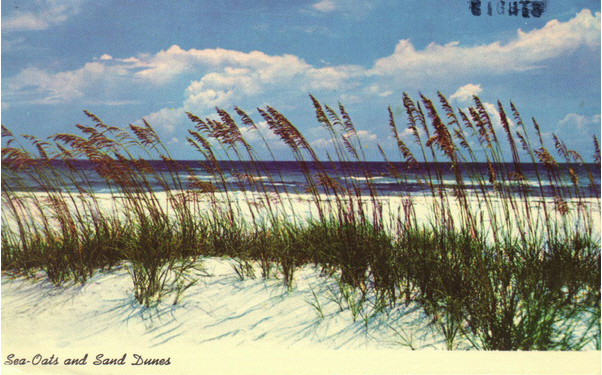
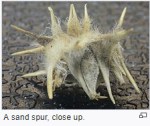
The sandy beaches of the Florida Panhandle are usually white and flanked by sand dunes covered with sea oats and sand spurs. Sand spurs are annoying because they, like spurs, grab on to your legs or your clothes. Sea Oats are graceful and protected. Pick one, and you might go to jail. Our panhandle beaches look quite a bit different than the multi-colored sand you might see south of Jacksonville. The sea oats add to the ambiance.


Florida Memory Photo


Wikipedia’s definition is accurate, I think: Uniola paniculata or sea oats, also known as seaside oats, araña, and arroz de costa, is a tall subtropical grass that is an important component of coastal sand dune and beach plant communities in the southeastern United States, eastern Mexico and some Caribbean islands. Its large seed heads that turn golden brown in late summer give the plant its common name. Its tall leaves trap wind-blown sand and promote sand dune growth, while its deep roots and extensive rhizomes act to stabilize them, so the plant helps protect beaches and property from damage due to high winds, storm surges and tides. It also provides food and habitat for birds, small animals and insects.

Trust me. You don’t want this in your yard. Wikipedia photo.

You can buy sea oats from nurseries but you can’t steal them from the beach. Frankly, when I was growing up here, it never occurred to me to pick the sea oats, much less buy them. They do stabilize the dunes and are an important part of the ecosystem. However, if you were to buy your own for your yard, you can use them to make bread.

As for the sand spurs, I think the devil made them.

Malcolm

Malcolm R. Campbell is the author of novels set in the Florida Panhandle, including “Lena,” “Eulalie and Washerwoman,” and “Conjure Woman’s Cat.”


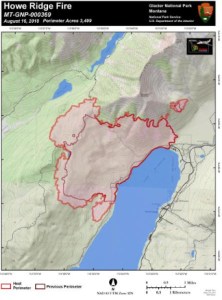
Glacier National Park – Howe Ridge Fire

From InciWeb: “Fire behavior increased yesterday yet there was minimal fire growth under smoky skies. The fire is estimated at 2,600 acres. Visibility hampered the CL-215 “Super scoopers” from working on the fire, however the Type I helicopter effectively cooled spot fires slowing the fire’s growth. Ground crews utilized existing trails to create fire breaks, continued to pump water for sprinklers for structure protection, and cooled hot spots at the residences on North Lake McDonald Road. Structure protection continued at remaining buildings at Kelly’s Camp. Fire behavior is expected to be more active today with increased winds and the potential of smoke lifting earlier in the day. The aircraft will extinguish spot fires and cool the head of the fire towards Stanton Mountain. Structure protection is the priority for ground crews and firefighters will continue to mop up hot spots along the North Lake McDonald road. Growth is expected on all sides of the fire today.”

Lake McDonald Lodge, across the lake from the fire, is closed for the season under an evacuation order. Avalanche Campground and Sprague Campground are closed. Going to the Sun Road remains closed from the foot of Lake McDonald to Logan Pass. Apgar remains in a “ready” status should changing conditions prompt an evacuation order.

NPS Glacier Photograph

According to the Great Falls Tribune on August 14, “The Howe Ridge fire in Glacier National Park destroyed several private residences as well as historic buildings owned by the National Park Service, the Park Service said Tuesday. Seven private summer residences, a cabin and the main camp house at Kelly’s Camp were consumed in the fire, which blew up Sunday night.”

KPAX TV reported this morning that firefighting efforts will increase as a Type 1 Incident Management Team takes over with additional resources and personnel.

–Malcolm

Current Promotions – Malcolm R. Campbell

  • The Kindle edition of Lena, the third novel in the Florida Folk Magic trilogy, is the prize in an Amazon sweepstakes that runs through August 22. Four copies are available. The winners will be selected at random when the sweepstakes ends and sent to those with the winning entries by Amazon. There’s no purchase necessary. Entrants will be asked to follow my Amazon author’s page which is something I know you want to do anyway. Click on the book cover to go to the sweepstakes page.
  • The Kindle edition of Mountain Song, a Montana novel with a few scenes in the Florida Panhandle, is Free on Amazon between August 16 and August 20. David, who grows up on a Montana sheep ranch and wants to spend his life climbing mountains, meets Anne Hill from Florida who is a child of the state’s swamps and blackwater rivers. They meet as seasonal hotel employees at Glacier National Park. A summer romance begins. But will it last?
  • The Kindle edition of At Sea, a Vietnam War novel and the sequel to Mountain Song, is free on Amazon between August 18 and August 21. David is assigned to an aircraft carrier serving on Yankee Station off the coast of Vietnam. This book was inspired by my time aboard the carrier USS Ranger (CVA-61).

Good luck and enjoy the books.

Malcolm

Review: ‘Barracoon’ by Zora Neale Hurston

Barracoon: The Story of the Last Barracoon: The Story of the Last “Black Cargo” by Zora Neale Hurston
My rating: 5 of 5 stars

What a shame that this book had to wait so many years to find a publisher. But we finally have Cudjo Lewis story. In her beautiful foreword, Alice Walker writes that “I’m not sure there was ever a harder story to read than this…” I agree. The story is unique in many ways: Cudjo, whose real name was Kossola, tells a story that includes his life in Africa and his life during the “Middle Passage” voyage to the United States after the slave trade was banned.  Most histories don’t include life in Africa or on the slave ship.

His story is dear because he wanted to tell it and because Hurston was a skilled anthropologist and knew how to collect stories. The story is dear because you can feel its truth in your bones; Hurston did not intrude herself or her perspectives into the narrative. And then, too, Curjo speaks in his own English dialect and that adds great depth and reality to the tale. We hear that Hurston couldn’t publish the book when she wrote it because the publishers wanted her to get rid of the dialect. I didn’t find it to be a problem even though a fair number of Amazon reader reviews say the dialect was hard to read. No, it wasn’t.

Cudjo has some traditional tales of his own to tell. These appear an appendix so that they won’t disrupt his story about being captured by blacks, placed in a barracoon (slave house), sold to whites, and then having to endure many days at sea before ending up at a plantation where he was expected to work. The experience seems incomprehensible to him. So, too, is the fact that once he’s set free, he has no money and no land, so where is he supposed to go?

Deborah G. Plant has done a fine job editing the material and writing an afterword and a glossary that place Cudjo’s story in perspective. Readers have a choice because the editor’s comments were placed in this separate section rather than being distributed throughout the narrative as lengthy and jarring footnotes. As such, you can read the story and then look at the added material–or simply read the story as a lover of Hurston’s works and/or oral history.

Cudjo’s story is filled with great loss, great wisdom, and–strange as it may seem–more humor than anger for a man torn away from the country of his birth and forced to live and work and endure a hard existence in a country where he was never whole again.

Malcolm

View all my reviews

Here’s why you can’t go home again

You can’t go home again because, by the time you get there, they will have torn it down in the names of “progress” and “development.” Or, should you find your home, the neighborhood will be gone, especially the most historic homes and buildings that made the place what was.

Looking at Atlanta’s penchant for tearing down the historic old in favor of the nonessential new, the late historian Frankin Garrett called this so-called development “municipal vandalism.” I had the good fortune to know this man who had a great office filled with old reference books at the Atlanta History Center. He had a photographic memory of everything that ever happened in Atlanta, but was the most nostalgic and angry about landmarks that had been wantonly bulldozed for parking garages and new buildings without souls. Atlanta’s city planners learned their craft from General Sherman’s “urban renewal” work there in July of 1864.

When I was in high school, my mother told me my father couldn’t go home again because the natural forests and even the orchards of his youth had all succumbed to development. In many cases, houses–as Peter Seeger would sing about in “Little Boxes”–that were made of ticky tacky and looked all the same. I didn’t really understand what Mother meant until I reached the age my father was when she said it.

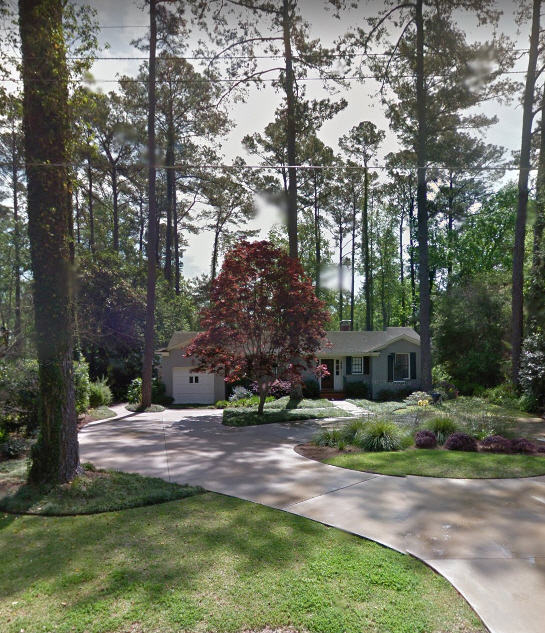
I have many memories of one of the first houses I knew as a child in Decatur, Illinois, a wonderful Queen Anne home with a beautiful vegetable garden and adjacent sidewalks which were perfect for my new tricycle. However, municipal vandals bought the land and tore the house down. This current patch of grass, entry drive way, and parking lot represent anti-progress:

Google Maps Photo

My brother, who still lives in Florida and makes occasional trips to Tallahassee, still drives past the house my parents owned between 1954 and 1986. When we closed up the house for good, the front yard was still filled with pine trees. The current owners have decided to celebrate concrete with a few landscaped areas for decoration. Our “personal fifty-acre wood” behind the house has now been converted to an “upscale” subdivision that can be seen from the backyard of this house where I grew up. I’ve seen both via Google Maps, but I haven’t been back since 1986 and that’s just as well, for I would probably destroy all that hardscape with dynamite and a backhoe:

My bedroom was the room on the far right. Google Maps Photo.

The older I get–and today’s my birthday–the longer my “municipal vandalism” list gets; places I never want to see again because of what people have done to them. My memories are much better than reality. I last saw San Francisco in 1987; I was surprised then by the amount of “development” that had occurred since my family lived there. “Progress” continues to occur, so I’ve retrieved my heart from that my city by the bay and hidden it in a forest that people have yet to “develop” into something that pales when contrasted with Nature’s work. I won’t bore you with my personal list of places where one bastard or another had no sense of history and/or no sense on the environment.

You probably have your own list.

–Malcolm

P.S. I set my novels in the past because, in my imagination, it’s still there. The most recent of these is “Lena,” the third novel in my Florida Folk Magic Series.