Nashville December 25th

On December 25, 2020, a car bomb detonated in downtown Nashville, Tennessee, United States, injuring at least three people and damaging dozens of buildings. The explosion took place on 2nd Avenue North between Church Street and Commerce Street at 6:29 a.m local time (CST). Officials have characterized the explosion as an “intentional act,” with reports of potentially multiple explosive devices being investigated. The explosion was felt “miles” away from the blast site. The Nashville Fire Department evacuated the downtown riverfront following the bombing. Witnesses reported hearing “gunshots early in the morning and a message coming from an RV parked in the street warning anyone in the area to evacuate.” The Federal Bureau of Investigation has taken over the investigation into the bombing. – Wikipedia

All we can do at this point is to ask “Why?”

And, due to the quick response of the police, there appear to be no casualties, thank goodness for that.

Perhaps it was too much to hope for that we would escape 2020 without another nasty event, another example, apparently, of the worst of human nature playing out in another public drama.

Sad news to wake up to on Christmas morning.

–Malcolm

Mary Magdalen Painting in ‘The Little Mermaid’

I saw “The Little Mermaid” (1989) several years after it came out and after I had read Margaret Starbird’s 1993 book The Woman With the Alabaster Jar about Mary Magdalen. Having focused on Mary Magdalen, who would receive a greater public interest after The Da Vinci Code appeared ten years later, I recognized a famous painting of the Magdalen in Ariel’s grotto of treasures and wondered how it came to be there.

Called “The Penitent Magdalene,” (or “Magdalen with the Smoking Flame”) the painting is one of several with that name by French artist Georges de La Tour done in 1640. In the Disney film, Ariel is shown looking at the painting, most especially the candle, as she tries to figure out the nature of fire–not something she would know about under the sea. Was Disney, for reasons unknown, comparing the red-haired Ariel with the red-haired Mary Magdalen?

Not really, at least not intentionally (that we know of). Writing in his blog on uCatholic in 2019, Billy Ryan says that animator Glen Keane “picked out that painting because he wanted a picture, an image, of a fire underwater to go with the lyric.” (Click on the word “blog” above to see a still and a video clip of Ariel looking at the painting.)

Regardless of what Disney and/or Keane intended, Starbird–whose focus is the sacred feminine–saw a deeper meaning in the painting in the film in her 1999 article: “Of all the possible pictures available from art galleries around the world, it is incredibly significant that the directors of the Disney® film chose to place Mary Magdalene at the bottom of the sea, for it is SHE who represents the lost Bride and the archetype of the ‘Sacred Feminine’ as partner in Christian mythology.” (Click on the word “article” to read the entire article.)

Perhaps Keane, who was Catholic, was aware of the painting because of his faith. It would surprise me if, in 1989, he was consciously thinking of the sacred feminine for that terminology and line of thought hadn’t come into the national consciousness (other than scholars) yet.

We may never know whether the painting was a convenient prop or whether it was intentionally used to make a larger point. Starbird thinks the painting’s use was more than coincidental, however it got there. I hope she’s right.

Malcolm

Writers conceal first, then reveal (possibly)

In a news story, the important gist of the story appears in the headline and the lead. In a short story, novel, or investigative non-fiction piece, the important point(s) are concealed until the end of the book or movie. Two kinds of stories, two kinds of approaches.

Since many of our regular TV dramas were COVID-delayed going into production, my wife and I have found ourselves watching documentaries, including “History’s Greatest Mysteries” narrated by Laurence Fishburne on the History Channel 

The episode about the escape of John Wilkes Booth focused on whether or not he (or somebody else) was killed by federal troops while hiding in a tobacco barn and subsequently if any of the Booth sightings, marriages, and fathered children were real or myth.

Near the beginning of the program, we learned that the lore of several families included the possibility that Booth was part of their family trees and that this question was going to be solved once and for all by DNA analysis. Ultimately, the DNA analysis proved that the families interviewed on the program had no connection with Booth. 

We were told this at the end of the show. Had this been a news program, that information would have been at the beginning: FAMILY LORE ABOUT BOOTH RELATIONSHIP DISPROVEN BY DNA ANALYSIS. But, if the History Channel series had divulged that at the beginning, the rest of the program would have disappeared. So, they concealed the ultimate truth to keep us watching.

Likewise, a program about a professional search for the submerged remains of Shackleton’s lost ship Endurance showed an expedition into the dangerous waters of Antarctica with a powerful ship and cutting-edge equipment to locate the ship which hasn’t been found for over one hundred years.

Had this been a news story, the headline might have been: LOCATION OF ENDURANCE STILL A MYSTERY AS EXPEDITION’S EQUIPMENT FAILS. But, since the producers wanted to keep us watching, they concealed this point until the end of the program. The equipment, designed to operate at the pressure and temperature where the wreck lay all broke down. But, we kept watching, thinking the ship might be found with one last attempt. Nope.

While I can understand the need for an exciting, as-it-happened program, I always end up feeling cheated when I learn that the producers knew it failed before they started putting together their TV show or movie. I want to shout, “cut to the chase.” But then, I don’t feel that way when I read a novel because it’s more fun to go with the flow of the story than to have the author say on page one, “Everybody’s gonna dies before the last chapter, just saying.”

That spoils the story, doesn’t it? But non-fiction, hmm, I think I’d rather know the answers at the beginning and then see how those answers were discovered, news story style.

Malcolm

As I wrote “Fate’s Arrows,” I felt no remorse whatsoever as I concealed most of the story’s truths until late in the story. After all, I viewed the book as a novel and not a news report.  

Witless People Being Taken Away, ha ha

Washington, D.C. (Star Gazer News) – The U. S. Marshals Service announced here today the formation of the Witless Protection Program (WPP) to be run in tandem with the Witness Security Program (WITSEC) that was established in 1970. The new program will protect stupid people from themselves and will be administered under the FISA court system for the betterment of all humankind.

“If the clueless person in your apartment building suddenly disappears,” said Marshal Dillon, “it means a secret court has decided that happens to him/her is best kept secret.”
When several reporters asked if people can nominate witless folks who haven’t disappeared, Dillon said, “Sure, in fact, we encourage it.”

According to informed sources, the U.S. postoffice is working with WPP to allow witless nominations to be placed into USPS “Santa Mailboxes” where–the FEDS promise–there is “no video surveillance whatsoever ever.”

WPP program director Chester Goode told reporters that witlessness is a disease that requires compassionate treatment modalities designed to “fix these people up good as new.”

When asked what “good as new” actually meant, Goode said that it meant whatever the federal government wants it to mean when national security protocols are considered.

“We’ve got more protocols than you can shake a stick at,” Dillon added. “If you step on a sidewalk crack and break your mother’s back, you’re gonna be taken off the sidewalk by Homeland Security Agents. Ditto for a mother punching another mother in the nose while hanging out clothes.”

According to an ACLU spokesperson, the new program is as unconstitutional as cream colored ponies and crisp apple strudels. 

“The ACLU’s got it bad and that ain’t good,” said Director Goode. 

–Story Filed by Special Investigative Reporter, Jock Stewart


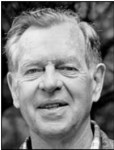
One Last Time: Joseph Campbell wasn’t my father

When the first edition of my novel The Sun Singer was released, I began blogging from time to time about the hero’s journey. After a while, people started asking if the originator of the hero’s journey approach to comparative mythology, Joseph Campbell, was my father. The short answer is “no.”

Laurence

In his day (1903-1987), my father Laurence R. Campbell was a prominent college journalism educator, focusing on the needs of high school journalism. He taught at many universities including Florida State in Tallahassee. I was born in California because that’s where my father grew up and was teaching at the time (UC-Berkeley) I showed up.

Joseph

Joseph Campbell (1904-1987), taught at Sarah Lawrence College and was widely known for writing The Hero With a Thousand Faces that introduced the general public to the hero’s journey monomyth. He later came to even wider renown when PBS aired a series of interviews between Campbell and Bill Moyers in 1988. 

Both men had a huge influence on me though–in spite of the fact they were here on the earth plane about the same time–their areas of expertise and the circles they worked within were so disparate that they never met or had any reason to know of each other.

Dad’s influence was greater because I saw him daily and knew him as a whole person rather than a faraway writer I saw on TV or found on the title pages of books. I became a writer because of my father and became interested in mythology because of Joseph Campbell.

My father was a Scout leader, an elder in the church, had liberal views, had a mischievous sense of humor, and was a strong defender of the need for a free and responsible press. He wrote hundreds of articles, journalism textbooks, and worked with high school students at scholastic press institutes. He also climbed the mountains in Colorado that I would climb later during a University of Colorado summer session in Boulder.

My father married a highschool newspaper advisor. I married a journalist and taught college-level journalism. 

By the time I learned that Joseph Campbell was influenced by Carl Jung, I had already discovered Jung and his writing. Likewise, by the time I learned that Campbell was a fan of James Joyce, I was already a fan of James Joyce and became an even more intelligent fan by reading Campbell’s analysis of such books as Finnegans Wake

When one looks back on his/her life, it becomes obvious that what seemed to be a puzzlement at various defining moments was, in fact, part of a synchronistic unfoldment into the journey one was already taking. Both Laurence and Joseph would have agreed with that. 

My dad frequently said (usually when I’d done something wrong), “What I am to be, I’m now becoming.” Joseph often said, “We must be willing to get rid of the life we’ve planned, so as to have the life that is waiting for us.” 

To sum up: I’m a bit of a rebel: I don’t know which man to blame for that. However, Laurence was my father. 

Malcolm

Malcolm R. Campbell is the author of “Fate’s Arrows,” available in hardcover, paperback, and e-book editions.

The new online map ain’t the old territory

When you set a story in the past and are researching its location, Google Maps isn’t the place to go. Why? Because looking at today’s online map, doesn’t tell you which of those roads were there twenty or thirty years ago.

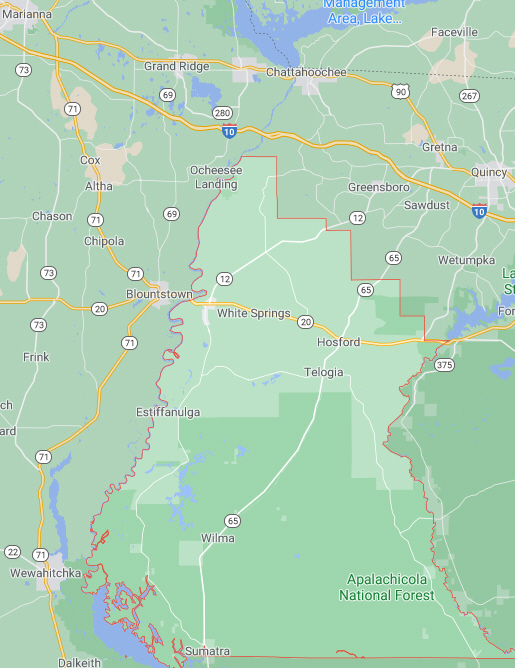
Here’s a Google map of Liberty County where my four Florida Folk Magic novels are set:

Since I grew up in the area, I can tell you right off the bat that I-10 wasn’t there in 1954. We used highway 90 for east-west travel. Most state highways I know one way or another, but I can’t be sure of city streets.

If you can’t find anything online or in the library about road maps from an earlier era, one solution is going to a site like eBay where there are usually old road atlases and service station maps from almost every decade in the last fifty years.

A few dollars spent on a paper map is money well spent. You can, of course, rely on Google Maps Street View to get a general idea of what areas looked like, especially those out in the county where no new construction has occurred. When you do this, you often find out that certain roads are scenic byways and probably have separate websites where you can look up flora and fauna, including the yearly growing seasons for plants so you know when flowers appear. (Nothing worse than saying Flowers are blooming during a season when they’re not!)
Old maps and the websites describing protected areas will sometimes link to folklore and history sites–quite a treasure hunt.

–Malcolm

Malcolm R. Campbell is the author of “The Land Between the Rivers.” Since it’s set before there were any roads, the accuracy of highway maps wasn’t a research issue.

What’s all that green stuff?

Part of describing a locale in a novel is mentioning the green stuff outside the car window. Oaks and Pine trees and flowering shrubs are usually obvious. But what about the wildflowers and grasses?

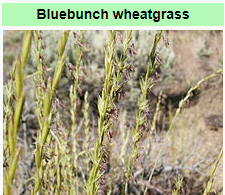
Wikipedia Photo

I once knew a man who knew what every single piece of green stuff was, whether it grew in a forest, savannah, marsh, or coastal area. When he led tours, I was there as he not only named and described every plant and its seasonal cycle but told us how to know one plant from another.

If there had been a test, I would have flunked. Even if I’d crawled through it, I wouldn’t have been able to tell the difference between Bluebunch wheatgrass and rough fescue.

I have wildflower guides for most of the areas I write about. I’ve found others online. But occasionally, I come across (in my writing research) a place where my characters will interact in some way and realize that I can’t be sure what all the green stuff is.

Many state, federal, and private wildlife areas and private preserves list the specialists in charge of interpretation. They have been a godsend. For some books, I’ve asked about the prominent plants one sees when driving through a place. In others, where there are, say, Longleaf Pines and other trees that depend on fire, I’ve asked specialists what order the smaller understory plants return after a fire.

I owe a great debt to specialists who will take time to field questions from a novelist, some of which take quite a few pages to answer. I always try to note down their names and organizations and mention them in each book’s acknowledgments. It’s my kind of thank you and also a way of saying that I’m a writer and not a biologist.

Malcolm

Malcolm R.  Campbell is the author of “The Land Between the Rivers” which focuses on early Florida Folklore and animals.

For goodness’ sakes, keep the notes you take while writing a novel

I tend to take notes on the backs of envelopes, grocery store receipts, and random pieces of paper. While working on a book, those notes pile up on my desk. Years later, I have no clue where they are.

Sometimes the notes go into a file folder. Sometimes I type them into a DOC file. File folders get lost. DOC files disappear when hard drives crash. What’s left after that? The memory that you used to know something, but now you don’t.

Case in point: a friend is reading an old novel of mine that has a lot of Blackfeet language phrases in it. I used to know what they meant. Now I don’t. So, when she asks, I can only say, “Figure out those phrases in the context of the scenes where I use them because I’ve got nothing for you.”

Awkward!

And now I’m thinking of writing a novel related to the one she’s reading. Or, seeing that there aren’t any notes in the house, maybe I won’t. 

A better filing system would save a lot of anguish. Not to mention time in terms of how long it will take to re-research stuff I already researched.  I guess when a book is done, I don’t think I’m going back that way again. So, stuff disappears. 

What I need is a crack staff (as opposed to a staff on crack) to tidy up the mess on my desk each time I finish a book. Then I might have a clue (as opposed to not having a clue).

My advice is to keep the notes you take (in an organized fashion) whenever you write a novel.

Malcolm

Since it hasn’t been that long, I still know how to find the notes I took while writing “Fate’s Arrows.”

Writers want to sweep you up into their stories

“Magic doesn’t sweep you away; it gathers you up into the body of the present moment so thoroughly that all your explanations fall away: the ordinary, in all its plain and simple outrageousness, begins to shine — to become luminously, impossibly so. Every facet of the world is awake, and you within it.” – David Abram, “Becoming Animal: An Earthly Cosmology”

An ancient campfire beneath a fetching moon. Trees standing close, listening to a storyteller spin out a tale that captures the imaginations of those sitting around the fire so completely that the listeners see no boundary lines between themselves and the characters within the story. Truly, there is no outside at this point, no separation between the words and the trees and the moonlight and the derring-do of the far-away people whom the storyteller conjures into the world of that very moment.

As Wikipedia says, “Through the telling of the story people become psychically close, developing a connection to one another through the communal experience. The storyteller reveals, and thus shares, him/her self through his/her telling and the listeners reveal and share themselves through their reception of the story.”

Creating such shared moments is more difficult in a book because the storyteller and reader are worlds away from each other physically until or unless the words are strong enough and vibrating powerfully enough to dissolve the illusion of physical distance. When the book works for a reader, the experience becomes as powerful as the campfire scene where all is connected.

To be sure, the connection between writer and reader depends not only on the skill of the writer, but the a reader’s (often) long-time experience with books (how they work), the subject matter, the reader’s state of mind and (probably) physical comfort. When conditions are optimal, the reader is swept up into the story as though s/he is sitting with the storyteller next to a fire in a quiet forest or within cabin’s sweet shadows.
Books for prospective writers try very hard to teach us what we need to do while researching and writing to ensure that conditions are optimal. My approach–which doesn’t necessarily work for all writers–is that the writer must first be swept up by the story and its characters before s/he can produce a novel that sweeps up readers in the way David Abram suggests.

No matter how a writer connects with his/her story, getting those conditions right takes practice. Nobody sounds like Coleman Hawkins, Stan Getz, or John Coltrane the first time they pick up a tenor sax. Nobody writes like Stephen King, John Hart, or Neil Gaiman the first time they pick up a pencil or sit down at a computer. All of these people evolved into the people they became. 

Time seems to fly while writers are becoming comfortable with words, plots, techniques, character development, and magic. In a world where many people want everything right now, it’s difficult to submit to the necessity of practice. Even the wizards at Hogwarts needed to practice their spells. So do storytellers dreaming of campfires and writers dreaming of books and short stories.

After that, the magic begins to work behind the scenes and become second nature to the man or woman with the pencil. 

Malcolm

Malcolm R. Campbell is the author of the magical realism series of novels that begins with “Conjure Woman’s Cat” and ends with “Fate’s Arrows.”


Hey, folks, my memoir is all about me

It’s a vanity thing, right?

So many people are writing memoirs these days because they’re ready to tell the world “all about me.” Before they even graduate from college. I wonder what they plan to say. I see that some MFA programs are offering courses in memoir writing. How discouraging it is to think there are enough self-centered people to justify such vanity fair courses.

If even half of the derring-do fantasies I had before I graduated from college were true, I might have enough for a memoir, say, James Bond and Rocky and Dirty Harry rolled into one. Some people, for better or worse, have exploits, over-the-top trials and tribulations, feats of extreme bravery, and inexplicable miracles to write about. Okay, so the memoir may not be a vanity thing.

I’m still suspicious about the memoir writing fad. Yes, I know, we all have things to say, but that doesn’t mean all that will fit into a book that the public cares about. Well, maybe it’s a “seeking closure” thing, cheaper than or in addition to psychoanalysis. Yet, is there a viable market for that?

Memoirs make me think of people who are all talk but no action. They have plans, great plans, but nothing comes of them. Sure, one can write a memoir called I Always Missed The Bus, but will it sell? And is it vain to think that it would sell? Especially if the prospective memoir writer “hasn’t done enough” to even get into Wikipedia?

The wonderful people most of us know don’t need the validation of a memoir or a Wikipedia entry to keep being wonderful. Those who could write and sell a million copies of a memoir are often the last people willing to do it. Telling people “all about me” isn’t who they are.

Memoirs can be very inspiring, even educational or motivational. Call me cynical, but I don’t think we need everyone’s life story in print. “All about me” is really a turn-off kind of thing (at best).

Malcolm