Another old white guy trying to escape the reformers’ notice

We can all agree on one thing, I think, and that is that most of the reforms underway have been too long in coming and are likely going to fall short of what’s needed.

As an old white guy, I can chip in a few dollars to organizations doing their best to push reforms along faster and make them more thorough, but since my income has almost always been below the poverty line, I can’t contribute what I don’t have.

Nothing I can say in support of the cause is helpful because–as a white guy–I don’t have a place at the table since the problems are, according to angry sources, all my fault even if I don’t realize they are all my fault.

How did that happen? Well, unknown to me, I have been running the world, even though I never got a memo or attended a meeting for people running the world.

I feel profiled.

Perhaps turnabout is fair play inasmuch as many of those doing the profiling have been profiled in horrible ways I can never imagine. The fact that I didn’t personally do any of the profiling or communicate with those who were doing it seems to be irrelevant.

I thought that voting for people who said they wanted to bring about reforms was good. But, in doing that, we discover a flaw in the U. S. system of governance. Even though Congresspersons and Senators claim they represent us, they are really following their own opinions rather than listening to their constituents. I don’t like campaign proposals that begin, “When elected, I will do XYZ.” Excuse me, but you need to check with the voters to see if we want you to do XYZ.  Stop casting votes without asking.

So, as a white guy, I’m assumed to be in agreement with the white guys who claim to represent my state. I hate to tell you, I don’t agree with them because they do what they do with no accountability. Once again, I feel profiled by people who think my lily-white Congressperson or Senator gets his or her orders from me.

I think of Cormac McCarthy’s line in Blood Meridian, “Whatever in creation exists without my knowledge exists without my consent.” I did not consent to the ills in our society, much less imagine that which went on in smoke-filled rooms that I didn’t know about.

What I knew about, I fought and still fight, but just how I do that isn’t any of the profilers’ business because they will say it wasn’t enough–and still isn’t. And, hell, they may be right, but not right enough to presume I’m part of the problem.

Might I suggest (at my peril, I know) that profiling white guys is costing the profilers many allies? Or, perhaps allowing us to work together doesn’t meet your platform’s needs. If so, I understand and will keep quiet about it.

–Malcolm
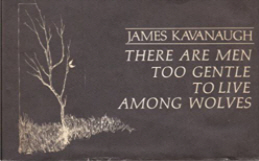
There are Men too Gentle to Live Among Wolves

Do you know such men and women?

I do and I hold them in high esteem if they survive in a world where badass is championed and streetwise is celebrated because such men–and women–are not afraid to say there is much in the world that they do not want.

First edition cover

There are Men too Gentle to Live Among Wolves is of course the title of James Kavanaugh’s first of twenty-six books of poetry, a book that came out in 1970 and has gone through an infinite number of printings.

Kavanaugh (September 17, 1928 – 29 December 2009) was a priest in Flint, Michigan who called for church reform in his controversial 1967 book A Modern Priest looks at his Outdated Church. In his obituary, Aaron Dome said in the “Kalamazoo Gazette” that Kavanaugh “wrote in the book that he felt extreme frustration and confusion about being forced to give advice that was in accordance with the church, but that he felt was not in people’s best interest.”

Wayne Dyer said, “I can think of no living person who can put into words what we have all felt so deeply in our inner selves….”

That is his strength, putting into words what we have all felt, and I first found it in There are Men too Gentle to Live Among Wolves. We know there is a better way of life than the “I’m going to kick your ass” approach to interacting with others. It’s important to acknowledge this and then take a stand on its behalf.

As Kavanaugh wrote, “I am one of the searchers. There are, I believe, millions of us. We are not unhappy, but neither are we really content. We continue to explore life, hoping to uncover its ultimate secret. We continue to explore ourselves, hoping to understand. We like to walk along the beach, we are drawn by the ocean, taken by its power, its unceasing motion, its mystery and unspeakable beauty. We like forests and mountains, deserts and hidden rivers, and the lonely cities as well. Our sadness is as much a part of our lives as is our laughter. To share our sadness with one we love is perhaps as great a joy as we can know – unless it be to share our laughter.”

It’s not easy to stand against the popular tides of confrontation, political polarization, and cynicism, much less the insurrectionist, gun-toting groups that want to scare the rest of us into accepting their bankrupt notions.

But we have to try, don’t you think?

Malcolm

My novels include “At Sea” and “Conjure Woman’s Cat.”

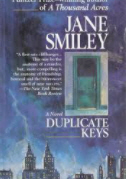
On re-reading Smiley’s ‘Duplicate Keys’

I first read this 1984 book in the mid-1990s after enjoying Jane Smiley’s 1991 Pulitzer Prize winner A Thousand Acres. I was disappointed because I expected more spooky police work and/or big-city thrills and chills. As a film noir fan, I’m used to harsher and darker crime stories

Publisher’s Description

Alice Ellis is a Midwestern refugee living in Manhattan. Still recovering from a painful divorce, she depends on the companionship and camaraderie of a tightly knit circle of friends. At the center of this circle is a rock band struggling to navigate New York’s erratic music scene, and an apartment/practice space with approximately fifty key-holders. One sunny day, Alice enters the apartment and finds two of the band members shot dead. As the double-murder sends waves of shock through their lives, this group of friends begins to unravel, and dangerous secrets are revealed one by one. When Alice begins to notice things amiss in her own apartment, the tension breaks out as it occurs to her that she is not the only person with a key, and she may not get a chance to change the locks.

Jane Smiley applies her distinctive rendering of time, place, and the enigmatic intricacies of personal relationships to the twists and turns of suspense. The result is a brilliant literary thriller that will keep readers guessing up to its final, shocking conclusion.

Okay, maybe I wasn’t ready for the “enigmatic intricacies of personal relationships” in 1995. Or perhaps I’ve either mellowed or become more eclectic in my reading since then.  Even so, I’ll probably never really grok the characters because they’re New Yorkers who enjoy subways, walking, lots of people, and all the other strangenesses I experienced whenever I visited NYC.

(I lived briefly in Syracuse as a kid, one of my brothers was born there, and then I went back there for grad school, but it’s on a different planet than the big city.)

The book is keeping my attention this time which says a lot for keeping books on one’s shelves and trying them out again later.

Malcolm

My novels include Fate’s Arrows (magical realism) and Sarabande (contemporary fantasy). Both novels are available in paperback, hardcover, Kindle, and Nook.

The Big Grape-Nuts Shortage

Just to clarify. The shortage of this venerable Post cereal, created in 1897, is big, not the Grape-Nuts. Who do we blame for this? Consumers. Cereal sales had been falling until the pandemic sent millions of people to the cereal aisles they didn’t know existed.

When I was a kid, my brothers and I campaigned for Sugar Crisp and Frosted Flakes while our parents stocked up on Grape-Nuts, the now discontinued Grape-Nuts Flakes, and the now discontinued Krumbles. When Krumbles went away, I switched over to Grape-Nuts.

My claim was that grape nuts were really scuppernongs that were harvested so late in the season that they couldn’t be eaten off the vine, much less turned into wine and jelly.

Our grandfather claimed that he’d been eating Grape-Nuts since he was a farmer in Illinois because he was ahead of his time and lined up for the first ready-to-eat cereal. However, he claimed it was made out of soybeans and that the smell that once hovered over Decatur, Illinois from the Staley Company was soybeans roasting over an open fire to be shipped to C. W. Post for the cereal.

Our parents said the cereal was made from wheat flour and malted barley flour and other stuff. The “other stuff,” it seemed, left room for either soybeans or scuppernongs.

According to Post,  “So, why is it called Grape-Nuts? As with many great emblems in history, there are two versions of the story. One says that Mr. Post believed glucose, which he called ‘grape sugar,’ formed during the baking process. This, combined with the nutty flavor of the cereal, is said to have inspired its name. Another explanation claims that the cereal got its name from its resemblance to grape seeds, or grape ‘nuts.’”

Years after our family’s debates about soybeans and scuppernongs, Grandfather died, and when we read his will we found that he had left each of us 100 pounds of Grape-Nuts because, as the old ad said, “they were better than gold.” Unfortunately, wevils ate away our riches at the warehouse, and this explains why we didn’t go to Harvard or Yale or the Riviera.

Nonetheless, I’ve been loyal to the cereal for old times’ sake.

Malcolm

My books include Fate’s Arrows, The Sun Singer, and Special Investigative Reporter.

Post-Christmas Thank You Letters

I learned as a kid that after we opened all the gifts under the Christmas tree, that my two brothers and I would dutifully be writing thank-you letters to the out-of-town relatives who sent us gifts. We had to appear grateful whether we liked the gifts or not. No sarcasm or honesty allowed as in:

Dear Grandpa and Grandma, Thanks for the unique shirt. I’ll be the only high school senior wearing a shirt that looks like this. In fact, I’ll probably get beaten up during phys ed class as soon as the school toughs see that I’m wearing a shirt that my history teacher Mr. Johnson says was popular in the 1930s.

Fortunately, my wife and I solicit and get lists of potential Christmas gifts from my daughter for the two granddaughters. So, we won’t make the mistake of sending them a damn shirt.

I have here three postcards thanking us for the loot. None of them contain profanity and/or sarcasm.

  • My daughter’s handwriting is strong, confident, and easy to read.
  • My oldest granddaughter, who just turned thirteen, writes strong prose in tiny letters. She could fit an entire short story onto a postcard and have space left over.
  • My youngest granddaughter still writes in large letters that I have to ask my wife to help translate. Cute, after I figure out what she said.

It’s been fun seeing my granddaughters’ handwriting evolve. They don’t know anything about cursive. Too bad, I think, but it’s not their fault. Kids’ handwriting starts out so big they can only fit two or three words on a postcard. Maybe that’s the point: “Hey, Ma, done already.” Then it gets smaller as they grow up. 

I know my daughter leaned on them to write these just as my mother leaned on me to write post-Christmas thank you letters. But I still like getting them. In time, they’ll outgrow the stuff we send and it will end up buried in a closet. But that’s okay as long as the gifts make them happy for a while.

–Malcolm

Line Editing, Copy Editing, or Proofreading?

For guidance, I turned to the authority, the Chicago manual. Yet even that widely accepted all-knowing guide doesn’t make a distinction among editing levels: “Manuscript editing, also called copy editing or line editing, requires attention to every word and mark of punctuation in a manuscript, a thorough knowledge of the style to be followed, and the ability to make quick, logical, and defensible decisions.”New authors are often confused about what level of editing they need, and rightly so. I hope to offer insight into the differences between line editing, copy editing, and proofreading.

Source: The Differences Between Line Editing, Copy Editing, and Proofreading | Jane Friedman

Authors, especially indie authors who aren’t used to the multiple editing cycles their work will go through at a major publisher, often consider hiring an editor, but then become unsure what kind of editing service they need to purchase. This blog helps make distinctions between editing types.

Copy, of course, is your printed-out or Word manuscript. A proof is your manuscript after it’s been laid out as it will look in magazine or book form. Generally speaking, proofreading is a search for the printer’s errors while copy editing is a search for the author’s errors.

So what is line editing and when do you need it? A good question. You’ll find a credible answer in this article in Jane Friedman’s blog.

–Malcolm

Malcolm R. Campbell is the author of “Fate’s Arrows,” the fourth novel in his Florida Folk Magic Series.

Review: To Wake a Giant

To Wake the Giant: A Novel of Pearl Harbor by Jeff Shaara

 My rating: 5 of 5 stars


When General Billy Mitchell wrote a report in 1924 that not only predicted the Japanese would attack Pearl Harbor but how they would do it, it was rejected out of hand.

Those who've seen documentaries and feature films such as "Tora! Tora! Tora!" know before they pick up Jeff Shaara's accurate and well written "To Wake the Giant: A Novel of Pearl Harbor" that military commanders and diplomats in the late 1930s and early 1940s continued to reject a Japanese attack out of hand.

Having read all of Jeff Shaara's historical novels, often about subjects I've studied, I'm accustomed to his impeccable research as well as the fact he makes history so human and readable that by the end of each novel, one feels like s/he was there. Unfortunately, some early Amazon reader reviews said Shaara's research on "To Wake the Giant" was sloppy. Subsequently, those reviews were shown to be inaccurate.

Unlike battles that last for days or weeks or months, the attack itself was short. So this book had to be a little different, focusing for many pages on the events leading up to 8 a.m. (25 minutes later than Mitchell's prediction) on the morning of December 7th, 1941. The events prior to the attack not only demonstrate the viewpoints of the major political and military players but show the attitudes of men serving onboard the Arizona and other ships in Pearl Harbor. Shaara shows the attitudes and emotions of those involved months in advance but while the attack is underway.

The human factor looms large in this novel and that's one of its major strengths. Once again, Shaara has put us into the action in a way we'll never forget. 


 View all my reviews

What did Daddy do during COVID?

The question used to be: “What did Daddy do during the war?” Perhaps now, it’s “What did Daddy and Mommy do during COVID?”

The answers might be, “Got sick and died,” “Lost their jobs,” “Got evicted,” or (possibly) “Wore a mask and hoped for the best.”

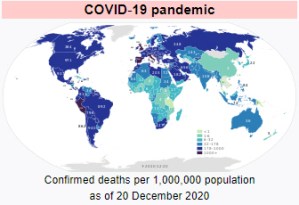
When people ignore the lockdowns, as they did at Thanksgiving and Christmas, more people end up sick. And yet, when people stay inside their homes, more businesses go bankrupt and more people lose their jobs. Will the vaccines rescue us? Time will tell. Some say we’ll be fighting COVID for years. I’m not surprised at that assessment.
And after all the precautions we’ve been urged to take, lately, the news is that things are going to get a lot worse. That’s not reassuring.

According to today’s news, Mitch McConnell blocked Senate consideration of raising the stimulus payments from $600 to $2,000, something the leader of his party is pushing for. Needless to say, Senators aren’t losing their jobs, worrying about health care expenses, or with their lifetime pensions, having money for the future. I guess we’re all supposed to be grateful for the crumbs our rich Senators and Representatives give us.

So, another answer for that did Daddy and Mommy do during COVID is “Got screwed by their government.”

I got a notice from the FEDs today letting me know my Social Security benefits are going up 1.3% Wow, what a difference that will make. <g>  Meanwhile, even though publishing had a decent year, what with people staying home and reading more books, that “decent year” mainly applied to major publishers.  The rest of us are seeing a giant downturn in sales.

So, another answer for what did Daddy and Mommy do during COVID is published new books that got lost in the shuffle. My $600 stimulus check (thanks,  Mitch,  you sorry bastard) won’t make up the difference. What kind of math are the Feds using?

More or less, Daddy and Mommy muddled through, waiting to see if their numbers were up or if they would make it to 2021. At my age, I’m surprised I’m still here. A lot of us feel that way.

Malcolm

Malcolm R. Campbell is the author of the four-book “Florida Folk Magic Series” that focuses on the KKK in the 1950s Florida Panhandle.

43 Writers’ “Rules for Writing”

Most writers have their own special “rules for writing,” even if they don’t talk about them. I find other writers’ rules fascinating, even when I don’t agree with them. A lot can be learned by reading about other authors’ approaches to writing.

The New York Times and The Guardian have published famous authors’ answers to this question on a number of occasions. The Guardian has a very long, disorganized article that collects many of the rules, which you can read here. This article is an attempt to organize that collection and to link to other authors’ rules as well, including more recently published authors’ rules on writing.

Source: » 43 Writers’ “Rules for Writing”

I’m of the same mind about this subject as author and writing coach Mark David Gerson (The Voice of the Muse). His writing mantra is There are No Rules. I agree. Rules for writing seem to me about as relevant as rules for enjoying a sunset or a kiss.

For those who, like the author of this article, find the rules of famous writers to be fascinating, this post by Emily Harstone in “Authors Publish” is the mother lode of rules. You’ll find Elmore Leonard, George Orwell, Neil Gaiman, Jack Kerouac, and even Nietzche. Nietzche’s rules begin with “Of prime necessity is life: a style should live.” I have no idea what that means.

Enjoy or be driven to drink, depending on your point of view.

Malcolm

Infinity, and beyond

“To see the world in a grain of sand, and to see heaven in a wild flower, hold infinity in the palm of your hands, and eternity in an hour.” – William Blake

Writers are often sustained by words, sometimes their own coming upon them like magic and visions, more often by those of the great visionaries like William Blake. The words, of course, lead writers higher than their own fragile wings can carry them without the power of what is infinite.

Frontispiece to Jerusalem is a painting by William Blake


The words and art of William Blake (November 1757 – August 1827) often suffice for me. I am drawn toward the words of mystics and visionaries. To my knowledge, no living person has mastered the fictional power of Gandalf or the wizards-in-training at Hogwarts. We have not yet learned how to use the higher powers within us to stop a bomb from exploding in downtown Nashville or a plane from crashing or a building from burning to the ground.

Our natural tendency to hate those responsible for exploding bombs and other terrorist activities probably impedes our progress toward mastery of what Marianne Williams was speaking of when she said, “Our deepest fear is that we are powerful beyond measure” and what William Blake was speaking of when he said, “If the doors of perception were cleansed everything would appear to man as it is, infinite.”

We are focused on the material close at hand, I think, rather than the larger picture of perception and what is behind the material universe we are aware of through our five senses. Until we grasp that larger picture, we’re not free, are we, and we will continue to view horrible events as fate or even the will of the gods.

When I look for quotations to post on Facebook before signing off for the evening, I find many soul-sustaining words. I choose Blake. Perhaps you choose Walt Whitman or Mary Oliver. No matter: the words that sustain us carry us higher than the sky where our destiny awaits.

Malcolm

Malcolm R. Campbell is the author of contemporary fantasy and magical realism novels and short stories, including “Fate’s Arrows.”