Briefly Noted: ‘Montana’s Charlie Russell’

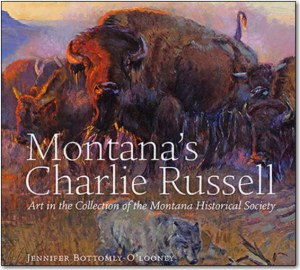
It’s difficult to read about Montana without coming across Charlie Russell sooner or later. He’s the state’s most celebrated and most widely known artist. This book offers a view of Russell’s work in the collection of the Montana Historical Society in Helena. Nothing is better than seeing the paintings up close. If you can’t do that, this book is a fine introduction.

CharlieRussellFrom the Publisher: Montana’s Charlie Russell brings to life the Montana Historical Society’s world-class collection of paintings, drawings, sculptures, bronzes, and illustrated letters by the Treasure State’s famed “Cowboy Artist.” Using advanced digital technology, each of the 230 pieces in the Society’s permanent collection has been meticulously photographed to bring to life, in vivid color, Russell’s artistic mastery. Carefully researched scholarship illuminates the stories behind each artwork. The result is a catalog of Russell’s art as you’ve never seen it before.

From the Montana Historical Society Press Release

MHS RELEASING NEW CHARLIE RUSSELL BOOK MORE THAN 60 YEARS IN THE MAKING

“In 1952 the Montana Historical Society acquired the Malcolm Mackay family collection of the artwork of Charles M. Russell that became the heart of its unmatched assemblage of the famed Montana cowboy artist’s masterpieces, paintings, illustrated letters, sketches and sculpture.

“Since then, it has been the dream of many to reproduce the entire MHS Russell art collection in a high-quality book that would celebrate the artist’s vision of Montana and the breadth of his amazing career — that took him from cowboying in the Judith Gap to one of the best loved artists of the West…

“…K. Ross Toole, MHS director in 1952, said while raising funds to acquire the Mackay collection: ‘If Montana has contributed one thing to the heritage of the whole West, it is Charles M. Russell’s paintings …. It was Montana that inspired him; it was Montana that he painted.'”

With this book on your coffee table, you can turn off the TV for the Winter.

Malcolm

Seeker for promo 1Malcolm R. Campbell is the author of “The Seeker,” a book about mountains, first loves and betrayal set partly in Montana’s Glacier National Park.

Briefly noted: ‘Walk Myself Home’

“tear down every poster every newsstand every high-tension wire every bill board every high-rise  every highway sign leading out of town  every aeroplane in the sky  every high and mighty penthouse hotel every bar and grill  tear up every alley where you were hurt  every research paper that described you and got it wrong  every house that trapped you  every letter  every spite  every thought that thought you less  every x and y with too much breath in your face  or too much blade at your throat  every shout  every temper  every gust of grit around your feet  every car parked outside your door  every doorway  every bank every bonnet  every promise  every classroom   every boy with a semi-automatic under his right arm  rushing in  yelling freeze  just before you do” – Excerpt from the book.

As I was blogging about the 1989 École Polytechnique massacre on my Calamities of the Heart blog, I thought of this 2010 anthology that serves in part as a voice for women who have been victims of violence and/or who live in areas where they must live in fear of it daily.

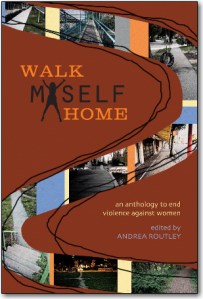
walkyourselfhomeIn the aftermath of Ferguson, some said that a white person cannot possibly understand the daily challenges and fears of African Americans. Likewise, it might be said that men cannot possibly understand that it’s like to live with the challenges and fears of women of all races.

When read carefully, Walk Myself Home edited by Andrea Routley may help men and women understand what’s on the other side of the gender gap.

From the Publisher: “There is an epidemic of violence against women in Canada and the world. For many women physical and sexual assault, or the threat of such violence, is a daily reality. Walk Myself Home is an anthology of poetry, fiction, nonfiction and oral interviews on the subject of violence against women including contributions by Kate Braid, Yasuko Thahn and Susan Musgrave.

“Walk Myself Home began as a small idea: to create a chapbook and sell it at the next LoudSpeaker Festival. The response was overwhelming. This small idea found a chorus of voices, and its sound was too big for a chapbook.”

From Amy Reiswig’s Review in Focus Online: “Be prepared. Many of these short works explicitly discuss or represent assault—at the hands of fathers, teachers, strangers, friends, neighbours. Routley also includes pieces addressing subtler forms of violence: derisive jokes, job discrimination and cultural assumptions around beauty, submission and gender roles. As she writes in the introduction, ‘In order to end violence against women in our society, we must be able to recognize it,’ and this means recognizing not just actions but attitudes.”

Ultimately, the book promotes hope, hope that–as Heidi Greco says her review–will lead to a time when “every woman can say with confidence – no matter the time of night or day – not to worry, that I’ll Walk Myself Home.”

Perhaps some day the book will be available in Kindle/Nook for those who cannot afford the paperback.

–Malcolm

Review: ‘The Kingdom of the Sun and Moon’

The Kingdom of the Sun and Moon, by Lowell H. Press, Parkers Mill Publishing (September 10, 2014), Ages 10 and up, 316 pages.

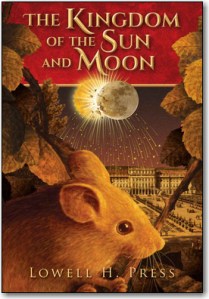
Starting with the cover, this is a beautifully crafted book.

Lowell H. Press has written an inventive novel about a hierarchy of mice living in the gardens and secret interior spaces of a castle inspired by the Schönbrunn Palace in Vienna, Austria.

The colony’s king cares little for his subjects and is mostly interested in taking the food they save throughout the year for his own use during the winter months.Two brothers, Sommer and Nesbit, discover that all is not what it seems, including the king’s purported fear of a pending invasion of the colony by a massive army of woodland mice.

Sommer, who is drafted by the king’s minions for a suicide mission on the colony’s behalf and Nesbit, who insults the king and flees into the dangerous forest, take different approaches to survival and justice. Sommer becomes a cadet commander, while Nesbit becomes known as either a worker of magic of an exceptionally lucky mouse.

Set in a 1700s world, The Kingdom of the Sun and Moon is a delightful story with well-drawn characters and an underlying culture and myth that will charm young readers while keeping their parents engaged whenever this derring-do yarn is shared around the dinner table or at at bedtime.

Press used his visit to the Schönbrunn Palace to great advantage in developing a setting for his story that is well suited to the mice colony’s culture and history as well as to the people and cats who appear throughout the tale for better or worse.

Sommer and Nesbit of the Long Meadow Colony are tiny, as mice go, but they make up for it in bravery and guile.

–Malcolm

Briefly noted: ‘Mercedes Wore Black,’ by Andrea Brunais

Mercedes Wore Black, by Andrea Brunais, Southern Yellow Pine Publishing (June 14, 2014), 291pp.

mercedesworeblackI’m enjoying this smartly written political thriller set in Florida where I grew up. As a former college publications adviser from a “journalist family,” I see immediately that Andrea Brunais knows the world of reporting and gets it right, especially in the domains of murder, political intrigue and the often-losing out Florida environment.

From the Publisher

Florida Politics. The only thing predictable is the unpredictability. When Janis is fired from her job at the newspaper, she focuses on the causes that matter to her. The environment and the economy. That embroils her in the 2014 election.

When her good friend Mercedes encounters danger and is brutally murdered, Janis begins to investigate. She finds herself in a political maelstrom of big money, lottery, and interests with opposing goals. Will she be able to find the crux of the problem—and Mercedes’ killer? Will she be able to expose corruption before anyone else is put in danger?

Quotes from the Reviews

  • “Fast-paced, exquisitely written, Mercedes Wore Black vividly depicts the underbelly of the newspaper industry and the all-too-real shenanigans of those who are ever willing to sacrifice Florida’s natural treasures” – Joe Guidry, The Tampa Tribune
  • “A fast-moving story with as much Florida flavor as a grouper sandwich.” Daniel Berger, Amazon reader review.

Floridians especially will enjoy this novel for it is rich in recent political history, on-going environmental issues pitting development against the land, and places state residents know well such as Tate’s Hell Forest, Sopchoppy, Bradenton, Tallahassee and Wakulla Springs. While these strengths will endear the book to Florida readers, they could be a little too much for those in other parts of the country–could be, for the intrigue is high level and will carry readers past the heavy local color.

I spent many hours at Wakulla Springs, a half hour south of Tallahassee where I grew up, and I always saw its old-Florida charm as unique and a bit strange. Now, after the protagonist’s best friend is murdered there  in Mercedes Wore Black, I don’t think I’ll ever see this home of snake birds, limpkins, turtles, and icy cold water the same again.

Highly recommended. See the full review here.

Malcolm

Malcolm R. Campbell’s Florida short stories include “Moonlight and Ghosts,” (Tallahassee) “Cora’s Crossing,” (Marianna) “Emily’s Stories,” (St. Marks)  and “The Land Between the Rivers.” (Tate’s Hell Swamp) His novel “The Seeker” includes major scenes at Alligator Point and Tate’s Hell.


Review: ‘Speaking in Forked Tongues’ by Brad Gallaway

Speaking in Forked Tongues, by Brad Gallaway, Signal 8 Press (April 22, 2014), 306 pages

Forked TonguesBrad Gallaway’s dark fantasy/horror novel Speaking in Forked Tongues is inventive, delightfully written tale about a young man who calls demons for a living. When folks can’t solve their earthly problems, they contact Helping Hands agency who sends out a caller with an underworld solution. Callers who have been to hell and back multiple times are the best in the business.

While the publisher’s description claims that protagonist “Bren Barran is a normal guy in most ways,” one might ask whether a young man who was adopted by demons, who grew up in hell, and who brings clients and demons together to fix what nobody else can fix can possibly be normal in most ways. Yet, Gallaway makes Barran seem normal, in spite of a predilection for dark, self-deprecating humor.

Unlike poor Faust who sold all of his soul for help from hell, Barran’s clients usually part with a mere sliver, insuring that the demon on call gets what he wants, Barran’s boss Nareth gets what she wants (a cut of the action), the callers get paid and that the happy clients have enough soul left to bring in repeat business.

What could possibly go wrong?

Even though hell is a well-run, ably governed and a relatively safe place quite unlike what we’ve all heard, there’s room there for jealousy and discord. Truth be told, Barran doesn’t think demonkind is any worse than humankind when it comes to bad traits except for the fact demons are physically larger, have claws, and know dangerous (and harmful) spells. So, when Helping Hand’s callers start disappearing and when Barran starts getting attacked on the street, it isn’t long before (seemingly) all hell breaks lose.

There’s a bit of expected gore in this book and a wonderfully tangled plot for Barran to navigate as he tries to solve his agency’s demon problem while staying alive. Naturally, Mom and Dad want to help, but according to the rules, they also have to be paid.  The bad guys in this story are really bad and Gallaway makes them seem uncomfortably plausible while leading readers to an ending they won’t see coming.

On a minor note, a warning to parents: The novel’s listing on Amazon claiming that the book is suitable for ages 1 to 17 is either an error or a devilish promotional trick. Teens and adults of all ages can probably stand the heat, while enjoying the trip.

Malcolm

Malcolm R. Campbell is the author of paranormal short stories and contemporary fantasy novels.


Review: ‘Long Man’ by Amy Greene

from Literary Aficionado

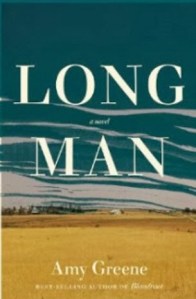
longmanAmy Greene (“Bloodroot”) lives in the foothills of eastern Tennessee where she was born and raised and, as the lyrical prose in Long Man testifies, fell in love with the land and the blue-collar Appalachian people who cling to their world through floods and droughts with great determination.

Annie Clyde Dodson is one of the valley’s last holdouts against eviction as the TVA completes a dam that will soon contain the waters of the river her Cherokee ancestors named Long Man. The river is rising and the TVA is dispersing Yuneetah’s residents before the lake claims their land forever. While Annie’s husband is ready to move on, Annie is too much a part of the valley to leave without a fight. Keeping the farm whole and safe for her three-year-old daughter Grace is more important than electricity.

The roads connecting Yuneetah to the world will be under water shortly after the moving-out deadline imposed by the TVA. Amos, a drifter who was born in the valley, comes back for one last look and his own hidden motives. Grace goes missing on a day Annie saw Amos in her cornfield. A desperate search begins. Some think Amos took her. Others think she ran off and drowned in the lake. The TVA refuses to draw down the water to give the searchers more time.

Long Man is at once a well-plotted, deliberately paced adventure and a dark love song to the mountain people who–like the Cherokee before them–are being displaced in the name of “progress.” The story is told from multiple points of view including Annie, her husband James, the bootlegger Silver who watches the world from her mountaintop, the sheriff who must do his duty, and Amos who moves through the woods and fields like a phantom. Each person has a story to tell as the drama unfolds and Long Man begins to take away the town.

bloodrootWhile the pacing of this highly descriptive and atmospheric narrative may frustrate readers who seldom read literary fiction, Greene’s novel is nonetheless an impeccable portrait of a doomed town and a resolute people. Annie, Silver and Amos are characters not easily forgotten–nor should they be.

Note: when I posted this review on March 13 on Literary Aficionado, I hadn’t read Greene’s earlier novel Bloodroot. How I missed it when it first came out in 2011, I don’t know. Long Man is the kind of novel that leaves me wanting more words by the author. I’m reading and enjoying Bloodroot now and feel rather sad that when I’m done, I may have to wait for a couple years before seeing another Amy Greene book.

Update: The Washington Post included Long Man in its list of the top fiction books of 2014. (November 20, 2014)

–Review by Malcolm R. Campbell, author of Emily’s Stories.

Review: ‘Suicide Supper Club’ by Rhett DeVane

suicidesupperclub“Life is crap and the weather is stupid-hot: reasons enough for four small-town Southern women to plan ‘the easy way out,’” the publisher’s description for Suicide Supper Club informs us. Rhett DeVane (“Cathead Crazy”) brings her trademark sparkling prose and deep insights into human nature to this story of the darkness and light in the lives of Abby, Loiscell, Sheila and “Choo-choo.”

Truth be told, the light is in short supply.

The lives of these kindred spirits play out in the Florida Panhandle between Chattahoochee, a small town with a main street dominated by a mental institution, and Tallahassee, the state capital, 44 miles away. Most of the festering family secrets, declining health, estrangement and physical abuse live and breathe in Chattahoochee for Abby, Loiscell, Sheila and Choo-choo. Tallahassee is for shopping, fine dining, cancer treatments and a prospective appointment with a hit man.

Suicide and humor are usually mutually exclusive worlds. But they seamlessly merge through DeVane’s inventive plot, fully realized characters, knowledge of Southern life and customs, and sense of place. Readers cannot help but feel the characters’ reactions to the darkness in their lives and, quite possibly, understand the rationale for a suicide supper club.

The light in Suicide Supper Club comes from the great love and esteem the four women have for each other and the ways they find for coping with the Florida heat and the crap. I grew up in the Florida panhandle, so it was easy for me to see near the beginning of this novel that when it comes to Chattahoochee and Tallahassee and the people who live there, Rhett DeVane gets it right.

You’ll see that, too, long before you reach the last page and learn whether or not Abby, Loiscell, Sheila and Choo-choo are still among the living.

Malcolm

Review: ‘What Casts a Shadow?’ by Seth Mullins

“Events are not things that happen to you. They are materialized experiences formed by you, according to your expectations and beliefs.” – Seth via Jane Roberts

whatcastsNOTE:  Over the years, Seth Mullins and I have discussed in various blogs and e-mails our affinity for the metaphysical information from the entity known as Seth who was channeled by Jane Roberts between 1963 and 1984 and subsequently chronicled in a series of books beginning with The Seth Material in 1970 (republished in 2011). Seth Mullins has previously explored spirituality, dreams and reality in Song of an Untamed Land and Song of the Twice Born while I have explored similar themes in my novels.

I hadn’t heard from him in some time when I received an e-mail asking my current address so he could send me a copy of his new novel What Casts a Shadow? (January, 2014).  He said that, among other things, the novel was an exploration of Seth’s view of reality in a contemporary story. Yes, there are multiple Seths here, but the one in Italics refers to the Seth as channeled by Jane Roberts and the Seth without the Italics refers to the author of this inventive novel.

What Casts a Shadow?

While the Seth material channeled by Jane Roberts was immensely popular during the 1970s and 1980s and continues to have a wide following today, my experience is that rather than feeling empowered by the phrase “you create your own reality,” a fair number of people fear and/or angrily reject the idea. For one thing, the idea doesn’t appear to make logical sense. Otherwise, people say either “if I create my own reality, why is my life filled with so many disappointments?” or “my thoughts must be totally screwed up to have created what I’m experiencing.” People had a similar reaction to ideas about “the law of attraction” as presented in The Secret and other books.

Seth Mullins’ protagonist Brandon Chane in What Casts a Shadow? has similar reactions when a psychologist suggests that the “world out there” isn’t out there. After Brandon’s mother died, he was stuck living with a drunken and abusive father who believes neither Brandon nor his new heavy metal rock band will ever amount to anything.

After his father lashes out at him prior to a performance, Brandon thinks: “My world is painted black; my entire inner landscape is barren. All the roads in my head lead to horrific ends. At the bleakest margins of this particular attack, I didn’t even care about the gig. I wanted nothing but oblivion.”

Mullins’ three-dimensional character is in many ways symbolic of creative people who want to express their unique visions of life through art, music, writing and other avenues but simultaneously believe that the world (or fate) is against them. Brandon and his best friend Tommy want to translate their feelings into their music; their music, they hope, will be their salvation.

Brandon reacts to the slings and arrows in his life with violence. Physical fights seem justified and bring release. Writing songs and performing them in front of an audience also bring release, but at the beginning of What Casts a Shadow? the songs aren’t as potent as knocking somebody down.

After a confrontation that involves the police and an interview with a consulting psychologist at the police station, Brandon ends up on Saul’s doorstep. Saul is a licensed therapist who believes individuals create their own reality.

Saul is a “new age” guru with a more or less conventional counseling approach. That is, he doesn’t sell guided-meditation CDs, lead drumming groups in the woods or ask his patients to recite affirmations. Instead, he asks Brandon to see his beliefs as beliefs rather than as facts and to compare his experiences with the states of mind leading up to them.

Mullins has created a protagonist that readers can easily identify with who has dreams that are running afoul of a seemingly apathetic world with bad people in it. Other than Saul’s active listening, Brandon will find clues that he might not be not doomed and worthless: Tommy understands him, his younger sister trusts him, the girl he meets doesn’t run away from him, and the music is evolving. Yet, his violence and anger feel so natural and justified!

Transformation and “success” in Brandon’s world will not come from a magic spell, a miracle drug or the intervention of a benevolent spirit guide. He will have to slog it out like we all do, day by day, doubt doubt, and reaction by reaction. What Casts a Shadow? will pull both open minded and skeptical readers into its story because that story mirrors so much of today’s world.

Malcolm

Review: ‘Firelight of a Different Colour’

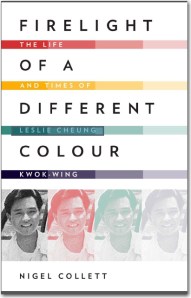
Firelight of a Different Colour: The Life and Times of Leslie Cheung Kwok-wing, by Nigel Collett, Signal 8 Press (February 25, 2014), 486pp, bibliography, notes and index

firelightWhile many of Leslie Cheung’s songs, recordings, concerts and films were widely known outside of Southeast Asia during the 1980s and 1990s, the impact of his death by suicide in 2003 on fans in Hong Kong, China, Taiwan, Japan and Korea probably wasn’t deeply understood by most of the English-speaking world.

Yet, in the years leading up to and including the British handover of Kong Kong to China in 1997, Cheung was in many ways the very embodiment of the colony’s film and recording industries.

Collett’s thoroughly researched Firelight of a Different Colour is both a tribute to Leslie and a likely resource for all future biographies and documentaries about the widely respected actor and highly popular Cantopop star.  For many English-speaking readers, the book is a wonderful, in-depth introduction to Leslie, Hong Kong’s entertainment business, and to the difficulties of gay performers within the colony’s compact and often-hostile media environment.

During the months leading up to his death, Leslie was plagued by clinical depression, fatigue and multiple physical ailments that friends and fans couldn’t help but notice. Yet, they were unprepared to lose him to anything other than early retirement. His death created shock waves followed by an outpouring of grief that, even now, suggests Collett has left “the pain still too raw for a full biography” from the viewpoint of the family and many fans.

Collett sees this book as provisional and fully hopes it will be superseded by true biographies and assessments. The strength of the book for those future works comes from its encyclopedic approach to Leslie’s life and career along with the collected footnotes and bibliography. The weakness–which is a small one at that–also comes from a linear and occasionally exhaustive presentation of facts (large and small) that includes lengthy plot summaries of films.

Inasmuch as films, concerts, and other celebrity events are strongly visual events for fans, the book would have been well served with the inclusion of personal and professional photographs of Leslie and other film and recording stars, concert venues, album covers, movie posters and production stills from “Farewell, My Concubine,” “A Better Tomorrow” and other films.

On balance, Firelight of a Different Colour represents the author’s very diligent attempt to re-energize the memories of fans, introduce Leslie to a wider audience, and gather the resources of another era for the writers and researchers of the future. It’s a must read for fans and a heart-felt introduction to those meeting Leslie for the first time within its pages.

Book Review: ‘New Dimensions of Being’ by Nora Caron

NDB cover smallAuthor Nora Caron (Journey to the Heart) returns with the gentle and deeply spiritual sequel New Dimensions of Being about a young Canadian woman named Lucina who has moved to Oaxaca for a much-needed change of scene. Fluent in Spanish and acclimated to the warm climate and culture of Southwestern Mexico, the former computer professional works as a waitress and shares her apartment with her boyfriend Teleo.

While she is happy with her decision to move to Oaxaca, Lucina’s sleep and serenity are being disrupted by frightening nightmares. Then she discovers she is pregnant. Her uncertainty about motherhood at this time in her life puts a strain on her relationship with Teleo and widens the scope of her spiritual quest.

New Dimensions of Being is a story about mentors. Teleo is an herbal healer; John is a shaman, Maria–a former actress–is wise in the ways of predatory men (vampires, as she calls them); Teleo’s mother is a midwife with strong connections to spirit as indigenous cultures view humankind’s relationship with Earth, gods and elemental forces; and Weeping Willow brings Lucina the Hopi worldview and its prospective  connection to her nightmares.

Each of these mentors has a role to play in Lucina’s quest, imparting wisdom and advice out of their experience. What does she want to do about her pregnancy, her relationship with Teleo, and her role as a woman at a time of spiritual shifts?

Written in a natural, easy-to-read style, New Dimensions of Being brings us a believable protagonist who is learning how, exactly, to define herself. At times, she is more reactive than active, when some of the mentors’ stories become lengthy.

However, her reactions ring true and her progress along her spiritual path will appeal greatly to women who are reclaiming their feminine energy and power in a patriarchal world, and to others who are focused on a more natural and cooperative relationship with Mother Earth.