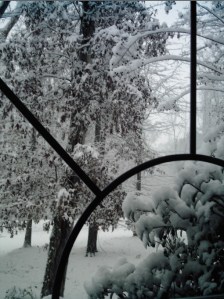
What a perfect afternoon for finishing the edits for the new edition of “The Sun Singer” coming soon from Vanilla Heart Publishing. The afternoon snow ensured that (a) few people would be showing up at the front door and (b) everyone would be trying to get home before a big traffic jam started rather than dialing my phone number.
After we took a few pictures and warmed up some leftover stew for dinner, I e-mailed the file to the publisher.
I haven’t heard about any traffic jams in Jackson County, but WSB radio out of Atlanta was monitoring bumper-to-bumper traffic around the Metro area as an above-average number of people left work early on a Friday afternoon. The Atlanta Journal-Constitution was reporting (as of 7:30 p.m.) “Over 160 accidents reported as metro area receives 2-3 inches of snow.”
Area roads are expected to get worse as temperatures drop beneath 32 degrees in light snow.
When one is on the road, snow can be an annoyance, though I certainly got used to it during the seven years I lived on the Illinois/Wisconsin border and commuted into Chicago. But around here, the snow is some how different: we’re not used to it, we don’t have the equipment to contend with it, and we definitely aren’t driving with chains or studded snow tires.
But when one is inside, the snow tends to quiet down the world and make ones home feel even more like a sanctuary. The quiet alone makes it a good time to work on a book.
Malcolm
Category: books
Jock learns Race Ready not meant for real men
 from Jock Stewart and the Missing Sea of Fire, a comedy/thriller about horses, horse thieves, girl friends and murderers. In the following excerpt, he’s on the trail of whoever stole Mayor Clark Trail’s race horse Sea of Fire.
Coral Snake Smith needed two omelets to loosen his tongue. For an informed source who made his living trading information for food, one might think Smith would have picked up some table manners along with the details of everyone else’s life. Jock drank half a cup of cold, gritty coffee and tried not to watch. Smith’s pig-in-a-trough noise was bad enough.
Jock’s dear old daddy always said, “Jock, take my word for it. Sloppy people are all going to hell.” He also said, “If a man smells like a whore house, he’s going to hell.” Smith had two strikes against him today and it wasn’t even noon yet.
“What did Lucinda Trail have to say?” asked Jock while Smith was licking his plate like an all day sucker.
Smith almost dropped the plate.
“Are your people following me around?”
Jock shrugged. “That, plus you’re wearing her perfume.”
“We were together, but not in the Biblical sense,” said Smith, and he grinned like it was something he spent a fair amount of time contemplating. “A man can do worse.”
“Word is, Clark has.”
Smith did a spit take with the remains of his coffee.
“So has your boss, but none of this is what Lucinda asked me about. She wanted to know why Monique Starnes bought two sacks of Race Ready.”
“What is that, some kind of Viagra knockoff?” asked Jock, recalling that while his Scotch tasted funny last night his performance had been better than usual.
Smith sat there with his mouth open, for once empty of anything approaching food. He looked like he’d seen a dunce.
“Race Ready is a brand of horse feed,” Smith said, with a fair amount of exasperation and condescension. “Martin and Brian Bentley over at the seed and feed stock it especially for Clark Trail. A new employee who didn’t know the feed had been set aside for Sea of Fire sold one sack to Ms. Starnes at seven AM and another sack at seven thirty-two AM. Brian called Lucinda and apologized for being out of stock.”
Since the waitress had temporarily lost interest in her job, Jock went to her station, selected a pot of coffee with the least amount of sludge in the bottom, and refilled Smith’s cup as well as his own. Doing this gave him time to collect his thoughts such as they were. Out of the universe of probabilities, one begged him to allow it to come to mind. But he wasn’t ready to think that way. So Jock temporarily dodged that line of thought by considering why Lucinda came to the Purple Platter.
“What was a woman like Lucinda doing in a place like this?”
“We keep in touch on a daily basis,” said Smith. “She facilitates that by sitting where you’re sitting now. She’s not exactly eye candy, but she trumps your sourpuss look without having to bat an eyelash or shove a shoe up a man’s trouser leg under the table.”
“Fine.”
So far, Smith had slung four sugar cubes into his cup. Now, he seemed to be studying the sugar bowl as though, what with the rain and all, Monday was turning into a five-cube day. He tasted his coffee, and then he dropped in another cube.
“Lucinda came in this morning dressed to the nines even though it was only eight thirty. Her face was blanched out more than her hair. She was disappointed when she learned that my network of quasi-ubiquitous sources knew nothing about the two sacks of Race Ready.”
“You’re not a seed and feed kind of guy,” observed Jock.
“Hardly.”
–
Copyright (c) 2009 by Malcolm R. Campbell
COMING SOON
An interview with Smoky Trudeau, author of “Observations of an Earth Mage.”
Disappointed in Jerry and Bobby
I don’t know how I would react to fame, the ever-prying lenses of cameras, the crush of people’s expectations, the constant roar of the crowd. Fame kills, I think, and it does so without remorse.
When I was young and in need of heroes, I saw chess champion Bobby Fischer as a viable candidate. I played chess badly, and so it was that I admired a guy about my age who played better chess at 13 than most chess players will ever play in their prime.
As a writer in training, I grew up with the canon of literature as it was preached during the 1950s; I rebelled against it, and so it was that I admired a guy of my mother’s generation who brought the Caulfield and Glass families to life outside the scope of what my teachers taught.
No one likes to see their heroes rusting away with age and crumbling into apparently flawed and strange creatures. Perhaps neither man expected the fame he achieved or understood its dangers. Bobby Fischer became eccentric and mean spirited and J. D. Salinger hid away from the public eye with what, at times, was an admirable persistence and what, at other times, seemed more like a self-righteous disdain for the rest of the world.
Rightly or wrongly, I am disappointed in both men because each of them threw his talent away. If Bobby’s mission was chess and if Jerry’s mission was short stories and novels, then let the vicissitudes of fame be damned and find a way to stay on course.
Bobby’s chess, including his innovations for the game, will continue to influence prospective masters who might benefit from his contributions to openings and end games. Jerry’s “The Catcher in the Rye” may well fade with time as its focus becomes more and more dated, but his writing brought us more than that in his sparse, but strong collected works. And perhaps there’s more, novels and stories sequestered for years in a safe that may one day find a friendly light of day.
Bottom line, though, I disappointed in Jerry and Bobby because they both quit, perhaps for cause, but that’s ultimately the weakest of rationale.
Review: ‘Buffaloed’ by Fairlee Winfield

My rating: 5 of 5 stars
When teenager Ovidia Odegard arrives in the United States in 1904, her first duty is to find suitable work so she can begin paying back her uncle for his out-of-pocket costs in sponsoring her immigration from Norway. Her dream, though is not only to be an American, but a Westerner, and that includes wearing a fancy buckskin jacket.
Providentially, Nancy Russell–the wife of the famed Montana cowboy artist Charles M. Russell–is looking for a housemaid at the couple’s home in Great Falls. When Ovida sees a copy of Russell’s pictorial “Studies of Western Life,” she can’t wait to board the train and head for the West she’s seen at the Nickelodeon.
When she arrives in Great Falls, she finds a dirty, modern city, and once she meets Charlie Russell, she begins discovering that the idealized West as it exists in books and movies is gone–if it ever existed. While Nancy Russell wants contracts and sales for Charlie’s art, Charlie would rather spend his time spinning yarns about the old days with his “bunch” down at the saloon. Not surprisingly, the house is a mess.
“Buffaloed” is Ovidia’s story as told to her grandson just before she died at 94, and it all begins when she mentions a secret she has never shared with anyone: the famous Charles M. Russell mural “Lewis and Clark Meeting the Indians at Ross’ Hole” at the Montana State House of Representatives” wasn’t really painted by Russell. It was a con, or so Ovidia claims.
Ovidia dangles this con before her grandson’s eyes throughout her remembrances because, as she sees it, he wouldn’t understand it if he didn’t know what happened in the Russell household from the moment she reported for work. What had she gotten herself into?
This well-researched book is just the kind of yarn that the master of tall tales, one Charles Marion Russell (1862-1926), would endorse without hesitation. The dialogue, the atmosphere, and the historical period in “Buffaloed” are superb. Fans of Russell and Montana history will discover that the book includes real events and places along with a supporting cast of historical personages.
In his book “Montana Adventure,” a friend and contemporary of Russell, Frank B. Linderman, writes that “Charlie Russell was the most lovable man I have ever known.” This is the Charlie Russell who emerges in Fairlee Winfield’s wonderful novel.
Now, if you live in Montana, mostly everything having to do with Charlie Russell is sacred, and that includes a lot of living and story telling that was also delightfully profane. Ovidia does have a confession to make in regard to that mural, but this is a novel, of course.
Winfield’s disclaimer at the beginning of the book reminds us that “Buffaloed” is a work of fiction. In addition to the standard reference books about Charles and Nancy Russell, Winfield also had a more personal resource for this story: her Norwegian grandmother did work in the artist’s home and had a lot of humorous and gritty stories to tell.
View all my reviews >>
Copyright (c) by Malcolm R. Campbell, author of “The Sun Singer” and “Jock Stewart and the Missing Sea of Fire”
Glacier Centennial: Grace Flandrau

“It is due to the discovery made by John F. Stevens in 1889 that four years later the evil spirit of the Blackfeet fled forever from Marias Pass before the onrush of a transcontinental express. A continuous highway of steel at last connected, by the straightest and lowest route, the headwaters of the Mississippi with Puget Sound.” — Grace Fandrau, “The Story of Marias Pass,” 1925
Author Grace Flandrau (1886-1971) was a journalist between the 1920s and 1940s who received high acclaim for her short stories and novels. Her novel “Being Respectable” is, perhaps, her best known.
At the time when the Great Northern Railway was seeking popular writers such as Mary Roberts Rinehart to help promote the wild country of Glacier National Park, they selected Flandrau to write a 24-page booklet about Montana’s Marias Pass.

Flandrau’s booklet promotes the discovery of the pass by Great Northern civil engineer John F. Stevens in 1889. “Travelers, unless they happen to be civil engineers, which, of course, most of them are not, are in the habit of taking the passing of railroads through mountain ranges, entirely for granted,” she writes on the booklet’s first page.
The booklet promotes a high point of Montana railroading history: it’s epic stuff, perfect for the eyes of prospective passengers who might be enticed to head west and experience the grandeur of the Backbone of the World first hand.
You can learn more about the career of Grace Flandrau in Georgia Ray’s 2007 biography of the author, “Voice Interrupted.”
In his review of the biography, Paul Froiland writes that “Ray has elevated St. Paul, Minnesota, novelist and journalist Grace Flandrau from obscurity to her rightful place alongside her contemporaries — Scott Fitzgerald, Sinclair Lewis, Willa Cather and Ring Lardner. This book is the first step in rehabilitating the reputation of one of the great — and most undeservedly forgotten — descriptive writers of the twentieth century.”
Copyright (c) 2010 by Malcolm R. Campbell, author of “The Sun Singer,” a novel set in Glacier National Park. My article about the park’s Swiftcurrent Valley appears in “Nature’s Gifts,” an anthology of fiction, nonfiction and poetry celebrating nature to be released by Vanilla Heart Publishing in March.
Review: ‘Now is the time to do what you love’
 Now is the Time to Do What You Love: How to Make the Career Move that Will Change Your Life by Nancy Whitney-Reiter
My rating: 5 of 5 stars
Picture this: Joe, a fry cook in Gainesville, Florida, wows his family and friends with his Chesapeake Bay Wild Striped Bass and Braised Short Ribs on evenings and weekends. After dreaming of opening a restaurant “somewhere near the Big Sur,” he sells his house, packs his family into a car and heads for California. Joe will learn the multiple definitions of “nightmare” and “disaster” before year’s end.
Or picture this: Joyce, who lives in Decatur, Illinois, has always loved children. She’s wondered for years whether to become a teacher or open a daycare center once her own children leave the nest. But she keeps waiting for some future moment when her world is more settled, ensuring that “what night have been” will remain “what never was.”
Dreams, some say, will take up as much space as we allow. According to Nancy Whitney-Reiter, most of us spend our careers trying to achieve success as it’s defined by others rather than proactively following our dreams and doing what we love. Yet, “Now is the time to do what you love” makes clear that ill-defined career-change goals may remain pipe dreams if we take no action or may become nightmares when we fail to consider realities and create a comprehensive plan.
After establishing the rationale for changing careers sooner rather than later, Whitney-Reiter leads readers through a frank assessment of exactly how their dream jobs will impact that lives, their emotions, their finances, their physical condition and their families. She includes pros and cons, examples, reality checks and “Is-It-Worth-It?” checklists.
When considering finances, for example, the checklist includes such statements as “I am willing to invest a significant amount of time on understanding and improving my financial picture” and “I understand that my expenses might actually rise during my transition between careers.” If one doesn’t agree with such statements, s/he may face roadblocks to his or her success.
After successfully working through the advice and checklists in part one, part two leads career-change dreamers into “Taking the Plunge.” To avoid the financial and emotional nightmare of becoming trapped in a new career that doesn’t meet expectations, one should make a sound written plan and find various ways for trying on the proposed career to see if it fits.
“Jumping into a new career,” says Whitney-Reiter, “is akin to jumping into an unknown river. It may look beautiful and inviting from a distance, but you really have no idea what it’s like until you become immersed in it. Sticking your big toe in–taking a trial run–allows you the opportunity to test the waters first.”
Part three analyzes the realities and requirements of popular career and second-career choices, including converting hobbies into money-making opportunities, leading travel groups, teaching and care-giving, social work, public speaking, nonprofits, real estate and law enforcement. Those considering these careers will find options, laws, certifications and other vital specifics. Others may discover a career they hadn’t yet thought of and/or sound examples of the kinds of considerations any new career includes.
Immensely well organized and practical, “Now is the time to do what you love” is the perfect companion for anyone who is dissatisfied with their current career and/or who is considering a second career after they retire from the first. To become viable realities, dreams require work. Whitney-Reiter’s experience, research and interviews show those ready to take the journey the important milestones to leaving a job that’s just a job and entering a fulfilling career doing that makes them personally feel successful and happy. The book is a very wise dream catcher.
Pied Type Doesn’t Have a Flaky Crust

The term “pied type” refers to handset type that’s been dropped on the floor, scattering in a mess.
Handset type was stored by font in a California Job Case, a removable drawer in a cabinet. The letters were arranged in the case in order of their frequency of use. Printers created words, one letter at a time in a composing stick–a small hand-held tray which the typesetter viewed upside down. (The Linotype did this automatically, one line at a time–quite a time savings)
When the typesetter finished a column or part of a column, he tied the type tightly together with string and then transferred it to a form to be mounted on the press. If he dropped it, he said he had pied his type. “Pi” or “Pie” type refers to mixed up stuff whether it’s a dropped block of type or pieces of the wrong font mixed up in a job case.
Handset type was still prevalent enough in the late 1960s that my journalism course work included a printing class in which we were all trained to set type this way. Years later, I would still find some printers–especially those doing formal invitations on small platen presses–to be setting type in a stick and letting lose with a lot of profanity whenever the type got pied.
Malcolm
Guard Cat

The answer to that question is probably “no” unless we’re talking about witches who can’t write without their familiar standing by.
Nonetheless, Katy guards my den while I’m at work. From her position next to the file cabinet, she can see all the way down the hall. This way, other entities–such as my wife, guests coming in the front door, or the other three cats in the house–cannot approach without challenge.
When Katy gets bored with her duties, she squeezes in behind me on my desk chair and falls asleep–with one eye open.
Malcolm
All That Is, Is Light
“All that is, is light.” – Erigena
“In a very real sense, we’re all made of sunlight.” – Thom Hartman
“Light gives of itself freely, filling all available space. It does not seek anything in return; it asks not whether you are friend or foe. It gives of itself and is not thereby diminished.” — Michael Strassfeld
“When you possess light within, you see it externally.” — Anaïs Nin
“Ever since we crawled out of that primordial slime, that’s been our unifying cry, ‘More light.’ Sunlight. Torchlight. Candlelight. Neon, incandescent lights that banish the darkness from our caves to illuminate our roads, the insides of our refrigerators. Big floods for the night games at Soldier’s Field. Little tiny flashlights for those books we read under the covers when we’re supposed to be asleep. Light is more than watts and footcandles. Light is metaphor. Light is knowledge, light is life, light is light.” — Diane Frolov and Andrew Schneider
“Death is not extinguishing the light; it is putting out the lamp because dawn has come.” — Rabindranath Tagore
“There is a muscular energy in sunlight corresponding to the spiritual energy of wind.” –Annie Dillard
“If you are in a spaceship that is traveling at the speed of light, and you turn on the headlights, does anything happen?” — Steven Wright
“Truly, it is in darkness that one finds the light, so when we are in sorrow, then this light is nearest of all to us.” — Meister Eckhart
“Our deepest fear is not that we are inadequate. Our deepest fear is that we are powerful beyond measure. It is our Light, not our Darkness, that most frightens us.” — Marianne Williamson
“God’s first creature, which was light.” — Francis Bacon
“The original religion of the Blackfeet was the worship of light personified.” — James Willard Schultz
Coming soon in a new edition from Vanilla Heart Publishing, “The Sun Singer,” a celebration of light.

Book Review: ‘When Memaids Sing’
 When Mermaids Sing by Mark Zvonkovic
My rating: 4 of 5 stars
Larry Brown’s musings about life as he observes it are insightful, humorous and often jaded. Outwardly, the protagonist of Mark Zvonkovic’s gently written novel “When Mermaids Sing” is a pleasant, unassuming Medford, PA high school English teacher who tries to get along with everyone and avoid conflicts.
He often feels manipulated by the requirements of his teaching job and the endless expectations of his parents and his girl friend Millie. Brown’s parents, both college teachers, expect him to play a role in their world, while Millie–an actress who might be cheating on him–expects him to make dutiful appearances in her social and family life. At work, where he may not really be happy, he’s hoping to be granted tenure. And, his cousin Bradley has joined a cult and might have lost himself in the addictive peace it provides.
Brown can ponder the humor and the irony of such realities because he has a “cure.” He copes with the chaos of his job and his relationships by retreating into memories of the halcyon summer days of his youth at a Cape Cod vacation house with his siblings and cousins. Those were the best years of his life. The present cannot compete with them. He doesn’t want it to.
Henry David Thoreau once said of Cape Cod’s Outer Beach, “A man may stand there and put all America behind him.” Likewise, Brown retreats to the house of his youth to put all of life’s troubling challenges behind him.
While making an obligatory appearance at his father’s annual party for freshmen college students, Brown meets a personable young woman named Jenny with a strong aversion to cults. Her brother Josh has joined the charismatic Path to God, the same group to which Bradley as sworn allegiance, if not his soul.
Jenny complains that Josh has repudiated their father as Satan and “become a different person.” A psychiatrist at the party remarks that the sudden personality change exhibited by cult members is due to brainwashing, not hypnosis. This, and the lack of fences and armed guards at an ashram, make it difficult for families to intervene.
Brown vacillates about the difference between the freedom to choose a path others don’t agree with and losing one’s freedom through brainwashing and choosing the same path. Jenny’s family is no longer splitting hairs. They’ve engaged the services of a well-known deprogrammer to help them extract Josh from the Cape Cod ashram even though everyone involved might end up being charged with kidnapping.
When Jenny points out that Bradley and Josh are together at the same place and enlists Brown’s help, he can no longer ignore the issue as a mere philosophical topic for debate.
Will Brown help Jenny, Bradley and Josh? He would rather not, because if he does, he will have to admit there’s more involved here than the rescue of two impressionable young people from the brainwashing of a cult. He will finally have to take a stand on something and answer a lingering question. Is escaping life by running away to a cult different than running away to the past?
The title of Zvonkovic’s carefully written novel is suggested by a line from John Donne’s playful “Go and Catch A Falling Star.” Catching falling stars and hearing mermaids singing are, in Donne’s thinking, rather unlikely events. Readers of “When Mermaids Sing” may wonder whether substantive change in Larry Brown is also unlikely. As literary fiction, the story relies heavily on theme, interior monologue and a strong sense of place rather than non-stop action on its introspective journey to a powerful conclusion.
–Malcolm R. Campbell for POD Book Reviews & More


