Operation Paperback, a great place for your gently used books

I used to re-sell my used paperbacks on Amazon. Sometimes I still do. But, for most books, the profits aren’t very good because so many people are selling books for a penny or two, hoping to make a pittance on volume by taking a cut of the amount Amazon allows for shipping. Then, too, you have to buy mailers or boxes and rush to the post office within two days of getting a SHIP NOW e-mail from Amazon.  Selling books on eBay has similar hassles and low profits unless you have something out of print and/or rare.

There’s a used book store in town that takes in used books IF you want to use the value they assign to them and apply that against a purchase in the store. The thing is, if the store is selling used books, I’ve probably already read them.

If you have an eagle eye, you’ve noticed the Operation Paperback logo on the right-hand side of this blog. Anyone can sign up and either donate money or become a shipper, all of this to give our troops books to read. When I was in the Navy, I would have welcomed an occasional box of books from people who cared that I was sitting on a ship in the Gulf of Tonkin with time between watches to use up.

Operation Paperback was founded in 1999 and since then has shipped 2.2 million books around the world and to veterans and their families in the U.S. In my case, I participate in the program via my publisher Thomas-Jacob Publishing. This means that when Melinda runs out of books she’s been stashing under the bed, I send her a few boxes to add to her collection. Then she ships them out to people who are looking for the genres I send.

The literary fiction I read isn’t in high demand. But the Tom Clancy/James Patterson kinds of books are. So, she gets all these because they’re not the kinds of books that lend themselves to reading them multiple times. I mailed her two boxes of books this morning, and snuck in a batch from Jim Butcher’s Dresden Files series. Think of them as cops and robbers with a wizard in the mix!

It’s amazing how much space paperback and hardback books take up in my den. So, I’m happy to have a good place to send those I’ve read. It sure beats throwing them in the trash! And, since I think it’s a crime to dog-ear or scribble in books, mine have no bent pages because I use bookmarks. And, as we used to advertise on eBay, my books come from a smoke-free environment. Of course, it’s possible my books smell like fried chicken, steak or beef stew.

Malcolm


Book Bits: Amazon algorithm, ‘We Don’t Eat Our Classmates,’ Sam Hawke, Anne Tyler, Indies Unlimited

I mentioned in yesterday’s post that we’ll be seeing the fourth Comoran Strike novel from J. k. Rowling this fall. I like the series and will be looking forward to the release.
Here’s some more news for your Monday.

  1. Viewpoint: The Amazon Algorithm Myth – “A problematic feature of the world in 2018 is that the social networks we have built seem to spread misinformation faster and wider than its more accurate counterpart, and this can lead authors to make decisions counter to their interests. One of the enduring myths surrounds “’The Amazon Algorithm.’” David Gaughran
  2. Review: We Don’t Eat our Classmates, written and illustrated by Ryan T. Higgins, ages 3-7 – “When a young T. Rex named Penelope starts school, she learns some lessons about her classmates; most importantly, they are not for eating…Fans of macabre, tongue-in-cheek humor (and twist endings!) will enjoy time spent with Penelope.” Kirkus Reviews
  3. NewsCooking and Sci-Fi Are the Hot Print Segments This Year So Far, by Jim Milliot – “The cooking/entertaining and science fiction categories had the strongest print unit sales gains among the adult categories in the first half of 2018 compared to the first six months of 2017, according to NPD BookScan. On the downside, religion had the largest decline among the adult fiction categories, with units dropping 50%.” Publishers Weekly
  4. Interview: A Particularly Potent Brew, Sam Hawke with Noah Fram – “I love a good assassin story but I wanted to write the kind of inverse to that: the tale of the spoiled and pampered officials being targeted, rather than the tale of the assassins themselves. What I particularly love about Robin’s books, and what makes them stand out from other assassin romps, is that the poisonings and manipulations performed are never presented in a glorified or glamorous way.” BookPage
  5. EssayReading Raymond Chandler in the age of #MeToo, by Megan Abbott – “And yet, even reading Chandler’s harsher passages, I find myself not turning away but moving closer. Trying to understand something. Am I still entranced? Even as I resist the faintly gendered connotations of the term, its suggestion of female helplessness in the face of male potency, I still feel the pull. What fascinates and compels me most about Chandler in this #MeToo moment are the ways his novels speak to our current climate. Because if you want to understand toxic white masculinity, you could learn a lot by looking at noir.” Slate
  6. Review: Clock Dance, by Anne Tyler  reviewed by Barbara Lipkien Gershenbaum – “”CLOCK DANCE is a riveting and wholesome story of family, relationships, humanity and self-discovery…. [Anne Tyler] is at the top of her writing game in this outstanding novel.” Book Reporter
  7. News Source: Indie Author Newsbreak, This news feature will offer author, publishing news, and tips every Friday. I found the Amazon Algorithm (item 1) story link here. Should be a good information source from the popular authors’ website. Indies Unlimited
  8. Quotation: “Go for broke. Always try and do too much. Dispense with safety nets. Take a deep breath before you begin talking. Aim for the stars. Keep grinning. Be bloody-minded. Argue with the world. And never forget that writing is as close as we get to keeping a hold on the thousand and one things–childhood, certainties, cities, doubts, dreams, instants, phrases, parents, loves–that go on slipping , like sand, through our fingers.” – Salman Rushdie
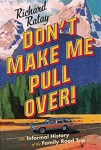
  9. Interview: Don’t Make Me Pull Over by Richard Ratay, with by Randy Dotinga – “I came up with the idea while on a family vacation. I found myself on a beach chair, looking at my young sons, who were then aged 6 and 8, and I thought about traveling 1970s America at that age with my own parents and siblings. It hit me how profound those experiences really were. They gave me some of my fondest childhood memories, they broadened my horizons in so many ways, and they profoundly shaped my relationships with my parents and my siblings for a lifetime. But I knew little about how the great American road trip experience developed.” Christian Science Monitor

Book Bits is compiled randomly by Malcolm R. Campbell, author of the upcoming novel “Lena” from Thomas-Jacob Publishing. Click on the book title to see the trailer.

–Malcolm


How many of these famous first lines do you know?

This is a pop quiz. Sure, you can copy and paste these lines into a Google search or look at the answers at the bottom of the page. But you won’t will you?

  1. In my earliest memory, my grandfather is bald as a stone and he takes me to see the tigers.
  2. A screaming comes across the sky.
  3. It is a truth universally acknowledged, that a single man in possession of a good fortune, must be in want of a wife.
  4. It was a queer, sultry summer, the summer they executed the Rosenbergs, and I didn’t know what I was doing in New York.
  5. Mother died today. Or maybe yesterday; I can’t be sure.
  6. It was a bright cold day in April, and the clocks were striking thirteen.
  7. The sky above the port was the color of television, tuned to a dead channel.
  8. Ships at a distance have every man’s wish on board.
  9. There was a boy called Eustace Clarence Scrubb, and he almost deserved it.
  10. We started dying before the snow, and like the snow, we continued to fall.
  11. The snow in the mountains was melting and Bunny had been dead for several weeks before we understood the gravity of our situation.
  12. Once upon a time, there was a woman who discovered she had turned into the wrong person.
  13. I was born in the city of Bombay…once upon a time. No, that won’t do, there’s no getting away from the date: I was born in Doctor Narlikar’s Nursing Home on August 15th, 1947. The time matters, too.
  14. Granted: I am an inmate of a mental hospital; my keeper is watching me, he never lets me out of his sight; there’s a peephole in the door, and my keeper’s eye is the shade of brown that can never see through a blue-eyed type like me.

–Malcolm

Briefly noted: ‘A Skeleton Key to Finnegans Wake’

“They lived and laughed and loved and left.” 
― James Joyce, Finnegans Wake

James Joyce is my favorite author, most especially his novels Ulysses and A Portrait of the Artist as a Young Man. With a minor in English, it was only natural and expected that I would study both of these books in school. School didn’t assign Finnegans Wake; perhaps they saved it for English majors and those working on a masters or doctoral degree. Or, perhaps the faculty was scared of the book.

I love the book, possibly for the language and the historical and cultural references and its endless puns and other humor. I also love chaos, and because of this, I suggest that people reading it for the first time should just go with the flow, setting aside worries or concerns about what it all means for a subsequent journey through the masterpiece.

If you want help, there’s help out there. If you want industrial-strength help, one option is Roland McHugh’s Annotations to Finnegans Wake. If you want getting-started help, then the 1944 A Skeleton Key to Finnegans Wake by Joseph Campbell, Henry Morton Robinson, and editor Edmond Epstein will save most of your sanity. Before this book was published, I don’t think readers–or English department professors–thought it was possible for anyone to understand, much less explain Finnegans Wake.

Publisher’s Description: “Since its publication in 1939, countless would-be readers of Finnegans Wake — James Joyce’s masterwork that consumed a third of his life — have given up after a few pages and dismissed it as a ‘perverse triumph of the unintelligible.’ In 1944, a young professor of mythology and literature named Joseph Campbell, working with poet Henry Morton Robinson, wrote the first key or guide to entering the fascinating, disturbing, marvelously rich world of Finnegans Wake. The authors break down Joyce’s abstruse book page by page, stripping the text of much of its obscurity and serving up thoughtful interpretations via footnotes and bracketed commentary. A Skeleton Key was Campbell’s first book, published five years before he wrote his breakthrough Hero with a Thousand Faces.”

In her June 2018 MythBlast| Mythic Mavericks essay on the Joseph Campbell Foundation website, Leigh Melander writes that “For years I have been intrigued with what I perceive as a particularly Celtic sensibility, an ability to dance on the knife’s edge between insight and nonsense, tragedy and comedy, sacred and profane. Not to say that only those of Celtic antecedents have this ability, of course, but there seems to be a profound and specific love for this dance in Celtic myth, story, and literature.”

An apt phrase as the foundation celebrates James Joyce this month, the man–whom I believe–knew how to dance on that knife’s edge. Skeleton Key, says Melander, “Has lasted as the bedrock unlocking of Joyce’s profanely sacred nonsensical insights for generations of scholars and readers.” To be sure, more intensive books have been written in the last 74 years to help readers decypher the the enigma people perceive in this novel, but Campbell’s and Robinson’s work is a sound first step to breaking the code.

Susan G. Hauser wrote in her her “‘Finnegans Wake’ Breakdown,” in Salon that “We had come to realize that reading Finnegans Wake without assistance was akin to crossing the Sahara without a camel.” That’s not a surprising assessment inasmuch as some of the purported best critics in the known universe proclaimed before the ink was drying on the novel’s first edition that it was unintelligible, and later, that it is “the greatest book that nobody’s ever read.”

Hauser says that the group of friends who came together to read, discuss, and understand Joyce’s novel “Began with the same resolute spirit displayed by Stephen Dedalus at the end of ‘A Portrait of the Artist as a Young Man.’ We felt we were doing a noble and brave thing, though we never dared to compare ourselves to the Wake’s first readers. To our mind they were just as courageous as the first people who ever tried eating lobster.”

Perhaps you should read Hauser’s article before you try reading Finnegans Wake. If you are brave–and not one of these people who tends to ask “what’s the worst that could possibly happen?”–and decide to tackle the Wake, you’ll probably order a copy of Skeleton Key after reading the first several pages.

Blind luck might suffice, but I doubt it.

Malcolm R. Campbell

Campbell is the author of the magical realism Florida Folk Magic Series of novels that includes Conjure Woman’s Cat” and “Eulalie and Washerwoman.” Coming soon, the final novel in the trilogy, “Lena.”


Dear Flora

Watching down on creation from the great sanctified church in the sky, I’m sure you are spry enough again to sing and dance in a ring shout circle, and re-conjure your memories of a life well lived.

Partial view of the cover art work for “Lena.”

As you watch us muddle through our days, perhaps you notice this old writer whom you once knew as that white boy around the corner who stopped by daily to see his best friend in the house where you worked as a maid in Tallahassee. Because my friend’s parents were frequently absent due to work, volunteer, and church schedules, you were the stern ruler of that household from dawn to dark.

In those days, I saw you as the heart and soul of that home even though our flawed traditions wouldn’t allow you to walk in through the front door. I loved and respected (and sometimes) feared you then, but I was not allowed to tell you so. After my mother and my grandmother, you were the best cook on the planet, but Southern booking wasn’t the best of what I learned from you.

I learned about faith and forbearance and streetwise savviness in a dangerous world along with the value of humor and tall tales as antidotes to the slights and terrors of the day. In those days, perhaps you saw me as part of the fair number of kids who hung out around that house and the woods behind it and had no way of knowing whether I’d end up in reform school or the priesthood. Well, I guess you knew I wasn’t destined to become a priest!

Like the children who lived in that house, Flora, I went off to college and then into the Navy and then into a life a thousand miles away. I’m sorry I lost track of you then. I wish I had hugged you goodbye before I went off into the world.

Now, as Lena, the third novel in my Florida Folk Magic series is nearing its release date, I want you to know that the book’s acknowledgements tell my readers you are my inspiration for Eulalie, the conjure woman who is the heart and soul of the series. Thank you for everything you taught me and my apologies for everything I have forgotten.

with love,

Malcolm

Coming this year: ‘Lena,’ the third novel in my Florida Folk Magic Series

We hear that books in series tend to sell better than standalone books. But, we also hear that if the first book in a series is well liked, the author might have trouble keeping readers’ interests in subsequent books.

Early reviewers who liked “Conjure Woman’s Cat,” said they though book two, “Eulalie and Washer Woman” was even better. The readers were happy and I was relieved that I hadn’t botched up the whole thing by writing a sequel.

The odd thing is, the sequel has sold fewer copies than the original and has a fraction of the reviews. Go figure.

So, I had mixed feelings writing a third book. On one hand, I thought that with the declining interest shown for book two, it was kind of silly to write book three. However, I had a few things left to say. Or, perhaps, the characters did. Book three was harder to write than the previous books. So, it took longer.

But finally, Lena is almost ready to send to my publisher. We’ve already been having conversations about the cover. As far as the cover goes, our artist for books one and two has moved onto other things. So, we’ll need somebody new.

What’s left to do? Well, this is the polishing the manuscript phase. That means going through the story page by page to get rid of any inconsistencies, typos, continuity problems, or stupid mistakes I can find before sending the DOC file to Thomas-Jacob Publishing. Fortunately, we have a great editor who will catch 99 and 44/100 percent of the mistakes I miss.

I have no idea how long it will take to get everything squared away. Several months, perhaps. Like most authors who get to know their characters throughout a series of books, I will miss these people. But, I suspect it’s time to move on to other themes and other stories. (I reserve the right to change my mind.)

For years, I wondered if I would ever find the characters and story lines to write about the racism in Florida during the years when I was growing up. For prospective readers, I hope I did.

Malcolm

Click on my name for my website.

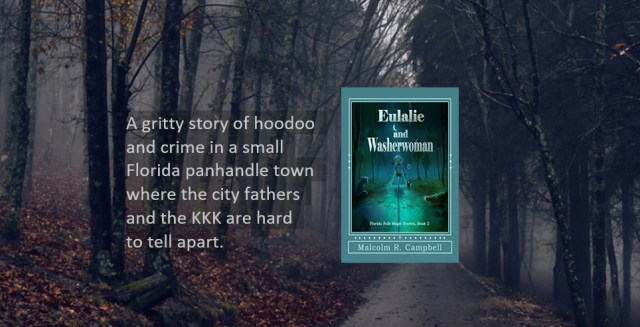
Get your 99¢ Kindle copy of ‘Eulalie and Washerwoman’ before the promotion ends

My Florida Folk Magic series novel Eulalie and Washerwoman has been available on Kindle this spring for only 99¢. However, we’re wrapping up this Kindle promotion soon, so this is a great time to get your copy before we return to the regular price.

Description: Torreya, a small 1950s Florida Panhandle town, is losing its men. They disappear on nights with no moon and no witnesses. Foreclosure signs appear in their yards the following day while thugs associated with the Klan take everything of value from inside treasured homes that will soon be torn down.

The police won’t investigate, and the church keeps its distance from all social and political discord. Conjure woman Eulalie Jenkins, her shamanistic cat, Lena, and neighbor Willie Tate discover that the new “whites only” policy at the once friendly mercantile and the creation of a plantation-style subdivision are linked to corrupt city fathers, the disappearing men, rigged numbers gambling, and a powerful hoodoo man named Washerwoman. After he refuses to carry Eulalie’s herbs and eggs and Willie’s corn, mercantile owner Lane Walker is drawn into the web of lies before he, too, disappears.

Washerwoman knows how to cover his tracks with the magic he learned from Florida’s most famous root doctor, Uncle Monday, so he is more elusive than hen’s teeth, more dangerous that the Klan, and threatens to brutally remove any obstacle in the way of his profits. In this follow up to Conjure Woman’s Cat, Eulalie and Lena face their greatest challenge with scarce support from townspeople who are scared of their own shadows. Even though Eulalie is older than dirt, her faith in the good Lord and her endless supply of spells guarantee she will give Washerwoman a run for his ill-gotten money in this swamps and piney woods story.

Editorial Review: Told through the narrative voice of Lena, Eulalie’s shamanistic cat, the fast-paced story comes alive. The approach is fresh and clever; Malcolm R. Campbell manages Lena’s viewpoint seamlessly, adding interest and a unique perspective. Beyond the obvious abilities of this author to weave an enjoyable and engaging tale, I found the book rich with descriptive elements. So many passages caused me to pause and savor. ‘The air…heavy with wood smoke, turpentine, and melancholy.’ ‘ …the Apalachicola National Forest, world of wiregrass and pine, wildflower prairies, and savannahs of grass and small ponds… a maze of unpaved roads, flowing water drawing thirsty men…’ ‘…of the prayers of silk grass and blazing star and butterfly pea, of a brightly colored bottle tree trapping spirits searching for Washerwoman…of the holy woman who opened up the books of Moses and brought down pillars of fire and cloud so that those who were lost could find their way.'” – Rhett DeVane, Tallahassee Democrat


Enjoy the story!

–Malcolm

‘Mountain Song’ book giveaway

My Kindle novel Mountain Song will be free on Amazon April 5-April 7, 2018.

Description: David Ward lives in the Montana mountains where his life was impacted by his medicine woman grandmother and his utilitarian grandfather. Anne Hill suffered through childhood abuse and ultimately moved in with her aunt on the edge of a Florida swamp. Their summer romance at a mountain resort hotel surprises both of them. But can they make it last after the initial passion wears off and they return to their college studies far apart from each other especially after an attack on a college street changes Anne forever?

This story begins and ends in the high country of Montana where David and Anne meet as college students working as seasonal employees at a resort hotel. In today’s terms, they would probably call themselves soul mates. Yet  summer romances are usually fragile, almost as though they’re a part of the places where they occur.

Add to that, an attack on a dark street corner while Anne is walking from a movie theater back to her dorm. She won’t let David help her because she believes that to become whole again, she must recover on her own. Both of them make mistakes at an emotional time when there’s no room for making mistakes,

I know this story well because–other than changing names, locations, and moments, it’s true.

Malcolm

Review: Jane Harper’s ‘Force of Nature’

Force of Nature (Aaron Falk, #2)Force of Nature by Jane Harper
My rating: 5 of 5 stars

When the Bailey Tennants accounting firm takes two employee groups into a rugged Australian mountain forest for an annual weekend of “team building,” the men’s group returns ahead of schedule and the women’s group straggles back to civilization late, injured, scared, and in a fighting mood, indicating that its working together skills need more attention. The group is also missing the bossy, opinionated Alice who apparently wandered off and got lost; statements from Lauren, Beth, Bree and Jill about just how that happened are vague and contradictory.

Federal Police Agent Aaron Falk (who first appeared in Harper’s “The Dry” in 2017) and his partner Carmen are pulled into the investigation because Alice has been providing them with evidence of the company’s illegal activities. Aaron and Carmen can’t help but wonder who, if anyone, discovered there was a whistle blower in their midst. And then, too, a serial killer used to call those mountains home.

Harper deftly handles the storyline by alternating her chapters between the present day investigation and the prior day-to-day troubles of the women’s group on the trail. In the here-and-now-investigation chapters, Falk, the local police, and the rangers find a tangled web of possibilities about what might of happened to Alice. Is she still alive?

In the up-close-and-personal chapters showing a women’s group starting a normal hike into the wilderness and then trying to find its way out alive, readers see that tensions, tempers, and mistakes are worse than police suspect.

Everyone, including Falk, has a past that complicates their reactions to the majestic wilderness. Falk carries memories of his father’s lonely hikes in those isolated mountains and wishes the family’s past had played out differently. Each of the women not only has personal and professional issues with the others in the group, but is distracted by unsettling family problems that keep pulling their focus away from making sensible decisions in a setting where terrain and weather always have the upper hand. So much for creating a cohesive team.

Harper clearly knows how to tell an exciting story and keep her readers guessing about what really happened until the final pages of the aptly titled “Force of Nature.”

Malcolm

Malcolm R. Campbell is the author of contemporary fantasy, paranormal, and magical realism short stories and novels.

View all my reviews

Book Bits: Sherman Alexie, Smoky Zeidel, ‘Freshwater,’ book covers, Amy Tan

According to the social media, people are impatient for Spring. Booker Talk (Item 2), one of my favorite blogs, wishes all of us Dydd Gŵyl Dewi Hapus i chi! (Happy St. David’s Day to You All) with a fine list of Welsh books to consider during inclement weather. It’s raining hard here in Northwest Georgia, so in between furtive trips into the yard to see what the bulbs are doing, I’m doing a lot of reading. If you’ve got stormy weather and don’t know why there’s no sun up in the sky, here are a few links to help you wait for Spring.


  1. Wikipedia Photo

    News: Sherman Alexie’s Response to Harassment Accusations – “After a month of online charges that he has been abusive to many women, particularly Native American women, author Sherman Alexie issued a statement yesterday. It’s a mix of admission and denial and, as with to much of the matter, it’s somewhat vague.” Shelf Awareness

  2. Lists: Books to mark Wales’ special day – March 1 is St David’s Day in Wales — “St David being our patron saint — so usually a day for celebration of all things Welsh. The celebrations will be very muted this year however with schools closed and concerts cancelled because of Storm Emma, so I thought I would mark the occasion by highlighting some new books from authors and publishers based in Wales.” BookerTalk
  3. New Title: Garden Metamorphosis: New and Collected Poems of Change and Growth, by Smoky Zeidel (Thomas-Jacob, March 1) – “In the midst of a confusing and frightening world, Smoky Zeidel remains true to form with her poetry, gently reminding us to close out the superfluous and remember that which is sacred. Garden Metamorphosis is both a love song to Mother Earth, and a celebration of the cycle of life Read the complete poems, plus Zeidel’s short story, ‘Transformed.'” Thomas-Jacob Publishing
  4. Ursu

    Feature: Sexual Harassment in the Children’s Book Industry, by Anne Ursu – “These are the sort of events we’re told to brush off — they’re jokes, they’re flattering, no big deal. But when you believe you are a professional and someone informs you they see you as a sex object, it can shatter your sense of self and your sense of safety.” Medium

  5. Quotation: “The future of publishing lies with the small and medium-sized presses, because the big publishers in New York are all part of huge conglomerates.” Lawrence Ferlinghetti
  6. Review: Freshwater, by Akwaeke Emezi, reviewed by Tariro Mzezewa – “In her remarkable and daring debut novel, “Freshwater,” Akwaeke Emezi draws in part from her own life to tell the story of Ada, a young Igbo and Tamil woman haunted by the ogbanje — the ‘godly parasite with many heads, roaring inside the marble room of her mind.’” New York Times
  7. Feature: Meet the Designers behind Your Favorite Book Covers, by Alexxa Gotthardt – “We talk with five designers whose book jackets are routinely hailed as crowd favorites. Their designs blanket young adult bestsellers like John Green’s Turtles All the Way Down (2017), literary classics like Vladimir Nabokov’s The Eye (1930), and tomes that rethink the form of a book (one comes with a remote control, and drives like a toy car).” Artsy
  8. Interview Amy Tan on Writing and the Secrets of Her Past, with Nicole Chung – “In ‘Where the Past Begins: A Writer’s Memoir,’ Amy Tan recalls the time a relative told her mother that she shouldn’t fill her daughter’s head with ‘all these useless stories.’ Why should Amy know so much, visit her mother’s painful memories, when it was beyond her power to change the past? Her mother replied: ‘I tell her so she can tell everyone, tell the whole world . . . That’s how it can be changed.’ As she writes in her memoir, ‘My mother gave me permission to tell the truth.’” Shondaland

Book Bits is compiled randomly by author Malcolm R. Campbell.