“Emily’s Stories” AudioBook: Thanks for the great reviews

I never know what combination of good luck and synchronicity brings a batch of nice comments and reviews to one book and not to another. Bottom line, whenever a reader leaves a review on Amazon or on Audible, I’m thankful they took the time to say what they thought (especially when they liked the book).

Emily’s Stories has some great reviews on Audible, for the story and for the audiobook’s narration. Seeing this makes my day.

Here’s what people are saying:

  • I recommend this audiobook more than any other
  • What a beautiful, beautiful story
  • A sweet YA paranormal fantasy story
  • An excellent book for young adults and others
  • Touching, great fantasy/paranormal stories

And those are just the titles for the reviews.  At present, Emily’s Stories has a 4.5 average rating.

Here’s the review from AudioFile Magazine:

Kelley Hazen’s spirited delivery enhances Campbell’s descriptive writing in these three stories about 14-year-old Emily Walters. “High Country Painter” present a talkative Emily and a realistic-sounding bird that directs Emily to magically draw obstacles to divert a grizzly bear. In “Map Maker,” Emily meets an eerie-sounding ghost who helps her save a sacred forest from developers. In “Sweetbay Magnolia,” Hazen captures Grandma Walters’s elderly voice as well as her persistence and wit to perfection. Young listeners will enjoy hearing Emily explain about TMI–too much information. Hazen’s skill at creating believable bird and ghost voices adds to the listening pleasure. S.G.B. © AudioFile 2017, Portland, Maine [Published: DECEMBER 2017]

Perhaps the young adults in your family will enjoy the stories as well.
Malcolm


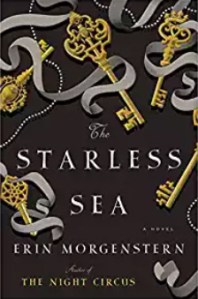
Review: ‘The Starless Sea’ by Erin Morganstern

This novel is a breathtaking display of exuberant lyrical prose, wondrously detailed imagery, and elaborate plotting. Interlocking tales and snippets of tales comprise this brilliant celebration of storytellers and how the times and places and characters of their art become woven, often covertly, into readers’ lives.

The purported protagonist, Vermont college student Zachary Ezra Rawlins, checks out a book called Sweet Sorrows from the library and finds within it a story from his childhood. At first, he can’t believe it, but then as he tries to find out where the book originated and how it was catalogued by the library, he discovers over time that he can’t truly believe anything.

Rawlins initially discovers that simply having the book has placed his life in danger. He’s not sure why. In fact, he may never be sure. As it turns out, there are doors everywhere that lead to an immense and seemingly infinite realm of books stored in ever-shifting below-ground castles and caverns.

One is reminded of Neil Gaiman’s Neverwhere tale about a hidden-away realm beneath the streets of London where the culture is quite different from everything at street level. In Morganstern’s unique world, which comes with its own mythologies and origin stories, the culture is not only different from the “real life” we know, but changes constantly like the play of moonlight on the surface of the sea.

Stories are not content to confine themselves to their original plots. Instead, they update and morph themselves not only into other stories but into the reality of the inhabitants and structures of the underground world itself. In one respect it’s chaos, but everything is tied together as though the stories themselves got together and made sure their changes meshed perfectly with the changes in other stories like the gears in a perfectly designed machine.

The stories, in fact, are all there is. They are not only the motive power and intelligence behind the underground library on the shore of the Starless Sea but impact the direction of the science and technology world that innocently exists outside the doors leading into the depths.

In defense of readers who enjoyed The Night Circus and were disappointed with The Starless Sea, Morgenstern’s new novel strays dangerously close to being a work of experimental fiction rather than a true fantasy. The plot isn’t linear and may not even exist cohesively from one chapter to the next. The ending–which works perfectly within the confines of the novel–will anger those who read through some 500 pages hoping for a resolution.

I’m content simply to experience the world Morgenstern has created in The Starless Sea and the immeasurable beauty of her storytelling. Fantasy or experimental–either way, it’s a gem.

–Malcolm


Amazon Reducing Orders to Publishers

In order to deal with congestion issues at its warehouses, Amazon has been cutting book orders to publishers over the last several weeks. It isn’t clear how widespread the reduction in orders is, but several independent publishers contacted by PW reported cuts in their weekly orders since late October. One publisher reported that an order placed last week was about 75% lower than an order placed last year at this time. “It’s a nightmare,” the head of one independent publisher said.

Source: Amazon Reducing Orders to Publishers

Amazon has caused a fair amount of talk and concern amongst small publishers, and rightfully so. Publishers who need holiday sales to “make their year” worry those sales won’t happen if Amazon lists the books as out of stock.

We have alternatives, but for many readers, buying a new book automatically means logging onto Amazon’s website. It’s a habit that’s hard to break, yet every time it happens it makes Amazon bigger and makes us more dependent.

We could just as easily log on to the Barnes & Noble site where prices are similar. Or we can buy directly from IndieBound. Powells claims it’s the world’s largest independent bookstore. Its website is just as easy to use as B&N’s site, though the prices are a bit higher. On the plus side, they sell a lot of used books and those prices are pretty good.

A fair number of local bookstores operate websites like Powells where we can order even if we live on the far side of the country.

These are some of our options. I appreciate what Amazon has done for self-publishers.

However, they are a business and have to make decisions that work for them (as in making sure bestsellers are in stock rather than buying something from a publisher who may only sell 25 books during the holiday season), so I try to buy from other places from time to time. I’m sure Amazon doesn’t care, but it keeps me from developing too strong an addiction to the A-to-Z people.

–Malcolm


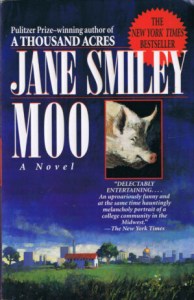
‘Moo’ by Jane Smiley

If you were born yesterday, or perhaps last week, you probably haven’t heard of this darkly satirical and nearly farcical novel about a midwestern agricultural college referred to as “Moo U.” I first read it a quarter of a century ago when it first came out. Now that I’m re-reading, I find it just as funny and just as true when it comes to university politics and the misfits who keep schools forever running on square wheels as I did in 1995.

I worked at two universities (not counting student jobs), attended four others, and–along with the rest of the family–followed by father to at least another five as he moved up through the ranks of college professors and deans. Suffice it to say, I know college politics in spades. That’s why I see this novel as the Bible detailing what’s really happening behind all those ivy-covered walls.

In a 1996 interview with Elisabeth Sherwin, Smiley says that she did not model the story after Iowa State University where she was teaching then. She told Sherwin, “I always wanted to write both a tragedy and a comedy on the same theme. ‘A Thousand Acres’ was the tragedy, the theme was American agriculture and technology, and ‘Moo’ was the comedy.”

At the moment, most people know Smiley from her recent “The Last Hundred Years Trilogy: A Family Saga Series” that includes Some Luck, Early Warning, and Golden Age. I liked the trilogy and see it as quite an achievement. But when I first found Jane Smiley’s work, it was her fifth novel, the Pulitzer Prize-winning A Thousand Acres. That one remains my favorite.

Here are a few excerpts from Moo:

“This was an aspect of Barbie-hood that Mary had never given any thought to, that Barbie created Ken, anatomically incorrect to the very core of his brain, where he understood as well as he understood his own name that Barbie was inviolable.”

“He was turning out to be one of those men whose interest diminished as they got to know you. You got into this pattern of trying to be interesting by revealing more and more of yourself, like a salesman unpacking his sample bag, but the man, though he looked like he was smiling and paying attention, was really shaking his head internally—not that, not that either, no I don’t think so, not today.”

“Those Latin American and Eastern European novelists aren’t any help here. They live inside the mansion of female desire as if it is their right. Their own desire is a nice healthy dog on a string, ready to eat, fuck, fetch, piss on the bushes.”

Unfortunately, I can’t find a pithy excerpt that illustrates the dark side of Moo U. I can’t tell you how and why I think Moo is true of some really colleges without libelling a lot of people. If you decide to read Moo, I suggest you wait until after you’ve graduated from college. If you read it before you go to college, you’ll never go to college.

Malcolm

Why do I write?

Why do I write?

The short answer to that question is, “I don’t know.”

When asked, I usually respond with:

Why do you read?

Most people have trouble answering that question other than listing the reasons other people read and using them to make people go away.
I know why I read: so I have less time to write. I was actually a writing mentor once and gave it up after a while when I realized I was teaching my mentees all my bad habits. My bad writing habits have saved me from a life in an institution, a university or a mental institution, places like that.

When people ask me why I write, I usually tell them that as I got older the gigolo business wasn’t supporting the lifestyle to which I’d become accustomed. As it turns out, writing isn’t supporting that either.

Storytelling, perhaps.

We’re told by gurus that we read and write stories because they tell us the important things about the world. I think I’ve learned more from reading fiction than from history books or the nightly news. I’ve probably discovered a lot more from writing than I have from any other journey. But then people ask me why I write, I can’t really say that because it sounds crazy.

Writers who sound crazy tend to earn more and find more readers than writers who sound sane. I think this is because sanity is boring. Books that are boring don’t end up on the New York Times bestseller list. Or in Oscar-winning movies.

What’s Important?

I think we all want to know. We see that the world appears to be in a mess: War. climate change. Murder. One religion vs. another. BS on the evening news every night.

Most of us want to know the truth, the real truth behind all the BS. We learned early on that stories, especially old stories that we linked to ancient legends and myths, might have clues for us. I think that’s why I read and write.

The clues I’ve found, or think I’ve found, don’t make sense if I discuss them at the local Waffle House. People say, “Well, that’s just crazy.” I know it sounds crazy, but then that’s why I think it’s true. That’s the great paradox of living in this world, I suspect. The truth always sounds like it isn’t the truth.

Yet, we continue to believe that while reading and writing, we catch glimpses of the truth. So, we keep on playing our games with words. It’s like a journey into the unknown. When I start reading or writing, I have no idea where I’ll end up. Yet, I see a pattern to what I’m doing as I read books with a common theme that support each other and as I write books with common themes that support each other.

When people ask me why I write, I give them the short answer: “It beats driving a truck.” The real answer is too difficult to pin down just as the real answer for why I read what I read is hard to fathom. What about you. Do you have a short (and true) answer for why you read an/or write?

Malcolm

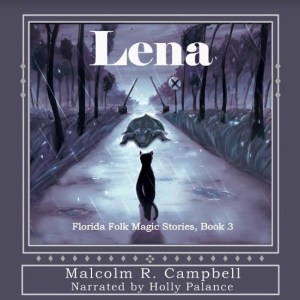
Malcolm R. Campbell is the author of “Lena.”

Dang, I hate throwing away books

When we moved five years ago, I took so many boxes of “Friends of the Library” books to the library that they screamed, “Help, please make it stop.” And then they complained when I didn’t come to the book sales and take away as many books as I donated. “I’m downsizing,” I explained. They didn’t care.

Later, I unloaded (that doesn’t sound good, “so turned in”) a grocery sack full of books at a local used book store for “store credit.” Luckily, I found a couple of things that looked good. I came out with fewer books than I walked in with.
There were some places to donate books, but they’ve become more selective and, when it comes down to it, I cannot afford to pay the shipping costs for each book I want to get off my shelf.

So, it’s a crime, I know, but I’m now tossing out old, badly dated books in the trash each week. I decided, for example, that I no longer need my 1980 backpacking guide or a stack of paperbacks I didn’t like the first time I read them.

I used to sell these on Amazon, but Amazon has made establishing a seller account more difficult and I can’t compete with the sellers who’re charging a penny per book and trying to make a little on the shipping. Same goes for eBay.

We’ve discussed moving again. That means I need to get rid of a lot of stuff. Books in bulk are really heavy. I don’t feel like going through another move with more books than most small-town libraries.

Plus, boxes of books really tick off moving companies because when they make their estimates, they don’t expect all that extra weight or the time it takes to load those boxes into their truck.

Lately, I’ve been re-reading a lot of books on my shelf (as well as those stacked up in a closet). This is my poor attempt to stop bringing so many new books into the house. The trouble is, my favorite writers keep writing new stuff that I can’t resist. For example, Erin Morgenstern (The Night Circus) is releasing The Starless Sea next week and Theodora Goss just released The Sinister Mystery of the Mesmerizing Girl, the third “Athena Club” novel. This means that I’m under relentless pressure to throw more stuff away to make room for the new stuff.

What I need, is the phone number for a place that accepts old books for good causes and then sends a truck out to pick them up. So far, no luck.

Malcolm


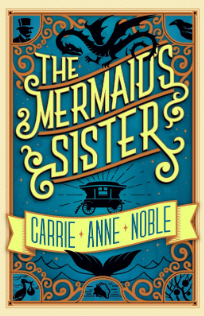
Books: ‘The Mermaid’s Sister’ by Carrie Anne Noble

What a delightful story to re-read on a cold, windy day. I mentioned it here before in a post about magical realism books on Amazon. Published in 2015, this was Carrie Anne Noble’s debut young adult novel and it’s done well. (It has won several awards, has 3,394 ratings on Amazon and is a bestseller in the folklore category.)

Publisher’s Description

There is no cure for being who you really are…

In a cottage high atop Llanfair Mountain, sixteen-year-old Clara lives with her sister, Maren, and guardian Auntie. By day, they gather herbs for Auntie’s healing potions; by night, Auntie spins tales of faraway lands and wicked fairies. Clara’s favorite story tells of three orphaned infants—Clara, who was brought to Auntie by a stork; Maren, who arrived in a seashell; and their best friend, O’Neill, who was found beneath an apple tree.

One day, Clara discovers iridescent scales just beneath her sister’s skin: Maren is becoming a mermaid and must be taken to the sea or she will die. So Clara, O’Neill, and the mermaid-girl set out for the shore. But the trio encounters trouble around every bend. Ensnared by an evil troupe of traveling performers, Clara and O’Neill must find a way to save themselves and the ever-weakening Maren.

And always in the back of her mind, Clara wonders, if my sister is a mermaid, then what am I?

Noble says on her website that her favorite authors are Mervyn Peake, Neil Gaiman, Maggie Stiefvater, Ardyth Kennelly, Catherine Cookson, C.S. Lewis, and J.R.R. Tolkien. If you like any or all of them, you’ll probably enjoy The Mermaid’s Sister as well. Noble published The Gold-Son in 2017.

–Malcolm


Unread book on my shelf is an unexpected gift

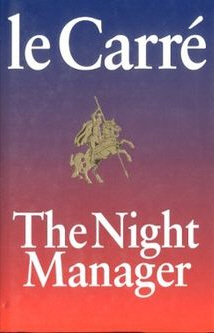
“And gradually it dawned on him, if a dawning can take place in total blackness, that his life has consisted of a run of rehearsals for a play he had failed to take part in. And that what he needed to do from now on, if there was going to be a now on, was abandon his morbid quest for order and treat himself to a little chaos, on the grounds that while order was demonstrably no substitute for happiness, chaos might open the way to it.” – The Night Manager.

Best I can tell is that I bought a trade paperback copy of John le Carré’s The Night Manager in 1993 when it came out, put it on my bookshelf, and forgot about it. I have no idea how or why it ended up on the shelf without being read. I lived in an Atlanta suburb at the time and was apparently more focused on the one-hour commutes to a variety of technology companies where I wrote computer documentation and occasional code than reading novels.

Like most of the author’s fans, I wondered how he would focus his spy novels once the cold war was over. The Night Manager was the first book with a different kind of plot: unscrupulous international arms dealers. The book was generally a success, though Publishers Weekly said at the time that it ended in a way that would make a sequel easy to write.

I’m enjoying the book, a change of pace from the more straightforward, technology-intensive spy novels by such authors as Clancy and Patterson  (and those writing under their names) because the plot is not strictly linear. Nobody needed to worry about le Carré running out of subject matter in the 1990s for now, at 88, his new novel Agent Running in the Field demonstrates that there’s still room in the fictional universe for spies and those who write about them. As an author, I’m impressed with anyone his age who is still writing.

I never saw any of the episodes of the 2016 TV series based on this book. I’m glad I didn’t, for that would have spoilt the gift of finding an unread book on my shelves that I didn’t already know lock, stock, and barrel.  The TV series starred Tom Hiddleston in the lead role as the night manager and also included Hugh Laurie (“House”).

Publishers Weekly liked the book, saying that it was “written with all le Carre’s mastery of atmosphere, character and desperate political infighting among the smoothest of Old School Brits.” I agree. And it’s refreshing to read a spy novel that doesn’t include the manufacturer’s specs of every gun, helo, suppressor, and piece of surveillance gear used by the operatives.

What fun, though, to find a “new book” that didn’t cost me $25 on Amazon.

Malcolm


Re-Reading Les Misérables at My Age: I Must Be Nuts

During the summer and fall, I’ve been re-reading a lot of the novels on my shelves. It’s been fun. Re-reading Les Misérables has not been fun. I think all the radiation treatments have not only left me feeling fatigued, but they’ve disrupted my ability to concentrate on long books.

When I bought this paperback edition in the 1980s, I read the whole thing, including the longer-than-necessary descriptions, political diversions, character background, and interior monologue. I was pleased that I stuck with it then just as I was pleased when I once completed mountain climbs to 14,000 feet and hikes of 25 miles or more without needing to go to the hospital afterwards. Like most people, I was younger then.
I still like the plot, many of the descriptive turns of phrase, and the snarky wit. But when it comes down to it, trying to read this novel today is about as absurd as trying to hike the Appalachian Trail without getting in shape first with neighborhood walks and shorter hikes. I’m on page 283of 1,463. If this were the Appalachian Trail, I’d be dead by now or lying at the bottom of a steep slope waiting to hear the welcome sounds of rescue helicopters.

To use an old phrase, I think I’m going to “cry uncle” on this attempt and put the book back on the shelf where it will impress all who see it rather like a photo of me standing at the summit of Mt. Everest or K2.

As Wikipedia notes, “More than a quarter of the novel—by one count 955 of 2,783 pages—is devoted to essays that argue a moral point or display Hugo’s encyclopedic knowledge, but do not advance the plot, nor even a subplot, a method Hugo used in such other works as The Hunchback of Notre Dame and Toilers of the Sea.” Yes, I suppose I could push forward and scan those sections, but the type is small (note the smaller page count on my version when compared to the original) and that seems like more trouble than it’s worth.

My attention span at present is more suited for watching Survivor or NCIS on TV or a Clancy/Patterson style novel that moves along with large print, lots of action, and is over before you know it. To use a Survivor tradition, if some of Hugo’s characters had gotten voted out of the novel at tribal council, it would be a lot easier to read now.

Sure, I feel disappointed just like any other beer-drinking couch potato who spends a ton of money to get to Mt. Everest and learns that s/he doesn’t even have the stamina to make it up to base camp.

Have any of you read this novel? If you did, how much of it did you skim through? (Asking for a friend.)

Malcolm

I’m very appreciative of the wonderful reviews from listeners who found this audiobook, enjoyed the story, and loved actress Kelley Hazen’s narration. 

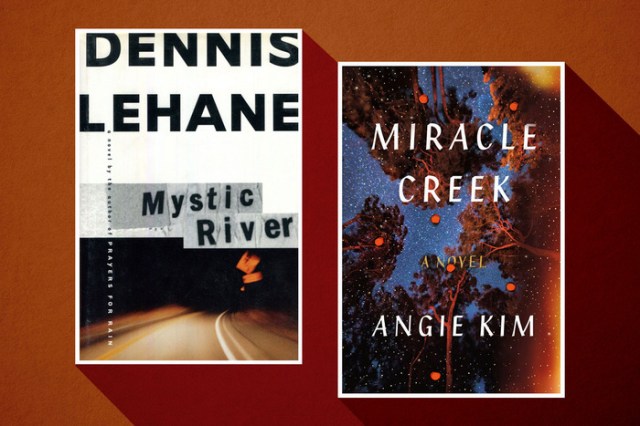
Angie Kim: Learning from ‘Mystic River’ to Write ‘Miracle Creek’

What I really wanted was a Dennis Lehane master class, which he sometimes teaches, though nowhere near me and not at that moment. So I made one for myself: I sat in my tiny writing nook and reread Mystic River from cover to cover, multiple times, and dissected it down to its component scenes. I created a detailed outline, color coded by character, and used it to make timelines, chronologies, and charts to figure out the book’s structural skeleton — the major evidentiary discoveries, the twists and the red herrings, the whodunit reveal to the readers and the various characters. Eventually Miracle Creek took shape, and along the way, I learned a few key lessons.

Source: Angie Kim on Using ‘Mystic River’ to Write ‘Miracle Creek’

Most of us don’t have the time or money to take a master class from one of our favorite authors, much less attend an MFA program where that author is part of the core faculty.  If the author’s writing in the genre you want to attempt, you have an alternative. Read and re-read one of your favorite books.

In fact, that might be better than the class, as inspiring as the class will be. Many of us learnt more about plotting, character development, and dialogue from reading the kinds of books we wanted to write. In my case, it was Dune and Earth Abides. Ultimately, I would change my mind about what I wanted to write, but the lessons and discoveries made while reading those novels were of lasting value.

It’s a choice, we all grapple with: learning through lecture and discussion OR learning by seeing a final product that illustrates how it was done by the master.

–Malcolm