Feds say they’re solving global warming with ice cubes.

Washington, D. C., April 21, 2023, Star-Gazer News Service–“We’re not taking coals to Newcastle, we’re taking ice cubes to the Artic to lower temperatures, stop rapidly melting snow and ice, and put an end to the rising sea levels,” Homeland Security Deputy for Hail Mary Causes Bill Smith told reporters here today.

According to the department’s website, the original plan was mounting air conditioners on top of pack ice,  but scientists vetoed the idea due to classified logistics problems. Planners said that adding ice to ice made more sense.

President Joe Biden kicked off the plan by throwing the first “ice to the Artic” cube out the window of Air Force One late last night.

“It was better than starting the baseball season by throwing out the first call at Wrigley Field,” he said.

Press Secretary Karine Jean-Pierre downplayed the President’s purported disappointment after he received an e-mail from Barack Obama that said, “Say it ain’t so, Joe.”

“He used to hear that a lot when he was Vice President,” the press secretary said.

Project managers said that the ice cubes are not, as some Republicans have suggested, coming from the freezer of an old Frigidaire in the basement of the White House.  They are, in fact, being harvested from existing glaciers around the world and transported to drop zones by retrofitted DC-3 aircraft.

Volunteers at coastal communities that are viewed as the greatest risk, are measuring the mean sea level daily to help Homeland Security chart the progress of the project.

“We’re determined to save the planet with ice cubes,” said Smith, “even if hell has to freeze over first.”

-30-

Story filed by Jock Stewart, Special Investigative Reporter

EPA to Implement Cistern Plan to Solve Rising Seas Problems

Washington, D.C., July 25, 2019, Star-Gazer News Service–The Environmental Protection Agency (EPA) will soon begin placing rows of used crude oil storage tanks, each capable of holding 16 million gallons of liquid, in the open spaces at solar farms, wind farms, abandoned military bases, and Alien holding cells at Area 51. These tanks will be linked to a vast pumping station and pipeline network that will extract seawater from the oceans to counteract rising sea levels.

At this morning’s press conference, EPA Deputy Manager of Oceans, Leilani Moana reported that while the agency has not reversed its position about the unreality of climate change and related rising sea levels, it recognizes that small, short term climate anomalies are causing a public panic about the future of states like Hawai’i and Florida.
“Since the EPA feels your pain,” Moana said, “our top scientists and engineers  have devised a system of pumping stations, pipelines, and aqueducts to remove water from coastal areas and store it inland until it can be safely released.”

Some of the pumping stations would be tied into desalinization plants that would reduce the pressure on river systems for potable freshwater during times of drought.

According to a NASA white paper, launching water into the sun on Saturn V rockets would be cost-prohibitive even though some experts said such a program would cool the sun slightly, allowing Arctic glaciers to reform to help stabilize sea levels.

“The world’s excess heat is primarily caused by heated arguments about climate change that are turning the entire issue into a self-fulfilling prophecy,” Moana said. She added that groups claiming that the weight of the water in the cisterns would push the U.S. deeper into the ocean are unfounded.

Scientists told reporters this morning that the water held in the cisterns would always remain available to be pumped back into the oceans should weather anomalies ever decrease sea levels to the point where cruise ships were scraping bottom trying to get in and out of popular tourist destination ports.

“The Earth’s water supply is a closed system,” said EPA Chief Oceanographer Porter “Po” Seidon. “The water we have is all the water we have. All we’re doing is improving upon the Creator’s design to better manage that water in times of weird high temperatures or weird low temperatures.”

“We think we’ll have the system up and running before we lose southern Florida,” Moana said.

Story filed by Jock Stewart, Special Investigative Reporter


Climate Change: Impacts on Coastal Resources

from the EPA:

Impacts on Coastal Resources

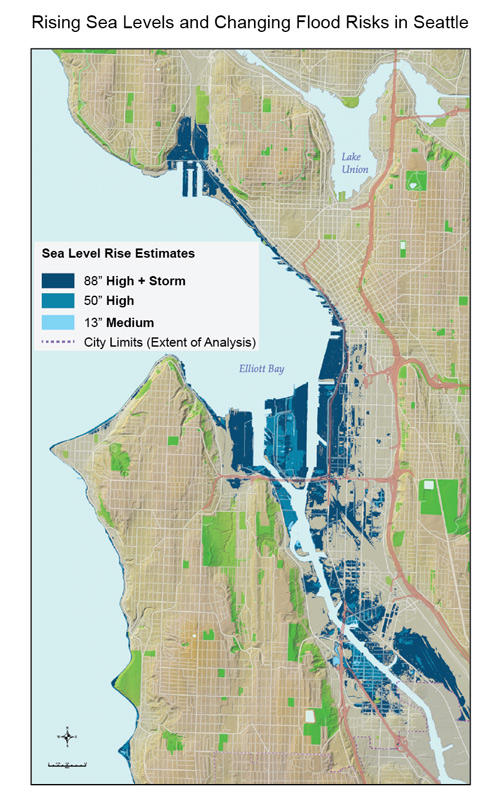
Climate change is damaging the Northwest coastline. Projections indicate an increase of 1 to 4 feet of global sea level rise by the end of the century, which may have implications for the 140,000 acres of the region that lie within 3.3 feet of high tide.[2] Sea level rise and storm surge pose a risk to people, infrastructure, and ecosystems, especially in low lying areas, which include Puget Sound. Warming waters and ocean acidification threaten economically important marine species and coastal ecosystems.[2]Map of Seattle showing areas projected to fall below sea level during high tide by end of the century. The high (50 inches) and medium (13 inches) estimates are within current projections. The highest level (88 inches) includes the effect of storm surge.Many areas of Seattle are projected to fall below sea level during high tide by the end of the century. Shaded blue areas depict three levels of sea level rise, assuming no adaptation. The high (50 inches) and medium (13 inches) estimates are within the range of current projections, while the highest level (88 inches) includes the effect of storm surge. Source: USGCRP 2014[6]

Flooding, seawater inundation, and erosion are expected to threaten coastal infrastructure, including properties, highways, railways, wastewater treatment plants, stormwater outfalls, and ferry terminals. Coastal wetlands, tidal flats, and beaches are likely to erode or be lost as a result of seawater inundation, which heightens the vulnerability of coastal infrastructure to coastal storms.

Some coastal habitats may disappear if organisms are unable to migrate inland because of topography or human infrastructure. This is expected to affect shorebirds and small forage fish, among other species. Warmer waters in regional estuaries, including Puget Sound, may contribute to an increase in harmful algal blooms, which could result in beach closures and declines in recreational shellfish harvests. Ocean acidification is also expected to negatively impact important economic species, including oysters and Pacific salmon.

For more information on climate change impacts on coastal resources, please visit the Coastal Resources page.

At present, this information can be found on the EPA site here. In the future, the work of our scientists is purportedly going to be reviewed by politicians before it can be released.

–Malcolm