“As a Man Thinketh is a self-help book by James Allen, published in 1903. It was described by Allen as “… [dealing] with the power of thought, and particularly with the use and application of thought to happy and beautiful issues. I have tried to make the book simple, so that all can easily grasp and follow its teaching, and put into practice the methods which it advises. It shows how, in his own thought-world, each man holds the key to every condition, good or bad, that enters into his life, and that, by working patiently and intelligently upon his thoughts, he may remake his life, and transform his circumstances. The price of the book is only one shilling, and it can be carried in the pocket.” It was also described by Allen as “A book that will help you to help yourself”, “A pocket companion for thoughtful people”, and “A book on the power and right application of thought.” – Wikipedia
 An original copy of the 1903 edition of James Allen’s remarkable book sat on my father’s bookshelves while I was growing up. The book was thin, the cover was old (nothing like the current cover on Amazon), and the text was written in an old-fashioned style. It took me a long time to discover the book and realize that what is held within it a remarkable prescription. (You can download a free copy here as well as from Project Gutenberg.)
The book, which I’ve mentioned on this blog several times before, contains what used to be called “aphorisms” (suggestions for “right living.”) It can be read that way, that is to say, if you think positive thoughts and avoid negative thoughts, you’ll be a happier, more likeable person.
Or, it can be read literally, as though continued focus on a particular kind of thought will manifest that thought in one’s life. This is the way I read it. Many books, including The Secret and others about the law of attraction, affirmations, and practical meditation owe their existence to this book.
“THE aphorism, ‘As a man thinketh in his heart so is he,” not only embraces the whole of a man’s being, but is so comprehensive as to reach out to every condition and circumstance of his life. A man is literally what he thinks, his character being the complete sum of all his thoughts.'”
That’s not easy to see because we seem to have been programmed to think a lot of negative thoughts. Maybe they’re rants or gripes or poor me notions or the kind of gossip people used to trade at the barbershop. It’s easier to say something is screwed up than to find hope in the world. So, if we think negative thoughts most of the time, that’s who we are even though from time to time we read a book or go to a lecture and spend a few days thinking positive thoughts.
Peer pressure influences us a lot, I think. If everyone around us is saying things are going to hell in a handbasket, it’d hard to step forward and say, no they’re not. So we don’t say it. Who would believe it if we did say it? It takes a lot of effort to see that thoughts are things and that they control what happens in the physical world. One has to give the notion a try and work with it for a while to see any results.
Suffice it to say, when a friend comes on hard times, it’s best not to say, “You caused this to happen.” It’s easier to say that hard times were caused by fate, bad breaks, or God moving in mysterious ways. That places the responsibility everywhere else. And, it obscures the fact that–to paraphrase Marianne Williamson–we are more powerful than we know. The sad thing is this: if we have been “programmed” since birth to believe that we believe, it’s difficult to change to a new way of seeing the world, much less expect others to accept it. Those who speak out about this are usually mocked one way or another as (according to the old phrase) being a “goodie-two-shoes” or naive or just plain crazy.
I’m lucky. I can insert my beliefs into my fiction without being put in a home because people assume all that comes from my characters or another reality. If you’re in the insurance business or sell cars for a living, I don’t know what you’re supposed to do. Life insurance salespeople really can’t say, “You’ll die whenever your ready” and car salesmen really can’t say, “The next time you decide to wreck your car, come see me for a new model.”
If I could, I would go door to door handing out copies of James Allen’s book. If people read them, the world would be forever changed,
—Malcolm
 Malcolm R’ Campbell’s hero’s journey novel “The Sun Singer” and the heroine’s journey novel “Sarabande” are based on the principles in James Allen’s book.
 In my version of reality, what happens in the world is the total of what everyone in the population desires with enough fervor to be able to see it and taste it and experience it in their dreams and in their mind’s eyes. We can say, then, that each of us is responsible for what we get and all of us are responsible for what our city, our state, our country, and our world experience.
 Each of us needs to put hope and energy into what we want. That’s how what happens, happens. In our personal lives, we must be positive and expect the outcomes we desire. And yet, many people begin each week with a pessimistic, Murphy’s law expectation about what will happen. They get what they focus their energy on, so if they think things will go wrong, then things will go wrong, confirming their beliefs about how the world works.
 If we can one day grasp what James Allen wrote years ago, “As a man thinketh in his heart so is he…A man is literally what he thinks,” we will understand that the “bad” and the “good” of life do not come from fate or Murphy’s laws but from ourselves and how we see ourselves and the world. Understanding this is the true power we have over bad things that seem to come out of nowhere.
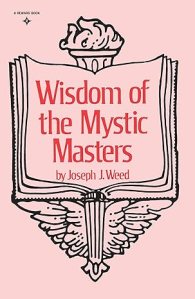 Once upon a time, when I was starting to take my curiosity about esoteric subjects seriously, I read Wisdom of the Mystic Masters and other books by Rosicrucian author Joseph Weed. As a Rosicrucian, Weed was no doubt aware of the fact that the road to mastery is a long road. So, in looking back on these books, I’m surprised at how they were so blatantly oversold (this reminds me of The Secret) in that they implied all you had to do was read a popular account of ancient lore and soon thereafter you would become all-powerful and quasi-divine. Like The Secret, these books came and went quickly because–while there was truth in them–it could not be learned and perfected during the halftime show of the football game that had taken over the living room’s TV set.
 If you look closely at what these hyped books offer, it’s very similar to what James Allen wrote years ago in his wonderful 1903 book As a Man Thinketh. My father had this book on the family’s shelves and I read it long before I’d ever heard of Weed. From the book of Proverbs. Chapter 23, it is written, “As a man thinketh in his heart, so is he.” In my view, this is all we need to know. No hype is needed.


 Photo from the trip: Diagon Alley at Universal Studios. There were long lines, of course, but it was fun seeing this re-creation as well as my two granddaughters’ reaction to it. They each bought an interactive wand which, if you used it just right, made things happen in many of the store windows.
 When some people read books filled with promises–like “The Secret” they are often inspired to try what they otherwise might not try. Sometimes they succeed. They’re more likely to succeed right after reading the book because they are attuned to the idea that all things are possible. So, before doubts enter into their thoughts, they often see things happen that they might never have expected prior to reading the book.
 Malcolm's Round Table