Review: ‘The History of My Body’ by Sharon Heath

“The Bible says that in the beginning was the void, and it hasn’t escaped me how fast the Lord moved to take care of His own particular vacuum—dividing day from night, spitting out vast oceans, carving out competing continents that would one day have the power to blow each other up. What an inspired series of creations to keep the devil of boredom at bay. No wonder God kept seeing that it was good.”

So begins the story of Fleur Robins.

Fleur Robins is called creepy child, poor child, little monster, odd duck, space cadet and assorted other synonyms for “weird” by almost everyone who notices her existence and tries to figure out whether she is gifted, autistic, simply hopeless or hopelessly simple. Fleur’s imagination contains many worlds because—as she explains life as the fifteen-year-old narrator of The History of My Body—positioning her body and mind “just this side of the lurking pit of nothingness” requires constant vigilance and ingenuity.

Whenever the void looms too large for her to handle, Fleur flaps her arms, bangs her head, pinches herself, emits strange noises and makes oddly literal pronouncements that simultaneously appear to miss the point and contain cosmic truths. No school will take her. An alcoholic mother loves her, but spends her days drunk or asleep. A mean-spirited father dislikes her, but fills his days with a pro-life crusade while filling an entire nursery wing of the family’s large house with children rescued from the “devil abortionists.” An odd-duck household/nursery staff cares for her, but is too busy to overtly save her from the void.

Fleur is her own teacher. She makes lists, keeps diaries, consults the dictionary frequently, and assembles the often-confusing puzzle pieces of information from others to make sense of the external world. She listens to the voices of her heart and her infinite imagination to define her internal world and to explore far-flung probabilities beyond the ken of “normal people.”

When she’s told that a woman who walks down the street every day in a bathrobe has lost her mind, Fleur falls into a figurative pit considering the ramifications:

“What kind of God would let people lose their minds? And was there some kind of cosmic Lost and Found where He kept them? I tell you, it gave me a serious case of the heebie-jeebs, thinking of God feeling so empty and alone that He needed to steal people’s minds to stuff into His own unfillably huge one.”

In her wise, superbly crafted debut novel, author Sharon Heath connects a series of highly improbable events into a tightly knit story about a self-taught young girl who believes her coming of age is a wonderful example of the butterfly effect: or, as Fleur came to understand nonlinear systems, a personal development with a sensitive dependence on initial conditions. Potential events spin off in all directions when Fleur finds a dying baby bird in the garden; while those that ultimately manifest as her body’s history could never have been predicted, they represent a meaningful synchronicity if not harmony.

Fleur’s phases of growth (incarnations, to her way of thinking) unfold as a metamorphosis out of the chaos of her childhood. Her progress isn’t ugly duckling to swan. It’s more like a butterfly transitioning from egg to larva to pupa to adult, or like the unfolding of the beloved David Austen roses she tended on the grounds of the childhood home of her first incarnation.

In The History of My Body, Sharon Heath masterfully combines darkness and light, tragedy and comedy, and the sublime and the ridiculous into a dazzling and beautifully ironic dance of opposites that create an unusual and endearing protagonist with an unforgettable tale to tell.

Malcolm R. Campbell is the author of four novels, including the recent contemporary fantasy “Sarabande.”

Review: ‘The Devil’s Elixir’ by Raymond Khoury

Reading Raymond Khoury’s The Devil’s Elixir can be hazardous to your sleep cycle! You won’t be able to put the book down until you reach the last page.

Once again, Khoury pairs up FBI agent Sean Reilly and archeologist Tess Chaykin whom long-time Khoury fans already know from their tangled and dangerous destinies in The Last Templar and The Templar Salvation. (See also my review of The Templar Salvation.) In this high-energy thriller, Reilly and Chaykin shift their focus from Templar and Vatican mysteries to a potentially more dangerous secret extracted and resynthesized out of the South American rainforest.

Eusebio, the priest who learned about a psychoactive alkaloid from a tribal shaman in 1741, viewed the “sacred brew” as a catalyst that could lead a seeker toward mystical enlightenment. Álvaro, his Jesuit brother at the mission, called the drug the devil’s elixir. In the hands of a present-day drug lord named El Brujo the drug represents not only a belief-changing experience but a chance for unlimited profits with a potion more powerful than meth, cocaine and heroine combined.

Reilly is is drawn away from New York into the high-body-count world of drug cartels and kidnappings when a former girlfriend calls to report her life is in danger. Former DEA agent Michelle Martinez’s story is so compelling that Reilly packs his bags and heads for San Diego immediately. Soon, his life will be at risk as will Chaykin’s. One way or another, sparks fly when Reilly and Chaykin are involved in a case. This time out, there are a couple of additional complications, one being that Reilly never told Chaykin about his earlier relationship with the “seriously hot” Martinez.

Khoury’s story moves briskly with alternating chapters from the perspectives of El Brujo, southwestern FBI operatives, the drug lord’s foot soldiers, Reilly and Chaykin. This approach heightens the intrigue by showing the reader thrills, chills and plot twists that the primary characters have yet to discover. Reilly is a strong-willed, indefatigable FBI agent who gives everything he has to keep his loved ones safe while keeping the devil’s elixir out of the black market supply chain. At the same time, his conscience constantly asks him whether the ends justify his means.

Readers new to Khoury’s fiction may think as they finish each chapter in The Devil’s Elixir, “certainly things can’t get any worse than this.” Those who have  read The Last Templar and The Templar Salvation know things never get better until the story’s over because following a Khoury plot is similar to riding a snowball through hell.

The Devil’s Elixir is a delightfully breath-searing ride.

Book Details

The Devil’s Elixir by Raymond Khoury

Hardcover: 384 pages

Publisher: Dutton Adult (December 22, 2011)

Language: English

ISBN-10: 0525952438

ISBN-13: 978-0525952435

Malcolm R. Campbell is the author of four novels, including the recent contemporary fantasy Sarabande.

Common Forest Trees of Florida – How being a packrat saves time

Looking at the pamphlet shown here, I can say that I have no idea how and when I got it, who scribbled on the cover, or even why the handy little pocket guide published in 1956 didn’t get buried in one of the numerous boxes of packrat stuff in the garage or attic.

Today, of course, a writer can Google just about anything. If he’s persistent, he can sort through all the hobby sites and find information he can count on. While writing my 2010 novel Garden of Heaven: an Odyssey, I needed a handy reference to Florida’s trees. And there it was: right on my shelf less then six feet from my desk.

Published by the Florida Board of Forestry since 1925, I’m guessing I stole or borrowed or received this pocket guide while I was in the Boy Scouts in North Florida. The guide contrains black and white drawings of leaves, acorns and cones along with a descriptive text for each tree. This makes it easy for a hiker or a Boy Scout in Tate’s Hell Forest, the Apalachicola National Forest, or the swamps and estuaries along the Gulf Coast to identify what he’s looking at.

I grew up around Baldcypress, Chinkapin, Tupelo, Sweetbay Magnolia, Sassafras, Cabbage Palmetto, and Swamp Cottonwood trees. So, one would think I’d be a walking encyclopedia about their common attributes, the quick  kinds of details a writer needs when he writes a sentence such as “David stood beneath the ______ leaves of the ____-foot tall Swamp Popular.” But  no, I’ve been away from Florida too long to remember even the simplest details.

If only I had a photographic memory!

I include a lot of detail in my novels about mountains, trees, lakes and wildlife. That helps anchor the magic and fantasy in the story while making the location settings three dimensional. There’s a risk, though. If you make a mistake, somebody’s going to write you a letter or focus his review on the fact that while the hero of the novel was in a gun battle fighting for his life beneath a Chinkapin Oak, you forgot to mention that the three- to seven-inch leaves are toothed or that the trees are between fifty and eighty feet tall. Nice to have a quick reference book!

When it came down to quick reference materials, I found it much faster to grab this old pamphlet off the shelf than to search online. Sorry, Google, but I rather enjoy being a packrat and every once in a while I can actually justify it.

Malcolm

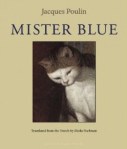
Book Review: ‘Mister Blue’ by Jacques Poulin

In Jacques Poulin’s Mister Blue, the novel’s protagonist, lives in a ramshackle house on the Île d’Orléans with his cat Mr. Blue. Jim’s world is defined by the bay, the St. Lawrence River, the beach and the novel he’s writing and not writing in the attic room where he works. As a novelist, he refuses to intrude into the lives of his characters; he watches and waits for them to fall in love on their own while he watches and waits for his chance to meet a mysterious young woman who has suddenly taken up residence in a small cave near his house.

Jim and Mr. Blue have seen her anchored sailboat, her footprints in the sand and a few possessions in the cave including a copy The Arabian Nights inscribed with her name, Marika. Yet, he refuses to overtly intrude into her life, certain that he will ultimately meet her by slightly nudged chance. When he cautiously visits the cave, the sees her bookmark’s progress through Scheherazade’s fanciful stories for the Persian king, but Marika is never home. Jim’s life suddenly shifts from that of an aging, divorced man dwelling in solitude with a cat to to an awakening writer in a shifting world of daydreams and obsession that mirror the fits and starts of a manuscript in the attic.

Before his obsession begins, he wonders if he’s picked the wrong subject for his novel. A former Hemingway scholar, Jim sees that he has broken Papa’s first rule: write what you know best.

“I had to acknowledge that I’d broken this rule. I was trying to write a love story without being in love myself. I’d probably chosen this subject because, as I felt myself growing older, I was afraid it was too late to fall in love one last time.”

Poulin’s compassionate story about a man searching for himself flows from beginning to end as smoothly and effortlessly as the river outside Jim’s attic window. The 150-page novel appears deceptively modest because the prose is just as unadorned as the protagonist’s gentle life of promising days and lonely blue days.

On days of hope, Jim’s novel moves forward and he almost finds Marika. Though he is forever just missing her, the marching bookmark in The Arabian Nights, the movements of her sailboat and other hints of her presence nourish him. On blue days, he sees no sign of her and loses himself in memories of the past and mourns the fact that his haunting, off-stage muse eludes him like words in his book.

“Words are independent, like cats, and they don’t do what you want them to do. You can love them, stroke them, say sweet things to them all you want – they still break off and go their own way.”

Poulin’s novel is a powerful masterpiece of understatement. What is real and what is dream? Neither Jim nor the reader can be sure in a story where seemingly disparate elements—an idealized woman, tennis games with a brother, the friendship of young girl who suffered an abusive past, and Mr. Blue—rise and fall like the tides in the bay without the heavy handed intervention of novelists and their characters.

This novel rubs up against a reader’s emotions with a soft, but persistent purr.

Mister Blue (Archipelago Books, January 3, 2012) originally appeared in 1989 as Le Vieux Chagrin (old sorrow) and in a subsequent English edition Mr. Blue, in 1993. Like the 1993 edition, this new edition comes to English readers through the work of the award-winning translator, Sheila Fischman. The novel has won Prix Québec-Paris, Prix Molson of the Académie des lettres du Québec, and the Prix France-Québec.

–Novelist Malcolm R. Campbell is the author of magical realism and contemporary fantasy including “Sarabande” (Vanilla Heart Publishing, August 2011).

contemporary fantasy for your Nook

My Book Reviews of 2011

Like most book reviewers who aren’t paid by a newspaper or a magazine to read 24/7, finding the time to read a book and then say something helpful about it is difficult. I could use an extra hour or two ever day just for reading. I don’t review all of the books I read. I currently have three books in the queue:

  1. Mister Blue by Jacques Poulin – I read and enjoyed this book and will post the review this year.
  2. Cinder by Marissa Meyer – Next on my reading list.
  3. The Devil’s Elixer by Raymond Khoury – Book on the way to my house.

Nonetheless, it was a good year for reviews. Here’s a look back at the books I reviewed or noted in 2011 for those you might have missed:

Next Review

Malcolm’s Round Table

Literary Aficionado

 Malcolm R. Campbell is the author of novels filled with fantasy and magic.

For a glimpse into the flavor of “Sarabande” (Vanilla Heart, August 2011) see his post: an assault where willow creek carries water away from the mountains

My Birthday Gift to You

Pennsylvanian L. E. Harvey, author of “Unbreakable Hostage,” “Loving Her,” “Imperfect,” and the recently released “Impeccable,” contributes today’s guest post. The Kindle edition of Impeccable was released on September 9 by Vanilla Heart Books. The trade paperback edition is due out in November. You may also like Lauren’s previous guest post “On Writing as Entertainment” which appeared here in April.

My Birthday Gift to You

Today is my birthday. Normally, I’ve hated my birthdays. And today throws me one foot deeper into my thirty-something’s and one frightening step closer to the big four-oh. Yet, today, I can’t help but have a stupid grin on my face.

You see today just plain rocks.  Today is bringing me quite a bit of change in my personal life in addition to the bigger number.  Professionally, though, I am celebrating not just my age, but also the release of my newest book, Impeccable.

Impeccable is the sequel to Imperfect, a book that I have discussed with the fabulous Malcolm Campbell previously. (See L. E. Harvey’s novels focus on women’s strengths.)  Now, we continue the story.  Now we see how everything from Imperfect ties together and affects every character.  Now we, and the characters, move forward.

So many people were shocked to hear there was a second book.  Ah ha!  Leave it to a writer to be tricky (we love doing that)!  Anyway, yes, there is a
second book.  Yes, Impeccable is it.  No, Imperfect is not the ending to it all.  And Impeccable is not the ending you expected.

Impeccable is the emotional, cerebral twin to the logical Imperfect.  Together, they blend and create a full story of which I am tremendously proud.  I always say that these two books are sure to touch your heart and change your mind.  I say that with good reason: as I wrote them, that is how they impacted me!

These books are not thrillers, nor are they erotic, nor are they fantasy, nor are they exciting.  They are simply touching.  They were written from my heart and I was literally transformed in the process of writing them.  I know that if I can be that affected by a book, you most certainly will be too!

So today, I am celebrating! I am celebrating my day, but moreover, I am celebrating my book.  I am celebrating a book that I loved writing.  I am celebrating a book that touched me on a spiritual level.  And I am celebrating a book that I hope – no I know – will have a tremendous impact on its readers and our society today. That is worth celebrating, don’t you think?

Would you please celebrate along with me?  Could you help me revel in my birthday?  Would you go out on a limb and purchase your copy of Impeccable today?  You might just be surprised at just how deeply this book touches you.  And it will only make my birthday grin bigger!

Thanks, and happy reading!

Publisher’s Description for Impeccable

Carol – abandoned – waiting… for what, she couldn’t know. She couldn’t see that there was more life waiting for her. Carol is forced to face the demons of her past as well as begin to face life without Alex. Struggling to make sense of it all, Carol experiences her new life and all of the highs and lows that come with that life. Will Carol finally make peace with both her past and present?

Teaser from the Novel

She couldn’t feel her body. She felt nothing, no pain, nothing, no heat, and no cold. She couldn’t feel anything. Where was she that she lacked all sensation? Carol diligently tried to focus on her surroundings and tried to make sense of all the activity going on around her, but she was unable to sustain that for long. Once again her eyes rolled back and Carol was consumed by black.

Commentary: ‘The Help’ by Kathryn Stockett

Kathryn Stockett’s bestselling novel The Help focuses on a secret project (fictional) in Jackson, Mississippi (real)  in the early 1960s put together by an idealistic white girl named Skeeter and a group of black maids led by the stable Aibileen and the sassy Minny. Other primary characters include Skeeter’s young peer group for whom the maids work, Hilly and Elizabeth and Celia.

In those days, there were lines one did not cross when it came to the acceptable and unacceptable interactions between white employers and their black (this term wasn’t in general use in those days) domestic help. Skeeter, who is somewhat naive and hopeful about the future, crosses those lines. She takes risks and so do Aibileen and Minny. They fictionalize their names and call their town Niceville. If they are caught sharing stories with each other (much less writing them down), they might be beaten or killed. And then there’s the matter of trust, the trust the maids must put in a white woman who’s not acting like the other white women do.

I liked the book.

The Book Has Already Been Thoroughly Reviewed

Yet, there are already 4,523 Amazon reader reviews of The Help, and numerous articles and reviews of both the movie and the novel in the press. It’s unlikely that I have anything new to add to the discussion at this late date. In general, the book has been well received by readers and reviewers. Its controversial nature has brought out the usual kinds of dissatisfaction about miscellaneous errors of fact, the realism or lack of realism of some of Stockett’s characters’ viewpoints and actions, whether or not Jackson as characterized in the book approximates Jackson as it was almost 50 years ago. Some of the critics have forgotten that The Help is a work of fiction and not an anthropologist’s treatise about Southern race relations and domestic help of the 1960s.

On top of the controversy is, perhaps, one issue: denial. Because the picture of black and white relationships painted in The Help isn’t pretty and because it depicts bigoted (though usually nothing like the overtly nasty Hilly Holbrook in the novel) whites hiring generally accommodating blacks in a complex mix of discrimination and trust, most people want to hide this picture under the rug. Understandably, nobody wants to focus on it, much less applaud it. My view is that pretending that it didn’t happen doesn’t really help us move forward as a homogenized people.

In addition to being a well-told story, The Help brings to light what those of us living in the South saw day to day, but seldom hear talked about. As Stockett portrays in her book, whites did not see blacks as their equals, yet they trusted them as integral members of the household to cook, clean and look after the children. My family moved to the South when I was six years old, to a town I’ll call Nicetown, that was much smaller than Jackson but that featured some people who acted like most of the characters in Stockett’s novel. Very few people acted like Skeeter, or, if they did so, they kept it quiet. The closest person to Skeeter in the book was my mother who was fairly outspoken (as was my father) against segregation.

1960s Nicetown Fact of Life

Maids in our white neighborhood were a fact of life. They came on the city bus which let them out in front of our house, and from there they fanned out to nearby streets where they worked. My best friend’s family had a maid who was, while the parents were gone, the surrogate parent figure in the house. She was more stern than the parents, but also much loved as long as no lines were crossed. She did not eat with the family, ride in the front seat of their car, go to their church, or talk with them friend-to-friend.

Like Skeeter’s Niceville, my Nicetown provided separate schools for blacks and whites, separate swimming pools and restaurants and neighborhoods, restrooms labeled men, white and colored, and drinking fountains labeled white and colored. There were separate churches, too, until our minister said our church was open to everyone; those who didn’t like it left and started another church. Like them or not, the lines were hard to cross because “separate but equal” made certain that interaction was minimized. Stockett gets this right in her book.

My grandparents had a maid who kept their house spotless even though she was older than they were. She treated us, my brothers and I, as the surrogate grandparent when she was left in charge of the house. Like my best friend’s maid, she was friendly and talkative until one started to cross a line and act like we were black or she was white. It wasn’t done, and if you tried to do it, the maids grew quiet and their employers talked about how we’d get in trouble—the same kind of trouble Skeeter risks in the novel—if we didn’t act with proper decorum.

The picture Stockett paints in her novel is a picture I saw, though naturally (as a boy growing up) I wasn’t privy to either the adult conversations of the maids or to the discussions of the Skeeter Phelans or those few in my neighborhood what most resembled The Help’s pretentious Hilly Holbrook, more moderate Elizabeth Leefolt, or the redneck Celia Foote. While I can say that I saw Minny, Aibileen, Elizabeth, and Hilly in my neighborhood, I don’t see these characters in The Help either as stereotypes or as representatives of everyone else in 1960s Jackson.

Dialect, Southern Accents and Anger

Some have criticized Stockett for her use of black dialect. Her fictional maids speak the same way the real maids in my neighborhood in Nicetown spoke. Stockett’s use of this dialect in the book is not only accurate but works as an excellent means of showing the otherness with which whites saw their black help as well as how the black help felt about themselves. Language is a part of one’s culture, not the stereotyping put down of a white author writing about black characters.

I do think Stockett should have included the Southern accents of her white characters as well. She said, I believe, in an interview that she never thought of her own family when she was growing up in Jackson as having an accent. When I moved into the South, most of those I met thought I was the one with the accent. Perhaps Stockett saw it this way, and grew up believing that the Southern accent, while meanly ridiculed by people from other parts of the country was, in fact, Standard Speech. The book would, I think, have been a truer painting if Skeeter, Hilly, Elizabeth and Celia also spoke in their own dialect.

I also would have liked seeing a little more anger expressed by the maids when they talked amongst themselves, though maybe not even in Skeeter’s presence. In reality, of course, anything approaching anger would have been a difficult passion to hold onto in those days because feeling anger led people to say and do potentially dangerous things. The emotions tended to have calluses over them, for self preservation and perhaps sanity. Even so, readers will leave The Help knowing how the help feels about whites in general and their employers in particular.

These are my impressions, then, of The Help, rambling as they may be. Stockett has done a difficult piece of writing, trying to accurately portray another time and place to an audience who will for the most part judge everything in the book by today’s norms. Stockett is a bit like Skeeter, hopeful and undaunted by the likely criticism. There’s a lot to admire in The Help, and part of what I like about it is that it makes the painting of how we were out from under the rug so that we can no longer deny it.

Malcolm

Malcolm R. Campbell is the author of four novels, including the recently released contemporary fantasy Sarbande. He grew up in Florida and currently lives in northeast Georgia.

Review: ‘Hotel on the Corner of Bitter and Sweet’

Minidoka Relocation Center, Idaho

“A Pearl Harbor attack intensified hostility towards Japanese Americans. As wartime hysteria mounted, President Roosevelt signed Executive Order 9066 making over 120,000 West Coast persons of Japanese ancestry (Nikkei) leave their homes, jobs, and lives behind and move to one of ten Relocation Centers. This single largest forced relocation in U.S. history is Minidoka’s story.” — National Park Service, Minidoka National Historic Site

“Now, therefore, by virtue of the authority vested in me as President of the   United States, and Commander in Chief of the Army and Navy, I hereby authorize   and direct the Secretary of War, and the Military Commanders whom he may from   time to time designate, whenever he or any designated Commander deems such action necessary or desirable, to prescribe military areas in such places and of such   extent as he or the appropriate Military Commander may determine, from which any or all persons may be excluded, and with respect to which, the right of   any person to enter, remain in, or leave shall be subject to whatever restrictions the Secretary of War or appropriate Military Commander may impose in his  discretion. ” — Franklin D. Roosevelt, in Excutive Order 9066, February 19, 1942, resulting in the relocation into camps of 122,ooo Japanese, many of whom were born in the U.S. and were American citizens.

“The internment of individuals of Japanese ancestry was carried out without any documented acts of espionage or sabotage, or other acts of disloyalty by any citizens or permanent resident aliens of Japanese ancestry on the west coast;  there was no military or security reason for the internment; the internment of the individuals of Japanese ancestry was caused by racial prejudice, war hysteria, and a failure of political leadership.” — Commission on Wartime Relocation and Internment of Civilians, April 15, 1988.

Hotel on the Corner of Bitter and Sweet by Jamie Ford

Had I written this powerful novel, my black sense of humor would have tempted me to weaken the story of Chinese American Henry Lee and Japanese American Keiko Okabe by including Franklin D. Roosevelt’s name in the book’s acknowledgements. Without his failure of leadership, there would be no bittersweet story to tell.

Ford knew better than that. Lee and Okabe are fictional characters living out their story between 1942 and 1986 against a backdrop of historical fact. Seattle existed in 1942 with Japanese and Chinese enclaves. Many of the residents in both sections of town were property owners, merchants, wives, school children and American Citizens. The Japanese residents of Seattle were removed and taken to Idaho where they were placed within the Minidoka Relocation Center until the end of World War II. Ford lets these facts speak for themselves.

In the author’s note he writes, “My intent was not to create a morality play, with my voice being the loudest on the stage, but rather to defer to the reader’s sense of justice, of right and wrong, and let the facts speak plainly.”

Hotel on the Corner of Bitter and Sweet is a universal love story. School children from diverse backgrounds meet and become friends. Their friendship isn’t supported by the prevailing social customs, the political realities of the day, or their families. In 1942, Henry Lee was sent to a white school in Seattle because his father thought it was in his son’s best interests. Born in China, Lee’s father dispises the Japanese because they have invaded his homeland. China is an ally of the United States. Since he doesn’t want young Henry to be mistaken for the enemy, he makes him wear a button that proclaims “I am Chinese.”

The other students at the white school see “Chinks” and “Japs” as subhuman and other and too alien to tolerate or befriend. While Henry grew up speaking Cantonese, his father has forbidden him from using it. Becoming a full American means speaking Enlish. When Henry meets Keiko at the school, he is surprised to discover that she’s never spoken any language other than English. Born in the U. S., she’s a full-fledged American even though the students who taunt Henry see her only as his “Jap girlfriend.”

We know before the novel begins that Keiko will be taken away. What we don’t know—actually, what we can’t know unless we have experienced it—is how Henry and Keiko will cope with the daily threats from whites, the ever-present fear of soldiers and FBI agents, the forced removal of people from the “Japantown” enclave in Seattle, or the forced separation that looms large and infinite in a person’s life. In part, the power of this story comes not only from the fact Ford lets the historical facts speak for themselves, but the thoughts and actions of his fictional characters as well. His understatement is finely tuned and carries the story well across its alternating time periods.

In 1942, Henry lives through the days of fear and friendships lost. In 1986, when the old Panama Hotel—a real Seattle Landmark—makes the news because its basement holds the stored-away belongings of many of the “evacuated Japense families,” Henry relives the old days, and wonders if he can come to terms with them and all that he lost and how he lost it. Even “now,” in the 1986 “present day” of the story, he is still wondering and still searching—for exactly what, he’s not sure—but he will know it when he finds  it.

Ford has written a terrifying and poignant love story that’s as haunting as the ever-present jazz music Henry and Keiko love and as filled with hope as two young people in any time period of culture or circumstance who promise they will wait for each other forever.

Malcolm

Coming September 6: Knock It Off, a guest post by Author Smoky Trudeau Zeidel

Fantasy with a sharp edge

Review: ‘Six Weeks to Yehidah’

Six Weeks to YehidahSix Weeks to Yehidah by Melissa Studdard

My rating: 5 of 5 stars

Melissa Studdard’s joyfully written “Six Weeks to Yehidah” takes us into ten-year-old Annalise’s magical dreamscape where thoughts become things and light manifests in sparkling colors that live and breathe and speak.

An inquisitive child by nature, Annalise prefers the woods and fields to staying indoors. So when she finds herself on a grand adventure with sheep that learn how to talk, she is more than ready to explore each new wonder than to worry overly much about the strange and happy world that rises up around her as she skips from cloud to cloud.

While the book is categorized as “young adult,” it might be more suitably labeled as “children’s literature” based on its dialogue and plot. Even so, the book is filled with deeply spiritual symbolism and tongue-in-cheek hero’s journey references that adults will enjoy while reading this well-crafted story to their children.

Like the classics that have come before it, “Six Weeks to Yehidah” will delight readers of all ages, each finding something new in it every time they rediscover Annalise’s story.

Malcolm

Fantasy with a sharp edge

I’ll be your fantasy server this evening

Welcome to the world of fantasy. My name is Malcolm, and I’ll be your server this evening.

Today’s special is Sarabande, a bone-chilling new adventure about a young woman named Sarabande who risks a dangerous journey into her own past. With the help of the Sun Singer, she plans to raise Dryad from the dead so that her cruel sister’s ghost can no longer cause pain and suffering throughout a peaceful mountain valley.

Fantasy is a Dangerous Place

You’ll be reasonably safe in the world of fantasy while I am here to guide you. Otherwise, may I suggest that you read Sarabande during the daylight hours in the company of others. Do not read the novel at night unless the doors are locked.

Like abandoned mines, fantasy leads deep into the heart of strange landscapes, forbidden worlds and dreams, places where everyday reality fears to tread. Be careful and do not wander off alone, for the mysterious world of fantasy can be dangerous. That’s why I’m posting a warning sign here just like the one I saw recently in Virginia City, Nevada where gold and silver were once extracted from the earth.

Mining Fantasy Novels for Gold and Silver

While growing in a house full of books, I discovered high-quality ore in such fantasies as The Once and Future King and Lord of the Rings. Recently, others have discovered gold and silver in the Harry Potter books. The gold of dreams and the silver of mystery are not only exciting—they jump start the imagination.

I hope you’ll enjoy Sarabande. It’s available today in multiple e-book formats at Smashwords. Other editions will follow soon, including paperback. Dig deep, enjoy the ride, but please, read safely in well-lighted places.

Malcolm