Publisher’s Description: During the nineteenth century, upstream diversions from the Gila River decreased the arable land on the Gila River Indian Reservation to only a few thousand acres. As a result the Pima Indians, primarily an agricultural people, fell into poverty. Many Pima farmers and leaders lamented this suffering and in 1914 the United States Indian Irrigation Service assigned a 33-year-old engineer named Clay “Charles” Southworth to oversee the Gila River adjudication. As part of that process, Southworth interviewed 34 Pima elders, thus putting a face on the depth of hardships facing many Indians in the late nineteenth century.
Reviewer’s Comment: “DeJong’s presentation of the oral interview transcripts is excellent. These interviews are a rich source of cultural and historical information about the Pimas.”—David Rich Lewis, Utah State University
–
“Montana Moments: History on the Go” by Ellen Baumlier – 200 pages, September 14, 2010, by the Montana Historical Society’s interpretative historian.
Publisher’s Description: Forget dreary dates and boring facts. Montana Moments distills the most funny, bizarre, and interesting stories from Montana’s history into pure entertainment. Meet the colorful cast of the famous and not-so-famous desperadoes, vigilantes, madams, and darned good men and women (and a few critters) who made the state’s history. You’ll get a laugh from the story of the transient vaudevillian who wrote Montana’s state song. Captain James C. Kerr’s tale of the Flathead Lake monster might make you shiver. No matter your reaction, the episodes recounted here always entertain. Best of all, each vignette takes about ninety seconds to read. So have fun exploring Montana – and enjoy a little history as you go.
Reviewer’s Comment: “The pages of Montana Moments overflow with enjoyable historical vignettes that cover nearly everything important that has happened in Montana’s history. Newcomers will find an excellent introduction to what makes Montana tick, while Baumler’s careful research and entertaining writing style will delight old timers.” — Harry Fritz, University of Montana
Can you hear the bandwagon, the buzz and the hype? All that sound and fury is the mad rush of newspapers, magazines and blogs to trot out their lists of the hottest, sexiest, and scariest summer reads for beach, boudoir and ballpark. Yes, there’s a lot to like. I have already found some “must reads” on the lists, including The Final Storm by Jeff Shaara and The Chieu Hoi Saloon by Michael Harris.
Yet, from my perspective, the LA Timesdoesn’t “get it.” Neither do most of the other summer reading lists bring disseminated by the older, well-established newspapers and magazines. What we have here is “old media” promoting “old media.” By that, I mean the traditional big boys in the fading world of print are promoting large, old media publishers as though the congomerates are the only game in town.
It’s been an elite club for years. Look at the names of the publishers on the LA Times’ list. You’ll be hard-pressed to find an independent and/or small press publisher in the group. You’ll find Scribner, W. W. Norton, Penguin, Random House, Knopf and William Morrow.
I’ll stipulate that even in a world where many old-line publishers are in trouble, where book stores are failing, and where e-books are overtaking print books in sales, most of the buzz and the books sold are still coming from the old-media conglomerate publishers. But that’s just the tip of the iceberg when it comes to reading opportunities.
Depending on those estimate you like, there are about 300 medium sized pubishers in the U.S. Most of them, much less the small publishers, never appear on the summer reads or the Christmas reads lists. (I was happily surprised to see a McSweeney’s book on the LA Times list.) But otherwise, what a shame, ignoring most of the publishers in the country.
New Pages features a fine list of Independent Publishers and University Presses here. The majority of the reading public either doesn’t know those publishers exist or inaccurately presumes the books coming from them are filled with footnotes and niche-market symbolism and weird experimental stuff. But take a look. See what you’ve been missing.
Jock Talks…The Collection combines four e-books in one for only $3.99.
Jock Stewart, who refutes charges that he was raised either by alligators or hyenas, believes that modern-day journalism would be going to hell in a hand basket if hand baskets were still readily available. He has chosen to make his stand for old-fashioned reporting at the Junction City Star-Gazer, a newspaper that—while run by fools and buffoons—knows the difference between real news and “stuff that sounds like real news.”
Mark Twain once wrote that “thunder is good, thunder is impressive; but it is lightning that does the work.”
Smoky Trudeau Zeidel’s “In a Flash” describes the kind of work lightning does when the “lightning rod” it selects is the umbrella in a young woman’s hand.
The woman died. That was to be expected. But not for long.
Lightning struck Smoky Trudeau Zeidel twenty two years ago on an overcast day in a Chicago suburb. Life since then has not been easy: the number of trips to the hospital, the number of surgeries and the number of days and nights in pain are sufficient evidence of that.
This is a well-told story about courage, strength and the work lightning does. Surprisingly, it’s also a story about counting one’s blessings. One can only read it and weep, and then experience a lingering euphoria for the challenges a person can endure.
A Little Protection by Victoria Howard – Handsome Matt Hemmings meets scientist Alexa McAllistair at a conference on nuclear energy in Rome…and against his professional judgment, he is smitten. The vulnerable – and beautiful – scientist arouses his protective instincts, and the desire to kiss her senseless. And it’s more than evident that she feels the same way about him.
Paco’s Visions by Robert Hays – Paco has visions, and his most recent vision helps him believe in the power of love. For a twelve year old boy, it is a big revelation. He and his sister, Rosa, live with Mama Jan, in a rich man’s mansion on Sanibel Island. Will his vision become their reality?
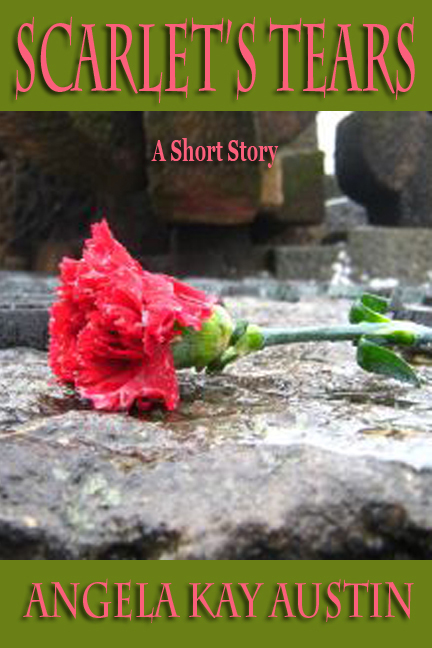
Scarlet’s Tears by Angela Kay Austin – When you lose everything you love, how are you supposed to believe it won’t happen again? The knife at her throat didn’t frighten Scarlet Anderson. In fact, it was a relief. Finally, she didn’t have to worry any longer about living another empty day. She’d be reunited with the ones she loved. Joshua Davis had faced a lot of challenges in his life, his faith and the love of his family had seen him through his latest battles. But, no person could help him, now. How had he managed to fall in love with someone who’d stopped loving herself? And what was he supposed to do?
“Ancient Greek heroes were men of pain who were both needed by their people and dangerous to them.” – Jonathan Shay in “Odysseus in America.”
“A slave stood behind the conqueror holding a golden crown and whispering in his ear a warning: that all glory is fleeting.” –Gen. George C. Patton
We reward our heroes with medals and praise whether they march away to war or run into burning buildings to bring people out to safety.
In either case, praise, like glory, is fleeting, and the transcendent renewal expected through trial by fire (or under fire) in the mythic sense of the hero’s journey may be a dream unrealized. The hero’s character, as Jonathan Shay, author of Achilles in Vietnam and Odysseus in America believes, may be wrecked by the trauma of the experience.
A psychiatrist working with Vietnam War veterans suffering from post traumatic stress disorder (PTSD), Shay focuses his books on what soldiers need to know before they go to war and on what all of us need to know when they return in psychologically damaged condition.
New York Times reviewer Chris Hedges, in his review of a translation of Homer’s Odyssey, wrote “It is his hero’s heart that he must learn to curb before he can return to the domestic life he left 20 years earlier. The very qualities that served him in battle defeat him in peace. These dual codes have existed since human societies were formed; and every recruit headed into war would be well advised to read the ‘Iliad,’ just as every soldier returning home would be served by reading the ‘Odyssey.'” The same can be said of Shay’s “Achilles in Vietnam” and “Odysseus in America.”
Those who march away are praised for marching away and for going beyond the call of duty to perform those duties thrust upon them. When they return, we ask what it was like, but our eyes glaze over when they try to tell us. Is the problem to large to fix? Shay doesn’t think so.
Betrayal of What’s Right
As Shay points out, soldiers often face what happened to Achilles in the “Iliad” when they go into combat. They face a betrayal, via commanders or the system, of what they believe is right and proper. Likewise, when they leave the battlefield, they often face what Odysseus faced in the “Odyssey.” They face the lack an adequate way of dealing with what they experienced while re-integrating into the mainstream world.
Whether it’s the trauma of war or the trauma of other horrific, and often traumatic, events where heroes serve of humanity’s behalf, Shay’s books are wonderful resources for the journey. Shay brings an optimism to his work that might help those who were there and those who were not there come to terms with each other and what happened before the medals were awarded and the fleeting praise was bestowed.
The books are also excellent reference materials for writers, psychiatrists and philosophers who study the classic hero’s journey.
Everyone aboard every Navy ship that cruised between California and Vietnam in the late 1960s knew about liberty in Olongapo, Republic of the Philippines. The city stood just outside the main gate of the U. S. Naval base at Subic Bay, a regular port of call for Western Pacific (WESTPAC) ships.
Old salts called the town “hell” and promised Seaman Recruits coming on board the carrier USS Ranger out of bootcamp that anyone leaving the main gate of the base on liberty would be corrupted immediately by booze, drugs, girls, gambling and crime. They called the drainage ditch separating the base’s main gate from the town “the shit river,” though I saw it as the River Styx.
I crossed the shit river multiple times and found the world there to be everything the old salts described. As a former Eagle Scout, it crossed my mind on more than one occasion, “if only my Scout master could see me now.” Our Scout troop was sponsored by a church, so the Scout master was the least of my worries when I thought of how the deacons, elders and Sunday school teachers should they ever see a photo taken on Magsaysay Drive.
As a writer in training, I saw Magsaysay Drive and the Galaxy Bar and the touts and the constant ruckus in the streets as “research.” But I doubt my Scout master would have understood, or anybody else I knew, for that matter. Luckily, webcams and cell phones hadn’t been invented yet. There was no Facebook either in 1968. This meant that no pictures of me crossing the shit river appeared anywhere–and since a lot of time has gone by since then, I doubt they ever will.
Everyone who might know the Eagle Scout and paperboy who went to hell and then put his research into a novel called Garden of Heaven is long gone by now. So, I think I can safely post this excerpt without word getting back to the old neighborhood.
Excerpt from Garden of Heaven:
Standing on the bridge over the Shit River listening to the half-naked children in flimsy boats below shouting for a handful of centavos, the city in his face was—with more pride than apology—very much a city with its tattered underwear showing. If Magellan only knew what was here now. If Dad only knew David was here now.
Night was settling down over the hazy first lights of the bars and hourly rate hotels along Magsaysay Drive and the razor-sharp edges of Kalaklan Ridge like an old whore.
David dropped several 25-centavo coins over the railing, heard an explosion of whitewater, heard the laughter and the shouting, ‘Salamat, Joe, Salamat.’
He crossed Perimeter Road, ignored the hopeful greetings of the money changers behind their well-caged windows, then dodged a badly mixed throng of sailors, girls and honking multi-coloured jeepneys that swelled out into the Gordon Avenue intersection. He cut across the street, smiling, waiving at imagined friends in the distance, and moved with the deliberate intent of a man who had crossed this street hundreds of times.
‘Casual alertness, that’s the key to surviving Olongapo’s jungle of thieves, gangs, girls, high-strung Marines, bored Shore Patrol and Hard Hats, and drunk boatswain’s mates and snipes,’ Lowell had said.
Touts were everywhere below the slapdash smorgasbord of disheveled signs and awnings, leaning telephone polls, and the rag-tag assortment of buildings with upper floors stacked up in odd strata.
Assorted conversations flew past, barely audible in the close heat… ‘Hintayin mo aki,’ …‘Magandang amaga, Carlo, kumusta ang bagong sanggol?’… ‘Hey Joe’… ‘Tao po! Tao po!’… ‘Hoy, tulungan mo akong magdiskarga sa trak na ito, pwede ba?’… ‘Good food here, Joe!’… ‘Galing akong Maynila. Nasaan ang Zambales Bank?’… ‘Balut, Balut!’… ‘Tayo na’t kumuha ng makakain’ ‘Magandang ideya, handa na ako sa napunan’… ‘Nagustuhan mo ba ang bago kong kamera?’
The sign for the Galaxy Bar was plainer than most. An unadorned interior stairway led to the second-floor club, a large room strewn with tables occupied by sailors, many with girls whose eyes caught the low light like predators or gods. David didn’t see anyone he knew. He had a small envelope in his back pocket for Maria.
Two girls who had bathed in perfume and spackled their faces with makeup were leaning against the bar watching a waitress organise a tray full of San Miguel beer bottles.
“Maria, tingnan mo itong malambing na lalaki.”
“Lamayo ka sa kanya, Adelaide.”
Assuming he’d actually heard her name in those quick Tagalog comments, Maria was the one wearing a red dress, thrusting herself forward to him as he approached, posing her sweet curves, allowing her long hair to seductively frame her face, smiling as though they were friends with a history. He could almost see himself in the high gloss of her lipstick.
The USS Ranger has been decommissioned. The USS Ranger Foundation is working diligently to convert the aircraft carrier into a museum on the Columbia Driver near Portland, Oregon. The effort requires multiple phases, the next being a comprehensive environmental site analysis of the propose mooring location.
The Foundation is seeking donations to help pay for its on-going work. If you would like to contribute to the $15 million dollar fund raising project to bring a historic ship to Oregon as a museum, please click on the link above. Once you’re there, you’ll find some handy PayPal buttons.
Regular readers of this blog know that my favorite place on the planet is Glacier National Park. I not only like visiting the “Crown of the Continent” in Montana, I like sharing the history, geology, flora and fauna with others. As Christmas approaches, I think of the books that will make great gifts.
Hughes, who served as Glacier National Park’s artist in residence during July and August of 2005, uses Adobe Photoshop to create prints that look like they were produced by silkscreen or wood blocks. These, he calls digital block prints.
The results are stunning. For anyone passionate about Glacier National Park, the views in this 144-page book will bring back wonderful memories.
–
The SPAM I Grew Up WithDuring the three years I’ve had this blog, I’ve made 415 posts, received 1,527 real comments and watched the Akismet filter trash 22,014 attempted SPAM comments. Without a doubt, none of the trashed comments were about the Hormel product I grew up with.
I’ll stipulate that I feel a slight–but fleeting–sense of embarrassment having to report that spammers have been busier trying to add their thoughts to the flow of words on Malcolm’s Round Table than I have.
And they’re bolder. I post something about Glacier, a spammer says, “Hi Dude, this reminds me of a place to get cheap Viagra.” I post something about one of my books, and here comes a long spam message about an automotive training school in London.
Most of these comments don’t see the light of day, thanks to Akismet.
I know this might sound like bribery, but I have a proposal, one that may sound a bit vain and immodest. When I see virtual SPAM, I ask “what’s in it for me?” That is, why should I provide free Internet space to somebody I don’t know who sells Viagra for a living?
But there could be something in it for me. For each spammer who buys a copy of one of my books (you have three to choose from), I will make a deal with Akismet to let you tell the world about your Viagra, downstream Internet marketing system, or your teliseminar about weight loss in the comments section here.
Simply buy a book, read it, enjoy it (or else) and post a glowing review on Amazon that proves you really know what the book’s about, and then send me your SPAM. You help me, I help you.
Send me a comment with your real name, picture, home address, Amazon account number and tell me what you think.
Otherwise, I much prefer the SPAM I grew up with.
—Malcolm Experience the magic of Robert Adams' Quest
If you’ve been lucky, you’ve been able to catch one of Guthrie’s book signings in Montana during the past six months.
I have two old favorites by the late Warren L. Hanna I would like to mention for your consideration for your reference shelf. The first is is “Montana’s Many Splendored Glacier Land” that provides an overview of the park from the early explorers up into modern times.
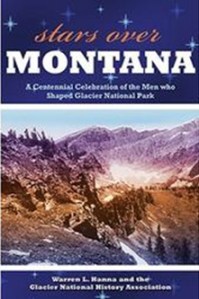
The other, which for reasons I don’t understand, is no longer sold by the Glacier Association. It’s “Stars Over Montana: A Centennial Celebration of the Men Who Shaped the Park.” Originally published in 1988, the book provides mini-biographies of the major players during the days when the shining mountains were discovered, including Hugh Monroe, Father DeSmet, William Jackson, James Willard Schultz, and Walter McClintock.
It’s still available here and there on the Internet in a reprint by TWODOT.
This book has served as an excellent reference for some of my earlier posts about the park and its early advocates. Hanna also wrote “The Grizzlies of Glacier.”
Lesa Campbell photo
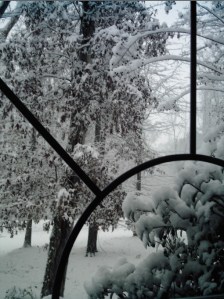
What a perfect afternoon for finishing the edits for the new edition of “The Sun Singer” coming soon from Vanilla Heart Publishing. The afternoon snow ensured that (a) few people would be showing up at the front door and (b) everyone would be trying to get home before a big traffic jam started rather than dialing my phone number.
After we took a few pictures and warmed up some leftover stew for dinner, I e-mailed the file to the publisher.
I haven’t heard about any traffic jams in Jackson County, but WSB radio out of Atlanta was monitoring bumper-to-bumper traffic around the Metro area as an above-average number of people left work early on a Friday afternoon. The Atlanta Journal-Constitution was reporting (as of 7:30 p.m.) “Over 160 accidents reported as metro area receives 2-3 inches of snow.”
Area roads are expected to get worse as temperatures drop beneath 32 degrees in light snow.
When one is on the road, snow can be an annoyance, though I certainly got used to it during the seven years I lived on the Illinois/Wisconsin border and commuted into Chicago. But around here, the snow is some how different: we’re not used to it, we don’t have the equipment to contend with it, and we definitely aren’t driving with chains or studded snow tires.
But when one is inside, the snow tends to quiet down the world and make ones home feel even more like a sanctuary. The quiet alone makes it a good time to work on a book.
Junction City, May 29, 2009–When Moe Anderson walked into the Main Street Book Emporium at high noon yesterday with a SIG SAUER P238 pistol in his pocket and robbery in his heart, he expected to leave with all the money in the cash drawer.
Jim Exlibris, owner of Main Street Book Emporium, believes dead hearing-aid batteries and author Susanna Clarke saved him a lot of money.
“I was waiting on a customer at the main register during the lunch hour when a man came in shouting, ‘wash up, wash up,'” said Exlibris. “The guy pointed to a bulge in the front of his trousers and held up his hands, so I assumed he needed our restroom at the back of the store.”
According to Maud Lukins, who was purchasing a hard cover copy of of Susanna Clarke’s Jonathan Starnge and Mr. Norrell for her grandson Arnie’s 15th birthday, the book store owner was obviously “deaf as a post” even though he was wearing two, $3,500 hearing aids from a name brand company.
“That rude, scrawny little guy who burst in and interrupted my purchase wasn’t happy to see me at all,” said Lukins. “He really did have a gun in his pocket and was saying ‘hands up.’ Even though I felt utterly discounted, I had the presence of mind to scream and that got Jim’s attention.”
Exlibris told police, who responded from the doughnut shop after the emergency was over, that Anderson became frustrated by the lack of personal attention and attempted to pull the gun out of his pocket, but it got stuck and went off.
“The thing made a horrible noise and I thought we were about to be dead,” said Lukins. “That’s when Jim picked up Arnie’s beautiful birthday book and threw it against Anderson’s head. Anderson was knocked out cold.”
Chief Kruller said Anderson didn’t hurt anyone because he was “shooting blanks.” Known to police across Texas as the bookstore bandit, Anderson’s “success” is purportedly based on intimidation rather than violence.
“If my hearing aid batteries had been working, I would have understood the guy, handed him a wad of money and then over charged old lady Lukins and the rest of my loyal customers to offset the negative cash flow,” Exlibris said. “Praise the Lord for Ms. Clarke’s 326,729 words and her 2.9-pound novel.”
Police ballistic experts claim that had Exlibris tried to subdue Anderson with a light-weight Silhouette romance, the bandit would still be at large.
 “Forced to Abandon Our Fields: The 1914 Clay Southworth Gila River Pima Interviews” by David H. DeJong – 192 pages with eight photographs and three maps, March 31. 2011.
 “Montana Moments: History on the Go” by Ellen Baumlier – 200 pages, September 14, 2010, by the Montana Historical Society’s interpretative historian.









 Artist Roy E. Hughes’



 Malcolm's Round Table