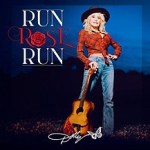
 When the novel was released on March 7, it began its life at number one on the New York Times bestseller list. It’s currently at number five on Amazon with 11,207 ratings with a 4.5 average. The companion album by the same name, Parton’s forty-eighth solo studio album, a mix of bluegrass and country, is described as high energy with a lot to like. Meanwhile, “Variety ” reports that a movie deal is already in the works with Reese Witherspoon’s company. The whole project appears to be doing well.
Amazon Description:
 From America’s most beloved superstar and its greatest storyteller—a thriller about a young singer-songwriter on the rise and on the run, and determined to do whatever it takes to survive.
Every song tells a story.
She’s a star on the rise, singing about the hard life behind her.
She’s also on the run. Find a future, lose a past.
Nashville is where she’s come to claim her destiny. It’s also where the darkness she’s fled might find her. And destroy her.
Run, Rose, Run is a novel glittering with danger and desire—a story that only America’s #1 beloved entertainer and its #1 bestselling author could have created.
–
Not a lot of detail there, but then I guess when you have Patterson and Parton working together, you really don’t need a lot of detail. Just mention the surprising co-authorship of the book, and sales will follow.
The last line of the book’s Kirkus review is an apt summary of what’s going on here: “The fairy-tale characters and details of the country-music scene are so much fun you won’t mind the silly plot.”
The Publishers Weekly review ends about the same way, “Never mind that the mystery element runs a distant second to the story of AnnieLee making good in Nashville. Parton fans will relish this timeless fairy tale, which displays the singer’s lively way with words and draws liberally from her experience in the music business.”
All About Romance begins its review this way: “Run, Rose, Run is just as charming as everything else connected to musician/actress/philanthropist Dolly Parton. Though it’s mostly a character study about three different personalities making their way through the Nashville scene than a thriller, the suspense element adds a nice bit of variety to the proceedings. It’s a fun, quick read in spite of its length – a page-turner with brief chapters.”
According to Book Marks, “Parton’s co-authorship of Run, Rose, Run may not suggest literary finesse, but she is able to supply an authenticity in the details of the American music business to match (in her own way) the political insights previously provided by Clinton.” (Bill Clinton and Patterson, another unlikely combination of authors, previously teamed up on The President is Missing and The President’s Daughter.)
I have not read Run, Rose, Run because I’m waiting for the price to come down, but I have read The President is Missing and can see the synchronicity of the thriller details from Patterson and the Presidential details from Clinton. I expected the same combination of skills/backgrounds in the Parton and Patterson collaboration.
I think the book will be easy on the eyes and a run-read if you like country music. That’s my guess because we all love Dolly.
—Malcolm
P. S. I sent Jim an idea about a guy with a paper route who’s being targeted by mob enforcers from a competing newspaper but haven’t heard back yet.
 Seven Thomas-Jacob Publishing, LLC authors bring you 15 of their short stories, excerpts, and poems. Sometimes offbeat, always captivating, the selections include historical fiction, magical realism, crime, psychological suspense, literary fiction, coming of age, and poetry for both children and adults. The works are grouped by author name, not genre, ensuring a surprise each time you turn the page.
 Where’s the header picture? I removed it because this blog posts to my author’s page on Facebook and the software that made that happen kept selecting the header picture to display with the post rather than the picture I had inserted into the post. That ended up looking like nonsense. Sometimes I could fix it, and sometimes not, but the hassle was getting to be just too much.
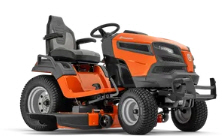 Darn it, Husqvarna. Thanks (sarcasm) for mounting the sparkplug in such a way that I have to add a socket to my socket and ratchet set just to change the sparkplug. I have accumulated several of these sets and, while each of them is capable of disarming a submarine’s torpedo (after it’s fired), none of them has a sparkplug socket–which costs about the same as the new sparkplug.
 Selling a chapbook for a good cause? If so, why make it hard to buy? First, there’s no apparent website displaying the chapbook. Second, you have to send an e-mail to the professor in charge of the project to find out the cost and how to order it. And then, you have to use a Paypal competitor (that’s owned by PayPal) to make your purchase. Maybe you love Venmo. It seems to be intended for those with mobile devices. Whether or not I can install it on my desktop PC is described in convoluted instructions around the web. The thing is, I don’t need it or want it. So, finally, after a lot of back and forth, I got the chapbook people to accept a check sent via snail mail. Making the chapbook hard to buy won’t help the cause. I hope the publisher didn’t mandate that poems to the chapbook had to be submitted in a WordStar file or rolled up inside a sparkplug socket.
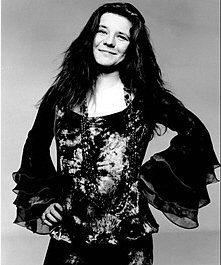 Thanks for the Janis Joplin pix. I don’t know who’s doing it or why, but Facebook has been displaying archival Janis pictures. She was a favorite of mine gone too darned soon. I hope some of the smiles on her face in these photographs came from joy rather than too much Southern Comfort. I still have her vinyl records but due to bad karma, I’m too hard of hearing to listen to them. I liked the way she thought: “Life is too damn short and [screwed] up to go through it silently loving someone and never telling them how you feel. [Screw] the consequences, [screw] the implications of the actions, to hell with it all… whatever happens as a result is better than the nothingness that is inevitable with silence.”

 Feel free to drink while reading the book. I suggest Scotch or red wine. Getting drunk will probably cause you to say I wrote The Great Gatsby on the next pop quiz. (If the book in front of you ends with the line “So we beat on, boats against the current, borne back ceaselessly into the past,” you are reading The Great Gatsby and that means the book store or the mob enforcer is messing with you.)
 There’s also a disconnect between FDOT and the damage it does. My primary concern is the endangered Florida Panther. Estimates vary, but there are less than 200 left.
 My two brothers and I had contiguous paper routes in Tallahassee, Florida, while we were in junior high and high school that we ran on our bikes every morning for years. We knew everyone in most of the houses from the high school to the north edge of town in the neighborhood where we lived.
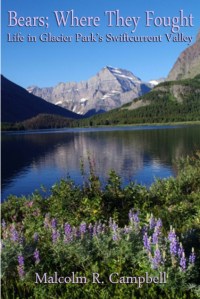 Malcolm R. Campbell writes fiction set in the park. Unfortunately, his only nonfiction contribution is out of print.
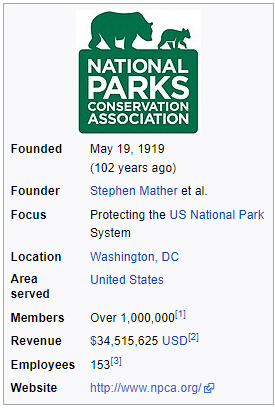 The National Parks Conservation Association (NPCA) is the only independent, nonpartisan membership organization devoted exclusively to advocacy on behalf of the National Parks System. Its mission is “to protect and enhance America’s National Park System for present and future generations.” Founded in 1919 as the National Parks Association, the organization was designed to be a citizen’s watchdog for the National Park Service (NPS) created in 1916. Among the founders of NPA was Stephen Mather, the first director of the National Park Service —
 Malcolm's Round Table