The Website: Calling it a Day

I have closed down my website which used to be found at http://www.malcolmcambellbooks.com/. At my age, I can legitimately say I’m semi-retired though I do turn out a novel now and then when the writing addiction takes over my life. You can find these books by searching on Malcolm R. Campbell on the Barnes & Noble website where you do have the option to purchase my e-books in a Nook format. You can also find my books listed on my Amazon author page at https://www.amazon.com/stores/author/B002BLZ3EO or by searching on Malcolm R. Campbell. Here, of course, my e-books appear as Kindle books. 

You can also find my books on my publisher’s website in the catalog section

I urge you to consider purchasing books through a private bookstore with a website that offers online sales; or by taking advantage of the listings at bookshop.org where you can find my books by searching on my name or on the book’s title.

Meanwhile, I’ll continue to announce new books on this blog, write occasional reviews, and otherwise fill the pages here with the usual sarcastic nonsense you’ve become accustomed to reading.

I’ve had a website at various times in my career, most often hosted by homestead.com which has easy-to-use editing software and also handles your domain name. If you are an emerging author with a lot of sales and name recognition, a website will probably help you. Otherwise, it probably won’t because readers search for authors they’ve heard of. If they don’t know your name, they won’t find your site.

Nonetheless, having a site is fun, and I do appreciate everyone who has visited this most-recent iteration of my website.

–Malcolm

The worst thing a writer can do is write

Most writers I know have been trying to quit for years. But, they got themselves fooled into thinking they can tinker with a little writing here and there and then quit any time they want. Not going to happen.

Writing just leads to more writing. Case in point. I was safely going day to day happy to tell myself that my book was stalled and that I was going to spend me resulting idle years keeping bees. I decided to take a few minutes to prove to myself I was really stuck, so I wrote a few paragraphs without really caring how I did it, and suddenly the dam broke and the whole story came flooding through my house like a flash flood in a dry wash.

So now I have to keep writing because I can’t claim I’m stuck. Should have left the darned thing alone.

Throw this crap away along with all your pens and pencils and keyboards.

Writing a few words is like smoking just more cigarette, stopping at the old watering hole for one more drink, or shooting up a bit of heroin just once for the road–so to speak. None of these things help you quit any more than writing just one more word gets the writing addiction off your back.

Let’s call it what it is: an addiction. If you write, you’re addicted and cold turkey is the only way out.

Don’t even write a check or a Christmas letter or a note to the milkman, or a grocery list. Just stop. Think of this post as tough love. If you can’t stop, shoot yourself in the foot, have yourself committed to a home, or go to jail. It’s for the best.

Malcolm

Malcolm R. Campbell keeps writing novels because he thinks he can quit any time he wants.


Cormac McCarthy’s two-novel release of the year

“These new novels flush McCarthy out of his rhetorical cover, and his decidedly austere and unillusioned answer to both of these questions is no. In a world lit by the “evil sun” of nuclear invention, all history, Bobby thinks, is nothing more than “a rehearsal for its own extinction.” And, when the world finally kills itself off, nothing will be left—not words, not music, not mathematics, not God. Not even the Devil.” – James Wood in “Cormac McCarthy Peers Into the Abyss,” The New Yorker.

Fans of Cormac McCarthy–and I am one of them–will see in the two paired novels (The Passenger and Stella Maris) which can be purchased separately or as a boxed set, a gift from the eighty-nine-year-old novelist that (perhaps) represent a swan song, a look at something different, the abyss as James Wood says.

The Passenger

NEW YORK TIMES BEST SELLER • The Pulitzer Prize–winning author of The Road returns with the first of a two-volume masterpiece: The Passenger is the story of a salvage diver, haunted by loss, afraid of the watery deep, pursued for a conspiracy beyond his understanding, and longing for a death he cannot reconcile with God.

NEW YORK TIMES BEST BOOK OF THE YEAR

“McCarthy returns with a one-two punch…a welcome return from a legend.” —Esquire

“Look for Stella Maris, the second volume in The Passenger series, available now.

“1980, PASS CHRISTIAN, MISSISSIPPI: It is three in the morning when Bobby Western zips the jacket of his wet suit and plunges from the Coast Guard tender into darkness. His dive light illuminates the sunken jet, nine bodies still buckled in their seats, hair floating, eyes devoid of speculation. Missing from the crash site are the pilot’s flight bag, the plane’s black box, and the tenth passenger. But how? A collateral witness to machinations that can only bring him harm, Western is shadowed in body and spirit—by men with badges; by the ghost of his father, inventor of the bomb that melted glass and flesh in Hiroshima; and by his sister, the love and ruin of his soul.
 
“Traversing the American South, from the garrulous barrooms of New Orleans to an abandoned oil rig off the Florida coast, The Passenger is a breathtaking novel of morality and science, the legacy of sin, and the madness that is human consciousness.”


Stella Maris

“NEW YORK TIMES BEST SELLER • The Pulitzer Prize–winning author of The Road returns with the second volume of The Passenger series: Stella Maris is an intimate portrait of grief and longing, as a young woman in a psychiatric facility seeks to understand her own existence.

“1972, BLACK RIVER FALLS, WISCONSIN: Alicia Western, twenty years old, with forty thousand dollars in a plastic bag, admits herself to the hospital. A doctoral candidate in mathematics at the University of Chicago, Alicia has been diagnosed with paranoid schizophrenia, and she does not want to talk about her brother, Bobby. Instead, she contemplates the nature of madness, the human insistence on one common experience of the world; she recalls a childhood where, by the age of seven, her own grandmother feared for her; she surveys the intersection of physics and philosophy; and she introduces her cohorts, her chimeras, the hallucinations that only she can see. All the while, she grieves for Bobby, not quite dead, not quite hers. Told entirely through the transcripts of Alicia’s psychiatric sessions, Stella Maris is a searching, rigorous, intellectually challenging coda to The Passenger, a philosophical inquiry that questions our notions of God, truth, and existence.”

The Passenger and Stella Maris are spun around existential themes and big ideas like morality and science. They follow the story of two siblings, Bobby and Alicia Western, who are tormented by the ghosts of their physicist father, inventor of the atom bomb that “melted glass and flesh in Hiroshima.” In The Passenger — which opens on a frigid night at Mississippi’s Pass Christian in 1980 and traverses the 19th century American South — salvage diver Bobby Western becomes a “collateral witness” to machinations that put him in harm’s way.  McCarthy, as ever, is interested in the “madness called the human consciousness”. – Nawaid Anjum in “Inside the violent, visceral world of Cormac McCarthy, one of America’s greatest writers” The Federal.

–Malcolm



‘Lady Sings the Blues’

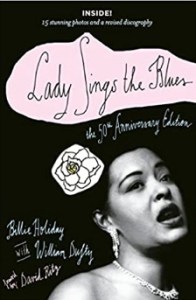
When the 1972 film “Lady Sings the Blues” aired the other night on one of the many DISH network channels, it was hard not to think of the original autobiography of Billie Holiday that was reissued in an anniversary edition in 2006. When you watch the movie, which I like, you’re seeing a bit of Diana Ross simmered and stirred into Holiday. I think you get closer to the real Billie When you read the book–though it’s hard to separate out the influences of those who helped her write it. I’ve heard all her songs and think they’re the best way to understand Holiday, especially if you have a version with analog sound instead of the always-slightly-false digital approach. (My bias.)

From the Publisher

“Perfect for fans of The United States vs. Billie Holiday, this is the fiercely honest, no-holds-barred memoir of the legendary jazz, swing, and standards singing sensation—a fiftieth-anniversary edition updated with stunning new photos, a revised discography, and an insightful foreword by music writer David Ritz

“Taking the reader on a fast-moving journey from Billie Holiday’s rough-and-tumble Baltimore childhood (where she ran errands at a whorehouse in exchange for the chance to listen to Louis Armstrong and Bessie Smith albums), to her emergence on Harlem’s club scene, to sold-out performances with the Count Basie Orchestra and with Artie Shaw and his band, this revelatory memoir is notable for its trenchant observations on the racism that darkened Billie’s life and the heroin addiction that ended it too soon. 

 
“We are with her during the mesmerizing debut of “Strange Fruit”; with her as she rubs shoulders with the biggest movie stars and musicians of the day (Bob Hope, Lana Turner, Clark Gable, Benny Goodman, Lester Young, Coleman Hawkins, and more); and with her through the scrapes with Jim Crow, spats with Sarah Vaughan, ignominious jailings, and tragic decline. All of this is told in Holiday’s tart, streetwise style and hip patois that makes it read as if it were written yesterday.”

I’ve read conflicting claims about Holiday’s acceptance as an artist after she recorded her most powerful song, “Strange Fruit.” Some say she found it harder to work after that while others say her status when up. The song is a strong indictment of the lynchings of African Americans.


Malcolm

Malcolm R. Campbell is the author of the Florida Folk Magic Series of novels in which the blues have a strong presence.

 

Typical e-mail exchange with a shipper

This is the season when UPS, FedEx, and USPS litter the front porch with packages and my e-mail inbox with notes that say “your shipment has arrived.” But sometimes the shipper is wrong and there’s no package there:

SHIPPER: (Not FedEx) Your package from WALMART arrived today.

ME: No it didn’t.

SHIPPER: Really? Did you check the outhouse?

ME: We don’t have an outhouse.

SHIPPER: Where do you do your business?

ME: The bathroom.

SHIPPER: Wow, we didn’t figure a redneck county like yours had indoor plumbing.,

ME: So where’s my package?

SHIPPER: Frankly, we rather hoped you’d forgotten about it by now. We think varmints ran off with it.

ME: Varmints?

SHIPPER: Yes, lions, tigers, and bears, oh my.

ME: I live in Georgia, not the jungle.

SHIPPER: So that “Georgia of the Jungle” song isn’t about you?

ME: Nope.

SHIPPER: Well, bugger.

Malcolm

Malcolm R. Campbell sometimes put his satire in a novel.


One with the Universe

While writing yesterday’s post about the I Ching, I thought of that long-ago phrase that was once very popular: “One with the Universe.” Unfortunately, “everyone” used that phase so extensively that it became trite and that didn’t matter because most people weren’t really applying it, they were just saying it.

Those of us who have studied Huna (Hawai’ian mysticism) see no difference between the universe and the Creator. Some Huna scholars put it this way: “There is nothing that’s not God.”

Whether you see all that is as a Huna mystic or as a member of a group with another approach to the “Cosmic,” it seems clear that if we are all doing our best to synchronize our lives with the universe–perhaps via the I Ching–we would not have the spectre of climate change hanging over our heads like the sword of Damocles. 

It’s a shame we have left the world in an apparently perilous condition for our children and our children’s children. This reminds me of those novels where a once proud family falls into ruin because the older generation didn’t manage the estate properly. We are not managing the World’s resources properly, evidence enough in my view that most of us are not one with the universe.

If you look up “one with the universe” in Google, for example, you’ll find multiple commentaries on how to synchronize your life, thinking, and work with the universe. The best of these tend to say that doing so will make a difference in ourselves and then in the state of the World. It’s easy to get discouraged and think, “okay, I’m doing my bit, but what difference can it possibly make?” the answer is always “More than you know.” When you think of the “six degrees of separation” concept, then it becomes clear that we aren’t all that far apart when we decide to act or change the way we think.

Many of us are fed up trying to get the “powers that be” to do something realistic about climate change. Not that we should stop trying. But we can increase the odds of success by synchronizing ourselves with the universe. Doing so is more powerful than all the letters we can write to government agencies. 

Malcolm

Aligning oneself with change with the ‘I Ching’

I  no longer remember what led me to the Book of Changes known as the I Ching. Most likely it was something Carl Jung wrote. He was a friend of sinologist Richard Wilhelm (1873-1930) who brought to the western mind the first translation of the I Ching, a work that so impressed Jung that he wrote a forward to it. I believe it was first translated into English in 1951 and, of all the translations, some say it is still the best. 

According to Princeton University Press, “The I Ching, or Book of Changes, a common source for both Confucianist and Taoist philosophy, is one of the first efforts of the human mind to place itself within the universe. It has exerted a living influence in China for 3,000 years, and interest in it has been rapidly spreading in the West.”

The universe, we suspect, is always in a state of flux, sometimes favoring things we may consider doing and sometimes not. The I Ching when used as an oracle shows us whether or not conditions are right for our plans just as a weather report tells us whether today is a good day to put out to sea. Most sailors wouldn’t begin a sea voyage in a hurricane. Likewise, when considering conditions with the I Ching, those with a Taoist perspective wouldn’t begin a project on a day when doing so goes against the universal flow.

In his foreword to the Wilhem edition, Jung said, “For more than thirty years I have interested myself in this oracle technique, or method of exploring the unconscious, for it has seemed to me of uncommon significance. I was already fairly familiar with the I Ching when I first met Wilhelm in the early nineteen twenties; he confirmed for me then what I already knew, and taught me many things more.”

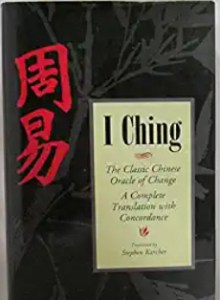
As an oracle, used for divination or for meditation, The I Ching is–so to speak–like a wise and all-knowing companion on one’s life’s journey. I probably started using the I Ching in high school and, basically, found that when I used it often, life just seemed to go more smoothly. I still have my original copy, though I’ve supplemented it with Rudolph Ritsema and Stephen Karcher’s I Ching: The Classic Chinese Oracle of Change [The First Complete Translation with Concordance].

The publisher’s description said, “We need the book when we stand at a crossroad of the soul.” I agree. The book’s answers to a flippant question are often like getting one’s hands slapped So, don’t ask it where you left your car keys or if you’re going to “get lucky” on your date tonight.

In this 1995 edition, the authors write, “The I Ching is a diviner’s manual or active sourcebook for what C. G. Jung called the archetypal forces. It organizes the play of these forces into images so that an individual reading becomes possible. . . These forces represent the flow of life and the experience of its meaning, its way or tao.”

Consistent use of the I Ching slowly changes an individual view of and approach to life. This benefit cannot be overstated.

I believe that most of our problems come from the arrogance of living outside the universe, a belief the I Ching would caution the seeker against.

–Malcolm


‘The Blue Angel’ with Marlene Dietrich and Emil Jannings

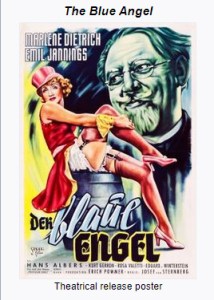
“The Blue Angel” directed by Josef von Sternberg was released in 1930 and, as Wikipedia describes it, ” presents the tragic transformation of a respectable professor to a cabaret clown and his descent into madness.” It’s often called a comedy-drama, but that seems based on short moments of humor in a film that shows how easy it is for a man to walk into a cabaret for innocent reasons and end up being corrupted by the predators there. Two versions of the film were made, one in German with English subtitles and one in English. The English version is an inferior production in part because speaking in fractured English completely destroys the atmosphere of the film.


I probably shouldn’t have told my daughter during our Thanksgiving visit that “The Blue Angel” is one of my favorite films. We had been talking about my love of noir films and movies with nasty characters like “The Little Foxes.” She hadn’t seen most of those I mentioned so I told her if she wants to see rock-bottom depravity (and, I mean, who doesn’t?) she should check out Marlene Dietrich’s and Emil Jannings’ performances in this film. As a writer, I often consider the workings of the dark side and how easy it is to become enamored of it until it kills you.

Of the film, the late Roger Ebert wrote, “‘The Blue Angel’ looks and feels more like a silent film, with its broad performances that underline emotions. Von Sternberg, who was raised in Europe and America and began his career in Hollywood, was much influenced by German expressionism, as we see in early street scenes where the buildings tilt toward each other at crazy angles reminiscent of ‘The Cabinet of Dr. Caligari.’ He was a bold visual artist who liked shots where the actors shared space with foreground props and dramatic shadows, and he makes the dressing room beneath the stage of the Blue Angel nightclub into a haunting psychic dungeon.”

Lola Lola

While he went on to make additional films with Dietrich, I see this as their best collaboration in part because of those “broad Performances” that Ebert mentions, That sweet song “Falling in Love Again (Can’t Help It)” is a haunting and chilling refrain behind the characters, especially Dietrich, a complex individual who brought those complexities to her work. She worked with von Sternberg in  “Morocco,” “Dishonored,” “Shanghai Express,” “Blonde Venus,” “The Scarlet Empress,” and “The Devil Is a Woman” among other films.

Thomas Caldwell writes that “The vampish woman (Lola Lola) is a force of powerful sexuality, which is aligned with the deadly forces of nature (her animal print costumes and the exoticness of The Blue Angel club) and otherness. Professor Immanuel Rath is the lonely and sympathetic male aligned with civilisation (he is a respected teacher) who falls prey to her untamed femininity.  Although by today’s standards the symbolism is inappropriate, the scene where Rath wakes up with a black doll represents the dark and mysterious foreignness of Lola Lola that is alluring yet ultimately dangerous and unattainable. Dietrich’s portrayal of Lola Lola would be extremely influential in the creation of the femme fatale personae that dominated the Hollywood film noir cycle of films.” 

The professor cannot help himself. That’s the message I see here as well as the danger of “everyday people” walking into a cabaret or bar where the rules are different and without mercy.

–Malcolm

Malcolm R. Campbell is the author of “Special Investigative reporter,” a novel about a jaded reporter who sees the dark side in the news of the day,


Rumours About Christmas

Got a tip from a reasonably informed source: “The Christmas people are at it again.”

Even though it was March, I drove downtown in my 1950 A4 Checker (for you young people, that’s a car, not an Internet fact checker) in a cold wind that raged drunkenly beneath black clouds that looked like they’d been painted onto a frightening sky by Salvador Dalí during one of his less-lucid moments.

Arrived at the Max Value Department Store at high noon, heard a clock ticking, saw a used-up department store Santa singing “Do not forsake me oh my darling.” He waived as though we were the same kind of people even though we aren’t.

There was a line of Christman trees with bright burning candles in the store window (actually behind the window) hovering over a pile of brown pine needles, crumpled tinsel, last year’s gifts, and last year’s dreams.

I waited until September and drove downtown again, saw that Max Value had burnt to the ground, demonstrating the danger of placing candles on Christmas trees. Nearby stores that hadn’t burnt down yet due to the vicissitudes of mob looting that is no longer a crime in most cities, already had factory-fresh trees and garlands, ribbons and bows, stacks of toys I’d never heard of, and signs that proclaimed, “To Hell With Hallowe’en and Thanksgiving, we’re merrily geared up for Christmas.”

I felt lower than Jimmy Hoffa at the bottom of the river with concrete shoes.

Skipping Hallowe’en was fine with me because I think the holiday is meant for dead people. But Thanksgiving. Ignoring that day is a crime in enlighted cities that feature skies painted by Thomas Kinkade. My town was still stuck with Dalí skies, Piccasso streets, and Picasso people that had eyes in all the wrong places. It was obvious to me why nobody cared about Hallowe’en or Thanksgiving: the world was filled with people who can’t see straight or who are blind or who escaped from an asylum.

I walked up to a store manager and said, “It’s not even Black Friday yet.” He laughed like that evil doll in a movie I wish I’d never seen and said “Corporate Calls the shots. Next year, we’re putting up our Christmas displays during the dog days of August.” “I assume there’s a discount for the fleas,” I said. “Hardly. Folks give them to their cat-loving friends as gag gifts.”

I left before I got angry enough to kill him.

The clean-cut Santa standing outside the main door was so fat, I decided he was already eating turkey. When I got home, I heated up a roast turkey TV dinner, thankful that everyone who knows me won’t accept any cards or gifts from me because “I’m out of touch” and proud of it.

Jock Stewart

Special Investigative Reporter

Marietta House Museum, Glendale, MD

Marietta is a historic house and former tobacco plantation located in Glenn DalePrince George’s CountyMaryland. On the National Register of Historic Places and the National Underground Railroad Network to Freedom, Marietta House Museum includes a federal era house, a cemetery, the original root cellar, and harness room, as well as Judge Gabriel Duvall’s original law office building. The historic site sits on 25 acres of Marietta’s original 690 acres. Today, visitors can walk the grounds and tour the plantation buildings and sites where free and enslaved people lived and labored.” – Wikipedia

While visiting my daughter’s family in Maryland for Thanksgiving, we all took a guided tour of Marietta House and learned more about slavery in Maryland. My daughter’s husband stayed home working on the Thanksgiving dinner. It was fabulous.

According to the website, “Marietta was built for Gabriel Duvall, one of Prince George’s County’s most outstanding citizens. Born in 1752, Duvall pursued a career of public service which lasted for more than 60 years. After serving in several positions during the Revolutionary War, he served in the Maryland House of Delegates, the United States Congress, the Maryland Supreme Court, and as Comptroller of the Treasury under Thomas Jefferson. Soon after 1812, when he was appointed by President James Madison to the U.S. Supreme Court, Duvall began the construction of Marietta. Over the next 20 years, he developed the 325-acre plantation and constructed a substantial rear wing for added living space. He served on the Supreme Court until 1835; in January of that year, he retired to spend the rest of his life at Marietta, where he died in 1844. Marietta remained the residence of his heirs until 1902.”

My granddaughters have visited a lot of museums and other sites, so they’re used to tours, displays of historic furnishings, and signage that describes the exhibits and the importance of the place. I do believe they liked the Christmas tree, toys, and cards that showed a very different era than they are familiar with. I’m less sure they were enthusiastic about the simulated food displays on the table in the kitchen. As for the irons lined up on the hearth–well, I wonder if they had a clue what those things would be used for what with today’s no-iron clothes.

If you like history, you might put this destination on your list of places to see if you live in or travel to Maryland.

Malcolm

Malcolm R. Campbell is the author of “Conjure Woman’s Cat.”