Mail Call 1968

While serving aboard an aircraft carrier on a nine-month cruise, I became as attuned to the comings and goings of our C-1A Trader carrier onboard delivery (COD) plane as a desert dweller is to a drop of rain. Long before Navy ships had e-mail service, the COD–as we called it–was our primary connection with home.

USS Ranger's COD
USS Ranger's COD
When the plane arrived, the words “Mail Call” echoed throughout the ship via the 1-MC public address system. The ship’s post office would be mobbed in minutes as each department sent a guy to the small window on the 03 level just forward of the island.

Many of us would head toward the post office before “Mail Call” was announced because our TV sets were generally tuned into PLAT, our ship’s Pilot Landing Aid Television. It was always on during flight operations. The retrieval of the slow-moving COD really stuck out amongst the landings of the jets.

One had to lurk, though, because if you bugged the post office guys before the mail was ready, they tended to work a lot slower. For a few moments after the arrival of the COD, they owned the boat.

Large packages were sniffed and poked and prodded en route back to the shop, office or berthing area for the slightest evidence they contained cookies. One of the top rules of the sea is that cookies are shared with everyone. A guy would be lucky to get one cookie out of a box of 50, crumbled or whole, as the gods of the mail service decreed.

Envelopes reeking of cologne or perfume brought a sailor a string of profane jeers and suggestions by anyone else close enough to pick up the scent. Smart guys told their wives and/or lovers to stop spraying My Sin Perfume on letters filled with sweet nothings or the suggested sins within would soon become public.

More often than not, the mail contained the every-day news of the moment, roughly three weeks after it happened back home. It always amazed me how much of home could be contained within a small envelope.

I left the ship in the Gulf of Tonkin aboard the COD for a trip home via Danang and Manila and to this day that remains one of my favorite flights. Before I flew off the ship, the old salts warned me that a catapult takeoff was similar to getting a kick in the butt from something large and angry.

They were right. But for once, it was a welcome kick.

Copyright (c) 2009 by Malcolm R. Campbell

Sportsmen, Conservationists Cheer America’s Wildlife Heritage Act

from Trout Unlimited:

WASHINGTON—Representatives Ron Kind (D-WI) and Walter Jones (R-NC) introduced a bill in the House of Representatives June 10th that will help improve populations of fish and wildlife on America’s National Forests and BLM lands.

“The America’s Wildlife Heritage Act is a bill that is good for America’s sportsmen and women because it will compel the federal land management agencies to do a much better job of prioritizing the needs of fish and wildlife populations in their planning processes,” said Steve Williams, President of the Wildlife Management Institute. “Fish and wildlife have taken a back seat to oil and gas leasing and other uses of federal lands for too long, and this bill will level the playing field as our nation’s multiple use laws have always intended,” said Williams.

The America’s Wildlife Heritage Act would end years of litigation and uncertainty surrounding the fish and wildlife planning protocols for federal lands by providing the Forest Service and the Bureau of Land Management (BLM) with clear directives and science-based tools to sustain and monitor healthy populations of fish and wildlife and their lands. The bill further would require improved coordination between federal and state agencies to achieve their mutual objectives.

“In addition to creating standards for establishing fish and wildlife population objectives to which BLM and FS land management plans are to aspire, the bill significantly directs and facilitates that these population objectives be achieved based on an evaluation and monitoring program that is designed and implemented in cooperation with the state fish and wildlife agencies”, said Gary Taylor, Legislative Director of the Association of Fish and Wildlife Agencies. “States have principal authorities and responsibilities for managing fish and wildlife within their borders, including on most federal lands, and it is vitally important that the states and federal land managers work closely together to enhance the sustainability of fish, wildlife and their habitats on these important multiple-use public lands”, concluded Taylor.

Forest Service and BLM lands hold some of the best remaining for big game and sport fish species, provide habitat for countless other species, both imperiled and common, and protect some 3,400 public water supplies. But they are also under increasing pressure oil and gas planned development and the serious changes wrought by global warming.

“Hunters and anglers are do-ers, and we are sometimes skeptical of planning and monitoring,” said Steve Moyer, Vice President of Government Affairs at Trout Unlimited. But we know that with the many forces of habitat destruction on our public lands, especially the adverse affects of climate change, our federal land managers must plan and monitor better if we are to enjoy hunting and fishing in coming generations,” said Moyer.


For more information about Trout Unlimited, click here.

For a summary of the act, click here.

Recent News: “Glacier National Park: The First Hundred Years” Wins Benjamin Franklin Award

Malcolm

Celebrating Glacier’s 2010 Centennial: Lord and Lady Snowdrift

In celebration of Glacier National Park’s 2010 centennial, here’s the first in a series of memories and historical anecdotes about Montana and the park. The following excerpt from “Garden of Heaven” is based on a pair of white wolves, called Lord and Lady Snowdrift, who purportedly were the terror of Montana many years ago. (See historical note at the end of the post.) In my view, today’s wolfers are just as determined and cruel as my fictional Jack “Jayee” Gordon.

In the following, my protagonist’s grandmother tells the story of her broken nose:

I could praise him, my husband Jayee, and forgive him for his long absences if it weren’t for Lord Snowdrift.

You know Mark Twain’s claim that he came in with Halley’s comet and expected to go out with it. Elizabeth Jane, my Little Deer, came and went with a white wolf.

Between 1916 and 1923, Jayee hunted Snowdrift, the “soulless wolf” who rampaged—so it was said—from the Bear’s Paw Mountains to the Belt Mountains, killing cattle and sheep. Snowdrift brought out the worst men and the worst in men. Wolves were evil, an ‘enemy of the state’ according to wolfer Ben Corbin who wrote The Wolf Hunter’s Guide some years earlier. Manic in his pursuit of the “sinister canis lupus” or “the devil’s four-legged scourge” as Jayee called the misunderstood puppies, your grandfather disappeared into the great fastness of his own skull where there was plenty of room for long journeys.

Jayee liked the role of the wolfer-hero and he packed the hallowed tools of his trade with the same care attended to his surveying instruments. He lived and breathed death in the clothing of traps, guns, strychnine, arsenic, cyanide, matches and gasoline, and dynamite. He was less cruel than some. He slept with the gospel of Ben Corbin closer to his heart than the words of Matthew, Mark, Luke or John.

I cannot say how often he set eyes on the illusive Snowdrift. Like as not, he saw more of that wolf with a claw missing from his left front foot than of his daughter with her open spine. Truth be told, I reared Jayee’s first daughter and truth be told, I buried his second daughter, Betty—my exuberant Áwakásipok—for the want of good medicine on May 1, 1923. Jayee missed those last days. He came by the ranch later that month after verifying Snowdrift had been shot stone cold dead by wolfers Stevens and Eckerd in the Highwood Mountains and that’s when I told him the news.

He found me in the pens clipping the cord of a new born that had just fought its way into the world hind legs first. The ewe gave me trouble and was in a fair sour mood.

Jayee burst into my line of fire like Santa, with an armload of dolls, his coat pockets bulging with scrip from Buttrey’s store.
‘Where’s my sweet bouncing Betty?’ he asked. I believe he thought she’d be playing in one of the pens. ‘Where’s Daddy’s little girl?’

‘She’s down in the cottonwoods,’ I said.

I had grabbed up the lamb by its front feet and was sloshing a bit of iodine on the navel cord when the heel of Jayee’s boot slammed into my face. He was accustomed to kicking fractious stock and used to laugh his ass off saying the ewes thought his foot was a battering ram. Odd to say, I reflected on that as I lay on my back while a squirming lamb caressed my freshly broken nose and a spooked ewe kicked me in the ribs.

‘Damn squaw. Has all your sense run off? How the f— can you leave her off alone while you mother the sheep?’ Jayee was into a first class shout. ‘I’m just asking you how the damned f— can you leave her?’

When I didn’t answer due to the ongoing commotion of sheep, he flung the ewe off me and allowed me to sit up and lean against the side of the pen. I wouldn’t let him near the lamb.

‘Did you bury the wolf?’

‘Wasn’t mine to bury.’

‘Betty was, had you been around.’

‘What are you saying?’

‘Walk down and read her tombstone while I settle myself.’

His face bleached out and that surprised me.

‘God, no. When?’

‘Two weeks ago. Pneumonia on top of everything else was the death of her.’

‘You could have written.’

‘Written where? The Havre, the Fair, the Grand? Your actual Havre address has been vague.’

‘The yard office might have been a start. Did you have any help?’

‘Fiona stayed with us.’

‘Tom’s fiancé?’

‘Of course.’

‘Where do we do from here?’

‘Well Jack, I’ve got a broken nose, a splitting headache, a bruised rib, a dress covered with iodine, and a lamb to see to. What about you?’

He reached down and wrenched my nose more or less straight. ‘I meant you and me,’ he said.

‘You and me what?’

‘Having a bite of supper and talking about our life.’

‘As for supper, why not heat yourself some sheep dumplings. As for our life, if the law allowed, I’d divorce you again.’

‘That’d be double jeopardy, my sweet pine.’ He flung a handful of scrip at me. ‘This’ll fetch you a new dress at Buttrey’s next time you come looking for me in Havre.’

‘I’ll come looking when pigs fly,’ I told him.

He left the ranch close near dark, though there was light enough for him to pay Betty his last respects—such as they were.

Now, my little bear cub, we have gone further than facts into the true story of How Granny Got Her Crooked Nose.


Historical Note:

Like as not, we can blame a combination of well-intended false sightings, good natured fibbing, tall tales, moon light, whiskey, and the probable existence of multiple white wolves for the lack of precise details about the real exploits of the wolves called Lord Snowdrift and Lady Snowdrift in Montana beginning in 1917.

Lord Snowdrift purportedly ranged over a 70,000 square mile area of Montana for many years preying on cattle and sheep. With or without the help of his mate Lady Snowdrift he was blamed for over 1,500 kills and credited with the ability to maintain a five mile-per-hour run for 24 hours straight. He was variously reported killed in 1919, 1923, 1930 and other dates.

In my brief account, I settled on 1922 and 1923 respectively for the years in which Lady Snowdrift and Lord Snowdrift were killed. These dates are provided by Jack Holterman’s book Who Was Who in Glacier Land, privately published in 2001 at West Glacier, Montana.

Copyright (c) 2009 by Malcolm R. Campbell, author of “The Sun Singer,” a novel set in a fictionalized version of Glacier National Park.

A few days in a 2010 Mustang

Ford 2010 Mustang
Ford 2010 Mustang
It all seemed so simple. Gordon Lightfoot was performing in Columbia, SC, just three hours away. Why not? We drove over and enjoyed the concert, though his voice sounded a little more strained then it had when we saw him in Atlanta a year ago. Perhaps a cold or an allergy, but nonetheless we were glad to see him again.

The plan was to be back in Atlanta in our trustworthy 10-year-old Ford Explorer by midnight. We had to drive 2.5 hours to Rome, GA the following day and needed some sleep first.

Instead, we arrived home at 3 a.m. in a bright red 2010 Mustang. Okay, so a little less sleep, but we drove to Rome anyway and everyone thought we’d gone crazy and bought a new car.

Truth be told, we enjoyed driving the Mustang for several days, though the circumstances could have been better and cheaper.

When leaving Columbia, the freeze plug blew out of the Explorer. This was late on a Sunday night–at the time we didn’t know it. We thought the water pump had gone out. It took a lot of cell phone calls to find a tow truck that would take the car to a place that would assess the damage the following day; then to call a taxi to take us to the airport, the only place with any rental cars open.

We called ahead and reserved a cheap, mid-sized car. But traffic was heavy and the place ran out of cheap. So they gave us the Mustang as a complimentary upgrade.

When my wife–who had several Mustangs in the 1970s–saw the car in the airport parking garage, she said “things are looking up a bit.”

The following day, we learned that there was no major damage to the Explorer–just a corroded plug. We thought it was going to be worse.

You can tell we’re both out of touch with today’s cars. When we pulled in to a gas station, we had no idea how to open the gas tank “door.” We expected a latch on the inside. We felt pretty stupid when we found out all you do is tap the door and it opens.

I keep wondering if Gordon Lightfoot is somehow responsible for all of this and needs to buy us a car or send us an autographed CD! Or maybe a sack of extra freeze plugs…

Visit Malcolm Campbell’s author’s site at Vanilla Heart Publishing.

Real journalists vs. great targets for satire

I am often critical of journalists. That’s because my father was a journalist and journalism educator, and I heard a lot from him while I was growing up how real journalists ought to approach the skills and ethics of their profession

HowToReportSeveral years ago, I accepted a posthumously awarded press association award on behalf of my father, Laurence R. Campbell (1903-1987). Standing up there in front of a room full of veteran student publications advisers, a few of whom were once my father’s students, I wondered how a writer who didn’t follow in his father’s footsteps could possibly connect with the audience.

All I knew to say was: “I worked as a college journalism instructor and student publications adviser for three years. I have to tell you that I felt like I was on a runaway horse.”

They knew what I meant. My father spent his life training others to be real journalists. He wrote hundreds of trade publication articles, ran summer journalism institutes and authored or co-authored numerous textbooks. The advisers attending that Florida scholastic Press Association convention in Tampa knew these books better than I even though I was there when Dad wrote them. I think, though, that I connected with the luncheon audience that day because, while I was an outsider, I cared a great deal about the profession.

SeaOfFireCoverWith my novel Jock Stewart and the Missing Sea of Fire coming out this summer from Vanilla Heart Publishing, I’m still an outsider looking into a world my father knew so well. My novel is a thriller with a lot of satire and comedy in it. To some extent, I’m satirizing the journalism profession and to some extent, I’m satirizing some of the pretentious people who make the news.

If I didn’t care, I couldn’t write the satire. I’m not a real journalist, but I know what one looks like and how he or she ought to act. For me, it was a real hoot poking fun at those who don’t live up to my expectations. I think my father would understand.

Copyright (c) 2009 by Malcolm R. Campbell

Bookstore Owner Subdues Robber with Jonathan Strange & Mr. Norrell

Junction City, May 29, 2009–When Moe Anderson walked into the Main Street Book Emporium at high noon yesterday with a SIG SAUER P238 pistol in his pocket and robbery in his heart, he expected to leave with all the money in the cash drawer.

Jim Exlibris, owner of Main Street Book Emporium, believes dead hearing-aid batteries and author Susanna Clarke saved him a lot of money.

“I was waiting on a customer at the main register during the lunch hour when a man came in shouting, ‘wash up, wash up,'” said Exlibris. “The guy pointed to a bulge in the front of his trousers and held up his hands, so I assumed he needed our restroom at the back of the store.”

According to Maud Lukins, who was purchasing a hard cover copy of of Susanna Clarke’s Jonathan Starnge and Mr. Norrell for her grandson Arnie’s 15th birthday, the book store owner was obviously “deaf as a post” even though he was wearing two, $3,500 hearing aids from a name brand company.

“That rude, scrawny little guy who burst in and interrupted my purchase wasn’t happy to see me at all,” said Lukins. “He really did have a gun in his pocket and was saying ‘hands up.’ Even though I felt utterly discounted, I had the presence of mind to scream and that got Jim’s attention.”

Exlibris told police, who responded from the doughnut shop after the emergency was over, that Anderson became frustrated by the lack of personal attention and attempted to pull the gun out of his pocket, but it got stuck and went off.

“The thing made a horrible noise and I thought we were about to be dead,” said Lukins. “That’s when Jim picked up Arnie’s beautiful birthday book and threw it against Anderson’s head. Anderson was knocked out cold.”

Chief Kruller said Anderson didn’t hurt anyone because he was “shooting blanks.” Known to police across Texas as the bookstore bandit, Anderson’s “success” is purportedly based on intimidation rather than violence.

“If my hearing aid batteries had been working, I would have understood the guy, handed him a wad of money and then over charged old lady Lukins and the rest of my loyal customers to offset the negative cash flow,” Exlibris said. “Praise the Lord for Ms. Clarke’s 326,729 words and her 2.9-pound novel.”

Police ballistic experts claim that had Exlibris tried to subdue Anderson with a light-weight Silhouette romance, the bandit would still be at large.

from Morning Satirical News

Coming soon, from Vanilla Heart Publishing: “Jock Stewart and the Missing Sea of Fire,” a novel by Malcolm R. Campbell.

Memorial Day – Remembering

“Somewhere behind the haze-gray façade of bulkheads there are people.
People too important to be likened to small cogs in a massive
non-human machine. Each man has a distinguishable face and personality, a specific job to perform and memories of a world an ocean away.” –M. R. Campbell and M. B. Marmaduke in Cruisebook, USS Ranger (CVA-61), 1969-70.

Classic Ranger photo by Edward Weeden from 1979

The U.S. Ranger Foundation is working to convert the decommissioned aircraft carrier into a floating museum to be moored in Portland, Oregon. On Memorial day, it’s fitting to wish them fair winds and following seas on this massive project. For more photographs by Weeden, click here.

I served aboard this ship in 1968 and 1969 and, unfortunately, knew men who were lost in action. See my fictionalized excerpt called Jack Rose – Only a Memory.

Selling Lottery Tickets in Holland

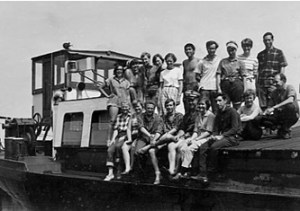
Aboard Rambler in Holland

I came across an old photo (I’m the one on the right in the row of those standing) of an international group of people who worked together for one month during the summer of 1967.

The first phase of our work consisted of traveling from Amsterdam to Gronigen aboard the motor barge Rambler selling lottery tickets to those attending the annual sailboat races. The lottery tickets supported the second phase of our work: the restoration of an old German ship as a school ship for the children of Dutch shippers.

The men lived in one hold of the ship, the women in the other. Since the holds were not intended as places of habitation, we got up and down with a movable ladder. Even so, this was a very relaxing way to travel and also a somewhat unique view of the country.

We quickly learned enough Dutch to sell the tickets. We had cheat sheets with us with answers for typical questions such as how much the tickets cost and what they were for. They cost one Guilder each (about a quarter) and supported work on a very unique schoolroom for children who moved around a lot.

We sold a fair number of tickets and, hopefully, made a good impression. When we got to our destination, the small town of Hoogezand (in the north, near Gronigen) we became front page news in the local paper. Since we worked on the old ship in a canal along the main road, we were an ever-changing local attraction. People stopped en route to work and, truth be told, were very impressed at the sight of women clinging to the side of the ship removing years old old paint with blow torches and jack hammers.

The ship, known as the White Swan, still exists, I think, but served its intended purpose for a while with a new life. I never saw the final result of the restoration, but always hoped I might one day travel back to the Netherlands and find the ship while the shippers organization was using it as a school.

This old photo stirs up enough memories for a Saturday afternoon and a long evening. But, I have current promises to keep and many chores to finish before I sleep. So, I write a snapshot of them here as I think back some 40 years and wonder how many children used the White Swan and where all the others in this old photograph are today.

Review: “Who’s to Blame?”

Who's to Blame?: A Literary Comedy Who’s to Blame?: A Literary Comedy by Jeffery S. Williams

My review


rating: 5 of 5 stars
SherChristispeare, “the greatest sleuth during Renaissance England” and Pancho, “the most loyal of sidekicks during Renaissance England” have two cases to solve in Jeffery S. Williams’ delightfully clever spoof of the Immortal Bard’s beloved “Hamlet” and “Romeo and Juliet.”

In Book One, SherChristispeare travels to Denmark to find out what manner of conspiracy led to the death of Hamlet and other notables. After using his advanced investigative skills and witty turns of phrase—while fending off siren spies and other tasty evils—to bring order to the chaos behind the crimes, our sleuth heads for Verona where Romeo, Juliet and others have recently been murdered in a manner must curious, if not foul. As they unearth twisted clues and sharp retorts, SherChristispeare and Pancho discover (more than once) that their lives are in jeopardy, and frankly they don’t see as much humor in it as readers will espy.

No knowledge of the Shakespeare plays is required to enjoy this hilarious novel. However, readers familiar with “Hamlet” and “Romeo and Juliet” will find Williams’ humor a rich stew seasoned with non-stop references and tangled-up lines. Suffice it to say, while all’s well that end’s well in “Who’s to Blame?,” SherChristispeare’s evidence points everyone—including the reader—in unforeseen directions, most of which are complicated, elaborate, and somewhat different than the original author of the plays anticipated.

The greatest strength of this novel arises out of dialogue which is clever, crafted by an adept author with a deep knowledge of his source material, and that is almost pure burlesque in style and tone. This dialogue is most effective in scenes where it introduces characters or otherwise advances the plot:

“Noble Ambassador,” I said and bowed, “I am SherChristispeare court—“

He waved me off. “I know who you are.”

I straightened to my full measure, “I am here to ask you about—“

“The Queen, the King, the Prince, and a soul named Laertes—all blood-stained and most still, most secret, and most grave.” His eyes twinkled at his pun.”

“So they were all at supper, ay?” I said.

“Supper?”

“Food for worms.”

“For what?”

“Never mind. What did you learn?”

The Ambassador recounted the story of we he had heard from the voice of Horatio—rife with carnal, bloody and unnatural acts, of accidental judgments, casual slaughters, and deaths put on by cunning and forced abuses.

“Tragical-comical. Historical-ironical,” I said.

Williams doubles the strength of his parody by making SherChristispeare and Pancho aware that they are punning, borrowing lines, and creating highly crafted Shakespearian-style wit. In dueling conversations between the sleuth and his sidekick, points are lost for lack of originality and theft from the Bard himself.

The novel sags ever so slightly in a few places where the plot is moved onto the back burner, giving way to long strings of one-liners which are essentially bouts of verbal one-upmanship. The plot, while inventive is overtly farcical and serves in many ways more as a scaffold for the jokes than as a strong storyline.

That said, “Who’s to Blame?” belongs on the top shelf with Richard Armour’s “Twisted Tales from Shakespeare” and our other favorite parodies. Lovers of words and wit will admire the care with which this sleuthing jest was created, wherein wordplay’s the game to bring an able sleuth acclaim.

View all my reviews.

The Time is Right for Glorious Snafus

Mercury is going into retrograde next week and I couldn’t be more pleased.

Without getting into the tedious details, the astrological event will bring us three-weeks of non-stop comedy, the kind of comedy tricksters secretly applaud even while they’re pretending to sympathize with those whose communications are all fouled up.

Goodness knows, Carson, Letterman, Leno and others made a good living looking for screwed up situations and then poking fun at them. Sure, there’s an element of sadism in this, but for true seekers on the path, foul-ups present a glorious opportunity for growth.

Astrologer Rob Tillett notes that with Mercury going into retrograde while in Gemini, you can expect mail, travel and appointments to be disasters waiting to happen. And when they do happen, the rest of us will be laughing at you while thanking our lucky stars that we’re momentarily not in your shoes.

Consider this post a friendly (ha ha) warning. Be ready to go with the flow and laugh at yourself. Then, when normal days return, you’ll emerge from the days of gremlins as a stronger person. You may not be ready to love Mercury, but you’ll thank him for the snafus he gave you to grow on.

Malcolm