Book Note: ‘Across Time’ by Linda Kay Silva

Across Time Across Time by Linda Kay Silva

My rating: 4 of 5 stars
A beautifully written book with a teenage protagonist who gets her life back together by helping others who live 2000 years in the past.

Author Linda Kay Silva has created believable characters and an imaginative plot in a book filled with deep wisdom.

View all my reviews >>

“Across Time” was published by Spinsters Ink in 2008. Protagonist Jessie Ferguson and some of the other primary characters also appear in Silva’s “Second Time Around” published in July.

Malcolm

The Devil Rides an ATV

“The fat pink slobs who go roaring over the landscape in these over-sized over-priced over-advertised mechanical mastodons are people too lazy to walk, too ignorant to saddle a horse, too cheap and clumsy to paddle a canoe. Like cattle or sheep, they travel in herds, scared to death of going anywhere alone, and they leave their sign and spoor all over the back country: Coors beer cans, Styrofoam cups, plastic spoons, balls of Kleenex, wads of toilet paper, spent cartridge shells, crushed gopher snakes, smashed sagebrush, broken trees, dead chipmunks, wounded deer, eroded trails, bullet-riddled petroglyphs, spray-painted signatures, vandalized Indian ruins, fouled-up waterholes, polluted springs and smoldering campfires piled with incombustible tinfoil, filter tips, broken bottles. Etc.” — Edward Abbey

My TV viewing is occasionally spoiled by advertisements showing clowns in four-wheel-drive and all-terrain vehicles bounding across the landscape as though such people are the conquering heroes of the wilderness.

While I often wonder why people think ownership of a 4WD or ATV vehicle provides them with status, the ads imply that it does. I’ll praise the man who claims status from his vehicle when he tells me that he designed and built the thing from scratch.

Until then, what is it in the wilderness that needs to be conquered by a vehicle, especially when the thing one’s riding is destroying the place itself while drowning out the natural voices of the ecosystem? Off the road, the vehicle is generally a blemish, the kind the devil himself might ride with an innocent grin.

“Enjoy the great outdoors, folks,” he might exclaim as he wrecks the place, disturbs its natural songs, spoils the quiet, and steals the back country’s soul.

Malcolm

for the latest Jock Stewart satire, visit the Morning Satirical News, last updated July 31, 2009

Novel focuses on Saudi oppression of women

While reading Homa Pourasgari’s recent novel, The Dawn of Saudi, I found myself stepping away from the well-plotted story of two women, one from Saudi Arabia and one from the U.S., who marry Saudi men and are trapped inside the barbaric hell of fundamentalist sharia law. I had to step away and remind myself that no, I’m not reading historical fiction, I’m reading a contemporary story.

Anger pulled me away: anger at the oppression of women based on an ultra-conservative interpretation of Islam and outmoded cultural views.

I found myself almost equally angry at the stance of the United States. We condemn human rights abuses around the world, yet we are mostly silent when it comes to those within the Kingdom of Saudi Arabia. I have to agree with Pourasgari that we “remain quiet in the name of oil, greed and politics.” How shameful these reasons are!

The Center for Democracy & Human Rights in Saudi Arabia says that, “as documented by Human Rights Watch, Amnesty International, Freedom House and even the US Department of State, Saudi women are among the most oppressed and marginalized citizens in Arab and Muslim countries.” In an author’s note at the end of her novel, Homa Pourasgari describes the social and legal environment in Saudi Arabia more directly: “Women have no rights and are considered the property of a man.”

Pourasgari’s novel tells a compelling story, but the depressing reality of it is a heavy weight around my neck.

See my review of the book on Writer’s Notebook.

A Good Day for a Smile

Nora Roberts sells 21 books every minute. When you go to her website, you’ll find all of her titles are available in an Excel spreadsheet. 160 of her books have been New York Times bestsellers. After all these years and all these books, I wonder if she still feels a sense of excitement and adventure on the day each new novel is listed on Amazon. On each book’s official release date, does she sit back in an easy chair, smile and enjoy the experience?

SeaCoverMy second novel, Jock Stewart and the Missing Sea of Fire, was listed there yesterday. Exhausted from non-stop proofreading, I didn’t notice the listing until late in the evening and the book’s description hadn’t appeared yet. It’s there now and yes, it does make me smile–partly because it’s there, partly because my Jock Stewart character is so off the wall, I can’t help but be amused at the antics he gets away with while following truth, journalism and the evil-doers who stole the mayor’s racehorse and killed his publisher’s girl friend.

Writing is an adventure that unfolds in the quiet of an author’s den. My den’s a mess and I have no clue where anything is. I’m the hermit of a room lined with books, some by Ms. Roberts and dozens of other authors whose work has also contributed to my on-going education. It’s nice, though, to step outside the solitude once in a while and see what’s going on in the world past my horizon of books. Seeing one’s book listed on Amazon is a perfect excuse.

I have a smile on my face today. When you read the book, I hope you will, too.

That’s The Way It Is

“It is hard to explain why Cronkite’s death matters today. If you came of news consumption age after the dawn of cable news and the Internet, you have not known a time when commentators did not scream at each other, when they did not express political views, when shedding a tear when the president was gunned down was actually controversial because it showed emotion. — Al Tompkins, Poynter Online

WCTV, the lone television station in Tallahassee, Florida during the 1950s and 1960s, was a CBS affiliate, ensuring that I would grow up listening to the evening news as presented by Douglas Edwards and then Walter Cronkite. With Cronkite’s death yesterday, an era ends–figuratively. I cannot say that it ends in reality for cable and satellite news have, for the most part, stepped away from the best journalism of Cronkite’s era and have replaced it with something unrecognizable to veteran reporters.

I trusted Cronkite for many reasons, the first of which was that he was a real journalist, honing his craft for United Press International in World War II. He was a reporter before he was an anchor. I also trusted him because, other than championing the kind decency any average person would champion, Cronkite seldom betrayed what he thought.

I know what most of today’s anchors think and that’s why I don’t trust them. Walter’s agenda was reporting the news as clearly and as objectively as he could. Many of today’s anchors have expanded their agendas to include advocacy of one political spin or another.

Today’s ratings appear to demand infotainment rather than true journalism for a high percentage of each hour’s broadcast minutes. With Cronkite’s death, perhaps we will stop and think what we have been doing to the art and craft of news reporting for the 28 years since we last heard him end a broadcast with his trademark “That’s the way it is.”

For my latest Jock Stewart satire about the declining state of investigative journalism and newspapers, I invite you to read The Last Investigative Reporter in America.

Copyright (c) 2009 by Malcolm R. Campbell

‘100 Years, 100 Stories’

The National Park Service has been plans for the 2010 Glacier National Park Centennial. Montana residents have already had a chance to view exhibits of centennial artwork at multiple locations including the airport at Kalispell.

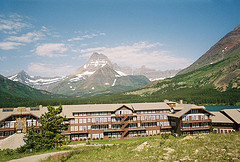
This November, the NPS plans to release a commemorative book of stories about the park written by visitors, workers and long-time area residents called 100 Years, 100 Stories: The View Inside Glacier National Park. I’m pleased that my story about salvaging furniture and then cleaning up the rooms at a flooded Many Glacier Hotel during the 1964 Montana flood has been included.

Among other things, the book is expected to serve as not only a collection of memories, but as a fund raising memento to help cover costs for the 2010 centennial. I’ll post an update when the book becomes available.

Malcolm

Many Glacier Hotel
Many Glacier Hotel

Independence Day

“You have to love a nation that celebrates its independence every July 4, not with a parade of guns, tanks, and soldiers who file by the White House in a show of strength and muscle, but with family picnics where kids throw Frisbees, the potato salad gets iffy, and the flies die from happiness. You may think you have overeaten, but it is patriotism.” ~Erma Bombeck

A few Americans are looking at New York City from the Statue of Liberty’s re-opened crown today. Many will see fireworks, if not in their home towns, but on television. Many are spending the day with family. Many are having–or will soon have–a fantastic meal. All of us who celebrate this day one way or another are enjoying what we have: freedom.

We did not achieve freedom easily; in fact, in the years leading up to the vote of Congress on July 2, 1776, most colonists were not seeking or expecting independence from England.

We have not kept freedom easily, whether one considers wars or laws or political debates or a catalogue of threats dealt with.

As we enjoy the day, perhaps we will put off thinking that we will not keep our freedom easily. We have the power to destroy ourselves or to maintain the best of what we’ve had even within the scope of ever-changing conditions and challenges.

It’s a matter we must see to, as those who’ve come before us have seen to it for 233 years. I hope we remain up to the task.

Review: Rachel Kushner’s ‘Telex from Cuba’

Telex from Cuba: A Novel Telex from Cuba: A Novel by Rachel Kushner

My review


rating: 5 of 5 stars
Rachel Kushner’s well-researched debut novel about American nickel mining and sugarcane interests in Cuba’s former Oriente Province during the years leading up to Castro’s rise to power is a masterpiece quite simply because the author didn’t take the easy way out.

Her trips to Cuba, her family’s history and her interviews of multiple sources could have led to a commercial novel with a linear plot and a third-person restricted point of view. She could have plucked anyone out of her rich cast of characters and fashioned a credible story. Such a story would have read as realism, perhaps even as history, and given her writing skills, the novel probably would have done well.

Kushner took a risk when she stepped outside the domain of plot-driven, photographic realism and chose to allow multiple characters to tell portions of her story via a character-driven, theme-driven kaleidoscopic structure that is often a hallmark of literary fiction. Kushner has given her readers more of an impressionistic view of the well-off and largely isolated Americans in Cuba rather than a news story or a textbook view.

The result is a very rich immersion into the mindset and the culture of the time and place and people, much of which we learn two characters whose wouth is being defined by the swirl of events, K. C. Stites and Everly Lederer. The end of their childhoods is symbolic of the end of the Americans’ little paradise and sets the tone for this beautifully done novel.

View all my reviews.

What’s Your Iran Policy?

“News is a necessity in a democracy, for only those who understand the nature of their world can comprehend the perils and hazards facing them and thus survive the struggle. Men who enjoy a free and open encounter with vital ideas and issues, facts and problems of their epoch can best map their future.” Campbell and Wolseley in “How to Report and Write the News.”

“With Neda’s death, the Iran I know finally has a face. The sequence of her death is the sequence of our nation’s struggle in the past 30 years: The democratic future that 1979 was to deliver collapsing, then trails of blood — that of so many executed or assassinated — streaming across its bright promise. The film of Neda’s death is the abbreviated history of contemporary Iran.” — Roya Hakakian in “Commentary: Pray for Neda

As you watch the protests in Iran on television and read about the importance of Twitter in spreading vital news to those who are otherwise denied access to information, have you formed an opinion about what must be done and developed a policy?

Most often, we are shown only one side of the coin in Iran, and that is of a rogue nation figuratively in bed with North Korea and a long list of other regimes portrayed–and often hunted–like junk yard dogs.

We read of the nuclear threat, of “honor killings,” of rule by divine right, of repression and torture supposedly justified by divine concurrence.

We are busy people, plugged into each others daily lives via Twitter, Facebook, and cell phones, so time and space for Iran on our daily radar scopes is, indeed, quite limited. Perhaps a fleeting glimpse the Ayatollah’s face as we last saw it in a news photograph or a political cartoon, perhaps an image of a nuclear holocaust with stock images out of one of the “Terminator” movies, perhaps an image of protesters marching in the streets.

Understandably, it’s easy for these images to become lost in the great clamor of background noise that is, by the grace of God and circumstance, far away. Even so, you probably have an opinion about it and, perhaps, what our government’s policy ought to be. But your policy, has it reached the drawing board yet?

Some say the U.S. and Israel should, on one pretext or another–whether out of rationalization or a true clear and present danger–attack. Others see this view as absurd.

What then?

Lately, some voices suggested that the U.S. should take care in its statements about Iran’s invalidation of the election and its harsh treatment of the protesters lest the Ayotolla find sufficient “evidence” in our statements to “prove” the protests are being orchestrated by Washington.

In her “Commentary: Pray for Neda,” Hakakian writes that during her first cab ride in the U.S., the driver asked her where she was from. When she said she was from Iran, the driver responded “Eeran … Khomeini?” and then moved his hand across his throat in a knife-slitting gesture.

Hakakian concluded that from this that “2,500 years of civilization was reduced to one vile name and the invocation of a throat being slit. It did not take long for me to learn that between the Iran that I knew and the Iran that Americans knew was a discrepancy as vast as the waters that separated us.”

It’s likely, given our lack of daily attention–especially when Iran is overtly quiet–that our opinion of Iran is similar to that of the cab driver.

And, if we are not among those urging our government to attack, what then is our opinion about our government’s alternatives. Is it “hands off”? Is it “out of sight and out of mind”? Is it wait until “they kill each other anyway”?

In the dedication of her memoir “Escape from the Land of No,” Hakakian writes:

“Between 1982 and 1990 an unknown number of Iranian women political prisoners were raped on the eve of their executions by guards who alleged that killing a virgin was a sin in Islam.
This book is dedicated to the memory of those women.”

From an Iran as a rogue nation perspective, it’s easy to see how you might see the guards full-frame in fron of your face and regard them as vile men who should be shot.

However, Neda’s death and the impact the video of her last moments is having throughout the world represents a potential defining moment in my consciousness and, I suspect, your consciousness as well. The video shows us Neda, NOT the man who shot her. You can see, as I can see, the victim at the other end of the repression, at the bullet’s destination and her eyes are like my daughter’s eyes and perhaps your daughter’s eyes.

Those eyes are an invitation and an opportunity to acknowledge with love and compassion the women the guards raped and executed rather than focusing a powerless hatred upon the guards–or upon the Ayatolla and his like-minded clerics and his soldiers.

May I suggest that while the actions of the Iranian repressors are news, they are not the entire story, and that newspaper headlines and television images that focus only on the rulers at the expense of the victims represent dishonest journalism? How many thousand people, victims with eyes as haunting as Neda’s eyes, do you suppose have gone unseen since the Ayatolla came to power?

Like that cab driver, it has been very easy for us to sweep the oppressed beneath the rug with the rogue nation label on it.

What is your Iran policy today?

Can you look into Neda’s eyes and say, “I love you and your brothers and sisters without condition and count you amongst my extended family?” If so, you will no longer feel the powerless hatred that arises from only staring at the Ayatolla’s image and from only despising the actions of the prison guards. Instead you will see that out of compassion and love, your actions will change and you will become part of a groundswell of news that flows around the world focusing on the struggles and needs and humanity of the Iranian people rather than upon the words and deeds and inhumanity of their regime.

Should the protests be silenced and the headlines fade away, you won’t forget Neda’s eyes will you? You will continue to love her, won’t you, and see to it that you are never silent about the news stories that still need to be told. I hope that will be your policy about Iran.

Copyright (c) 2009 by Malcolm R. Campbell, author of “The Sun Singer” and the upcoming “Jock Stewart and the Missing Sea of Fire.” (This post from my Writer’s Notebook)

47,000 Miles and Counting

47,000 miles. That’s the combined length of all the trails in the U.S. National Trails System. Created by Congress in 1968, the system began with two, well-known established trails, the 2,158-mile Appalachian and the 2,648 Pacific Crest. Since that time, the system has been increased to include eight scenic and 18 historic trails.

The trails in the system are variously maintained and managed by the National Park Service, Department of Agriculture and Bureau of Land Management.

In March of this year, the National Park Service announced grants to five “Connect the Trails to Parks” projects totaling $333,000. According to acting director of the NPS Dan Wenk, the grant program (established last year) “will enable our visitors to better appreciate both the national parks and the national trails that touch or cross the parks through new connections, better information systems, and upgraded facilities. It is wonderful way to commemorate the anniversary of the National Trails System.”

For an excellent overview article (with a title I borrowed for this post) about the National Trails System, see the digital edition of Land & People produced by the Trust for Public Land.

If you click on the Appalachian and Pacific Crest links above, you’ll see examples of associations that support and help maintain two of the trails in this system. Volunteer opportunities and hiking information are available for most trails in the system.

Volunteer hours come into play when trail maintenance needs exceed the Federal funding. For example, as reported in Land & People, volunteer hours for trails across the system totaled 720,000 with a “sweat equity” value of $22 million in 2007.

Work continues to enlarge the system as evidenced by the upcoming 12 Conference on Scenic and Historic Trails in Missoula, Montana July 12-15. The conference will address the following general issues: (1) Expanding Outreach about the National Trails to all Americans; (2) Protecting the natural and cultural resources and completing the on-the-ground trails; and (3) Increasing the Capacity of public agencies and non-profit organizations to sustain the trails and their resources.

For a list of trails and their associated nonprofit agencies, click here.

While you may never have the time and energy to be a thru-hilker, one who completes an entire trail, you’ll find many sites and sounds and a lot of good exercise hiking bits and pieces of this marvelous system.