Alberta Wilderness AssociationDear Premier Stelmach:
We need your help to save the last 691 grizzly bears in Alberta. And, since natural habitats flow across boundaries, what you do to (or on behalf of) the bears in the Castle Wilderness impacts the bears in Waterton Lakes as well as in Glacier National Park.
Unless the Alberta Government makes a serious commitment to protecting habitat, the grizzlies have no chance of survival.
Many of the steps to save these bears have little cost. For example, the Province could close or restrict remote roads, trails and seismic lines which have outlived their purpose and have no economic benefit.
It’s not just a problem of grizzlies, as magnificent and symbolic as they are to us. The disappearance of bears reflects a problem with the whole eco-system. Other species are severely threatened in Alberta because the Province has not taken care of its wild lands and wild life.
You have said that “nothing is more important than protecting the land we’ve inherited”. I hope, Mr. Premier, you will act on this conviction.
There was a time when Alberta was committed to conservation. You have the opportunity to restore a conservation ethic in the life of Alberta and leave a proud and profound legacy.
Three months after wealthy biotechnology company CEO William Archer is lost at sea or kidnapped off his research yacht in the warm waters of the Hawaiian Islands in Rick Chesler’s inventive thriller “kiDNApped,” Special Agent Tara Shores faces a very cold case.
She also faces the uncertainties of three civilians intruding into an investigation. Was Dave Turner really looking for a wedding ring on the ocean floor when his dive boat was stolen and his employer was murdered? What can Archer’s son and daughter from the mainland possibly contribute just two days before the court declares their father legally dead?
Shores, a veteran agent who first appeared in “Wired Kingdom” (2010), is about to stamp the case file “INDETERMINATE” because there are no leads and no ransom demands. While Archer’s son Lance wants to drink beer and chase girls until he can collect his inheritance, his sister Kristen wants Dave to return to the ocean floor on the off chance his interrupted search is related to her father’s disappearance.
When their dive attracts unwanted attention, Shores and her disparate crew are suddenly in the line of fire. Kristen wonders if her genius father encrypted a call for help in the DNA of ocean bacteria. Shores wonders how she can possibly babysit civilians who are more likely to get in the way and/or get killed than anything else.
Rick Chesler has written a breathtaking tropical adventure that combines a cutting-edge technology search for clues with a madcap, island-to-island race against bad guys that would put a smile on the face of any James Bond aficionado.
Agent Shores definitely needs a new rubber stamp for her case file: HAZARDOUS TO MY HEALTH.
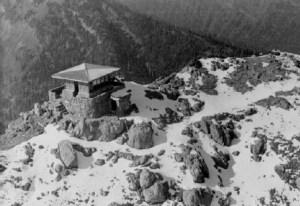
The Environmental Assessment (EA) for the proposed stabilization of the Heavens Peak Fire Lookoutis complete and ready for public review and comment.
Built in 1945 by conscientious objectors, the rustic stone lookout was in operation until 1953 when aerial fire detection became the new standard.
The building was listed on the National Register of Historic Places in 1986; however, the original historic fabric and structural integrity of the lookout is being lost through lack of maintenance and harsh weather conditions on the 8,994-foot Heaven’s Peak.
The planned project would be limited to repairs that would minimize further deterioration and keep the structure standing without upgrading the rail leading to the lookout.
According to the plan, “the building’s roofing system would be repaired and new roofing installed, and the floor would be repaired. Window and door components would be repaired, plexi-glass would be placed in selected windows for viewing purposes, shutters would be repaired or replaced, exterior and some interior surfaces would be re-painted and minor re-pointing, masonry, and concrete repairs would be made where necessary.”
Released last month, the EA concluded that the project will have moderate adverse long-term impacts on the site and that wildlife impacts will be negligible.
Click here to view the project page and read the documents.
About 5 miles south of the Canadian border, his grandmother nudged him awake.
“Nináistko,” she said, pointing to an imposing limestone monolith, thrust like the broken end of a giant’s club into a rolling ridge on the eastern edge of the mountain range.
“I don’t like it grandma,” he told her.
She pinched the back of his neck.
“Kyiopok, my little bear cub,” she whispered, “since I heard no spirits asking for your opinion, that mountain is where you must go. You must cry for your vision and find your great love.” –Garden of Heaven
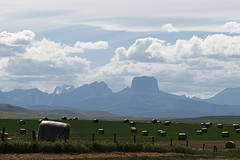
The 9,080-foot Chief Mountain in Montana sits on the border of Glacier National Park and the Blackfeet Indian Reservation. Sacred to the Blackfeet, the mountain is a prominent landmark for tourists and others traveling betweeen Alberta and Montana on State Road 17.
Directions and Location
NPS Map
From a car, the east face of Chief Mountain can be easily viewed thirteen miles north of Babb, Montana about five and a half miles south of the Canadian border.
If you’re visiting the park by car, head north out of Babb on U. S. 89, and then about four miles out, bear to your left onto MT 17. This road is also known as the Blackfeet Highway and the Chief Mountain International Highway.
You can also see Chief Mountain by taking one of the park’s red buses between Many Glacier Hotel and the Prince of Wales Hotel at Waterton Lakes National Park in Alberta.
Vision Quests
Chief Mountain, known as a klippe, or rootless mountain, was reported by Peter Fidler of the Hudson’s Bay Company in 1792 and by Meriwether Lewis in 1805. Early explorers were told that Flathead, Kootenai and Blackfeet used the mountain for vision quests.
When Henry L. Stimson climbed Chief Mountain in 1892, he reportedly found the remnants of an old buffalo skull said to have been left there by a Native American on a vision quest. Billy Fox (the man’s exact name is disputed), who climbed with Stimson, called the skull “the old Flathead’s pillow.”
In my novel The Sun Singer, Robert Adams climbs this mountain in an alternate universe where it is named The Guardian. In Garden of Heaven, David Ward climbs this mountain, referring to it by its ancient Blackfeet name Nináistko. Both Adams and Ward climb the mountain for vision quests.
Both of them follow the East Face Route, described as “for experienced and patient rock climbers only” by Gordon Edwards in his widely known reference A Climber’s Guide to Glacier National Park. If you don’t have Edward’s book, Summit Post has basic climber’s information for Chief Mountain, including routes.
According to Jack Holterman, in his Place Names of Glacier/Waterton National Parks, the name “is both the name of the mountain and a personal and family name.” Nináistko (the Blackfeet name of Mountain Chief) was a prominent leader. His portrait was painted by artist George Catlin in 1832.
Geology
Chief Mountain is a pillar of Precambrian belt rock that was pushed some fifty miles east along the Lewis thrust fault. The fault itself can be seen in multiple locations throughout the park, perhaps most easily near Many Glacier Hotel. Chief, then, is an example of older rock sitting on top of the younger Cretaceous rock. The mountain displays good examples of Altyn limestone and Appekuny mudstone, two of the park’s more noticeable formations on the east side.
The Lewis Overthrust occurred 60 to 100 million years ago. While it’s fun to envision the mountains racing east as though they were on a roller coaster, the rock moved slowly over a long period of time; had there been a man to stand there and watch, he might not have noticed anything.
Personally, I like the Blackfeet story, as I note it in Garden of Heaven: Many said the great rocks that formed the backbone of the world were piled one upon the other and sculpted into shining mountains by Nápi, the Old Man who created the world from a ball of mud fetched up from the depths of the dark primordial waters by Muskrat.
The View
Chief Mountain (right) - Park Service Photo
A climber standing on the summit of Chief Mountain will be struck by the fact that the mountains of the Rocky Mountain front come to rather an abrupt end there they meet the plains. Westward, you’ll see Mount Merritt and Mount Cleveland. Slide Lake sits just southwest of Chief, and then farther away, Mount St. Nicholas, Red Eagle and Going to the Sun.
Eastward past the highway, you’re looking into the land of the Blackfeet Nation. On the horizon are the three main buttes of the so-called Sweetgrass Hills. According to legend, Nápi flung them out there. Geologists refer to them as island mountains.
A more accurate name would be Hills of Sweet Pines, the actual translation of the Blackfeet name Kâtoyísix. Unfortunately, the name “Sweet Grass” was inaccurately applied and is now pretty much engraved in stone.
Names
Early British maps called Chief Mountain “Kings Mountain.” Lewis called it “Tower Mountain.” For awhile, it was called Kaiser Mountain, probably after freight-hauler Lee Kaiser. The official name, comes from the Blackfeet Mountain of the Chief, or Old Chief.
In their book Waterton and Glacier in a Snap, Ray Djuff and Chris Morrison write that they believe “the best view of this impressive mountain, which resembles a chief’s head looking at the sky, can be had from Alberta.” About that, they just might be right.
Section of current NPS mapThe Garden of Heaven was a name suggested for a valley between Glacier National Park’s Morning Eagle Falls and Lake Josephine by naturalist Morton J. Elrod in 1924.
Elrod, who wrote the park’s NPS-approved hiking handbook called Elrod’s Guide and Book of Information of Glacier National Park described the Garden of Heaven as follows:
“The open narrow valley along Cataract creek for perhaps two miles below Morning Eagle Falls, beginning where the trail comes out into the open, is a very beautiful flower garden in July and August. At the foot of the towering Garden Wall, flanked on all sides but one by protective mountains, the writer has called it and wishes others might call it, ‘The Garden of Heaven.’ By wandering away from the trail and examining the mossy banks of the meandering streams, the fully beauty of the wonderful garden will be understood.”
Elrod’s guide was published in 1924 and revised in 1930. Unfortunately, the name for this valley on the trail to Piegan Pass didn’t make it into park naturalist George C. Ruhle’s Guide to Glacier National Park when it replaced the Elrod guide as the official park trail handbook in 1949.
Instrumental in forming the park’s ranger naturalist program, Elrod and Ruhle worked together. So, it’s probable that Ruhle was well aware of Elrod’s name for the valley. In fact, much of the information in the Ruhle guidebook–which went through three editions–closely approximated Elrod’s facts and descriptions.
I have found no other park reference to the Garden of Heaven other than in Jack Holterman’s encyclopedic 1985 Place Names of Glacier/Waterton National Parks, on which I worked as an editorial assistant at the Glacier Natural History Association. I have never found the name on a map or mentioned in any other park trail guide.
Elrod’s description is apt. The trail above Lake Josephine between Mt. Gould and Mt. Allen is a wonderful spot. The falls itself is a little over five miles from Many Glacier Hotel. Hikers can “cheat” on the walk by taking the Swiftcurrent Lake and Lake Josephine launches.
The rare, long out-of-print park guidebook by a prolific writer and photographer is the origin for the title of my 2010 novel Garden of Heaven: an Odyssey. (Some readers have thought that took the title from the 14th-century poet Hafiz’s poem by that name.)
If anyone ever finds a postcard, guidebook, or trail map that refers to the park valley by this old name, I would appreciate hearing about it.
“Ancient Greek heroes were men of pain who were both needed by their people and dangerous to them.” – Jonathan Shay in “Odysseus in America.”
“A slave stood behind the conqueror holding a golden crown and whispering in his ear a warning: that all glory is fleeting.” –Gen. George C. Patton
We reward our heroes with medals and praise whether they march away to war or run into burning buildings to bring people out to safety.
In either case, praise, like glory, is fleeting, and the transcendent renewal expected through trial by fire (or under fire) in the mythic sense of the hero’s journey may be a dream unrealized. The hero’s character, as Jonathan Shay, author of Achilles in Vietnam and Odysseus in America believes, may be wrecked by the trauma of the experience.
A psychiatrist working with Vietnam War veterans suffering from post traumatic stress disorder (PTSD), Shay focuses his books on what soldiers need to know before they go to war and on what all of us need to know when they return in psychologically damaged condition.
New York Times reviewer Chris Hedges, in his review of a translation of Homer’s Odyssey, wrote “It is his hero’s heart that he must learn to curb before he can return to the domestic life he left 20 years earlier. The very qualities that served him in battle defeat him in peace. These dual codes have existed since human societies were formed; and every recruit headed into war would be well advised to read the ‘Iliad,’ just as every soldier returning home would be served by reading the ‘Odyssey.'” The same can be said of Shay’s “Achilles in Vietnam” and “Odysseus in America.”
Those who march away are praised for marching away and for going beyond the call of duty to perform those duties thrust upon them. When they return, we ask what it was like, but our eyes glaze over when they try to tell us. Is the problem to large to fix? Shay doesn’t think so.
Betrayal of What’s Right
As Shay points out, soldiers often face what happened to Achilles in the “Iliad” when they go into combat. They face a betrayal, via commanders or the system, of what they believe is right and proper. Likewise, when they leave the battlefield, they often face what Odysseus faced in the “Odyssey.” They face the lack an adequate way of dealing with what they experienced while re-integrating into the mainstream world.
Whether it’s the trauma of war or the trauma of other horrific, and often traumatic, events where heroes serve of humanity’s behalf, Shay’s books are wonderful resources for the journey. Shay brings an optimism to his work that might help those who were there and those who were not there come to terms with each other and what happened before the medals were awarded and the fleeting praise was bestowed.
The books are also excellent reference materials for writers, psychiatrists and philosophers who study the classic hero’s journey.
When Alex and her husband Roy move into an apartment in a middle class English neighborhood and meet their grumpy, greedy and potentially insane neighbors, Ben and Pat Guppy, it becomes abundantly clear before chapter one ends with “And with that the battle lines were drawn up,” that any sane person would begin considering murder as a viable alternative to long-term unpleasantness.
After all, in any aquarium of dazzling tropical fish, the guppy is background clutter at best. But, should the rather plain and unamazing fish go rogue—like Benjamin and Pat in the finite world of the apartment building—then when all else fails, stricter measures appear more reasonable than reasonable measures.
In the well-written and vastly humorous “The Wonderful Demise of Benjamin Arnold Guppy,” Ben and Pat are quite accustomed to ruling their environment. New tenants, such as Alex and Roy, are informed by the 70-year-old Benjamin Guppy on day one of his rules and expectations: bedtime (and quiet) begin at ten except on Sundays when they commence at nine, dinner is at five. It gets worse. The Guppy’s don’t like to hear music, water draining out of the bathtub, or toilets being flushed.
Alex, who tells this story, says of Benjamin Guppy on the first page: “He made no effort to conceal his dislike of us from the outset, his opinion being formed immediately that we were not his sort of people. I consider myself fortunate in that.”
The Guppy’s shenanigans, and the delightfully droll and deadpan way the novel unfolds, are reminiscent of the outlandish kinds of circumstances played out in the 1970s BBC sitcom “Fawlty Towers.” Benjamin and Pat are clearly a couple of rogue guppies, yet their outlandish activities, their low character and the absurdity of their endless fishy demands for money for fabricated damages to their flat appear to be unnoticed by everyone except Alex and Roy.
Will Alex kill Benjamin? She has cause. And while her cause is a funny one—from the reader’s perspective—it’s hard to imagine Benjamin and Pat being humorous in real life. The strength of the book is an understated humor that builds throughout the novel rather like a snowball rolling down a steep hill. While some of Benjamin’s and Pat’s abusive words and deeds become a bit repetitive, Gina Collia-Suzuki’s style and tone more than makes up for that.
“The Wonderful Demise of Benjamin Arnold Guppy” is good for a lot of laughs, some uncomfortable truths about the nature of ill-bred apartment dwellers, and—for philosophers—an opportunity to ponder just how long a couple of angel fish can possibly swim in the dark and dangerous currents of an environment with so little privacy and space, the walls might as well be made of glass.
Spanish playwright Pedro Calderón de la Barca got it right over 300 years ago when he wrote of love and madness. On this day, we celebrate that reality with love, kisses and cash.
According to a survey reported in today’s Pittsburgh Tribune Review, “on average, lovebirds are expected to spend $116.21 each on V-Day merchandise.” If you’re 25 to 34, your average expenditure on Valentine’s Day is $189; if you’re over 65, then you’re getting by for about $60.
The temporary chocolate, balloon and flower department at the local Kroger—billed as the largest Kroger store in Georgia—was mobbed. Fortunately, I was just passing through en route to the Krispy Kreme doughnut display.
The facial expressions of those lined up, as though waiting for a St. Valentine’s Day massacre, were hard to read, though–surprisingly–nobody was showing outright fear. Maybe the fearful people show up later in the day. Some people were festive and others were determined, while most were businesslike and dutiful as though picking up sentiments of love was no more difficult that grabbing an eight-pack of toilet paper off the shelf.
In grade school, long before the political correctness mob outlawed the practice, each student in homeroom created a special Valentine’s Day mailbox for himself or herself and taped it to his desk. Mailboxes were typically crafted out of large mailing envelopes adorned with hearts, flowers and other cute pictures cut out of magazines.
Meanwhile, each student prepared a stack of cards to be distributed to his/her classmates via these mailboxes. Some people gave cards to everyone. Some only gave cards to their best friends. Many anonymous cards were hastily tucked into mailboxes by people who wanted to say “be my Valentine” without the recipient knowing who had a crush on them.
The practice has been discontinued because some kids didn’t get squat. Who knows, maybe they were ugly or unlovable or beat up people on the playground or wore clothes that had been handed down since Civil War days.
I don’t know, maybe this is good. An empty mailbox is a very hard lesson so early in life. Yet, it could be instructive as well. Some of those with empty mailboxes in 5th grade had full mailboxes in 6th grade because they changed their attitudes rather than having to face another massacre of the heart.
Love can be cruel as well as mad. Plato called it a grave mental disease. Jerome K. Jerome said it’s like measles; we all have to go through it. Victor Hugo said that being convinced we’re loved is life’s greatest happiness. Love’s reviews are mixed, don’t you think?
Is cupid a poor shot, is falling in love hard on the knees, or are there some kinds of madness that we just can’t do without?
This report was filed by the infamous, yet lovable, special investigative reporter, Jock Stewart of the Junction City “Star-Gazer.’
Or, on a lighter side, you may like a free copy of the “Love and Chocolate” e-book filled with humor, recipes, stories and (of course) love by the authors of Vanilla Heart Publishing. You can download your copy here: Gift from Malcolm
Deborah J. Ledford’s “Snare,” book two of the Deputy Hawk/Inola Walela Thriller Series quickly entangles readers who believe young Katina Salvo’s broken past will remain long ago and far away. A popular California songwriter and recording star, Katina has never released photographs and videos or appeared in a live concert because she doesn’t want her fans to know what happened in Valentine, Nebraska on August 29, 1995 at 11:29 p.m.
After convincing her twenty-three-year-old Native American signing sensation she owes her fans a live concert, business manager Petra Sullivan hand-picks a small theater in North Carolina so Katina can debut in a nonthreatening environment.
However, before they leave for the Great Smoky Mountains, Katina discovers that Petra has been hiding threatening fan mail from her. Both overprotective and nurturing, Petra is the mother Katina was never allowed to have. Katina asks if the series of letters is coming from the father she wants to forget.
While Petra maintains the nasty letters are simply a nuisance downside of being famous, Katina is less certain, and wonders what else Petra has been keeping from her. The concert goes forward as scheduled because, as Petra tells Katina, “you can’t hide out forever.” Plus, Katina’s safety is a top priority through the efforts of the sheriff’s point man on the security detail, Deputy Steven Hawk. Hawk also appeared in Ledford’s stunning debut novel “Staccato” (Second Wind Publishing, 2009).
The concert appears to be a triumph until Katina is attacked by a shadowy man in the audience who escapes leaving few clues behind. Katina thinks she knows who it was. Hawk thinks he is responsible for the security lapse. Together, they plan to ensnare the perpetrator. Against the advice of Petra, Hawk’s girl friend and sheriff’s department colleague, Inola, and veteran officer Kenneth Stiles, they fly to the Taos Pueblo in New Mexico where Katina’s past lies hidden.
In “Snare,” Ledford brings her readers a novel of contrasts: Katina’s horrible childhood vs. a successful recording career, people who can be trusted vs. those who follow their own agendas, Native American beliefs vs. mainstream spiritual viewpoints, and the lush beauty western North Carolina vs. the stark beauty of central New Mexico. “Snare” has been nominated for a Hillerman Sky Award, an honor presented to the mystery that best captures the landscape of the Southwest.
While “Snare” does not quite match the bone-chilling punch of “Staccato,” it excels in other ways with deeper character development, a realistic presentation of Native American society and beliefs, and the role of family and friends in the choices one makes. By no means legato, “Snare” provides an ever-tightening story with a realistic, satisfying and unpredictable conclusion
WEST GLACIER, MONT. – Ever wonder what’s going on during cold winter nights when the world seems still? On the evening of Saturday, February 19 the public is invited to join a free, four-mile, ranger-led cross country ski excursion into the winter night to discover how the park’s winter residents survive the cold and harsh months. This guided outing is suitable for intermediate-level skiers of all ages.
Supported by a grant from the Glacier National Park Fund, this moonlit cross country ski trip will be offered on February 19, the Saturday evening nearest the full moon in February (weather and snow conditions permitting). The ski excursion begins at 7 p.m.
In the event of severe weather or insufficient snow, individuals should call Apgar Visitor Center at 406-888-7939 to confirm the ski trip. All participants must bring their own cross country ski equipment as well as extra layers of clothing, a headlamp and water. Skis are available for rent at retail locations outside of Glacier National Park in West Glacier and other gateway communities.
The moonlit tour will begin at the Camas Road gate, a three-minute drive from the Apgar Visitor Center. There is no group size limit and no reservations are taken.
Park visitors are reminded that although this winter activity is free, valid park entry is required except when fees are waived. Even when entrance stations are not staffed, park entrance fees are required. Upon entering the park, visitors are directed to follow posted instructions to pay entrance fees at self-pay stations. Glacier’s winter entrance fee is $15 for vehicles and $10 for single entrants (hiker/bicyclist/motorcyclist) for a seven-day pass. Annual park passes, valid for unlimited visits to Glacier National Park for 12 months from the date of purchase, are also available for $35 and currently can be purchased on weekdays at the Backcountry Permit Office located in Apgar Village and on weekends from entrance stations when staffed.
For more information or to confirm the cross country ski program, please call the Apgar Visitor Center at 406-888-7939, on weekends, between 9 a.m. and 4:30 p.m.






 The rare, long out-of-print park guidebook by a prolific writer and photographer is the origin for the title of my 2010 novel


 Spanish playwright Pedro Calderón de la Barca got it right over 300 years ago when he wrote of love and madness. On this day, we celebrate that reality with love, kisses and cash.
 You may also like a bit of dark Valentine’s Day satire:
  Or, on a lighter side, you may like a free copy of the “Love and Chocolate” e-book filled with humor, recipes, stories and (of course) love by the authors of Vanilla Heart Publishing. You can download your copy here:

 Malcolm's Round Table