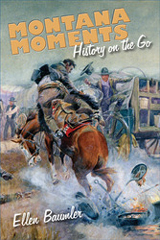
Book Note: ‘Montana Moments: History on the Go’

If you love Montana or simply enjoy humorous and shocking vignettes about the old west, Montana Historical Society historian Ellen Baumler has an easy-reading book for you.

Montana Moments: History on the Go, released last fall, is packed with the stuff of legend from strange epitaphs to bizarre happenings to comedic are-you-kidding-me yarns.

Harry Fritz of the University of Montana puts it this way: “The pages of ‘Montana Moments’ overflow with historical vignettes that cover nearly everything important that’s happened in Montana’s history. Newcomers will find an excellent introduction to what makes Montana tick, while Baumler’s careful research and entertaining writing style will delight old-timers.”

Do you know about the madams, villains and critters? Do you know who wrote the state song? Have you seen the monster lurking in Flathead Lake?

Click on the link above to buy the book from the Montana Historical Society in support of its work. Or, check out the book on Amazon.

Malcolm

Click here to enter the Garden of Heaven Give-Away drawing

Review: ‘Razor’s Revenge’ by Paul Chandler

“Lawyers spend a great deal of time shoveling smoke.” — Oliver Wendell Holmes

“The true culprit in my tale is the legal justice system. It
holds itself up as something to be admired and then proceeds to
render itself useless because it is so easily undone. All it takes is
something that any human being can speak: a lie.” — Samuel Razor, in “Razor’s Revenge”

When Samuel Razor is a young man, his promising company is stolen by three unscrupulous and corrupt men, judge Henry Craymoor, attorney Jarod Hibbard, and businessman Mark Harrington. They succeed by shoveling smoke.

Razor’s experience teaches him a powerful truth: the courts cannot protect the innocent from a well-crafted lie. As Razor plots his revenge against Craymoor, Hibbard and Harrington, this truth will serve as a mantra and a constant.

Paul Chandler’s (Peeper, 2004) thought-provoking novel Razor’s Revenge first tells the stories of the three conspirators and their desperate attempts to escape the retribution planned for them by Samuel Razor.

Time passes. Razor ages. We don’t see him directly, but through the eyes of Craymoor, Hibbard and Harrington, we understand that he is patient, relentless, thorough and richer than those who knew him way back when can possibly imagine. As Craymoor, Hibbard and Harrington see it, that vast wealth allows Razor cut their lives apart well past the limits of an eye for an eye and a tooth for a tooth.

But these men are small fish. The trophy Razor seeks is the criminal justice system itself where truth often falls on deaf ears while lawyers shovel smoke. As he ages and becomes infirm, Razor has one last dream in mind: he longs for the day when he can destroy the smoke and mirrors arguments and defenses common in our courtrooms with more truth than anyone can possibly imagine–or even want.

His dream depends on technology yet to be invented, so he hires people to research it, invent it, and test it well beyond the limitations of a preponderance of the evidence and reasonable doubt. If Razor’s researchers succeed, Razor’s revenge will be complete. The novel spends a fair amount of time on technology and testing, and some readers may find the lab work and marketing implications a bit heavy going.

Paul Chandler has, however, created an amazing paradox of a novel in which it becomes conflicting to dislike such men as Craymoor, Hibbard and Harrington as they consider punishments that exceed their crimes; and where it becomes very troubling to root for a wronged man who has yet to learn that revenge cuts both ways and might not lead to justice.

En route to the final verdict in Razor’s Revenge, readers who cheer Razor at the beginning will have ample opportunity to question whether absolute and merciless truth in a courtroom represents the best of all possible worlds or represents a dark victory.

Malcolm

Malcolm R. Campbell is the author of three novels, including Garden of Heaven: an Odyssey

Books on the Nightstand

My nightstand has so many books on it, there’s hardly enough room left over for the reading lamp and the alarm clock. I sleep better when there are plenty of yet-to-be-read books there. When they’re gone, I’m worse than a chain smoker who’s run out of cigarettes.

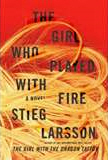
Running out of books is not an option. After finishing Stieg Larsson’s “The Girl Who Played with Fire,” I started reading two books simultaneously since one of them is on my computer. Yes, I know, if I had a Kindle, I could read e-books in bed.

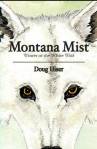
By night, I’m reading Montana Mist: Winter of the White Wolf by Doug Hiser. In addition to the wolves, this novel is filled with memorable characters and mountains. I couldn’t resist.

Publisher’s Description

In the remote Montana wilderness, a mountain man, once a professional athlete, lives his life in seclusion protecting and raising orphan wolves until he gives his heart to Sassy, a young woman hitchhiking across America. He guards his secrets and the other woman in his life, a beautiful blind woman, known as “Shy Girl.” The wolf pack roams the mountains as he searches for the white wolf, Mist; that he raised and released into the harsh snowy forested peaks, his ties with the wolves as close as the bond with his new love. Montana Mist is the story of one man’s secrets, the two women in his life, and the wild world of wolves of the remote forest in the last untamed region where man has not put his imprint on the land. A man shaped by the mystery of his past and the complication of his future while the adventure of his heart threatens to destroy his solitary precious world of mountain, wolverine, moose, elk, and wolf.

By day, I’m reading Razor’s Revenge by Paul Chandler. I enjoyed Chandler’s previous novel Peeper, and was happy to see the new release. This is very different (as its cover suggests) from Montana Mist, but equally absorbing.

Publisher’s Description

In 1958, a group of unscrupulous men use fabricated evidence, perjured testimony, and a crooked judge to steal Samuel Razor’s company. For ten years Razor allows them to believe they’ve gotten away with their crime. They continue to believe it until the day Razor comes for them.

Five decades later, Samuel Razor is a billionaire and an icon in the business world. His revenge taken, his youth long gone, and his health rapidly failing, there is one last important thing he wants to accomplish before he leaves this world, one more villain he needs to deal with.

The legal justice system-the very system that made the theft of his company legal and binding-is laughably easy to deceive. All it takes to defeat it is something that any human being can do: tell a lie. And from that lie come lawyers, trials, incompetent verdicts, and inevitably, unsatisfying compromises.

To ensure that the law only serves and does not victimize, there can be no lies, no lawyers, no biased judges. Samuel Razor has the money, the influence, and the motivation to reinvent the system. It will be his last and final act of revenge.

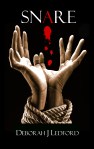
Coming up next, Snare by Deborah J. Ledford. The novel has has been nominated for The Hillerman Sky Award and follows Ledford’s outstanding 2009 novel Staccato.

Publisher’s Description

Native American pop singer/songwriter, Katina Salvo’s career is about to take off. There’s one problem: someone wants to kill her. Katina and her bodyguard, Deputy Steven Hawk, are attacked during an altercation at her first live concert. Could the assailant be a mysterious, dangerous man from her youth? Or her estranged father recently released from prison for killing her mother?

Performed against the backdrop of the picturesque Great Smoky Mountains of North Carolina , and the mysterious Taos Pueblo Indian reservation, SNARE is a thriller fans of Tony Hillerman will appreciate.

These will keep me busy for a little while, though I’m already looking for more so I don’t run out. What great books are waiting on your nightstand that I ought to be considering?

You might also like: Quick Sex, Weekend Relationships and Short Books

Malcolm

$4.99 on Kindle

Review: ‘The Girl Who Played with Fire’

The late Stieg Larsson (1954 – 2004) left a legacy that includes the Millennium Trilogy of novels, a dispute between his life partner of 30 years and his family over the estate, and an unfinished forth book that would continue the story he began in The Girl with the Dragon Tattoo and ended with The Girl Who Kicked the Hornet’s Nest.

As the second book in the trilogy, The Girl Who Played with Fire, is as absorbing as The Girl with the Dragon Tattoo. Once again, the primary characters are the crusading magazine journalist Mikael Blomkvist and the illusive goth super computer hacker Lisbeth Salander. Blomkvist and Salander are both complex, three-dimensional characters, the former, no doubt, inspired by Larsson’s career focus as a journalist. Salander is less goth than she was in “tattoo” and her background and motivations are more fleshed out.

Cast of Characters and Plot

Readers will know from the back cover blurb that Millennium Magazine’s investigative journalism in this book focuses on sex trafficking, that two people are killed before the material is published and that Salander is a suspect.

Once matters played out in The Girl with the Dragon Tattoo, Salander went on vacation. Unfortunately, this initial section of the book appears to have little to do with the plot. Salander’s development as a person gains strength during this vacation section. She does get involved in a harrowing experience. Yet, these events do not come into play later in the novel.

Except for other supporting characters whom readers met in “Tattoo,” most of the characters have few shades of grey. To some extent, they are stereotypes of the roles they play: liberal and conflicted journalists, sadistic had guys with a brutal and horrific way to life, and police with a dutiful approach but very little imagination.

Writing Style and Approach

Larsson tells his story from the viewpoint of multiple characters. This works more often than not in “Fire” because the reader sees what everyone is doing and what conflicts between them are upcoming. The approach works less well in cases where the point of view shifts to a character who, in real life, would think certain things, yet Larsson conveniently focuses their attention on something else.

One question on the reader’s mind, for example, is likely to be: “Are the police right about Salander and the murders?” Larsson goes into a “listmania” amount of detail about almost every part of the magazine work and police work, including the characters’ thoughts. Yet after the murders occur, he does not allow Salander to think either “I hope they don’t find out I did it” or “why the hell do they think I did it?” Such thoughts would go through most people’s minds. The tension is ramped up through the fact Salander does not ponder this, but it is an artificial device.

The surprising thing about the Millennium Trilogy phenomenon is that the books are popular (35 million copies sold as of last summer) in spite of their length. While some readers complain that they “just couldn’t get into “Tattoo,” the books sell well and generate a large number of reader reviews on Amazon and commentary on blogs and news stories.

The exceptional level of detail contributes to the length (“Fire” in paperback has 724 pages) and—at its best—immerses the reader into the the worlds of both the predators and prey in the book. The reader is brought “close in” to the action. At its worst, the detail wastes time, especially when it focuses on things (such as Salander spending a day shopping for furniture for her apartment) that do not advance the plot.

On Balance

On balance, the book succeeds. Its high points are the author’s development of Lisbeth Salander, the intricacies of its plot, and the author’s use of mini-cliffhanger plot points when he shifts the story’s view point from one character to another. The Guardian’s comment that Salander is a Laura Croft for grown-ups is certainly apt.

The ending of the book is satisfactory in terms of emotional justice for characters and readers. However—like other scenes in the book—it relies a bit too much on contrived coincidences. Nothing is totally resolved, though we can forgive the author that because at this point, since there’s still another book to come.

The Controversy Surrounding the Estate

Larsson died without a will. According to Swedish law, his life partner of 30 years does not have the rights of a spouse. Consequently, Larsson’s assets, including control of the books, passes to his brother and father rather than to Eva Gabrielsson.

Gabrielsson contends that the brother and father were virtually estranged from Larsson and herself and that she helped plan the Millennium series from the beginning. On the Support Eva web site, she also claims that “she was there when he received death threats from ultra-nationalist groups” and was an integral part of everything that the rest of the family had nothing to do with. Larsson’s own experience clearly was a major factor in the creation of the Blomkvist character and the other investigative journalists and she says she was part of it.

The brother contends in press releases, some of which you can find on the Stieg Larsson web site, that the family has been more than fair, that it has returned to Gabrielsson many assets she held in common with Larsson, and that they are willing to work with her in creating additional books. They contend that had Larsson wanted her to have total control of the estate, he would have married her and/or created a will.

Fuel will be added to this fire when Gabrielsson’s new book Stieg & Moi becomes available in Europe next week. Meanwhile, Gabrielsson will work on another Millennium Book. See “Stieg Larsson’s partner plans to complete final Millennium novel.” See also “Stieg Larsson feud hots up with partner’s memoir.”

Some commentators have said that the controversy surrounding the estate has the same flavor of the novels itself: that is, it’s about men who hate women. While that characterization’s accuracy depends on the “side” one takes in the dispute, it adds another level of detail and drama to an appealing series of books.

–Malcolm R. Campbell

Malcolm R. Campbell is the author of three novels, including the 2010 “Garden of Heaven: an Odyssey” about a man suspended between heaven and hell in a world where one place is often mistaken for the other.
In Wildness is the Preservation of the World

North Georgia Christmas
“Machinery and convenience are too often mistaken for civilization nowadays, but in fact civilization can be measured only by whether we live in harmony with nature, with one another, and with the divine.” — Arthur Versluis in “Island Farm”

In her excellent post called “Winter Walks and the Wild,” author and editor Zinta Aistars ponders the reasons she is drawn away from suburbia into the bitterly cold, snowy countryside of Michigan. She’s looking for a connection with the wild and, when she finds it, she also finds harmony.

She’s been reading Arthur Versluis’ “Island Farm,” a book that author James Cowan calls “a Walden for our time.” The book matches Aistars’ experience and for those who cannot—or who have not yet—gone in search of nature in its most basic form, the book tells us what we are missing and what we have lost.

What we are missing is our connection with the rest of the planet. By this I don’t mean our ability to watch breaking news from the far side of the world as it happens or to communicate with others through blogs and Facebook. The wonders of our technology obscure its deficits.

When Thoreau wrote the words “in wildness is the preservation of the world” in “Walking” in 1862, he went on to say that “the founders of every state which has risen to eminence, have drawn their nourishment and vigor from a similar wild source.” The comforts of our civilization have, I believe, not only blocked the flow of understanding and energy from that source, they have blocked our respect for the source as a viable source.

Nonetheless, we are hearing more about about nature and spirituality and connections these days. When we first heard such thoughts, we—as a modern society—tended to label them as tree-hugger platitudes and new age mumbojumbo. Now we’re starting to see that there might possibly be something happening behind the fog of platitudes and mumbojumbo. Hard science documents some of it and personal experience, like that of Zinta Aistars, documents some of it.

At present, we’re not yet sure just how big “it” is. We’re drawn more and more to the wild, but we’re not yet ready to plunge into it with a point-of-no-return attitude: “I want to become one with the deer from the comfort of my toasty warm car.”

The nearest shaman in our neighborhood still has a lot of teach us about connecting with the wild. And we still have a lot of listening to do before we’ll understand once and for all that our lives depend on that wildness more than on our technology.

“Civilization has so cluttered this elemental man-earth relationship with gadgets and middlemen that awareness of it is growing dim. We fancy that industry supports us, forgetting what supports industry.” — Aldo Leopold in “A Sand County Almanac”

Only $5.99 at OmniLit

Out of the Darkness

Every sixteen minutes, someone in the United States dies by suicide, according to the American Foundation for Suicide Prevention (AFSP).

The AFSP conducts Out of the Darkness walks to increase national awareness and to help raise funds for education and research for suicide prevention.

I am pleased that my brother, Barry, will be participating in the upcoming Orlando, Florida Annual Community Walk on February 5th. He will be walking for TEAM STRAT in honor of the late rap artist and poet David Campbell (STRAT).

“Although we have lost him in life, he will always live on through his son Taylor, his poetry, his music, and many wonderful memories.”

The Orlando walk will be held February 5, 2011 at Baldwin Park: 2420 Lakemont Ave.

Review: ‘The Templar Salvation’

The Templar SalvationThe Templar Salvation by Raymond Khoury
My rating: 4 of 5 stars

Raymond Khoury’s The Templar Salvation (2010) sequel to The Last Templar (2006) is better than the original. Like the original, The Templar Salvation presents a story of lost/hidden church secrets with dual time lines, a lot of historical detail, and plenty of action.

In the present day, Khoury brings back FBI agent Sean Reilly and archeologist Tess Chaykin in a race with terrorist Mansoor Zahed to find a cache of early Christian documents. In 1203, while the Fourth Crusade siege of Constantinople is in progress, a small band of Templars sets out to rescue and then hide the same set of documents. In both time lines, the Catholic church doesn’t want the documents to come to light.

The Last Templar featured an amazing opening scene. The Templar Salvation’s opening, while slightly less spectacular is action-oriented and inventive. Tess is in danger. Sean rushes to the rescue and, in spite of the law enforcement resources available in Turkey and at the Vatican, becomes the point man in a search for Tess, Mansoor, the documents, and a variety of people who end up dead.

The Templar Salvation is more tightly woven than The Last Templar. It also contains fewer “talky scenes” where Tess and/or Sean explain elements of the 1203 story to present day police officers as though 800-year-old information trumps current evidence or the need to get out of the squad room with some sense of urgency. The Templar Salvation might be called “The Book That Will Not End.” Tess, Sean and Mansoor find themselves within nanoseconds of being killed (or worse) numerous times throughout the story only to escape/survive and keep on searching, fighting or running.

Nonetheless, the improbable story somehow makes for more exciting reading than The Last Templar. The Templar Salvation is a violent, tangled, twisted, groaner kind of escapist read that features the kind of over-the-top, don’t-worry-about-civilian-deaths-and-collateral-damage law enforcement that viewers of the TV series “24” tuned in every week to see.

Like agent Jack Bauer in “24,” Sean Reilly is as relentless as a Terminator in his quest for neutralizing the bad guys and possibly obtaining justice. And, like Jack, Sean keeps going, going and going even though his wounds would have killed ten normal men.

The book is a guilty pleasure.

View all my reviews

Malcolm R. Campbell is the author of “Jock Stewart and the Missing Sea of Fire,” “Garden of Heaven: an Odyssey,” and “The Sun Singer.”

Crawford W. Long Museum Opens Wall of Fame Exhibit

Wall of Fame - Dave Rosselle photo
Jefferson, GA, January 8, 2011 — The Crawford W. Long Museum unveiled its new Wall of Fame exhibit honoring the museum’s founding contributors at a dedication ceremony here this afternoon. Known as the Birthplace of Anesthesia, the museum—in its three historic buildings on the town square—celebrates the work of Dr. Crawford W. Long’s first use of ether for surgical anesthesia on March 30, 1842.

Plaques on the Wall of Fame celebrate the names of almost 600 individuals, families and businesses who donated time and money to create and develop the museum which opened in 1957.

Speaking to the one hundred guests—including relatives of the museum’s founders—Jefferson Mayor Jim Joiner said the exhibit honors “those whose vision led them to create an educational memorial to Dr. Crawford Long on the site of the first use of anesthesia for surgery, a discovery now considered America’s greatest contribution to modern medicine.”

In 1951, Jackson Herald publisher T.P. Williams and Crawford Long biographer Dr. Frank Kells Boland met with the Georgia Historical Commission in to discuss the creation of the museum. The commission said it would provide half of the funding for the purchase of a building if the citizens of Jefferson could raise the money. The local fund-raising drive was successful in less than a year.

The Crawford W. Long Memorial Museum Association was incorporated in 1955. Officers included those who had led the fund-raising drive: Frary Elrod, Storey Ellington, Robert Bailey, Edmond Garrison, Morris Bryan Jr., Thomas Bryan, Jack Davidson, and T.P. Williams. The museum is now owned by the City of Jefferson with the ongoing support of the Crawford W. Long Association.

Association board president Roxane Rose presented museum projects manager Lesa Campbell with a bench in honor of her late mother Sallie Holsonback who died last September. The bench was placed in the museum’s 1850s Pendergrass Store building.

Today’s dedication ceremony coincided with the first anniversary of the museum’s re-opening after a two-year restoration project that included exhibit upgrades and structural renovations to the facility’s historic buildings. During the past year, over 2,000 visitors and 43 groups have toured the museum.

Last year, visitors attending the museum’s re-opening came out in force on a bitterly cold day. Today’s guests attended the Wall of Fame dedication while weathermen were broadcasting winter storm warnings. (The six-inch snowfall held off until everyone got home.) With luck, Mother Nature will be more accommodating for upcoming events, including a March 30th Doctors Day celebration and the opening of a Civil War medicine exhibit on April 15th.

Ice Bound in Jackson County Georgia

Snow and Shadows
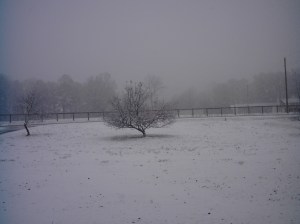
Last weekend’s snow in central and north Georgia dumped six inches of very celestial powdery white stuff on our small town. A few hours before it all began Sunday night, I saw the mayor at an event at the Crawford W. Long Museum and asked if the city was ready for the winter storm.

He indicated we would attack the streets with our personal shovels and spades. So far, nobody’s shoveling off our street. The problem really isn’t the snow. It’s the freezing rain and freeing drizzle that came down on top of the snow. The traffic around metro Atlanta is a chaos of wrecks, jack-knifed tractor trailers blocking the interstates, and cars in the ditch.

At least, metro-Atlanta has sand and salt trucks and plows. We don’t. So, we are more or less ice bound even though the ice is probably less than a half an inch. Yesterday, the temperature got up over freezing for just long enough to begin creating slush, slush that froze solid last night making the roads worse than they are.

Footprints next to a slick driveway
We’ve been making do with whatever groceries happened to be in the refrigerator from last week. The vat of chili has been tasty, but were running low on wine, candy and doughnuts. The snow has brought a lot of birds to our feeders, giving the cats something to watch out the kitchen window.

After living in northern Illinois, I feel somewhat awkward being snow bound and/or ice bound with less than a foot of snow. A friend who got hit with 14 inches of snow says that we’re just lightweights down here in Jackson County, Georgi.

Possibly so. We’re staying warm, though. Wasting time on Facebook. Reading more. Being ice bound is conducive to working on my next novel. Goodness knows, I can’t escape from it right now. As the words pile up, I can feel virtuous about my dedication even though the weather ought to get a mention on the acknowledgments page of Sarabande when it comes out later this year.

Thank you for all your help, Mother Nature.

Ah, a locomotive’s horn: well, at least the trains are running.

Malcolm

Learn more about my novel The Sun Singer via Vanilla Heart Publishing’s book club extras!

Review: ‘Labyrinth’ by Kate Mosse

Labyrinth (Languedoc Trilogy, #1)Labyrinth by Kate Mosse
My rating: 4 of 5 stars

Kate Mosse’s engaging and well-researched novel Labyrinth (2006) brings readers another version of the Holy Grail and those who would protect it, seek it, destroy it and use it. Labyrinth joins Khoury’s The Last Templar (2006) and The Templar Salvation (2010) and Neville’s The Eight (1997) and The Fire (2008) in its presentation of a religious secrets story that switches back and forth between time periods and characters.

Set in thirteenth-century Languedoc and twenty-first century southern France, Labyrinth presents readers with medieval and modern characters who are searching for the Grail with good and bad motives. Alaïs du Mas, the daughter of the steward of historical character Raymond-Roger Trencavel in Carcassona, resides in a world where Cathars and Catholics live in harmony with each other. Alice Tanner, a professor of English literature in Sussex, is a volunteer in an archeological dig in the Sabarthès mountains in France in 2005.

The lives of these dual protagonists—and the characters around them—become intertwined across history when Alice inadvertently discovers some of the Grail secrets Alaïs dedicated her life to protect. Alaïs’ world is under attack by a Crusade and subsequent inquisition ordered by Pope Innocent III in 1208 against the Cathars who were viewed by Rome as a heretical sect. Alice’s world is that of a modern police investigation into deaths and thefts linking a mainstream archeological dig with a shadowy world of those who follow or oppose the Grail.

The mirror aspects of the characters’ lives across the centuries serves Mosse and her plot well. Unlike Dan Brown, who viewed the Grail as Mary Magdalene and Arthurian literature that viewed the Grail as a sacred chalice, Mosse presents instead the secret artifacts which are intended to lead true seekers through both a real and a figurative labyrinth to the Grail as a transcendent experience.

With the exception of a slow beginning and a few sections where the detail in both the modern and medieval worlds becomes more history and travelogue than a novel, Labyrinth is a well-told story. The novel’s discussion guide notes that the book begins with short glimpses of the leading characters without any narrative to tie them together or explain their motives, and then asks “what effect does this have on you, as a reader?” It’s a good question. Some readers will find it slow and unnecessarily obscuring of the story, while others will find that it heightens the intrigue and suspense.

For readers who want to know more about the life and times of the Cathars, Mosse includes a historical note, a selected bibliography, information about the langue d’Oc spoken in Alaïs’ world as well as a glossary of Occitan words.

View all my reviews

Copyright (c) 2011 by Malcolm R. Campbell, author of two hero’s journey novels,The Sun Singer and Garden of Heaven.