do you know why you read what you read or does it just kind of happen


“A reader’s tastes are peculiar. Choosing books to read is like making your way down a remote and winding path. Your stops on that path are always idiosyncratic. One book leads to another and another the way one thought leads to another and another. My type of reader is the sort who burrows through the stacks in the bookstore or the library (or the Web site — stacks are stacks), yielding to impulse and instinct.” ― Jane Smiley

I’m a creature of habit and my strongest habit is inconsistency.

During the Vietnam War, bar girls in navy liberty ports used the phrase “butterfly man” to describe sailors who weren’t “loyal” to the same woman every time they came to port.

Assuming I can forget where that phrase came from, it aptly describes the apparent inconsistency of a writer’s reading habits as well as his/her seemingly slapdash approach to the art and craft of writing itself.

As Smiley says, our paths are winding and are choices along them are idiosyncratic and ruled by impulse and instinct. I grab books off the shelves because they seem like they’re going to be good. I am seldom fooled by this approach, though I have gotten stuck with a few books I wished I hadn’t grabbed off the shelves.

When I try to outline or, so to speak, plot out my reading choices (such as reading only one genre or reading all the books that receive certain prizes), I end up with a mess. Inconsistency makes perfect sense to me because I trust instinct and impulse more than I trust to-do lists and step-by-step plans.

I spent a lot of time out doors when I was growing up, and while certain things were good to do based on experience, one had to be ready for anything, to watch for signs, changes of weather, become attuned to sounds and scents and wrap that all together into moving up a mountain or along a trail with a fair amount of intuition. Sure, a lot of it was knowledge that had become internalized and then followed without having to think about it. But instinct kept one aware of dangers and wonders that plans never uncovered.

The worst thing people can for me is to recommend books. Then, suddenly, I start feeling an obligation to read those books, and get back to them the moment I’m done as though I’m doing a school book report. Funny, how there are people I like and agree with about a lot of things except the books they want me to read. “They want me to read book ABC because it’s by the same author and/or similar to book XYZ which they know I liked.”
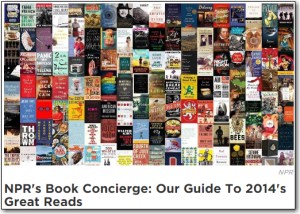
I know NPR and other media outlets mean well with their lists of a year's best books, but I don't take those ideas a gospel.
I know NPR and other media outlets mean well with their lists of a year’s best books, but I don’t take those ideas a gospel.

I dislike most of the books suggested to me based on that kind of reasoning.

This will sound superstitious and insanely inconsistent, but I’m a “force is with me” kind of reader and writer. That is to say, if I’m “supposed to read” a certain book, I’ll find if by myself one way or another. If it’s a book I probably won’t like, I either don’t hear of it or stay away from it for unknown reasons.

My wife and I often finish each other’s sentences, but we seldom finish books one of us reads and recommends to the other. If you’re not my wife (and the odds are 100% that you’re not) you have a snowball’s chance in hell of handing me a book to read that I’ll be happy with.

Over the years, family members have given up on picking books for me as gifts. When Christmas and my birthday approach, they want to see a wish list from which to choose. (I just need to remember not too buy anything off the list before December 25th and August 12th have come and gone.)

So, how have you fared? Do family members and friends tend to know what you want to read and suggest or send books to you that you actually like. Or do they strike out?

I feel bad when people send me books I don’t like because having to tell them I don’t like the book they selected is about as difficult to do without injury as answering such questions as “how do you like my new dress,” “isn’t my hairdo just perfect,” and “would you like some more of my green bean casserole?” So many hurt feelings, busted noses and broken marriages come from answering those questions incorrectly.

Seriously, if we like each other, please don’t say, “Malcolm, you really need to read Lust in a Broken Birdbath (or whatever).”

Malcolm

Malcolm R. Campbell’s Vietnam novel “At Sea” is free on Kindle August 15-17.

Thoughts on getting older

If you came here today expecting wisdom or anything approaching sage advice, you’re screwed.

For one thing, I don’t think you came here for that reason because, as we were saying during the Vietnam War, you can’t trust anyone over 30. Today, our youth culture still maintains this truth, adding to it the idea that it’s completely unnecessary to know anything about what happened over 30 years ago.

oldclipartI’m amused by people half my age who explain things to me that I knew before they were born. I think my parents were amused by this when I told them stuff I learned in college. Some of what I told them they experienced first hand–like World War I and the depression.
For those of you under 30, World War I happened before World War II, though with today’s math instruction in the schools, that probably doesn’t make sense. And, the depression wasn’t the kind one tried to escape with Valium or Xanax.

Quite possibly, I have a long list of things about which I can say, “been there, done that, got the tee shirt.” Unfortunately, more and more people haven’t heard of any of those things even if they do have the tee shirts.

One of those things is walking or riding my bike to school. That doesn’t seem to be done anymore. In fact, it appears to be borderline illegal. I’m reading this novel right now in which a single mother wonders how so many parents can attend–by her calculation–some 30+ hours a week of school related activities: plays, talent shows, recitals, togetherness sessions all of which occur during working hours. If you don’t show up, the parents that do show up pity you and think you’re rearing* your children wrong. They think that, too, if they see your kid riding or walking to school.

I work at home as a quasi retired, borderline crazy writer. That means I can log on to Facebook and Twitter any time I want. When I’m there, one thought is this: what the hell are all these other people doing out here during working hours? I know, I know, since corporations and other employers are borderline criminal, it’s okay to steal time from them by texting and looking at Facebook. Or, maybe their employers think it’s okay and have hired extra staff to cover the time when the current staff is online. That sounds like something that would happen in France.

I guess it comes down to this, my thoughts on getting older probably sound like the same kinds of thoughts by parents and grandparents had when they were getting older, and that boils down to you kids have it easy, hell, my generation had to claw its 20 miles  to school on snowshoes. Most of you didn’t know my parents and grandparents, so maybe this snow information is something new.

See what I mean? You’re screwed (figuratively speaking, hopefully) for reading this post.

Malcolm

* One way you can tell I’m over 30 is that I say “rearing kids” instead of “raising kids.” In the old days, “raising” referred only to pets and/or pigs. And jackasses, too, I would think.


Conjure: why those frizzle chickens are handy

“The Frizzle is a breed of chicken with characteristic curled or frizzled plumage. While the frizzle gene can be seen in many breeds, such as thePekin and Polish, the Frizzle is recognized as a distinct breed in a number of European countries and Australia. In the United States frizzled chickens are not considered a breed, and at shows are judged by the standards of the breed they belong to.” – Wikipedia

Unless one keeps chickens or attends 4-H competitions, most of us will probably never see a chicken with frizzled (curled) plumage, what one blogger calls the “divas of the chicken world.” However, if you’re researching hoodoo for your books–as I have been–it’s amazing what you learn about all kinds of things that are indirectly related to your subject.

So, how would chickens help a conjurer?

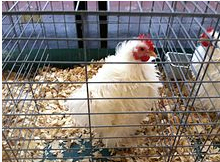
Frizzle chicken - Wiipedia photo
Frizzle chicken – Wikipedia photo

First, conjure includes what’s often generically referred to as foot track magic, tricks (hexes) that are placed on the ground in order to keep away or send away people who might walk through them or over them; they are also used as one of the many techniques that can protect one’s own property.

Second, the best defense is a good offense, so if you’re a conjurer, you want your property protected so that others can’t come on it while you’re asleep or away and place tricks on the normal pathways use use to come and go, walk to the potting shed or garden, or gather eggs from your own chickens.

If your chickens aren’t confined in a coop, what do you see them doing on the property? They’re constantly scratching the soil looking for something to eat. If they scratch through a hex sign, for example, they destroy it. According to some conjurers, black frizzle hens are a very good defense against anything a rival did to your property if they find a way to get onto it without your own magic turning them away.

As the very handy Lucky Mojo site puts it, “The backwards curling of the frizzled feathers on these birds is seen as a natural expression of their ability to undo bad work that has been laid down to walk over. Frizzles come in all the usual chicken colours and patterns, but since black hens are the birds most often used to scratch up evil powders in the yard, it follows that a black Frizzled hen would be the best possible bird in the world for that purpose. As with the black cat, also much admired and much feared in hoodoo work, a black Frizzle hen’s dangerous associations with the infernal can be parlayed by a deft root doctor into a powerful tool for undoing and reversing evil and uncrossing clients..”

If you’re working evil, you’ll find the eggs from black hens very effective, but that’s another story. If you want the chickens for style, you should know that their plumage doesn’t offer as much protection against rain and cold weather as flat feathers. Keep them in a sheltered place during bad weather.

–Malcolm

Malcolm R. Campbell is the author of the hoodoo novel “Conjure Woman’s Cat,” available at major booksellers in paperback, e-book and audiobook.


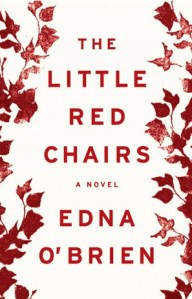
Quickly Noted: ‘The Little Red Chairs’ by Edna O’Brien

“On the 6th of April 2012, to commemorate the 20th anniversary of the start of the siege of Sarajevo by Bosnian Serb forces, 11,541 red chairs were laid out in rows along the 800 meters of the Sarajevo high street. One empty chair for every Sarajevan killed during the 1,425 days of siege. Six hundred and forty-three small chairs represented the children killed by snipers and the heavy artillery fired from the surrounding mountains.” – from “The Little Red Chairs”

What do the fairy tale setting in a remote Irish town and Radovan Karadzic, the Butcher of Bosnia, have in common? In a sane world, nothing. In her alternate history, 85-year-old Edna O’Brien combines what begins as an apparent folktale with the chilling angst of an Irish woman, Fidelma, who stumbles beneath the butcher’s spell before she knows he’s the butcher. As a stranger in her small town, Vlad is an event, a hypnotizing holy man and trickster with wisdom and danger in his eyes, the kind of man every mother warns every daughter about.

littleredchairsAs the story begins with all the charm of “The Music Man,” it’s easy to fall beneath the steel wheels of O’Brien’s spell and hope against hope tht her words are leading toward something perhaps a bit scandalous, something that might leave the townspeople–and especially Fidelma–with a few bittersweet scars of the kind that aren’t really cut that deep. But O’Brien’s tale goes where it must, to graphic and unspeakable horror from which Fidelma cannot quite escape. None of those 11,541 chairs was for her, but–if she had lived and breathed outside of fiction–destiny owed her a chair and, perhaps, absolution.

The Butcher of Bosnia is, in some mysterious way, the air which this story needs in order to breathe, and yet in other ways who he is and what he did are not the novel’s focus. The focus is Fiedelma, her suffering, her acts which were a curse to her village, her misplaced innocence that brought her, as naivete often does, to a hell from which there was no escape.

This novel is not for the faint of heart. As Joyce Carol Oates wrote in her New York Times review, “O’Brien is not interested in sensationalizing her material, and ‘The Little Red Chairs’ is not a novel of suspense, still less a mystery or a thriller; it is something more challenging, a work of meditation and penance. How does one come to terms with one’s own complicity in evil, even if that complicity is ‘innocent’? Should we trust the stranger who arrives out of nowhere in our community? Should we mistrust the stranger? When is innocence self-destructive? Given the nature of the world, when is skepticism, even cynicism, justified? Much is made of innocence in fiction, as in life, but in O’Brien’s unsentimental imagination the innocent suffer greatly because they are not distrustful enough.”

When we consort with the devil, by whatever name he identifies himself, should we not expect betrayal? It’s not an easy question, spells being what they are and innocence being what it is. Is there a message in this book? Yes: trust ensures our doom.

Oates’ questions are ever on our minds these days when terrorism comes out of nowhere and visits pleasant communities and exuberant celebrations in large cities.  I wonder if we can afford to be innocent these days. If not, what a pity. Suffice it to say, Fidelma will find little pity because those who (we often say) should have known better are seldom afforded the compassion granted the skeptical or the ignorant.

Yes, this novel is a masterpiece. Yes, it is well told, dark and deep. But it should carry on its cover a warning: “Abandon all hope, ye who enter here.” You cannot read this novel without being forever changed. I dealt with the book quickly here because I am too faint of hear to speak about it at length.

Malcolm

Oh no, I missed the top earning writers’ list

Here’s the list (stolen from Jane Yolen’s Facebook profile):

1. James Patterson $95 million
2. Jeff Kinney $19.5 million
3. J.K. Rowling $19 million
4. John Grisham $18 million
5. Stephen King $15 million
5. Danielle Steel $15 million
5. Nora Roberts $15 million
8. E.L. James $14 million
9. Veronica Roth $10 million
9. John Green $10 million
9. Paula Hawkins $10 million
12. George R.R. Martin $9.5 million
13. Dan Brown $9.5 million
14. Rick Riordan $9.5 million

I’m shocked. I don’t see my name there. What the hell happened? Maybe Forbes magazine screwed up the math.

–Malcolm


There’s nothing in your spam queue at the moment

An empty spam queue is good news whether it’s one’s e-mail account or one’s blog.

According to “A Brief  History of Spam,” a pervasive urban myth is that (when referring to the meat product introduced by Hormel in 1937) the letters S, P, A, M are an acronym for “Scientifically Processed Animal Matter.”  I’m sure the Hormel company doesn’t agree. But I wonder, what does the company call its e-mail queue of unwanted junk mail?

snakeoilWordPress protects bloggers from most of the SPAM. I look in the queue from time to time to see what’s there. Unlike my e-mail accounts which occasionally have legitimate e-mails in the SPAM queue, there is almost never anything other than the lowest quality animal matter in my WordPress SPAM queue.

I’ve written about the SPAM queue here from time to time because I can’t figure out how or why SPAM would ever work. It has a snake oil quality about it that looks even worse (assuming that’s possible) when the messages are written with the pretense that the spammer has actually read the post to which they’re attached.

Many newsletters destined for my e-mail accounts suggest that I put their addresses in my “this stuff is okay” list (or whatever it’s called) since they often have links in them that anti-SPAM software interprets as SPAM.

That’s too bad because my e-mail account has way too much SPAM in the SPAM queue for me to sort through it item by item. Maybe spammers should wise up and make their e-mails and comments look less like SPAM.

If spammers tried to sell me what my blog subjects suggest I might be willing to buy, they might have more luck. That’s what I would do if I went into the SPAM business. Goodness knows, I wouldn’t be peddling Viagra to people with writing-related blogs. I’d be peddling writing services. I never find any of those in my WordPress SPAM queue.

Not that I want to. When we advertise legitimate products, we’re advised to target our audiences. That’s what we do when we boost a post on Facebook. We look for people who might really want our book or short story collection or authors’ services site. Spammers don’t seem to do that. I’m glad they don’t, because I don’t want more stuff I have to manually delete.

You can tell it’s a slow day when I waste time pondering SPAM.

–Malcolm

Malcolm R. Campbell’s publisher, Thomas-Jacob, is giving away a free Kindle Fire tablet to one of the people who subscribes to the new mailing list. The Random drawing is a couple of weeks away. So, if you want a shot at the Kindle and if you want to keep up with my work and the work of the other authors at Thomas-Jacob, here’s the link for the subscription/entry form.

When magic creates the ride, all the writer can do is hang on

“A bit of advice
Given to a young Native American
At the time of his initiation:
As you go the way of life,
You will see a great chasm. Jump.
It is not as wide as you think.”
― Joseph Campbell


Magic is like drugs. However, once you let it take over, you’re not lost. You are found. Logic, the more addictive drug, will become your greatest trap because, like an old bad habit, it works on you, makes you think that magic is a a delusional part of your unconscious that’s escaped into your mind like devils, makes you doubt yourself.

magicbookWhenever I run back to logic, I stop writing. I stop writing because logic tells me loud and clear that hanging on to a magic carpet as my fingers type words on the screen is no way to write a book. It’s illogical. One must plot and plan and outline the who shebang from beginning to end. Yes, that makes sense. The thing is, I don’t know the story I’m telling until I’m telling it, and then all I know is what happens next.

When logic gets a hold of me, I’m scared to write: I don’t think I can do it because I don’t know how I do it. As I mentioned in my last post, we create our own reality. So, we meditate, play around with the law of attraction, go on shamanic journeys, repeat affirmations and cast spells, but how quickly that can fade in the chilling light of day when the car won’t start or your spouse is sick or the man you hired to build a fence around part of your property hasn’t shown up for six weeks or the trees in your yard of dying for lack of rain. Where’s the magic now?

Logic breeds on itself. The more I think I need it, the more I use it, doubting myself more and more in the process.  Sooner or later, I say to hell with that and jump the growing chasm of doubt. The rains come, the fence gets built, my wife gets well, and the words flow.

Some say magic gives the practitioner more control. I suppose if one thinks of magic is the wizards in the Harry Potter books hurling never-fail spells across the room, then perhaps it does. But there’s a paradox here. Exerting control is logical thinking. To live and write by magic means surrendering to the greater part of oneself and the universe and one understanding that the less one pushes, the smoother the ride.

A couple of days ago, I used the word “epitaph” in a figurative way in my work in progress. The moment I did it, I knew it wasn’t figurative at all. Magic knew where it was going before I did and logically it made so sense to go there. After resisting that idea for two days, I saw I had no choice but too get out of the way of the story in the same kinds of ways our greater selves ask us to step out of the way of the directions our lives are meant to go.

MRbloghop2016Too much logic ensures it’s going to be a bumpy ride.

When I was in the navy, I often heard the proverb “Smooth seas don’t make good sailors.” Maybe we need a few of those hard knocks of life to finally understand we’re going about it all wrong and start seriously looking for a better way.

I think I ran through every pothole the universe had to offer until I realized I was gripping the wheel as though my life and art depended on it. Early in life, we often become brainwashed into thinking we need to grip that wheel the way we do.

Whenever writer’s block looms  large before me, I remind myself to let go while I write. My hope is that my readers will let go while they read.

–Malcolm

Malcolm R. Campbell is the author of the magical realism novella “Conjure Woman’s Cat,” available in paperback, e-book and audiobook.

This post is part of the Magic Realism Blog Hop. About twenty blogs are taking part in the hop. Over three days (29th – 31st July 2016) these blogs will be posting about magic realism. Please take the time to click on the frog button for a list of other blogs in the hop. Links to the new posts will be added over the three days, so do come back to read more.

Storytelling, dreams, and magic

Life in Truth (as opposed to the “life actual” world we see with our eyes) “tells us of the world as it should be. It holds certain values to be important. It makes issues clear. It is, if you will, a fiction based on great opposites, the clashing of opposing forces, question and answer, yin and yang, the great dance of opposites. And so the fantasy tale, the ‘I that is not you,’ becomes a rehearsal for the reader for life as it should be lived.” – Jane Yolen in “Touch Magic”

MRbloghop2016When we wake up from a dream, we’re aware of the fact that we didn’t realize we were dreaming while we were dreaming, but accepted what was happening as real no matter how improbable it seems in the light of day. Daydreams are somewhat the same. We’re imagining surfing in Hawaii or climbing Mt. Everest when somebody says, “you look like you’re a thousand miles away.”

Authors hope readers will react to their books like this. We want the reader to step into the story and, as the words flow forward along the pages, believe a little or a lot that the story is real. When a book is compelling, readers are often startled when the phone rings or somebody knocks on the front door and they find themselves back in “life actual” in somewhat the same way they react when they wake up from a compelling dream.

It’s said that Samuel Taylor Coleridge suggested that when stories contain human interest and a semblance of truth, readers will temporarily suspend their judgement about the implausibility of the plot, setting and characters. Readers willingly suspend their disbelief and see the novel, short story, play or movie as life actual rather than life in truth.

A general fiction author will take us to a real place, or at least a realistic place, in our own comfortable domain of life actual (sometimes called “consensual reality”) and tell us a story that could happen (or might have happened) in the “real world.” (I put “real world” in quotation marks because both Quantum physicists and spiritual gurus have called into question whether the world we perceive as real is real.)

Contemporary fantasy authors will take you to a hidden place within the world we know where magical events occur. The Harry Potter series is a good example of this. Most of the magic within Rowling’s books was confined to Hogwarts and other magical locations. The consensual reality at Hogwarts was different from the consensual reality in London, and both readers and wizards knew that they were traveling between parts of the world with different rules.

perception2Magical realism authors bring magic into the world we know. In a magical realism story, the magic is part of the characters’ everyday life and is accepted as just as real and viable as the cars they drive and the pots and pans in their kitchens.  The characters don’t see magic as something with the world “maybe” attached to it whether that magic comes from the land, from ancestors or spirits, or from the spell casting or innate abilities of the people involved.

The authors of general fiction (or realistic genres), contemporary fantasy, and magical realism all want readers to suspend their natural disbelief in the reality presented in the novel, and accept it as real in the same way they accept dreams and daydreams as real. In some ways, readers are like those who go up on stage during a hypnotist’s or magician’s performance and say, “Yes, I’m willing to be hypnotized” or “Yes, I’m willing to be fooled by your illusions.”

Perception is Reality

Storytellers, hypnotists and stage magicians (illusionists) can place you into somewhat of a dream state in which you accept what’s happening as real because we believe that perception is reality in one or more of these ways:

  • Psychologists might say you see the same reality as everyone else, but are impacted by it differently because of how you feel about it or yourself.
  • Quantum physicists might say that reality is more than we perceive with our physical senses and that our thoughts or our presence impact it in ways we may not realize.
  • Those who study and accept what used to be called “new age” belief systems will say that our perception and our thoughts create the reality we experience and that we can be taught how to do this consciously.
  • And others will say that our perception of what is real can changed temporarily due to hypnosis, strong emotions or other traumas, alcohol or drugs, or some other life actual cause.

When it comes down to it, most authors don’t think about “perception is reality” while they’re writing. Learning one’s craft brings authors the techniques they need to tell a page-turning story that readers perceive as real while they’re reading it. Most of us want to be tricked one way or another when we watch a hypnotist’s or a stage magician’s performance. We don’t usually think about being tricked or enchanted or hypnotized when we pick up a novel, but that’s what happens if the story on that novel’s pages is well told.

Magical Realism or Just Plain Realism?

I see the world as a child of the new age. I’ve had arguments with publishers about whether my novels and short stories should be called general fiction or magical realism because I believe everything in my stories is real. But, publishers, bookstores and readers tend to like seeing the genre labels because those labels help them choose the ways they like being hypnotized or enchanted (in a magical sense) by an author.

What do you see?
What do you see?

I’ve always written about the world I perceive. Until others pointed it out, I didn’t realize I was writing magical realism. I had to ask, “What makes my stories fit into that genre?” Publishers, editors and writing gurus kept telling me, “You and your characters. . .”

  1. View the spell for creating a pillar of fire or jinxing a troublesome neighbor as no different than a recipe for mac and cheese.
  2. Assume haints and other spirits are just as likely to be in the forest as deer and raccoons.
  3. Give myths and legends just as much credence as recorded history–or suggest they’re more accurate
  4. Think trees, rocks, storms and the land itself are conscious.

I said, “Yes, of course I perceive everything that way. Doesn’t everyone?”

As it turned out, most other people don’t share my perception of reality in their day-to-day lives; however, enough of them like being lured into short stories and novels with that kind of perception to make magical realism a popular genre.

I think I was the last to know.

The world as we know it draws lines between our dreams and our waking hours, between illusion and five-senses perception, between magic and non-magic, and between life actual and life in truth. Magical realism takes away all those lines.

Malcolm

This post is part of the Magic Realism Blog Hop. About twenty blogs are taking part in the hop. Over three days (29th – 31st July 2016) these blogs will be posting about magic realism. Please take the time to click on the frog button for a list of other blogs in the hop. Links to the new posts will be added over the three days, so do come back to read more.

Wow, almost 100,000 views for this blog

roundtablelogo

Aw shucks, folks, thanks for all the visits and for putting up with the fact I haven’t felt the need to place this blog squarely in one niche or another.

  • The all-time favorite post is: The Bare-bones structure of a fairy tale. Even though that post is a little over two years old, it still out performs every new post from week to week. I have no idea why, but at over 7,000 views, it’s well ahead of the rest of my 1,065 of posts since 2007.
  • The second most popular post is: Heave Out and Trice Up. This, I understand. A lot of people search for the meanings of navy jargon and slang, most especially what “heave out and trice up” actually means. This post was written in 2010 and still gets hits every week.

I’ve done a lot of reviews on this site, a few author interviews from time to time and talked about writing (including my own). Those posts are in the majority. However, when north Florida’s notorious Dozier School was in the news, my 2012 post about the White House Boys got a lot of hits. So did my 2013 (and frequently updated) post about the fate of the aircraft carrier USS Ranger that was scrapped rather than turned into a museum.

Since my books are mostly set in Montana’s Glacier National Park and the Florida Panhandle, I’ve written posts about my stories’ settings. Those get more hits over time than they do on the day they appear. I’m glad you find them whenever you find them.

I’ve appreciated your comments over the years as well. One never knows what people will say. I do know it takes time for you to write them.

Want a chance at a free Kindle Fire?

For those of you who’ve enjoyed reading my books and short stories, I want to mention that my publisher is starting a newsletter. I hope you’ll sign up. It’s free. Better yet, one subscriber will receive a free Kindle Fire Tablet. Deadline is 16 days from now. Click here to subscribe and enter the random drawing for the Kindle.

As for heaving and tricing

Now, for those of you who are curious about heave out and trice up, it has nothing to do with throwing up while seasick or drunk. I don’t know if navy ships still use the phrase as a wake-up call over the ship’s public address system. It means get up and raise your bunk (rack) or hammock up away from the floor (deck) so that the compartment cleaners can sweep out your berthing (sleeping, not having babies) area.

–Malcolm

Malcolm R. Campbell writes magical realism, contemporary fantasy and paranormal novels and short stories.


How does your worldview influence your writing?

When you read a hard-as-nails police or espionage novel, do you wonder about the worldview of the author? Do you assume s/he’s politically conservative, possibly career law enforcement or military, and/or heavily interested in weapons, military strategy, law and order issues and personal and national security?

When you read a novel about people coming of age, discovering themselves in hero’s journey styled stories, or finding love among the ruins, do you wonder if the author is writing out of his or her own philosophy of life and “the big picture”? Do you assume s/he is politically liberal, possibly a teacher or a psychologist, and/or heavily interested in social programs, personal and religious freedom and a lifetime of learning?

I’m not sure we should make these assumptions. If we do, we might be surprised how often an author writes “against typecasting.”

worldviewOn the other hand, many of us write short stories and novels that are heavily influenced by our “philosophy of life” or our view of the universe and an individual’s place within it. When I read a page-turning espionage novel and marvel at the author’s knowledge of weapons and tactics, I see quite clearly that I could never write such a book. I have no experience with military weapons and have never been drawn to study them, much less to form a clear picture about their technical differences or what it would be like to use them in a real world situation.

On the other hand, when I read a magical realism novel I assume that the author has an affinity for the magic and the stories generally associated with the time and place in which the story is set. A good researcher can find out what myths and legends might apply to a town or a region. But blending those into a story probably requires a sense of magic just as a spy novel often requires its author to have a sense of weapons and combat situations.

Perhaps somebody has written a doctoral dissertation or a definitive book about stories and the authors who tell them. Perhaps there’s research out there that shows the connections (or lack of connections) between authors’ books and authors’ political/philosophical/religious beliefs.

Personally, I see writing within–or somewhat within–one’s worldview as another way of writing what you know. Expediently, it’s a practical approach because in general terms, our worldview is our comfort zone. We know more about how situations within that view might unfold and how characters embracing our attacking that worldview might develop, react and think. Some (perhaps many) authors might refute this idea by showing how they have been a chameleon–so to speak–by writing books that contrast so greatly with each other that readers could only conclude that they have no worldview at all, have multiple worldviews, or changed their worldviews over time.

That said, perhaps my musings on this subject boil down to this opinion: If you’re an emerging writer, writing from within your worldview gives you a greater chance of “getting it right” than writing about characters and events you don’t grok in your daily life.

That’s my experience. What’s your experience?

–Malcolm

Malcolm R. Campbell is the author of fantasy (“The Sun Singer,” “Sarabande”), paranormal (“Moonlight and Ghosts,” “Cora’s Crossing), and magical realism (“Conjure Woman’s Cat,” “Emily’s Stories,” “Willing Spirits”) novels and stories.