I gotta ask, ‘whose chair is this?’

Every morning it’s the same.

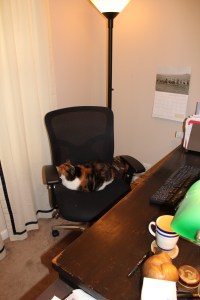
chairwithkatyAfter the kitties are fed and the dishwasher is emptied, I find something figuratively described as breakfast and pour a cup of Maxwell House coffee which will be good to the last drop. Katy, a big-boned or a fat calico (depending on who’s describing her) follows me around while I do this.

Then I take the “breakfast” and coffee to my den. Katy follows. If I forget something, like my glasses, she follows me back to the kitchen while I retrieve them and returns with me to the den like a dog who’s just passed an AKC utility obedience trial and merits as CDX designation.

However, were the trial judge to follow us into the den, s/he would discard the CDX one nanosecond after Katy occupies 55% or more of my desk chair. Katy stays there until dinner, ebbing and flowing–one might say–to occupy smaller or larger portions of the chair. Sometimes, I feel like I’m about to be evicted and say, “Katy, I gotta ask, whose chair is this?”

She thinks it’s her chair. Well, that figures.

Malcolm


Human Trafficking Awareness Month

nativehopeAlthough human trafficking “is a global issue, it is also prevalent very close to home. Native American women and children make up 40% of sex trafficking victims in the state of South Dakota alone. According to federal data, Native women are twice as likely to be sexually assaulted as women of other races. They are also subject to high rates of intimate-partner violence and other forms of assault. These factors, along with poverty, substance abuse, and foster care, can make them vulnerable to exploitation. Secretary of the Interior, Sally Jewell, reiterates the ‘threat of human trafficking to Native communities and sex trafficking of Native Americans and Alaska Natives,” describing the ‘first citizens of the United States as some of the most vulnerable.’” – Native Hope

Read more at Native Hope

According to their website, 88% of the crimes committed against native women are committed by non-Indians. This is a long-standing and intolerable problem and, frankly, the kind of statistic we believe we’re more likely to hear from a third-world nation. Of course, many Indian reservations rank below many third world nations when it comes to health care, employment, sanitation and other services most of us take for granted, and quality of life. Nonetheless, the facts surprise me.

Most of us cannot do anything about this problem by ourselves. Yet, through working with others, we can create meaningful change and improve the lives of countless women.

You can help by clicking on the highlighted link above, learning more, and considering a donation.

And, as the site says, “If you believe someone you know may be a victim or is in a vulnerable position, read our article on signs to watch for. If you are a victim and need help, please call the hotline at the National Human Trafficking Resource Center at 1-888-373-7888.”

See also: National Indigenous Women’s Resource Center  and Wiconi Wawokiya – a Lifeway to a Better Future Without Violence in Our Community.

–Malcolm

Writing Prompts and Flash Fiction Contests

If you’re the kind of writer who lives and breathes flash fiction and/or who responds well to writing prompts, take a look at the frequent contest and prompt posts at Indies Unlimited.

indiesMost recent prompt: Dew Drops – photographic prompt.

Latest Contest (January 15th Deadline):  Aftermath -original, unpublished prose up to 500 words. No entry fee.  Prizes: 50 euro first prize; 25 euro second prize; 15 euro third prize; All winning entries (including shortlisted stories) will be published in the January 2017 issue of Brilliant Flash Fiction.”

Tempted? Looking for something to do this week? Plus, it might be fun.

Malcolm

Thyme for cooking, conjure and health

“Thyme (/ˈtaɪm/) is an evergreen herb with culinary, medicinal, and ornamental uses. The most common variety is Thymus vulgaris. Thyme is of the genus Thymus of the mint family (Lamiaceae), and a relative of the oregano genus Origanum.” – Wikipedia

If you’re a Simon & Garfunkel fan, you probably remember their third album “Parsley, Sage, Rosemary and Thyme.”

If you have an herb garden, you know that thyme is easy to grow, looks nice and smells good.

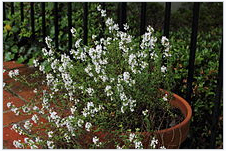
thymeIf you have a spice rack in the kitchen, no doubt there’s some thyme there. I add thyme to my spaghetti sauce. A lot of recipes call for its use in roasts, scrambled eggs, chowder, biscuits and with potatoes and other vegetables. Sunset says that “Thyme is a kitchen workhorse, infinitely useful with a wide range of meats and vegetables, and also with both savory and sweet fruit dishes. With cooked dishes, try adding thyme at the beginning and then a little more at the end, just before serving to make its flavor pop.”

Medicine

The leaves and oil of thyme have a lot of claims behind their efficacy in treating diarrhea, stomach ache, whooping cough, colic, soar throat, flatulence, and as a diuretic. The Natural Society website states that “The volatile essential oils in thyme are packed with anti-septic, anti-viral, anti-rheumatic, anti-parasitic and anti-fungal properties, which explains why thyme-based formulas are used as an expectorant, diuretic, fungicide and antibiotic.”

Spirituality

When used as incense, it’s been said to stimulate courage and purify homes and temples. According to Wichipedia, “It was mixed in drinks to enhance intoxicating effects and induce bravery and warriors were massaged with thyme oil to ensure their courage. Women wore thyme in their hair to enhance their attractiveness. The phrase ‘to smell of thyme’ meant that one was stylish, well groomed, poised, and otherwise attractive. Thyme is a Mediterranean native spread throughout Europe by the Romans. Their soldiers added it to their bathwater to increase bravery, strength and vigor. It enjoyed a long association with bravery. In Medieval England, ladies embroidered sprigs of thyme into their knights’ scarves to increase their bravery. In Scotland, highlanders brewed tea to increase courage and keep away nightmares.”

Conjure

You can buy this curio online in several places

My interest in thyme, other than using it a lot in my cooking, is for its folk magic applications. Hoodoo practitioners use it to help their clients sleep, usually as an incense placed on charcoal or leaves placed inside or beneath a pillow for a so-called “magic dreaming pillow,” and for attracting money. Growing thyme in a garden, grows your wealth. It protects you and helps your income if you tie the leaves up in paper money and bury it where two paths cross beneath a full moon. It can also be added to bath crystals and sachets–or even as a perfume.

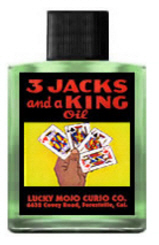
Add it to a mojo bag with bayberry, cinnamon, and alfalfa to attract money. Some practitioners mix it with galangal, vetiver, patchouli and cardamon when making Three Jacks and a King oil for gambling. (Massage the oil into your hands when you pick up the deck of cards and “feed” your mojo bag with it.) Traditionalists recite the 23rd Psalm when they use the oil. Some folks dress (coat) candles with it or even sprinkle it on poker chips.

Catherine Tronwode, author, practitioner and owner of the Lucky Mojo Curio Company, says that old time recipes like Three Jacks and a Kind, are “slightly different — some placing emphasis on catching lucky numbers through dreams, others on being hit with lucky “coincidences” or hunches, and still others on obtaining uncanny runs of finger dexterity at cards or dice — or all of these combined with luck at love and games of chance — but they have in common the underlying aim of enhancing the magician’s internally generated forces, enabling action upon the external world.”

For information about the use of thyme and other plants in conjure, consult Hoodoo Herb and Root Magic: A Materia Magica of African-American Conjure by catherine yronwode. For plant usage in pagan, Wicca and traditional witchcraft, see Cunningham’s Encyclopedia of Magical Herbs by Scott Cunningham.

–Malcolm

Malcolm R. Campbell is the author of two folk magic novels, “Conjure Woman’s Cat” and “Eulalie and Washerwoman.” Both books are available in e-book, audiobook and paperback editions.


I love the self-taught writer

“Everywhere I go I’m asked if I think the university stifles writers. My opinion is that they don’t stifle enough of them. There’s many a best-seller that could have been prevented by a good teacher.” – Flannery O’Connor
englishteacherI subscribe to several writer’s magazines and occasionally find an article I like. I like articles that make suggestions, start people thinking on their own, send aspiring writers off to their keyboards where they just go for it.

I made my worst grades in high school and college English classes because, (a) I already spoke English and didn’t know why I needed a course in my native language, and (b) When it came to writing–and worse yet, to reading–the teachers and the textbooks strayed far outside the boundaries of suggestion.

I balk at rules. Suggestions, though, are like writing prompts. (“A man walks into a bar, orders a glass of milk, and the bartender kills him.”) With a prompt or a suggestion, the sky’s the limit. With a rule, the creative person is stuck more or less in a coffin with no place to go. When you ignore the rules, your grade suffers, even when you do it well.

“Write an analysis of this classic book, discussing the symbolism I’ve already told you is it it,” the teacher tells us. Screw that. I’ll tell you what I see in the book, not what you see in it or what the author of our anthology of excerpts (complete with non-transparent discussion questions) sees in it. The book = me + the words. That’s it. You (the teacher) are not there. When the teacher doesn’t find his belief system in your term paper, your grade suffers, and woe be unto you if your belief systems makes more sense to the teacher than his or her own.

When I look through a writer’s magazine for suggestions, I stumble over dozens of advertisements for MFA programs with long lists of regular and visiting faculty members who will help “you” become a better writer. I don’t think this is possible and that what really happens is those who don’t want to write get properly stifled and that those who do only listen to the lectures and critiques and discussions to hear what fits the philosophy of writing they have before they walk in the door.

When kids are free do go outside and simply play, they come up with amazing things as they follow their whims and their imaginations and their feelings of that moment. This is how I visualize writers in the process of teaching themselves. They follow the intuition they have right now, rather than being given a list of literary terms and styles to use in a writing assignment. Unfettered is where our best work arises.

My opinion, to be sure. But try it (that’s a suggestion and not an order). In fact, this entire post is biased because it represents what I like. . .reading what I love, experimenting with stuff, and seeing what happens. Others may like short story instructors to say “today we’re using irony” and poetry instructors who say “today we’re using enjambment.”

It’s not that I think we should legislate against English classes for English speakers and creative writing classes for people who want to write creatively or even against running a Master of Fine Arts degree for people who want some resume material. We might see better books if we did that, but somehow, there’s something uncomfortably authoritarian about ridding ourselves of those who want to force rules upon us with yet another rule. So, we’re stuck with it, being chained to a system for writing freely.

Philosopher Denis Diderot purportedly said, “Let us strangle the last king with the guts of the last priest.” I’ve liked that statement ever since I first heard it in nursery school or kindergarten. A word of warning, if you play with that statement, substituting other professions into it, it’s best not to write a theme in English class that attempts to prove the truth of the argument that “We should strangle the last creative writing instructor with the guts of the last English handbook author.” It seemed funny at the time, but my teacher took it personally, which is what I intended while proclaiming that I was speaking, well, philosophically with a touch of irony.

Basically, I believe that if a person wants to write poems, short stories and novels, they should get on with it, run them up the flagpole, and see what people think. If nobody gets it, perhaps they need work. Well, writing is always work, so that’s win-win for everyone. As writers, I think we flourish when we put out moments of free play down on the page.

–Malcolm


Montana Historical Society Calendars for 2017

Click on the graphic for the online store.

My den has had a wall calendar next to the desk from the Montana Historical Society for 25 years in a row. The Society’s four calendars for 2017 are a great example of their yearly selections.

I like the black and white archival photographs calendar since it comes every year as a membership benefit. There’s almost always a selection of paintings from Montana artist Charlie Russell and a scenic photographs calendar and, as you see in the photograph here, Indian art.

Since I often write about Montana, all of these are inspirational. I find myself looking at them as I work almost as though their mandalas.

For non-members, these calendars, from top to bottom in the graphic, retail for $12.99 (an engagement calendar), $10.95, $9.95, and $14.99

Cowgirls and Cowboys

Growing up with westerns on TV and in the theaters, cowboys were an icon of the American west, larger than life and nearly mythic. However, photographs in “Cowgirls & Cowboys” show people at work. As the calendar’s introduction points out, these women and men worked in a beautiful place and came to know the land, weather and their animals very well. Nonetheless, they “endured long hours and difficult conditions for relatively little pay.”

The Lakota Way

This beautiful calendar features the work of Lakota and Iroquois artist Jim Yellowhawk, “whose work evokes Lakota star knowledge and the unique Lakota way of life.” He grew up on South Dakota’s Cheyenne River Reservation. You can see samples of his work on his website here.

Each month includes a Lakota wisdom story from teacher and historian Joseph M. Marshall III who grew up on Rosebud Sioux Indian Reservation. His books include The Lakota Way of Strength and Courage and The Day the World Ended at Little Bighorn. On his website, he writes, “Cante wasteya nape ciyuzapelo.  I take your hand in friendship.  This is a common Lakota greeting.  The literal meaning is with a good heart I take your hand.” 

I’m drawn to Montana’s land, history and people. Even if you’ve never been there, a calendar from the Big Sky Country can brighten up a room. Chances are good, though, that your state or favorite place has a historical society as well. Their calendars remind us of why we like a place and–especially if there are kids in the house–have a wonderful educational value as well.

–Malcolm


Microsoft to update your brain due to atomic clock hacking incident

Washington, D. C., January 1, 2017 (hacked time), Star-Gazer News Service – After the National Security Information discovered that Kim Jong-un ordered the Supreme Hacking Department of North Korea’s administration to hack into and disrupt the Unites State’s atomic clock, President Obama had a new problem:

To be puctual, or not to be punctual, that is the question:
Whether ’tis nobler in the land to suffer skewed time
With it’s Slings and Arrows of undestined misfortune,
Or to take Arms against a malware sea of code,
And by opposing, obliterate it, to say we now awake
To end the Heart-Ache of sleep in our hexed abode
And hope the replacement era suits us better for goodness’ sake.

North Korean hacked time at the fictional present moment.

According to 98.6% of the federal government’s panel of scientists, most Americans believe today is January 1, 2017 because the North Korean malware introduced a stream of malicious leap seconds into the heart of the atomic clock so that ever since the dog days of August, time has moved “faster than theoretically possible.”

“Among other things,” said Temporal Control Officer (TPO) Erwin Schrödinger, “birds and bees are ‘doing it’ more often than usual, work days are longer and weekends are shorter, and most of what’s happened in the last four months never happened.”

Press secretary James “Jay” Carney said that the administration has decided to “let the temporal cat out of the temporal box” and “take arms against the malware sea of code.”

According to Schrödinger, most Americans will suffer no ill effects from an over-night reprogramming of their brains via software contributed by Microsoft.

actualtime
Actual time

“While you sleep, perchance to dream,” said Carney, “your brain will be taken back to August 11th and will be re-set so as to allow the entire nation to move ahead in harmony with time as the good Lord has defined it, ordered it, and calculated it. Most people will suffer no ill effects and will wake up tomorrow as though nothing has happened. Quite frankly, nothing has happened since the lethargic and indolent dog days, so for most people it will be business as usual even though a few people may have to reboot their sex lives and other coping mechanisms several times to get back on track.”

Concerned about the ethics of violating Star Trek’s temporal prime directive and voiding four months of seemingly real activity, the administration erred on the side of caution by taking no action in spite of the fact it was informed of the hack while it was happening. Some government philosophers said that if we got a “do over,” the same things would happen because they were destined to happen. Others said that “tweaks in the updates’ reprogramming code would keep people from doing the wrong things they did and the result would be a better world.

The decision was finally made when Obama asked if reprogramming the clock and the brains of the populace would bring back Debbie Reynolds and Carrie Fisher.

“We told him it would,” said Schrödinger, “even though everything that may have happened since August 11th is neither true nor not true until we reprogram ourselves the new truth is set free–or isn’t.”

“Make it so,” the President said.

–Story by Jock Stewart, Special Investigative Reporter

Are you eating collards, black-eyed peas and cornbread?

“Each ingredient has meaning and purpose. Black-eyed peas represent coins, collard greens represent dollar bills and cornbread represents gold. Eating each Southern staple on New Year’s Day is supposed to guarantee a prosperous year, ensuring wealth and luck. While, I do not believe in luck, I do believe in the power of tradition.”

– Amber Wilson in her blog For The Love of the South

Wikipedia Photo
Wikipedia Photo

As far as I know, I had black-eyed peas, collard greens and cornbread only once on January 1. Something bad happened in the days after that and while my parents and their friends discussed the fact that the meal wasn’t a magic charm in my case, I no longer remember what the bad thing was. Must have blocked it out.

Even though I like these things (the collards take a lot of vinegar to disguise the taste and the black-eyed peas have  to be fresh rather than baked into a brown mush like many people do), my wife doesn’t like any of them. Well, we both like cornbread and still have some left over from Christmas Day.

Why tempt fate by eating this combination again at New Year’s?

I like a lot of Southern food: boiled peanuts, mullet, fried catfish, hoppin’ John, pumpkin frybread, Vidalia onions and yellow squash, hush puppies, grits, and a ton of stuff from New Orleans. But collards never got into my top 100 things to eat. Neither did black-eyed peas, for that matter.

Maybe we’ll have steak on new year’s day along with a baked potato wrapped up in tin foil and some fake bacon bits ready to go. Of course, if you believe in the whole collards, black-eyed peas and cornbread spell, go ahead an eat it at your own discretion and maybe it will bring you luck for 2017. By the way, if you click on the link above for Amber’s blog, her recipe for this old Southern spell actually looks pretty good.

Happy new year!

Malcolm

A great example of local history for authors

I like history and folklore and frequently mention them in my books as part of what makes up the place where my story is set. Since history and folklore are tied to real people and what those people believe, the interesting tidbits we use need to be treated with respect.

We paint the reality of a place in part with old stories.

I’m currently reading Zora Neale Hurston’s Tell My Horse, a folkloric study of Jamaica and Haiti based on her trip there in the 1930s. Early on, she talks to a man whom she refers to as Brother Levi. What Brother Levi has to say about the meaning of the word “Christmas”might sound sacrilegious to some people. That’s fine, because if an author were to mention this story in a book, s/he would be doing so not as gospel or a religious tract, but to establish a strong ambiance for the location.

The writer doesn’t necessarily paraphrase a story like this. S/he has a character mention it or mention the days when Brother Levi was a strong influence on local culture and beliefs, or perhaps includes it in a narrative overview of the country’s beliefs that newcomers are unaware of and might come across over time.

Hurston’s Story

Brother Levi: “We hold a candle march after Joseph. Joseph came from the cave where Christ was born in the manger with a candle. He was walking before Mary and her baby. You know Christ was not born in the manger. Mary and Joseph were too afraid for that. He was born in a cave and He never came out until He was six months old. The three wise men see the star but they can’t find him because He is hid in the cave. When they can’t find him after six months, they make a magic ceremony and the angel come tell Joseph the men wanted to see him. That day was called ‘Christ must day’ because it means ‘Christ must find today,’ so we have Christ-mas day, but the majority of people are ignorant. They think him born that day.”

I have no plans to write about Voodoo in Jamaica. But if I were setting a novel there, I would find this snippet a delightful way of setting the stage, of showing an alternative point of view. I love reading folklore for what it is, but I take note of things that might one day become part of the depth of place I’m always trying to establish when I write.

–Malcolm

Malcolm R. Campbell is the author of the award-winning “Conjure Woman’s Cat” and its sequel “Eulalie and Washerwoman,” magical realism novels about a north Florida conjure woman’s battle against racism and the Klan.

The tragic losses of 2016

Americans like statistics almost as much as baseball aficionados. As we wend our way toward the end of a year, we see them, those statistics.

  • Most important news stories
  • Best books of the year
  • Top-earning movies of the year
  • Deaths of famous people.

In the social media, people have been saying 2016 is a bad year for the high number of deaths of famous people, most recently Carrie Fisher and Watership Down author Richard Adams. And a few days ago, George Michael. Those who die younger than some unknown age are said to have died too soon. Even so, the loss of people who have lived well past the normal life expectancy is said to be tragic.

statsCelebrities impact us in larger-than-life ways. So, it’s not surprising that the deaths of well-known people impact us more than the numbers of people who died in Aleppo or the fact that traffic fatalities exceed the death tolls of most (if not all) of our wars.

So, we mourn the losses of the rich and famous whom we don’t personally know as though they are close friends and family. Those we don’t know, aren’t on our radar because–suffice it to say–in spite of the large numbers of dead in Aleppo, there’s no apparent connection between us.

That lack of an apparent connection is one thing that, quite possibly, keeps us sane as individuals, for we do not have the capacity to mourn everyone who dies with the same level of grief that’s present when we lose a spouse, parent, or child–or, apparently, a celebrity.

In some ways, celebrities are stand-ins for the heroes of old, and we celebrate them for doing and being what we believe everyone should be capable of doing and being; likewise, we chide them and turn on them when they disappoint us almost as though they’re our own wayward children.

How odd life and death are. We know in our hearts that everyone dies, yet express surprise when they do. As a writer, I often wrestle with this seeming paradox, but I have to tell you I haven’t come up with a suitable answer to it. In my other blog, I wrote that It’s hard to say goodbye to Princes Leia.  And it is. It seems natural that it is and it seems ironic that it is when those closer to home who are, say, friends of a friend impact me less. I hate to dismiss all this with something lame like “that’s just the way people are.”

Perhaps like Star Trek’s Mr. Spock, I mourned the loss of Janis Joplin in 1970 while wondering why I was mourning her loss. Yes, I liked her music. But I never met her, never saw her in a concert, didn’t have an autographed picture of her, hadn’t memorized her discography, and didn’t drink Southern Comfort. But still, I felt bad about it more than just shaking my head at the lost potential of her “going too soon,” “dying too young,” and the other things people said when when she was gone.

I still don’t understand the tragic nature of death or why the deaths of strangers often impact us more than the deaths of people who, by all reasonable statistics, are much closer to us. But mourning is what we do in good faith and quite naturally, so other than wondering about it as an author might, I can only say that it’s the way things are. That’s okay, I guess.

Malcolm