My wife got me this 100000000000-piece puzzle for Christmas.

Apparently, there’s still more work to be done.
–Malcolm
My wife got me this 100000000000-piece puzzle for Christmas.
Apparently, there’s still more work to be done.
–Malcolm
 The Magic Strings of Frankie Presto by Mitch Albom
My rating: 5 of 5 stars
Mitch Albom’s words and the songs they play in “The Magic Strings of Frankie Presto” comprise a “Pure Perfect Fifth,” a term related to an ancient system of musical tuning that has been linked to alchemy and the transformation of souls. Narrated by Music himself, this tale about an orphan from Villareal, Spain who becomes the best guitar player in existence is the quintessence of a well-told tale accompanied by the music of the spheres and the wisdom of many players.
Frankie’s mentor, known as El Maestro, reveres composer and guitarist Francisco Tárrega, teaches the classics, demands constant practice, and tells his young student to respect his left hand by keeping the nails trimmed so that the sensitive fingertips feel the pain of every note. They begin with Tárrega’s “Lágrima” (teardrop), and that song becomes a fitting leitmotiv throughout the novel.
Frankie can play it all, from the free strokes and rest strokes of Spanish guitar, to every standard rock and roll chord progression, to the worried notes of the twelve-bar blues. Though Frankie Presto plays a guitar with magic strings, his life is almost pure blues, pure “Lágrima.”
He is forever haunted by the violent unknowns of his childhood, people who suddenly go missing, the comings and goings of fame and not fame, his lover Aurora’s long absences, injuries and penances, and the on-going conflict between a beautiful voice that makes him rich and a guitar technique that nourishes his soul. Once, when he told El Maestro he wanted to be perfect as both a singer and a guitar player, Le Maestro said that both was the same as neither.
Frankie is forever running and forever searching. Through it all, his music leads him while he feels the pain of every note. Near the beginning of Albom’s novel, we learn that Frankie is dead, that we are standing around before the funeral talking with Music about Frankie’s life through a Chroma-filled remembrance that includes all his sharps and flats and rests. His story is filled with mystery, too, the unexpected riffs that come out of nowhere like the here-and-gone notes of a jam session, moments that fall together that had seemed separate, and a hidden continuity Frankie doesn’t know about until late in life. The unexpected arises again and again in different keys from the walking base line that drives the story measure by exceptional measure. And he wonders, is this gig destined synchronicity or perfectly orchestrated manipulation. He will have to decide that before the plays his last song.
By the end of the novel, with the help of an all-wise narrator and the testimonies of those who knew him in ages past, Frankie knows everything about himself and his magic strings, why things happened as they did, and the blessings of music as his song resolves into a coda of joy with a lasting counterpoint of “Lágrima.”
–Malcolm
What do you do when it’s time to downsize your personal library? I suppose you can sell some of the books on eBay or Amazon, but most buyers at these outlets won’t pay more than a few pennies over shipping costs. That’s certainly not the fate most of us want for the older editions of niche books and classics.
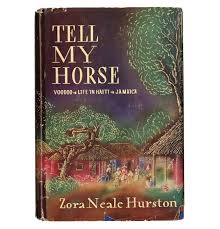
A Facebook friend of mine used her intuition plus a healthy dose of reality based on the subjects I’ve discussed on my blogs about the research I’d been doing for two folk magic novels. She sent me a message telling me she was thinning out her library and thought she had a book that needed to be in mine. Would I take it in. It was an adoption, I thought even though I’d have to wait and see what it was.
Of course, when it comes to adopting pets, we seldom say we’ll adopt a pet without knowing what it is; nobody wants to be contemplating a regal cat or a playful puppy and have a tiger snake or an alligator show up. But, knowing S___, I didn’t think I’d end up with anything like those living books in the Harry Potter series that have teeth and are always angry when the wrong person tries to read them.
Her intuition was spot on. She sent me the 1938 original edition of Zora Neale Hurston’s Tell My Horse, an anthropological study of Voodoo in Haiti and Jamaica blurbed by Carl Sandburg, no less, with words like “bold,” “beautiful,” “priceless,” and “unforgettable.” The New York Times said of it, “Strikingly dramatic, yet simple and unrestrained…an unusual and intensely interesting book richly packed with strange information.”
I’ve read a lot of Hurston’s work from her novel Their Eyes We Watching God to her news coverage of the unfairly conducted 1952 Florida murder trial of Ruby McCollum to stories and books like Mules and Men collected while she was gathering hoodoo and other Florida folklore for the Works Progress Administration’s (1935-1943) Federal Writers Project. But Tell My Horse wasn’t in my library until yesterday afternoon at 4 p.m. when the mail arrived.
I know little about Voodoo (a religion), having mostly researched hoodoo (folk magic) except when I’ve stumbled across accounts out of New Orleans about notables such as Marie Laveau. So, I will enjoy reading this study about a related subject from one of my favorite authors; I’ll treasure the book and my highly intuitive Facebook friend who gifted it to me. I don’t know how long she had the book. When I told her Tell My Horse arrived, she said, “I knew you’d give it a good home. It languished with a friend of mine who was an antiquarian bookseller, until I found it in a dusty corner. I came to her through the experimental film of Maya Daren who was allowed to film and participate in voodoo rituals as Hurston did in her medium. It is a great relief to find her a place to thrive.”
S___, the book won’t languish in a dusty corner and, if you happen to stumble across this blog, I love you for your spirit of adventure, your kindness and your wonderful gift.
Now I know a good way to send my old books off into the world before they take over the house (my wife says they already have). Like Tell My Horse, many of my books are older than I am and will need loving homes rather than moldy basements and dusty attics.
–Malcolm
Malcolm R. Campbell is the author of two, Florida folk magic novels “Conjure Woman’s Cat” and “Eulalie and Washerwoman.”
“Wherever the creative power of desire is, there springs the soil’s own seed. But do not forget to wait.”
– C.G. Jung, The Red Book
If you are not a winter person, Winter requires patience in addition to bracing oneself against the cold and the extended time of darkness.
 Some folks welcome the solstice because once the shortest day and longest night have come and gone, they feel like they can begin the happy countdown to Spring. Others–and I am one of them–believe Winter and darkness are part of the natural progression of everything throughout nature. Seeds require Winter, a time of waiting and preparing before flowering and fruiting are even possible.
Humans are like that, too, I think, though I’ll admit that being a Winter person becomes more difficult with age. One discards short sleeved shirts sooner, starts wearing heavier jackets, and copes less well with the cold.
Mentally, more than physically, I still welcome a time of patience, of waiting for ideas to germinate, and noting the temporal and spiritual components of ancient Yule celebrations.
As more and more of us become further separated from farms and their harvest cycles, it’s not easy to maintain ones place in the annual cycle of things. This is a pity, I think, for our mental and spiritual development has so much in common with the natural world’s “great wheel of the year” throughout the seasons.
However you see Winter and the solstice, best wishes and seasons greetings.
–Malcolm
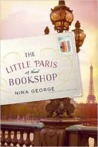 The Little Paris Bookshop by Nina George
My rating: 4 of 5 stars
This is a sensual book, filled with logic-numbing regrets, dreams, desires, wines, culinary extravagances, books that heal broken hearts and knit together shattered souls, and dreams larger than the imaginations of people who keep life in check or feel safer walling up their most excessive hopes.
Some say the book is pure sugar. Those who say that have never truly danced the tango as Paris bookseller Jean Perdu was taught to dance the dance by his long-lost lover Manon whom he has mourned for twenty years. (She simply left him one day without a word.) Now he sits on his “Literary Apothecary” barge–long tied up tight against a Paris pier rather than moving like a dancer on the river as boats are intended to move–and almost psychically “reads” the hidden away words of his customers’ stories so accurately that he can recommend the books they need to heal and, perhaps, to dance unfettered.
Unfortunately, he cannot prescribe for himself. Yes, he has danced the tango and set aside thinking for pure feeling and unchained inhibitions. So why has he chained his boat and his total self to a Paris pier when he knows what life can be if he let go of everything but the yearnings of “right now”? The answer is not mine to give you.
I can say that Jean Perdu finally unties his boat and motors down river to find out why he’s been held fast by memories. He meets other people who need but who don’t quite know what they need. Borrowing Hemingway’s words, the journey becomes a “movable feast” and the plot turns upon the question of whether or not Monsieur Perdu will prescribe for himself the charity and clarity he needs to enjoy it.
Like a rare evening meal when the best red wine, the best lamb cutlets with garlic flan, and the best conversation with people who know low to listen with their eyes conjure an experience that memory will often doubt could have been real, “The Little Paris Bookshop” takes its characters–and its readers–into the heart of bliss that will ever seem too unlikely to be possible.
The best way to dance the dance while reading this exuberant novel is to unchain yourself from whatever logical rules and proprieties bind you. Doing that is the book’s prescription.
Looking at the older drafts of my book and short story manuscripts is similar to going down into the Grand Canyon and seeing the strata of past eras stacked up like cord wood.
Every revision of a book came at a different era of my life, eras that no longer represent the focus of my thinking in the present. Same story, of course, just as I’m still the “me” of ten or twenty years ago. But the ambiance is different. The emotions change, too, depending on whether I was angry about something similar to an event in the novel or, some years later, felt more mellow about it.
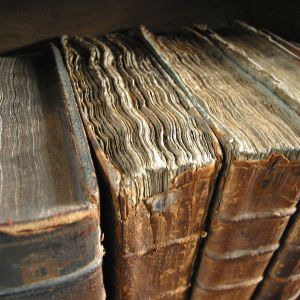 I’m reworking an old novel now that has gone out of print. I’m surprised by some of the things I find: (a) Wow, did I write that? (b) Crap, why the hell did I say that? (c) I don’t remember this scene at all.
I try never to change the basic story, but tend to polish a little here and clarify the meaning a little there. Of course, Amazon keeps everything, including books that came and went years ago and haven’t been in print for years. So, if I get this book fixed up the way I want it, there will be an author’s note at the beginning that tells readers the names of previous versions. (I’m not into the romance authors’ ploy of releasing old stories with new names and/or new covers so that readers buy them without realizing they read the things 20 years ago.)
A writer’s journey down into the depths of his older work shows him (hopefully) that he’s writing better stories today than he wrote when he first started out. Most of my really old stuff never gets revised! The work also shows him where he might have slipped in recent years as though he forgot about some of his better techniques. He sees changes in himself as well, for the work–as Virginia Woolf wrote in Orlando, “Every secret of a writer’s soul, every experience of his life, every quality of his mind is written large in his works.”
If you’ve ever come across a diary you kept years ago or the saved letters you wrote to an old friend or family member who’s since passed on, you know what I’m talking about. No matter how careful or flippant or circumspect you were, your secrets are still there–the secrets about yourself as you were then, whenever you wrote what you wrote. What a strange and eerie way to re-discover the selves we thought we’d outgrown and buried in the past.
I see all this when revise or rewrite old books. In some ways it’s a blessing, and it some way’s it’s not.
–Malcolm
If you love magical realism, Florida, conjure or a bit of mystery, I invite you to discover my two folk magic novels, “Conjure Woman’s Cat” and “Eulalie and Washerwoman.”
 As you might have noticed, there’s been a fair amount of political talk going around this year.
A lot of it illustrates my hypothesis that politicians–especially career politicians who don’t believe in term limits–are people who were consigned to hell who’ve been let out on parole because hell is full and/or because Satan thinks they’ve been rehabilitated and/or because having them running loose in the temporal world is the result of another one those “learning experiences” both God and the Devil want humanity to wallow through, albeit for different reasons.
Looking at the results of this learning experience so far, it appears we have failed. No, this isn’t a comment about who won and lost, but about how we’ve played the game.
Badly, I would suggest.
Will Rogers, who wasn’t a fan of government, once said, “I don’t make jokes. I just watch the government and report the facts.” Assuming he’s in a grave, he would be turning over in it now because the facts no longer matter. They’re not even funny.
We live in a world of fake news and selective-reporting-by-corporate agenda. People are arguing on Facebook, citing “the fake news I believe” vs. “the fake news you believe.” The gist of this approach is that people listen to “news” reports and editorials based on the fake news that best coincides with their view of the world as they think it ought to be. Any sane person steps into these debates at their peril usually to be slammed by people on both sides of the aisle as an ignorant troll.
So where are we now? Some say we’re in a hell of a mess. It’s so bad that most of our comedians have gone from being funny to being strident. It’s so bad that 75% of people’s prayers these days are that the people believing the wrong set of lies will perish in a flood or volcano. It’s so bad that hell itself looks like a paradise.
So, what’s to be done?
Some say, if you can’t beat them, join them. That sounds unseemly, like a sell out, like the fastest way to hell in a hand basket. Some say, “sue the bastards,” though the trouble is, we can’t seem to agree on which bastards need to be sued. Some say, “make love, not war,” and while that’s not a bad idea, it probably won’t send the nasty politicians back where they came from. Others are running around like chickens with their heads cut off and, as we all know, that doesn’t accomplish a whole hell of a lot.
My advice–which isn’t worth a damn–is to keep silent until the extremists on both sides of the political spectrum run out out of ammo. That may take a while, but better safe than dead.
–Malcolm
 For years, I wanted to take a famous fairy tale and turn it upside down. The result is my Kindle story “Waking Plain” which is a fairy tale while poking fun at “Sleeping Beauty.”
In “Sleeping Beauty,” like other tales, the woman is always beautiful, needs a man to rescue her, and that man is somebody who (after waking her up or otherwise saving her), sweeps her off her feet because he’s not only a rich king or prince, but is really handsome.
What if “Sleeping Beauty” had been a hag? Yes, she’d probably still be asleep.
What if the guy who kissed her was the castle janitor? Does she wake up and die of fright? Does the king give him a meaningless title so he’s fit to marry the princess? Or, maybe the janitor is thrown in the dungeon?
These are the kinds of questions that need to be asked.
But, more could be done. So, I made the sleeper a rather plain prince who, as the story unfolded, was more of an out of sight, out of mind kind of royal. Who’s going to wake him up? Maybe nobody, God willing.
Enjoy the story.
Malcolm
After finishing the festive part of my day–putting up the outside Christmas lights–I gulped down a shot of morphine, calmed my mind, and went down into the WordPress netherworld where the spam queue is guarded by snakes, lost souls, and the ghost of Jack the Ripper.

Fortified against demons and chaos as I was, I felt as strong as anyone does when they confront their personal hell. Maybe I should have studied Jung’s “Red Book” longer rather than taking drugs. Listen, I’m not making this up: neither Carl Jung nor morphine prepared me for the utter and infinite nothingness of an empty spam queue.
An illusion?
Perhaps so. After all, we’ve learned–as I posted yesterday–that we have no clue what reality is all about. Stands to reason, we probably know squat about unreality as well.
The only real thing in the spam queue is the sound of dripping water, or maybe it’s blood or Gatorade–nobody quite knows–but I heard it today and within the vast nothingness of the afternoon, the normalcy of the sound became worse than the sound of the tell tale heart in Poe’s story. Drip…drip…drip. Nobody ever finds the dripping water, or whatever, because the place is jam packed full of spam. Except not today.
It’s not that I miss the spam, those penny Viagra sales, the services that write posts for your blog, the prospective foreign wives who want marriage and a green card before they disappear, the something-for-nothing stock brokers, the SEO experts who say my blog isn’t SEO optimized, the people from Colorado selling pot in oregano bottles, and all the other black market crap that’s actually cheaper at your downtown department store.
No, it’s not that I miss it, I don’t believe it isn’t there. Somehow, the unseemly became unseen like an invisible mirage. You’ve probably seen those horror movies where scary music blasts into your head every time some hapless character opens a closet door–yet nothing bad springs out. You know something the hapless character doesn’t know. What you know is that after 15 closet doors have been okay, the 16th door is hiding something really bad, something so bad that the sound track won’t even tip anyone off that the door should never be opened.
That’s the feeling I had this afternoon in the empty spam queue, you know, that it wasn’t really as empty as it looked, that I’d walk around a corner with my guard down and fall into a pit of maggots selling auto insurance to anyone in my state.
Worse yet, with no visible spam, the place was open to all possible spam, the spam of my nightmares, the spam I think about on lonely roads, the spam people threaten me with during Facebook flame wars–this is the cruelest cut of all, the “empty” spam queue, because the spammers know that the spam of my fears is worse than anything they can ever deliver.
–Malcolm
Malcolm R. Campbell is the occasional author of paranormal stuff (surprised?) like Cora’s Crossing, Willing Spirits and Moonlight and Ghosts.
The bar room response to statements like “Some scientists say we know little to nothing about reality” is, “How would we know?”
As an author, I’m very conscious of the reality I create when I write a novel. What the readers see and when they’re allowed to see it via a biased or unbiased character is closely orchestrated.

Author Zadie Smith (Swing Time) said in a recent interview, “People want to control how they are perceived. On Facebook or Instagram, you show others what you want them to see. My experience, though, is there is a lot more going on in the interior. You find out who you are by the things that you do, and it’s not always a pleasant discovery.” In Mother Night, Kurt Vonnegut said it this way: “We are what we pretend to be, so we must be careful about what we pretend to be.”
I “love” novels that claim to be based on true stories. My response is often, “so what?” Looking more closely, I want to ask, “based on whose perception of that purported true story?” Who told the story? Why did they tell it? Which witnesses or historians were the most accurate? How did the author adjust story events and characters to make a more exciting novel?
Police claim eye witness accounts are usually unreliable. Other than lying or supporting one agenda or another, an eye witness seldom sees an entire event. Without knowing it, his brain fashions the probable scenario for the things he missed and then he believes his entire account. And, a lie detector won’t catch the unintentional fabrication. Think of all the eye witnesses to historical events, the things covered on the nightly news, and other “true stories.” What did they see as opposed to their brains’ versions of what they think they saw?
 According to some scientists, the reality problem is worse than we think it is. Donald Hoffman’s use of evolutionary game theory suggests that that our perception of reality is an illusion. According to his models and research, this happens because our evolution has created us to “see” what aids our fitness and safety more than an accurate picture of what’s in front of us.
“Evolution has shaped us with perceptions that allow us to survive. But part of that involves hiding from us the stuff we don’t need to know. And that’s pretty much all of reality, whatever reality might be,” Hoffman says.
Many gurus from the often diverse worlds of science and spirituality have long claimed that reality as we generally view it is an illusion, our own dream perhaps, or maybe the universe’s dream, or the result of our brains’ algorithm for converting what is–in actuality–energy into physical stuff.
I have always believed we create our own reality via our thoughts. I can’t prove that any more than I can say whether or not Hoffman is correct or way off course. I’m fairly certain about the truth of Zadie Smith’s view. As a writer, I delight in the chaos and uncertainty of all this, because it makes storytelling such a powerful reality-generating art. Those of us who write novels are very similar to those who are good at spinning yarns around a camp fire with versions that differ from one telling to the next. We see reality as fluid like a mixed drink that one bartender makes one way and another bartender makes another way, often depending on what s/he thinks the customer wants or his/her general mood of the moment.
In Harry Potter and the Sorcerer’s Stone, Snape said, “I can teach you how to bottle fame, brew glory, even put a stopper on death.” He did this with potions. Writers bottle truth, brew reality, and manage births and deaths with words. Enjoy it all, but don’t for a moment think it’s anything more than an illusion.
–Malcolm
Malcolm R. Campbell is the author of “The Sun Singer,” FREE on Kindle December 9, 1o, and 11.

