A bunch of stuff for Sunday

  • We’re all looking for ways to cope with pandemic anxiety. You may find this free workbook from the Jung Center to be of help.
  • Several things have helped me cope. First, I don’t have to leave the house often. Also, I have chores (like mowing the yard) and enjoyable work (a new novel in progress). As you get older, you’ll discover that even with a riding mower, cutting the grass is a multi-day project. One day to cut it and several days to recover from all the aches and pains that arise from riding over a fairly rough yard that was part of a farm several years ago.
  • I’m re-reading Jeff Shaara’s historical novel A Chain of Thunder about Grant and Sherman’s siege of Vicksburg. Vicksburg is often overlooked by those who study the Civil War because the battle ended one day (July 4, 1863) after the Battle of Gettysburg (July 3, 1863). Both were important Union victories, but Vicksburg was far away in what was in those days called “The West” and Gettysburg was close at hand.
  • I know all of you have been waiting with bated breath for news about the pot roast I mentioned recently in my slow cooker post. It came out great. We’ll finish it at supper tonight: that means I’m not spending the afternoon in a hot kitchen. My wife grilled some asparagus for a tasty side dish.
  • With most of our regular TV shows done for the season, we have been turning once again to old movies. In addition to Netflix, we find many of them on Turner Classic Movies which is part of our basic package on DISH. The Noir Alley films air at midnight on Saturday. (We archive them to view later.) Many of TCM’s movies are introduced by hosts who provide a little background. I especially like Noir Alley’s Eddie Muller because he provides interesting facts about the movies, directors, stars, and trends before and after the films.
  • A favorite author of mine said she has a new book coming out soon. I can’t tell you who she is or the name of the book because it’s not yet in release and if I mention it here before the publisher announces it, there will be hell to pay. Fresh hell, probably.

–Malcolm

My novel Mountain Song is free on Kindle through the end of the day today.
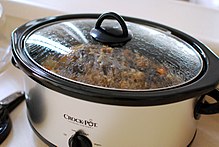
The slow cooker blues

The blues don’t come from how great the pot roast tastes after it simmers for eight hours in a slow cooker. The blues come from the fact that after several hours or so, the entire house smells like supper is ready. This turns into an afternoon of snacking to keep one’s hunger at bay. Then, when it’s really time to eat, you’re no longer hungry.

Our house smells great right now because I peeled carrots and potatoes and quartered onions at the crack of dawn. I added a bunch of secret herbs and spices. I won’t tell you what those are because if you try them and don’t like them, y’all might turn into an angry mob. One tip: the cup of Port wine is what makes it work so well, and that’s odd because I really don’t like Port.
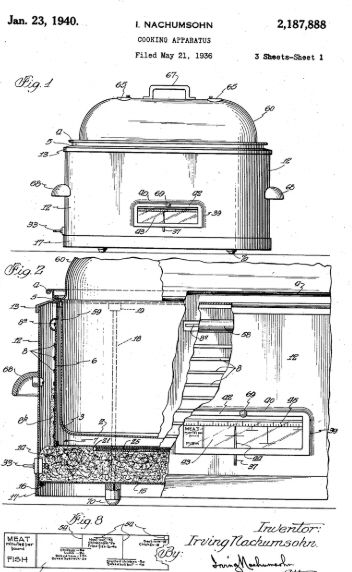
The inventor’s specs

The trick, I think, is to keep your afternoon snacks small–say, one Dorito or one Babybel® Cheese round out of the mesh bag or one chocolate chip cookie. Wash this down with about ten glasses of quality wine (preferably red though certainly not Port or bottom shelf Chianti).

We bought our first real Crock-Pot from Sunbeam (now Rival) in the 1970s when they were suddenly the best thing since fire. After a while, they became pas·sé, and those who still used them never told anybody since they’d be mocked as badly as those who admitted they were still drinking Mateus Rosé wine.

Now that their popularity has returned along with other time-saving devices aimed at families where both spouses have fulltime jobs, I can admit here in my blog that I’m making pot roast in a slow cooker (a real Crock-Pot, by the way).

Unfortunately, writing this post didn’t help with the hunger problem. Somewhere I read that every time you take off the lid to a Crock-Pot to check on what’s happening, you have to add 30 minutes to the cooking time. I have no idea whether that’s true, so I can even pretend to be tasting things (for quality control) the way I do when I make stew in the Dutch oven.

And it’s a bit early to be pouring a glass of wine.

–Malcolm

Malcolm R. Campbell’s novel Mountain Song is free on Kindle.


Cormac McCarthy: Maybe not the best author to read during a pandemic

When I run out of factory fresh books, I turn to my bookshelves and re-read older books. I stumbled into the Cormac Mcarthy section recently (I have most of his books) and read Cities of the Plain. Most things go wrong in this book, but I read it all the way through because l like McCarthy’s dialogue, descriptions, and the tone of his books. I think he writes with grit and stars rather than ink. This book has a few good people in it.

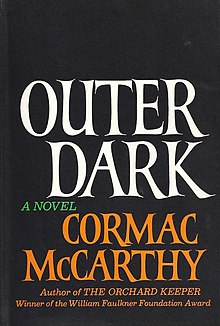
I thought, what the hell, I’ll read another. I chose Outer Dark. This novel has a lot more grit in it and even the stars aren’t clean. It doesn’t have any good people in it, though some try hard to be good in narrow ways.

Guy Davenport, in The New York Times, said, “Nor does Mr,. McCarthy waste a single word on his character’s thoughts. With total objectivity, he describes what they do and records their speech. Such discipline comes not only from mastery over words but from an understanding wise enough and compassionate enough to dare to tell o abysmally dark a story.”

The fact that it’s so well written commits one to keep reading even though reading McCarthy is often like drinking poison for recreation. If it were badly written, it wouldn’t bother readers so much, especially when the world around us during this pandemic seems to have come out of something McCarthy might have orchestrated for his next novel or screenplay.

Time to move on to another section of my bookshelf.

Malcolm

Malcolm R. Campbell’s Mountain Song is free on Kindle.


Writers: How to know when you’ve got your groove back

Some manuscripts have a meh quality to them. That’s not good. If you’re bored with it, the publisher will also be bored along with prospective readers. Take two aspirin or a double Scotch and go back to it in a few days. If it’s still meh, get rid of it, at least let it set for a while and go on to something else.

But some manuscripts sing. That’s the first clue about getting your groove back. Then more stuff begins to happen:

  • You’re reading a compelling novel like Cormac McCarthy’s Cities of the Plain and here come your characters right in the middle of it, talking the dialogue right out of the book (You got a girl? Shit no. You sound like you’ve had some bad experiences. Who aint? You fool with them and that’s the kind you’ll have.)
  • You’re watching one of the final episodes of “How to Get Away with Murder” and after Annalise Keating says, “Prayers are for the weak–I’ll stick to beating your ass in court,” one of your characters blurts out “Say which?” and you find yourself writing dialogue for your book while people on the show are getting away with murder.
  • Taylor Swift is singing “The Man” and you get it mixed up with Burl Ives’ “The Big Rock Candy Mountain because your story is pushing on your hand like the dog that’s not getting petted.

  • You’re ready for a good night’s sleep, turn out the lights, the cat snuggles in close and purs outs a lullaby, and ten minutes later you realize your seeing scenes from your story rolling through your mind’s eye like big trucks on a long-haul highway.”
  • Your spouse and/or significant other says, “Do you want sex,” and you say, “No, I’m busy, but thanks for asking.”

Storywise, you got it bad and that ain’t good because you won’t have your life back until you finish your book. The groove’s got you.

–Malcolm

It’s not as safe as I thought going back to 1955

My novel in progress, set in the Florida Panhandle in 1955, started me thinking that if only I had a time machine, I could go back to 1955 until the Pandemic is over. That means worrying about the KKK, but I’ll stay out of sight.

Tank ventilator known as the iron lung. Wikipedia photo

Crap, there’s a cold war going and the feds are developing ICBMs with nuclear war heads, Eisenhower might use force to protect Taiwan while sending military advisers to South Vietnam. All of that is bad and might wipe out the world. Little did he know how much of a mess those advisers would ultimately cause: 1,353,000 deaths, including 58,220 U.S. casualties.

Meanwhile, everyone’s worried about polio, with over 16,000 new cases each year, 1,879 of which were fatal. Those who loved gallows humor suggested saving the coupons (redeemable for merchandise) from their Raleigh cigarette packs for an ion lung. Since I’m suddenly psychic, I know that Salk’s polio vaccine will be out in a couple of months.

Wikipedia graphic

Marian Anderson has just become the first Black singer to sing at the Metropolitan Opera. My characters would like that. About a month later, fifteen-year-old Claudette Colvin was kicked, handcuffed, and verbally abused by police in a Montgomery bus for refusing to give up her seat to a white lady. My psychic powers tell me that her lawsuit resulted in bus segregation becoming unconstitutional the following year.

The U.S. is in the middle of the second, so-called “Red Scare.” McCarthyism is sweeping the country like a virus.

Okay, the hell with it, I think I’ll stay here in 2020 in spite of the year’s threats and challenges.

Malcolm

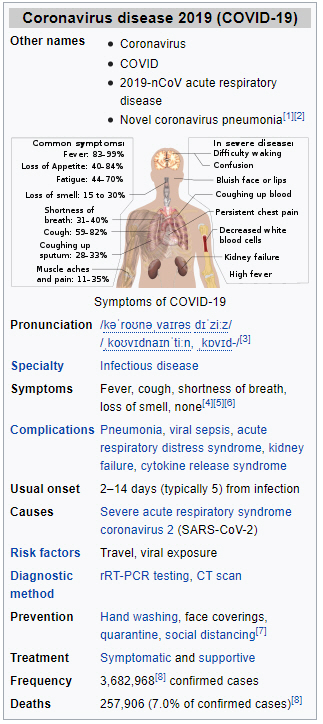
Does the on-going pandemic add to your stress levels?

There have been complaints about how the crisis has been handled, from the seeming impossibility of getting straight answers to when quarantine restrictions should be relaxed to the progress (if any) made on cures. People who work outside the home are often without a paycheck. People with kids don’t know when the kids are going back to school and that leads to uncertainties about the whole family’s scheduling.

Wikipedia Graphic

The twenty-four-hour news channels keep up continuous coverage, trying to account for every fluctuation in illness and death levels, policies and procedures, and unexpected and unfair incidences of collateral damage caused by the lockdown and the disruptions of products in the supply chain.

Add to that the fact some of the COVID-19 symptoms match what people experience with seasonal allergies, chronic sinus problems, colds, and low-grade flu-like symptoms. One wonders am I getting it? And, if so, getting tested is an apparent crapshoot, and then if there’s no cure, what good does it do to know you have it when medical aid is limited?

In one respect, I’m not impacted as badly as most people because I’m semi-retired and work from home. On the flip side of the coin, my age and my wife’s age put us in the group of people who are the most at risk.

The bottom line for many of us is the tidal wave of uncertainties, including the rather hopeless opinions from many that even if the virus were snuffed out tomorrow, “normal” is a long way off.

In many ways, it seems as though the emotional damage caused by the pandemic and our response to it might be worse than the virus for most people. Though, as the death tolls increase, more and more homes will experience the virus first hand and/or will know friends and close acquaintances who died.

Plus, everything’s up in the air: sports, concerts, beach time, flying anywhere, getting back to work, eating out. . .

Some editorialists wonder if we’ll ever get back to “normal” or even if we want to get back to “normal.” They suggest some things might be changed forever, while other things might need to be re-invented in new ways that are better.

I have no answers for any of this, but my sense of things is that COVID-19 is the biggest disruption to our way of life since the flu epidemic of 1918, World War II, and perhaps the Korean War. It will be hard to recover from this, I think, even when the virus is gone.

My 2₵. I’d like to hear yours.

Malcolm


Mail Call 1968 – no e-mail or web access on the ships in those days

from the archives

While serving aboard an aircraft carrier on a nine-month cruise, I became as attuned to the comings and goings of our C-1A Trader carrier onboard delivery (COD) plane as a desert dweller is to a drop of rain. Long before Navy ships had e-mail service, the COD–as we called it–was our primary connection with home.

USS Ranger's COD
USS Ranger’s COD

When the plane arrived, the words “Mail Call” echoed throughout the ship via the 1-MC public address system. The ship’s post office would be mobbed in minutes as each department sent a guy to the small window on the 03 level just forward of the island.

Many of us would head toward the post office before “Mail Call” was announced because our TV sets were generally tuned into PLAT, our ship’s Pilot Landing Aid Television. It was always on during flight operations. The retrieval of the slow-moving COD really stuck out amongst the landings of the jets.

One had to lurk, though, because if you bugged the post office guys before the mail was ready, they tended to work a lot slower. For a few moments after the arrival of the COD, they owned the boat.

Large packages were sniffed and poked and prodded en route back to the shop, office or berthing area for the slightest evidence they contained cookies. One of the top rules of the sea is that cookies are shared with everyone. A guy would be lucky to get one cookie out of a box of 50, crumbled or whole, as the gods of the mail service decreed.

Envelopes reeking of cologne or perfume brought a sailor a string of profane jeers and suggestions by anyone else close enough to pick up the scent. Smart guys told their wives and/or lovers to stop spraying My Sin Perfume on letters filled with sweet nothings or the suggested sins within would soon become public.

More often than not, the mail contained the every-day news of the moment, roughly three weeks after it happened back home. It always amazed me how much of home could be contained within a small envelope.

I left the ship in the Gulf of Tonkin aboard the COD for a trip home via Danang and Manila and to this day that remains one of my favorite flights. Before I flew off the ship, the old salts warned me that a catapult takeoff was similar to getting a kick in the butt from something large and angry.

They were right. But for once, it was a welcome kick.

Malcolm

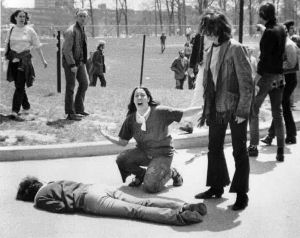
Remembering May 4, 1970

The Kent State shootings occurred 50 years ago today when the Ohio National Guard fired 67 sounds into an unarmed crowd of anti-war protesters, killing four and wounding nine. Among other things, the “Massacre” is said to have helped end the Vietnam War, bring down the Nixon administration, and ask hard questions about just how police and national guard personnel are supposed to disperse protestors.

At the time, the shooting led to a strike of some four million high school and college students and the closure of many schools. Nixon, of course, had been elected (among other things) on his stated objective of ending the war. The protest was sparked when the U.S. expanded the war by bombing Cambodia.

While I was still in the navy on May 4, 1970, I would leave the service as a conscientious objector four months later. I supported the protestors but disagreed strongly with protests that caused violence. Riot control police have become more dangerous to everyone since Kent State as the police become have more militarized. This isn’t helpful now and it wasn’t helpful then.

I took part in anti-war protests prior to joining the navy (to avoid being drafted into the army) and my sympathies were almost always with the students UNLESS they committed the kind of violence they were protesting.

I wonder if we have learned anything since Kent State. As I watch news stories which show police SWAT teams that look more like Army Rangers and Navy Seals than the police, I tend to doubt it.

–Malcolm


I should have been there

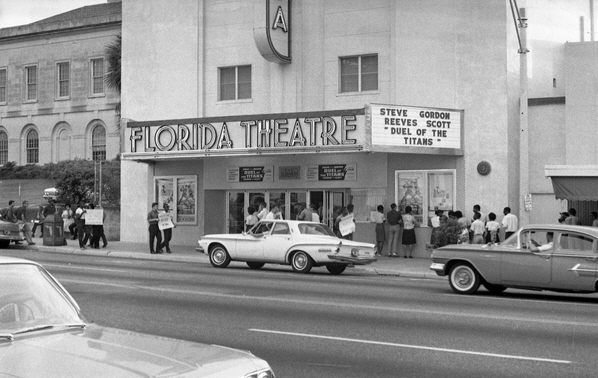
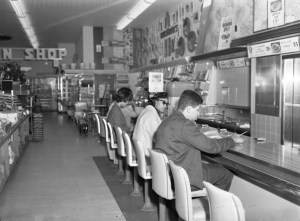
In the early 1960s, Tallahassee, Florida where I grew up was the site of multiple lunch counter sit-ins and movie theater protests. Many of these were organized by CORE and drew a fair amount of participation from students at the primarily black Florida A&M University. I was attending high school and college (FSU) in Tallahassee during these protests, but I wasn’t there.

Florida Memory Photo
Woolworth’s Lunch Counter – Florida Memory Photo

My excuses for not being there are many, including:

  • Tallahassee Police, who sided with the angry white on-lookers, we physically and verbally abusive.
  • Protesters’ eyes were damaged by the use of tear gas.
  • Protesters were fined and/or put in jail for violating a restraining order.
  • The KKK threatened not only the Blacks but the scattering of whites who joined the picketing and lunch counter sit-ins. Burning crosses appeared in people’s front yards.
  • Picketers were assaulted around town and once a person was identified, picketers were likely to have their yards filled with angry people.
  • I wasn’t ready to take on the backlash that I’d be subjected to from high school and college students who had been my friends.
  • I was sure I’d be fired from my jobs and that my participation would cause trouble for my father who was an FSU professor.

As FAMU student and CORE organizer Patricia Stephens Due–who was tear-gassed and ended up with permanent eye damage–said in her book Freedom in the Family–most Blacks weren’t there either even though the common perception is that they were a united front. Not so.

When I was working for Western Union across the street from the Florida Theater, it would have been easy to walk over there and join the pickets or sit at that lunch Woolworth’s lunch counter while on break. There’s an empty seat in the foreground of that lunch counter photo. Logically, it would have been easy to sit there, but when fear of the consequences takes over, it becomes emotionally impossible to sit there.

Looking back today, I’m embarrassed by my excuses and lack of courage.

–Malcolm

Malcolm R. Campbell’s novel The Sun Singer is currently free on Kindle.


Car Shopping for My Characters

Cars are often one indicator of a character in a novel. Black ops characters usually drive something with many tactical advantages in a fight; other characters are often described by their sports cars or family cars, most of which cost more than the readers of the novels make in a year.

In my novel Lena, (set in 1954) I introduced a new character to the Florida Folk Magic Series named Pollyanna. The name made her sound like a spoiled brat who lived at the estate of wealthy parents. In fact, she grew up at a fish camp and knew her way around the business and everything that went with it. She needed a practical vehicle:

This is a 1949 Ford F-1, 1/2-ton Silvertone Grey pickup truck. It was the lowest of the line of Ford F-series trucks made between 1947 and 1952. Perfect for a fish camp, though Pollyanna would have gotten a 3/4-ton F-3 if she could have afforded it. Pollyanna always had a 1935 Smith & Wesson model 27 .357 magnum revolver in the glove box or in a thigh holster.

Since she lives near a small town, everyone recognizes her truck. This  isn’t helpful when she’s spying on bad guys. So, along with a blonde wig, different clothes, etc., she drives the family’s seldom used Blue 1949 Dodge Wayfarer coupe:

oldcaradvetising photo

When I visualize a character, I try to see what kind of car fits who they are. The town storekeeper drives a 1949 2R clover green Studebaker pickup. The Sanctified Church uses a Buick Roadmaster hearse. The fuel hauling company drives an Autocar surplus tanker truck. The police drive Chevrolet Bel Air squads.

Finding the right car for each character is sometimes a thrilling treasure hunt and sometimes an exasperating search when years and models seem to be missing from the Internet.

For me, tracking down cars is a heck of a lot more fun than trying to figure out what kinds of clothes my female characters would be wearing years ago.

–Malcolm

The Kindle edition of Malcolm R. Campbell’s contemporary fantasy novel The Sun Singer is FREE on Amazon.