Old Homes

I used to wonder who lives where I used to live. Since my addresses have been somewhat scattered, there’s little chance to drive by the homes of my memory to see if they’re still there, if they’ve grown smaller than I recall, or if there’s a bike in the drive and a swing on the porch.

Some people I know not only drive by, they stop and ring the doorbell and say, “Good afternoon, I used to live here.” Even though I’m a Leo, I don’t have the gumption for doing that. While my friends are often given tours and lemonade, I’d probably get a puzzled “So what?” or “Who cares?” if I stopped to shoot the breeze and possibly a few pictures.

Decatur, Illinois
Decatur, Illinois

If I lived in Illinois, I would drive past the house pictured here where my mother’s parents lived when I was born. Old photograph albums contain black and white pictures of me as a toddler on this porch with numerous people, chairs, and toys. No doubt, the house is smaller than my memory recalls.

Decatur and this house on Wood Street contain many of my earliest memories and many of them have morphed into the memories of my fictional characters. Robert Adams in my novel “The Sun Singer” lives in this house and he knows the people up and down the street and how long it takes to ride a bike from the front door to Fairview Park.

In a novel-in-progress, my protagonist David Ward lives just around the corner in an apartment where my grandparents lived when I was in junior high school. Like Robert, David knows the neighborhood well.

Truth be told, their fictional memories have, over time, replaced my own memories and have become much more real to me. Such is the way a writer’s mind works. We start with what we know and build it into something quite different in our stories. I don’t have to stop at either house and ask who lives there, for I already know: Robert Adams lives on West Wood Street and he has an aquarium with a large angel fish back in his bedroom. David Ward lives on Edward Street and his personal computer is sitting on the dining room table where I ate many meals when I was young; if I were to look closely at the screen of that computer, I would see that David is writing a short story about his neighborhood, a real location I haven’t seen for over forty years that lives on in the thoughts and deeds of my characters.

Robert’s and David’s memories are now more powerful than mine, for I’ve enhanced them, visualized them, interacted with them, and put them down on paper they have in many ways taken on lives of their own outside my consciousness. Frankly, I’m happy with the people who live in these old homes because I put them there.

Copyright (c) 2009 by Malcolm R. Campbell, author of “Jock Stewart and the Missing Sea of Fire.”

Twitter: not the end of the world

I’m not a big fan of twitter even though some of the tweets that have scrolled across my screen were funny, pithy, or linked to interesting posts and articles.

Some will say “I don’t get Twitter.” Others will say Twitter’s just as addictive as texting and will soon collapse as another transitory fad.

The Twitter and text messaging debate includes warnings that these forms have taken the partial demise of proper English from slapdash e-mails and are further obliterating the language by forcing upon us ungrammatical conventions and more sloppy writing.

Such warnings appear to be as nonsensical as suggesting that those who write classic 17-syllable haiku are destroying our language or that TV commercial pitchmen are reducing words to the ugly and the very ugly. Language changes as our needs change. It’s dynamic and not engraved in stone unless it’s an epitaph.

I think English will survive Twitter. Those who get it, get it. Those who don’t. don’t. For some, Twitter’s a God-send, for others a pointless time-waster. Maybe English will change. If so, I will find it amusing to see how our English and literature teachers and other guardians of the status quo handle the new upheavals in their lives.

I’m not losing any sleep over Twitter.

Meanwhile, Roy Peter Clark’s Poynter Online post called “From Telegraph to Twitter: The Language of the Short Form” might reassure you that brevity is the soul of wit and that Twitter-wise and language-wise, all is not lost.

Copyright (c) 2009 by Malcolm R. Campbell, author of the comedic thriller “Jock Stewart and the Missing Sea of Fire.”

Snowfall

North Georgia
North Georgia

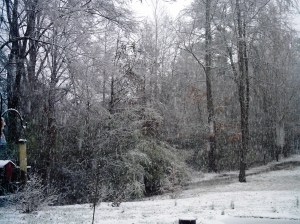
Six inches of snow are enough for officials to call a snow day for students throughout Jackson County, 50 miles northeast of Atlanta. Now, where did I leave that old set of studded snow tires?

Somebody on Twitter asked this morning how the snow is affecting us. So far so good as the power flickers from time to time rather than going out. Makes me glad we have APC surge protectors with battery backup for our computers.

There’s been more time to read. I just finished a review of Secret Son by Laila Lalami and am now reading Saara’s Passage by Karen Autio.

I’m giving some thought to clearing away some of these piles of paper that have drifted high along the counters and desk in my office and them seemingly frozen there even though each item seemed important when it was carefully added to the top of the clutter.

With no grocery shopping to do this morning (my usual Monday morning chore), I had more time to put out a fresh block of suet for the red bellied woodpecker who was, instead, pecking at the few remaining seeds in a feeder. The titmice and chickadees and cardinals now have a fresh storehouse of sunflower seeds. There are breadcrumbs out there for the bluejays. Crunching about in the frozen snow was certainly more relaxing than wheeling a cart up and down the aisles at the grocery.

Since I don’t have to commute several hours to work, I can enjoy our snow day, though I’m not enough of a kid to go outside and make any snow angels in the front yard.

REVIEW “Faust” by E. A. Bucchianeri

Faust: My Soul be Damned for the World: Volume I Faust: My Soul be Damned for the World: Volume I by E.A. Bucchianeri

My review


rating: 4 of 5 stars
E. A. Bucchianeri describes her two-volume work on the back cover as “a comprehensive exploration of Dr. Faust, the man who sold his soul to the devil, and those who lived to tell his tale.”

“Comprehensive” is almost an understatement, for the scope and scholarship of this two-volume, large-format “Faust – My soul be damned for the world” is astonishing. Bucchianeri traces the evolution of the Faust legends and literature from the historical individual who called himself “Faustus” (c1466 – c1538) through early folktales and Christopher Marlowe’s drama “The Tragical History of Doctor Faustus” (1604) to Goethe’s closet drama “Faust: The Tragedy Part One” (1829) and “Faust: The Tragedy Part Two” (1832).

Clearly, the Faustian literature evolved with the times, and at each stage, Bucchianeri shows how the influences of the church, state, society and the education, upbringing and life experiences of the of the principal authors and commentators changed the intent and flavor of the legend. The Faust story, as Joseph L. Henderson notes in “Man and his Symbols” (Carl Jung, Ed.) dramatizes man’s battle with the dark or negative side of his personality, the “‘shadow’ figure that Goethe describes as ‘part of that power which, willing evil, finds the good.'”

One of the greatest strengths of Bucchianeri’s work is in its heavily documented presentation of the vast symbolism found throughout the multiple versions of the legend.

The historical Dr. Faustus, Faust books and folk tales, Marlowe’s drama with its “A and B texts,” the puppet plays, and Lessing’s unfinished drama comprise Volume I. At the outset, Bucchianeri writes, “Faust, the notorious reprobate who willingly forfeited his immortal soul to the devil in exchange of the fleeting illusory pleasures of the world as recounted in famous works of drama, literature, drama and music did not originate as the imaginary brainchild of a literary genius. A historical figure named ‘Faust’ did exist.”

Separating the historical personage from the folklore that quickly arose in letters, pamphlets and that individual’s own circulated exaggerations of his “powers”” requires careful research. “Faustus,” was the title/pseudonym used by Georg Helmstetter who was born in or near Heidelberg, Germany in the mid-1400s. He was an educated man and, according to reports, an accurate astrologer. His self-aggrandizing claims of dark-side occult powers and an association with the Devil gave rise to the initial folklore and popular Faust books.

Bucchianeri brings order to the documented facts about Christopher Marlowe’s contribution to the Faust legend during Elizabethan times. She writes that the poet and dramatist “recognized in the character of Faustus his personal cynicism in regard to the subject of religion and his ardent desire to accomplish great deeds in the world.”

Here, as with the Goethe material, the author ostensibly presents readers with a miniature biography of the dramatist as a means of demonstrating important themes in the resulting play. Marlowe’s difficult route to a college degree and his rebellious views and lifestyle play into his version of “Faust.”

Goethe worked on “Faust” throughout his lifetime. Like Marlowe, Goethe had deep and basic questions about religion. He brought to “Faust” his youthful, manic-depressive mood swings and a wealth of study into subjects including the greater and lesser mysteries, alchemy and freemasons as Bucchianeri shows in Volume II.

Written in an academic style, “Faust – My soul be damned for the world,” will be of especial interest to scholars as well as serious students of the Faust legends, Marlowe, and Goethe. The scope of work and impeccable research may, in fact, be definitive insofar as the development of the literary Faust is concerned.

Some readers will find the biographical detail about Marlowe and Goethe to be too lengthy, far exceeding that which is required to illustrate how their personalities and their lives and studies influenced their Faust dramas.

If a second edition of “Faust – My soul be damned for the world” is released, the work will be greatly strengthened by the addition of an introduction that explains how this work differs from earlier Faust literature, concise chapter summaries and additional subheads and sidebars to break up the ponderous sections of straight text, a biography showing the author’s credentials for writing the book, and a comprehensive index.

That said, this work is a labor of love that greatly adds to our understanding of the literary Faust as he grew with the changing times.

View all my reviews.

Review: “Burning Bright”

Burning Bright Burning Bright by Tracy Chevalier

My review


rating: 3 of 5 stars
London at the time of the French revolution takes center stage in this beautifully written novel featuring location and themes over plot. When craftsman Thomas Kellaway moves his wife Anne and teen-aged children Jem and Masie from the Piddle Valley in Dorset to London in March of 1792, they are all but overwhelmed by the contrasting grandeur and ugliness of the big city. Thomas hopes he can better support the family making chairs for the circus and Anne hopes distance will heal her tortured mind after the accidental death of their son Tommy.

Tracy Chevalier has drawn a deep and richly detailed portrait of London, especially the Borough of Lambeth where the noisy, dirty and boisterous lifestyle of the poor that differs so greatly from the quieter world of Dorset is accentuated when the circus comes to town.

Contrasts flow through the Kellaway’s lives as surely as the Thames flows through London, and here the author draws upon William Blake’s focus on “contraries,” or pairs of opposites, for the novel’s theme. London, in “Burning Bright” becomes an alchemist’s athanor wherein the Kellaways will undergo their transformations beneath the piercing gaze of Blake, the adept who applies his “Songs of Innocence” and “Songs of Experience” within the novel as Holy Scripture.

Blake serves as a catalyst within the story line, yet he is a one-dimensional character who primary speaks in philosophic riddles and quotes from his favorite poems. While Jem, Masie and their new, streetwise friend, Maggie, view the home of William and Kate Blake as calm sanctuary within a world where the trials of childhood are greatly magnified by the dangerous environment, the reader will come away having learned more about the Borough of Lambeth and than the famous poet and print maker.

Like her adult characters in “Burning Bright,” Chevalier appears unwilling to step past Blake’s fame, notoriety and fiery persona and confront the poet head on. Doing so would have brought closure to the novel for readers and characters alike. We have a well-crafted slice-of-life portrait of a rural family’s brief sojourn into the big city. What we don’t have is an overt look at what it finally meant to them.

View all my reviews.

Review: Women of Magdalene

Women of Magdalene Women of Magdalene by Rosemary Poole-Carter

My review


rating: 5 of 5 stars
My review from Powell’s Books:

“It’s easy to get in, but once there it is impossible to get out,” New York World reporter Nellie Bly wrote in her “Ten Days in a Mad House” expose about the poor conditions and mistreatment of patients at Blackwell’s Island asylum in New York in 1887. Deplorable by today’s standards, the approach to mental health then wasn’t far removed from the days when professionals considered the insane to be those suffering God’s punishment or the Devil’s possession.

The fictional Magdalene Ladies Lunatic Asylum in Rosemary Poole-Carter’s darkly beautiful novel fits perfectly into a time period when the treatment of female mentally ill patients was likely to be neither moral nor effective. Confinement was often a matter of convenience for the families of women viewed as domestic failures who were best kept out of sight and out of mind.

When young Civil War surgeon Dr. Robert Mallory arrives at the Louisiana institution for employment as general practitioner after the war, he soon sees that God and the world have forgotten the women of Magdalene, and the only devils on the premises are the asylum’s owner Dr. Kingston, his former assistant Dr. Hardy, and their dictatorial matron.

When Robert questions Kingston about the inhumane treatment of the women housed in the former plantation mansion, Kingston discounts Robert’s competence to judge what is right and proper in the realm of mental illness. Later, Robert will ask why no women are ever cured and allowed to leave the facility. Cures? There are no cures, only what Kingston describes without noticeable guile as “sanctuary.”

In Poole-Carter’s haunting, yet gritty prose, Magdalene floats almost dreamlike within a misshapen world of malaise and mist that will ultimately claim all who remain there–and for a high price. Robert, like the women, arrives at the asylum having been harmed by the world and with a growing expectation that he will be injured further by the methods and practices within the shelter of Magdalene’s walls.

This novel casts multiple spells over its readers and its characters. Readers with a growing understanding that the abuses at the fictional Magdalene were drawn from the world of standard abuses of the times, won’t be able to forget what they see there. As for Robert Mallory, in spite of his resolve, he’s not sure he can complete his personal journey out of the past and cure what ails Magdalene before he becomes yet another shadow alongside the old plantation’s dark river.

View all my reviews.

Note: Author Vivian Zabel will visit the Round Table on February 19th to discuss her novel Prairie Dog Cowboy.

Images of Betrayal – Review

images2Tyson doesn’t have time for movies, the mall, or school because her parents have abandoned her to a roach infested apartment with paper-thin walls in the bad part of town. She works as a waitress at a diner where the tips are hardly enough to pay the rent or buy the groceries. Then, things get worse.

Claire Collins has created a practical and responsible teenage protagonist with true grit. But practicality alone doesn’t solve the problem of a mysterious photographer named Walker who shows up at the diner with mesmerizing eyes and a stare that doesn’t quit. He has a camera that predicts the future and from the photographs of violence he shares with her, Ty’s future looks bleak. Worse yet, her friends are under threat as well.

This fine mystery is well written and well paced. The characters are three-dimensional and they react to danger the way everyday people do, and goodness knows, Collins has provided plenty of danger. The book is hard to put down as one problem after another appears.

While the climax of the novel really works, the denouement is a little too perfect to seem realistic. Readers used to books being set in the traditional and more-legible Roman font may find the sans serif type face a little difficult to get used to.

That said, this book will get your attention and keep it. What fun!

Images of Betral was published by Second Wind Publishing (“The Best Authors You Haven’t Read Yet.”) Collins is also the author of Fate and and Destiny, “A romantic thriller set on a snowy mountaintop. During a blizzard, Andrew’s dog, Shadow, finds destiny–a beautiful woman left for dead, but very much alive. With her she brings mystery, danger and passion to the little cabin.

Collins’ books are available on line at Second Wind and major booksellers.

Copyright (c) 2009 by Malcolm R. Campbell. (My reviews are posted on Amazon and on my March of Books review page.)

Why I Write

It’s been quite obvious to me over the years that most people think writers are screwed up people.

While I’ve served on an aircraft carrier, run a locomotive, used a backhoe, driven spikes on a new RR roadbed, delivered papers, and been the voice you hear when you want computer phone support, this doesn’t cover up the fact that I’m a writer. Like Jack Palance in the movie “Shane,” I stop conversation when I come into a room. It’s not because everyone’s waiting for me to say something quotable, it’s because “regular people” see writers as different.

Variously, we are cursed, crazy, bookish, studious, libertine, bohemian, licentious, and ultra-left wing. Storytellers, like magicians, circus people, actors and patent medicine salesmen have always been seen as part of a con or a scam or the occult.

I see myself as none of these things, but it’s hard to shed the images in other people’s mind’s eye.

I see writing as a career like any other. While some writers become rich and famous, that’s not the norm. Most authors cannot earn a living from their novels. Like the rancher, insurance salesman, school principal, truck driver and computer programmer, I’m a working to support my family and maybe take a vacation once in a while.

My father was a writer, so that was an influence, just as the sons of ranchers and salesmen and teachers often step into their parents’ professions. It’s what they know and it’s what I know.

After people work a job for a while, they get better at it, and they learn tips and tricks for making it more meaningful to them in the context of their lives. Some people hang out in shops and break rooms; I hang out in libraries.

People in all professions believe that–even though they need to earn a living–the work they do is beneficial to the world, probably not the entire world, but to those they meet day to day. A friendly truck driver will stop when s/he sees your broken down car on the shoulder of an Interstate. A writer disseminates information and ideas s/he hopes will be of value, practically and/or spiritually.

My novel The Sun Singer is a case in point. First, I was writing what I know: mountains, hiking, climbing and a touch of mysticism. Such things can be entertaining and give readers a few hours of fun. But I also saw a deeper message in The Sun Singer, a path toward personal transformation that readers could either accept or reject without losing track of the entertainment value of the adventure story. I’m not a guru and wouldn’t want to be one. I don’t have the cosmic scheme of things figured out. But maybe I can say a few things that will help others to figure it out and get as close to the truth as they can. That’s everyone’s calling, isn’t it?

We’re all trying to make the world better while keeping food on the table.  The work is practical and spiritual. I try to live that in my life as a writer because it’s what I fell into, or possibly what I was led into. My best friend from high school fell into being a captain of tall ships that sail  around the world. What a unique profession that is, yet he sees me as the crazy one. Go figure. He sails and I write. It pays the bills and makes for a wonderful life.

Coming February 19th

cowboycoverI‘m pleased to announce that Vivian Zabel, author of “Prairie Dog Cowboy,” will be here on February 19th to discuss her new book. What a wonderful story it is!

Four of the people  (within the U.S. and Canada) who stop by and ask a question or make a comment on my blog and/or the other blogs she is visiting will receive a canvas tote bag with Zabel’s 4RV Publishing logo.

While she’s here, please don’t act like writers are screwed up. Play like we’re a couple of ranchers.

Copyright (c) 2009 by Malcolm R. Campbell

Three posts for writers

Many of you know I also maintain a Typepad weblog called Writer’s Notebook. If you love reading, writing and books, I invite you to take a look at several of my latest posts:

The people who visit you online are more than numbers

NEA: More Americans are Reading Literature

Your passions fuel your reading

You can find recent book reviews posted on my March of Books page on my web site and you can see my author’s web log on Blogger called Sun Singer’s Travels.

As always, thanks for the visit!