Submissions wanted for CAMAS Glacier Issue

Camas, the literary magazine of the University of Montana is dedicating its Summer 2010 Issue to Glacier National Park in concert with Glacier’s Centennial Anniversary. The deadline is March 15, 2010.

The magazine is seeking feature articles (2000-3000 words), essays (500-2000 words), interviews and profiles (250-2000 words), fiction (500-2500 words), and poetry of varying lengths.

For complete guidelines and submission information, click here.

It should be a great issue for fans of Glacier National Park.

–Malcolm, author of “The Sun Singer,” a novel set in Glacier National Park.

Every Kid Needs a Dog

Every kid needs a dog even if that dog belongs to somebody twenty blocks away.

I had a paper route for years, the kind where you go out on your bike at the crack of dawn (in rain, sleet, snow, etc.) and throw papers into yards throughout the neighborhood.

There were numerous rodent-sized dogs along the way that came snapping across yards all full of themselves but would shut up when the newspapers knocked them in the side of the head.

There was an ugly collie named Danger that bit me, getting me out of jury duty some years later in a dog bite case when the attorney asked for a show of hands from those of us in the jury pool of anyone who had ever been bitten by a dog. Goodbye, he said. Aw, shucks.

And then there was a boxer dog named lazy that started following me every morning as I did the route. Then he started showing up at hour house before I got up and would wait out there for the daily run to begin. Finally, he started staying at our house all the time.

His owners were okay with it, since the dog had adopted other kids before. They knew to drive by our house whenever they they wanted to take Lazy home.

Lazy couldn’t resist following a kid on a bike. Unfortunately, when I did the biking merit badge in Boy Scouts, he followed me out of town on one of my 25-mile treks. Needless to say, I couldn’t ride fast enough to get away from him. He gave out before I did at the twenty mile mark.

He ran under some people’s house–one of those on blocks–and wouldn’t come out. They wouldn’t come out either because they thought the shaving-cream-style foam around his mouth meant RABIES. I said boxes always look like that though, truth be told, he was foamier than usual. I couldn’t coax him out from under that house for love or money.

Finally, thinking I had probably been attacked by wolves or fallen into a ditch, my parents found me. They persuaded the people in the house that it was safe for them to open the front door four inches and hand out a bowl of water. Lazy drank it like he’d been running in a desert. After another bowl, he allowed himself to be coaxed into the car.

Lazy (his full name was Lazy Bones) loved coming inside the house when the parents weren’t home. He enjoyed being swung around in a wide circle at the end of a rope: people driving by almost ran their cars into the ditch when they saw that. And he loved play-growling around the hands of anyone wearing gloves. (We might have taught him to do that after seeing police shows on TV. Mother wasn’t amused when Lazy lurched out of some bushes when she innocently game outside wearing gardening gloves). Lazy was in no way lazy.

Lazy was “our dog” for some ten years, maybe longer. When I gave up my paper route, he followed my brothers. He knew that my brothers and I were three kids in need of a dog.

Malcolm

Update: I posted a photo of Lazy, my two brothers and I in a “formal portrait” over on my Writer’s Notebook blog’s “Wordless Wednesday” post on 2/14/2010.

Book Review: ‘Nero’s Concert’

Nero's Concert Nero’s Concert by Don Westenhaver

My rating: 4 of 5 stars
“A Nero: Any bloody-minded man, relentless tyrant, or evil-doer of extraordinary cruelty; from the depraved and infamous Roman Emperor C. Claudius Nero.” – “Brewer’s Dictionary of Phrase & Fable”

Almost twenty-one centuries after the Great Fire of Rome, most people believe that Nero fiddled while Rome burned. In reality, Nero–who ruled as Emperor between AD 54 and AD 68–played a lyre, and the fiddle as we know it had yet to be invented. Even the historian Tacitus discounts the rumor that Nero sang and played his lyre while enjoying the six-day spectacle of his city on fire. But the fiddling myth lives on.

Nobody knows whether the fire was accident or arson. Disgruntled Romans said Nero started it for reasons of insanity or to clear away land for a new palace. Nero blamed and persecuted Christians to direct the public’s antagonism away from himself. Don Westenhaver’s well-researched novel “Nero’s Concert” provides readers with a what-might-have-happened scenario for the calamitous days of July, 64 AD and their aftermath.

In “Nero’s Concert,” Nero does not start the fire. He asks his close friend Rusticus to investigate in hopes of proving Christians are responsible. Nero doesn’t get the answers he’s looking for. Tensions mount and the friendship between Nero and Rusticus becomes strained. Subsequently, Rusticus’ life and safety are jeopardized when Nero turns to Tigellinus, the sadistic prefect of the Praetorian Guard, for more appropriate conclusions and when Rusticus falls in love with a Christian.

In addition to Nero and Tigellinus, Westenhaver’s novel includes Seneca, Poppaea, St. Peter and other historical characters. Rusticus, who is wholly fictional, attends to both his duty and his heart, making him a wonderfully level-headed protagonist for a story about a chaotic city with an erratic Emperor.

When Camilia, a nurse helping the injured during the fire, tells a Tribune she’s found a murdered senator among the dead, the Tribune says he will take her information to Rusticus rather than Tigellinus.

“I don’t know Tigellinus obviously,” says Camilia, “but his reputation is that he punishes those who bring bad news.”

“Yes,” the Tribune responds. “Whereas Rusticus seems quite different–analytical and professional. Somewhat distant rather than friendly. But I worked with him on the fire and he was fair to everyone.”

Through the novel’s wide window into the past, readers see the workings of the Roman hierarchy via Rusticus’ investigation and his interactions with Seneca, Nero and Tigellinus. As Camilia and Rusticus spend time together, readers learn about daily life and about the horrors of being a Christian at a time when such beliefs are likely to lead to imprisonment, torture and death. The author has taken great care in his presentation of facts about Rome’s rulers, buildings and people. An author’s note at the end of the novel supplies additional details.

While Westenhaver’s writing is highly readable, his modern-day words and phrases add a disruptive casualness that doesn’t fit the time or place. When Thaddeus calls out to Rusticus with the words “Hey boss,” the reality of Rome within the novel crumbles a bit. So, too, when Nero’s efforts to improve his image are referred to as “public relations,” an individual is called “your guy,” a parade is called a “big deal,” and sexual encounters are described as “getting laid.” Personal taste may dictate whether or not this is distracting.

The research behind the story gets in the way of the story occasionally when the primary plot line is diverted into travelogue-style moments around the city and a vacation trip Rusticus and Camilia take to the Bay of Naples. Likewise, a visit with an imprisoned St. Peter strays past its intended purpose into a monologue about Christianity. Such information does provide interesting facts and insights into the characters and the times, but at the expense of the novel’s pacing. Some readers may skim these sections while others may enjoy the additional atmosphere.

On balance, “Nero’s Concert” is an engaging love story as well as an entertaining and informative account of a time that lives in our consciousness as myth more than fact. Readers will come away from the novel knowing that, in all likelihood, Nero neither played a violin nor fiddled around while Rome burned.


Copyright (c) 2010 by Malcolm R. Campbell

View all my reviews >>

Glacier Centennial: Caroline Lockhart

Newspaper reporter, bestselling novelist and rancher Caroline Lockhart (1871-1962) was probably the first woman to go over Glacier National Park’s Swiftcurrent Pass. Working for a Philadelphia newspaper under the pseudonym “Suzette,” she came to Altyn, Montana in 1901 and spent the rest of her life in the West.

At the time, Altyn was a boisterous mining boom town in the Swiftcurrent Valley in present-day Glacier National Park, a town its promoters said would soon become the rich center for gold, silver, copper and even oil. (See my essay about Altyn and the Swiftcurrent Valley in the upcoming “Nature’s Gifts” anthology to be released in March.)

In Cowboy Girl, an excellent biography of Caroline Lockhart, John Clayton writes that “Suzette’s arrival represented major news for Altyn, which had been born less than three years previously, when a strip of land was taken from the Blackfeet Indians and thrown open to mining. Altyn’s prospectors believed that within a few years its destiny would be decided: ‘the richest and biggest camp on earth or nothing.'”

By all accounts, Lockhart was ornery, strong-minded, strong-willed, and outspoken. (She called novelist Zane Grey a “tooth-pulling ass!”) Some suggest that her liberated personality kept Lockhart and her novels–several of which were made into movies–from being better known over the long term. Her novels include Me-Smith, Lady Doc, The Man from Bitter Roots, and The Fighting Shepherdess.

Lockhart owned a newspaper in Cody, Wyoming, where she also served as the first president of the Cody Stampede. Her fight against prohibition would keep Lockhart and her paper in the public’s often-angry eye. Even though she came west as a Phildelphia “Bulletin” reporter, she had grown up on a ranch; she found her dream again when she bought a ranch at Dryhead, Montana near the Pryor Mountains. She increased the size of the ranch and became, in her mind, a true cattle queen. The ranch is now owned by the National Park Service as part of the Bighorn Canyon Recreation Area.

In his article “Project Slows Decay at Lockhart Ranch,” Clayton addressed challenges of restoration–historical authenticity vs. practicality–when he noted that “the research also provides delicious evidence of how characters of the past dealt with hardships. For example, Lockhart had an old-style plank floor in her kitchen. She liked the look of it, but mice could easily creep through its gaps. So she kept two bullsnakes in the house to kill the mice. Today, by contrast, the Park Service uses gravel fill beneath the planks to keep out the rodents.”

Lockhart came west via the Great Northern Railway looking for adventure. By all accounts she not only found it but became a part of it. According to a the National Park Service’s Caroline Lockhart page, the aging liberated lady wrote, “There are no old timers left anymore. I feel like the last leaf on the tree.”

Copyright (c) 2010 by Malcolm R. Campbell, author of two novels, “The Sun Singer” (set in Glacier Park) and “Jock Stewart and the Missing Sea of Fire” (set in an imaginary Texas town).

Glacier Centennial: Mary Roberts Rinehart

“If you are normal and philosophical; if you love your country; if you like bacon, or will eat it anyhow; if you are willing to learn how little you count in the eternal scheme of things; if you are prepared, for the first day or two, to be able to locate every muscle in your body and a few extra ones that seem to have crept in and are crowding, go ride in the Rocky Mountains and save your soul.” — Mary Roberts Rinehart, in “Through Glacier Park,” 1916

Mary Roberts Rinehart (1876-1958), a popular mystery novelist of the day, wrote about Glacier National Park under the sponsorship of the Great Northern Railway. The railroad built and owned the primary hotels in the park and conducted an extensive “See America First” publicity campaign to promote its playground. Rinehart wrote “Through Glacier National Park” and followed that up with “Tenting Tonight” two years later.

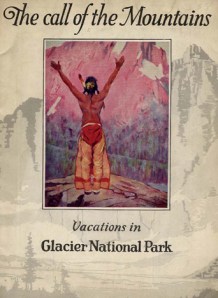
Rinehart, whose novels and “Saturday Evening Post” short stories were popular with the public was perfect for the GN’s publicity department because she had readers ready to follow her exploits in the wilderness, and then to take a Great Northern train to view the “care-killing” scenery she described. Rinehart also wrote the introduction to the railroad’s 48-page “The Call of the Mountains” brochure in 1925.

In his book “Man in Glacier,” C. W. Buchholtz writes that Mary Roberts Rinehart’s, books, “while contributing a female point of view, gave substantial credit to railroad investments. In ‘Through Glacier Park,’ published in 1916, Rinehart gave a dutiful, twenty-page chapter describing the various hotels, chalets, and camps.”

The railroads pushed hard on the “See America First” campaign. Great Northern–a predecessor of today’s Burlington Northern Santa Fe–had sixty miles of track along the southern border of Glacier National Park that set the tone for its brochures, dining car menus, advertisements, and even many of his passenger car names and decorations. An idealized version of the mountain goat, “Rocky,” was a Great Northern logo for years.

As C. W. Guthrie notes in her book “All Aboard! for Glacier,” “If there was one attraction American had that Europe did not, it was the Wild West. The world’s image of the frontier landscape, peopled by the likes of mountain man Jim Bridger, scout Kit Carson, hard-riding, fast-shooting cowboys, and proud, fearless, sometimes savage Indians was born of fact, nurtured by myth and is distinctly and proudly American.”

Rinehart’s tour of the park–complete with river boats, multiple guides and packers, and two photographers–was by no means typical of those experienced by most tourists who arrived at East Glacier or West Glacier (Belton) via the railroad’s 1,816-mile mainline between St. Paul and Seattle. But her words resonated with those who wanted a taste of the adventures she described at hotels owned by a railroad that would operate as Glacier’s primary concessionaire until 1960.

“Now and then the United States Government does a very wicked thing,” she wrote. “Its treatment of the Indians, for instance, and especially of the Blackfeet, in Montana. But that’s another story. The point is that, to offset these lapses, there are occasional Government idealisms. Our National Parks are the expression of such an ideal.”

You can read Rinehart’s “Through Glacier Park” online here. You can see beautiful examples of railroad promotional brochures here. For additional detail, C. W. Buchholtz’s park history “Man in Glacier” can also be found online.

Copyright (c) 2010 by Malcolm R. Campbell, author of “The Sun Singer,” a novel set in Glacier National Park. My article about the park’s Swiftcurrent Valley appears in “Nature’s Gifts,” an anthology of fiction, nonfiction and poetry celebrating nature to be released by Vanilla Heart Publishing in March.

Glacier Centennial: Art of Preservation

Fourteen pieces of art have been selected for Glacier National Park’s Centennial. Wild places inspire artists. In turn, their work inspires others to love wild places. The art follows the Centennial theme: Celebrate, Inspire, Engage.

On tour throughout the state, Glacier’s Centennial art can currently be seen at the Natural History Center in Missoula between January 14 and February 24 from 8 a.m. to 4 p.m. The Center is at 120 Hickory Street.

MNHC will have a special reception Friday, February 5th from 5 to 8 p.m. The reception is free.

Malcolm

Coming Soon

Vanilla Heart Publishing will issue a new edition of my 2004 novel “The Sun Singer” this spring. The novel is set in Glacier National Park.

Author Interviews from Visual Arts Junction

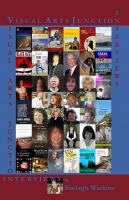
Shelagh Watkins, author of Mr. Planemaker’s Flying Machine, has compiled and published a book of author interviews conducted during the past year at Visual Arts Junction. The authors discuss their styles and influences as well as recent works, excerpts of which are included.

This Mandinam Press book can be viewed or downloaded free in multiple formats at Smashwords or purchased as a paperback via Lulu.

It was a pleasure being included in this volume with authors Pat Bertram, D. K. Christi, Caryn Gottlieb FitzGerald, Jean Holloway and others. Watkins’ hope is that “the interviews will entertain and inspire readers to find out more about the authors and their books.”

As 2009 winds down, I would like to thank those who have found adventure and magic in The Sun Singer, humor in Jock Sterwart and the Missing Sea of Fire, and yarns and tall tales in A View Inside Glacier National Park: 100 Years, 100 Stories. Best wishes for an exciting 2010 which, I hope, will include an infinite stack of books on your desk and nightstand.

Malcolm

All That Is, Is Light

“All that is, is light.” – Erigena

“In a very real sense, we’re all made of sunlight.” – Thom Hartman

“Light gives of itself freely, filling all available space. It does not seek anything in return; it asks not whether you are friend or foe. It gives of itself and is not thereby diminished.” — Michael Strassfeld

“When you possess light within, you see it externally.” — Anaïs Nin

“Ever since we crawled out of that primordial slime, that’s been our unifying cry, ‘More light.’ Sunlight. Torchlight. Candlelight. Neon, incandescent lights that banish the darkness from our caves to illuminate our roads, the insides of our refrigerators. Big floods for the night games at Soldier’s Field. Little tiny flashlights for those books we read under the covers when we’re supposed to be asleep. Light is more than watts and footcandles. Light is metaphor. Light is knowledge, light is life, light is light.” — Diane Frolov and Andrew Schneider

“Death is not extinguishing the light; it is putting out the lamp because dawn has come.” — Rabindranath Tagore

“There is a muscular energy in sunlight corresponding to the spiritual energy of wind.” –Annie Dillard

“If you are in a spaceship that is traveling at the speed of light, and you turn on the headlights, does anything happen?” — Steven Wright

“Truly, it is in darkness that one finds the light, so when we are in sorrow, then this light is nearest of all to us.” — Meister Eckhart

“Our deepest fear is not that we are inadequate. Our deepest fear is that we are powerful beyond measure. It is our Light, not our Darkness, that most frightens us.” — Marianne Williamson

“God’s first creature, which was light.” — Francis Bacon

“The original religion of the Blackfeet was the worship of light personified.” — James Willard Schultz

Coming soon in a new edition from Vanilla Heart Publishing, “The Sun Singer,” a celebration of light.

See the book trailer!

Malcolm

‘Man in Glacier’

“In Glacier National Park, remains of the past are not always as difficult to locate. Old snowshoe cabins and ranger stations can be found in many parts of the park; a few old homesteads, including their houses, fences, and outbuildings can still be found; exploration shafts as well as mines, along with the miners’ cabins, recall the mining era, just as rusting oil rigs mark that transitory search; the Swiss-type architecture of the huge park hotels, chalets, and lodges reminds the viewer of a grandeur and style no longer used in contemporary buildings. All of these relics remain as monuments to the people who lived and worked in Glacier and associated this mountainous region with their personal concept of ‘utopia,’ success, and adventure. Only a small group of people ever settled within today’s Glacier Park; even fewer people could be classified as “explorers” of the region; and the number of people active in insuring Glacier’s preservation is even smaller.” — C. W. Buchholtz

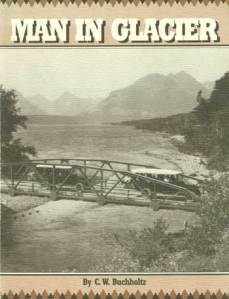
C. W. Buchholtz’s “Man in Glacier” has, since its publication in 1976 by the Glacier Association, been the definitive overview for those interested in the history of Glacier National Park.

This 88-page, illustrated 10.9 x 8.3 book includes the following chapters:

The Red Man Roams the Mountains
The White Man Cometh
Explorers and Exploiters
Preservationists, Politicians, and a Park
Producers of a Playground
Guardians of Glacier
Man and Nature in Glacier National Park

As a long-time member of the Glacier Association (formerly The Glacier Natural History Association), I have turned to this book many times for dates, details and yarns about the shining mountains.

Guest post for writers on author Pat Bertram’s blog: “The Place is More Than Scenery.”

Coming December 8: An interview with Helen Macie Osterman, author of the new novel “Notes in a Mirror”

Malcolm

The Thirteen Days of Christmas

On the first day of Christmas,
My true love sent me for fun
A cartridge for my shot gun.

On the second day of Christmas,
My true love sent me for fun
Two Victoria’s secrets,
And a cartridge for my shot gun.

On the third day of Christmas,
My true love sent me for fun
Three French kisses,
Two Victoria’s secrets,
And a cartridge for my shot gun.

On the fourth day of Christmas,
My true love sent me for fun
Four calling cards,
Three French kisses,
Two Victoria’s secrets,
And a cartridge for my shot gun.

On the fifth day of Christmas,
My true love sent me for fun
Five beholden kings,
Four calling cards,
Three French kisses,
Two Victoria’s secrets,
And a cartridge for my shot gun.

On the sixth day of Christmas,
My true love sent me for fun
Six hounds a-baying,
Five beholden kings,
Four calling cards,
Three French kisses,
Two Victoria’s secrets,
And a cartridge for my shot gun.

On the seventh day of Christmas,
My true love sent me for fun
Seven mugs a-brimming,
Six hounds a-baying,
Five beholden kings,
Four calling cards,
Three French kisses,
Two Victoria’s secrets,
And a cartridge for my shot gun.

On the eighth day of Christmas,
My true love sent me for fun
Eight aides a-bilking,
Seven mugs a-brimming,
Six hounds a-baying,
Five beholden kings,
Four calling cards,
Three French kisses,
Two Victoria’s secrets,
And a cartridge for my shot gun.

On the ninth day of Christmas,
My true love sent me for fun
Nine caddies prancing,
Eight aides a-bilking,
Seven mugs a-brimming,
Six hounds a-baying,
Five beholden kings,
Four calling cards,
Three French kisses,
Two Victoria’s secrets,
And a cartridge for my shot gun.

On the tenth day of Christmas,
My true love sent me for fun
Ten hordes a-pillaging,
Nine caddies prancing,
Eight aides a-bilking
Seven mugs a-brimming
Six hounds a-baying,
Five beholden kings,
Four calling cards,
Three French kisses,
Two Victoria’s secrets,
And a cartridge for my shot gun.

On the eleventh day of Christmas,
My true love sent me for fun
Eleven gripers pissing,
Ten hordes a-pillaging,
Nine caddies prancing,
Eight aides a-bilking,
Seven mugs a-brimming
Six hounds a-baying,
Five beholden kings,
Four calling cards,
Three French kisses,
Two Victoria’s secrets,
And a cartridge for my shot gun.

On the twelfth day of Christmas,
My true love sent me for fun
Twelve grenades with pins a-missing,
Eleven gripers pissing,
Ten hordes a-pillaging,
Nine caddies prancing,
Eight aides a-bilking,
Seven mugs a-brimming
Six hounds a-baying,
Five beholden kings,
Four calling cards,
Three French kisses,
Two Victoria’s secrets,
And a cartridge for my shot gun.

On the thirteenth day of Christmas,
My true love sent me for fun
A baker’s dozen epiphanies,
Twelve grenades with pins a-missing,
Eleven gripers pissing,
Ten hordes a-pillaging,
Nine caddies prancing,
Eight aides a-bilking,
Seven mugs a-brimming,
Six hounds a-baying,
Five beholden kings,
Four calling cards,
Three French kisses,
Two Victoria’s secrets,
And a cartridge for my shot gun.

–Jock Stewart

To view my FriendFeed posts about books and publishing, click on the icon below.

Subscribe to me on FriendFeed