“Some Cupid kills with arrows, some with traps.” — William Shakespeare
Puberty hits us like the opening of a starting gate in a horse race. And, what a horse race it is: sex, drugs, and rock and roll for a short-term rush that often has long-term consequences.
We meet in homeroom, date during first and second period, have sex during the lunch hour, and are married or living together before school is out. College students move about as fast, but often with more booze.
We’re so sure at 17 or 18 that we have met the love of our life. We can’t imagine being with anyone else. In our young eyes, this is clearly forever. So how does life unfold when one becomes a mother or a father and/or a husband or a wife before s/he is all the way out of his or her own childhood nest?
Time to roll the dice?
Some of us step out of the way of cupid’s arrows or, with luck, are only slightly wounded. Some of us are careful and some of us aren’t. To use an understatement, it’s quite a learning experience, one that may haunt us or define us or challenge us for the rest of our lives.
Now, in matters of both head and heart, I don’t believe in fate. For better or worse, I think we are–at least subconsciously–aware of the choices we are making whether they are leading us toward oblivion or a fairytale life of happiness.
Yes, I know, my view is controversial. But, in terms of what we do with the messes and smart choices we’ve made, at the nitty gritty level of experience it doesn’t matter how it happened and whether it was destiny or fate.
Both messes and smart choices present opportunities and challenges. However we make our beds, we can allow the consequences to either control our lives into hell on earth or lift our lives up above the norm.
I explore these ideas in my novel Garden of Heaven about a young college student named David Ward who is certain a young woman named Anne Hill is his soul mate. Things go horribly wrong as is common in fiction as well as real life. David and Anne betray each other and one of them is out for revenge–that also happens in real life, and it all begins with cupid’s poison arrows.
MYTHRIDER: Did you know Adam and Eve were created in north Florida? Preacher E. E. Callaway thought so and, for years, promoted Florida’s Garden of Eden on the Apalachicola River fifty miles west of Tallahassee. Now the preserve with its rare trees and ravines is managed by the Nature Conservancy, but it still has a Garden of Eden trail for old time’s sake.
I used the Garden of Eden as one of the settings in my novel Garden of Heaven.
–
MORNING SATIRICAL NEWS: Jock talks about the new study which claims it’s better for your health to drink than to abstain: “Before sobering up this morning I read a paper in the Alcoholism: Clinical and Experimental Research Journal about a new study that claims sobering up is bad for a man’s health.”
You can always count on Jock Stewart to tell you the true facts about the important news of the day.
–
WRITER’S NOTEBOOK: My friend Rhett DeVane has co-written (with Larry Rock) a fabulous spoof of the latest vampire fad in fiction called “Evenings on Dark Island.” I couldn’t resist posting a snippet or two in today’s Teaser Tuesday blog.
This book is so good, it almost makes a guy feel like biting somebody’s neck.
When I write fiction set in real places, I like including the real names of stores, streets and attractions, both past and present.
These little true-life facts help describe the places even though readers unfamiliar with the areas usually won’t know whether those details are real or made up–especially if the details don’t refer to widely known local attractions and buildings.
For example, in my adventure novel The Sun Singer, I mention Glacier National Park’s Many Glacier Hotel.
Cypress at Tate's HellIn Garden of Heaven, I mention Florida panhandle locations such as Alligator Point and Tate’s Hell Swamp. The names alone conjure up impressions in the readers’ minds even before my characters get there and experience the beach and swamp locations that aptly characterize the North Florida environment.
In some cases, my details come out of the past, adding to the “historical record” so to speak while functioning in the novel as places to shop and things to see. Set in the 1960s to 1980s, Garden of Heaven mentions the particulars of the family’s 1950 Nash Ambassador as well as the fact that it was purchased at Bopp Motors in Decatur, Illinois.
In this case, it was easy to write about my protagonist David Ward’s family traveling in a Nash since that’s what my family had when I was six years old. As for Bopp motors, I could have called it Smith Motors or Illinois Motors, but our Nash came from Bopp, so I used the real name of the dealership.
The old Nash was part of my experience as a child just as, in Garden of Heaven, it’s part of David Ward’s experience as a child. To some extent, the little true-life details are simply part of “writing that you know.” But they also help nail down both the action sequences and the place settings in the story.
Example from the book:
He was riding with his parents and grandparents in the proud 1950, blue Nash Ambassador equipped with latest of everything from Airflyte Construction to Duo-Servo brakes to Hydra-Matic drive, from Great Falls, where they visited random aunts and uncles to Pincher Creek, Alberta, where they visited assorted cousins. The car was hot, in spite of the Weather Eye ventilating system.
Many Glacier Hotel in Glacier Park’s Swiftcurrent Valley adds ambiance to The Sun Singer whether I made up the name or not. So, too, Tate’s Hell Swamp near the mouth of the Apalachicola River at Carrabelle, Florida. I could have called these locations Glacier Resort Hotel and Murky Waters Swamp, but I like the authenticity of the real names and places.
In some ways, those obscure true-life details give readers who remember the old days and/or who have traveled through an area in my novels, a little something extra.
Related Post: Impeach Earl Warren – About the old signs that used to appear throughout the Florida and Georgia countryside at the time Garden of Heaven is set.
—
The Sun Singer is gloriously convoluted, with threads that turn on themselves and lyrical prose on which you can float down the mysterious, sun-shaded channels of this charmingly liquid story. –Diana Gabaldon, Echo in the Bone (Outlander)
When a sailor reports aboard Navy ship right out of boot camp, s/he will have four immediate concerns: (1) Not being fooled by old salts into searching the boat from stem to stern for pieces of equipment that don’t exist, (2) Getting lost, (3) Following the proper General Quarters “traffic pattern,” and (4) learning Navy phraseology.
1MC Speaker
The Navy insists upon standard phraseology in its deck logs, phone talker communications, reports and 1-MC (ship-wide public address system) announcements. 1-MC announcements are accompanied by boatswain’s pipe calls which all sound the same at first.
While I was working on a novel about the sea, I remembered what it was like being transferred to the aircraft carrier USS Ranger (CVA-61) right out of boot camp. Compared to boot camp, the ship was much better duty, but there was still a lot to learn.
When I reported aboard, I was informed that I had been assigned to a floating city with an airport where the residents spoke a foreign language. Soon, I would have to learn what was supposed to happen when we “set condition zebra” (a readiness condition with certain hatches and fittings closed); and that a “shot line” didn’t refer glassware on a bar but to a small-diameter line fired over an alongside ship prior to an underway replenishment (UNREP).
Reveille throughout the city came a lot earlier than one expected even though the chief petty officers in charge of our boot camp companies at Great Lakes had brainwashed us that squared-away sailors loved getting up early. But they didn’t tell us that aboard ship a BMOW (Boatswain’s Mate of the Watch) would announce over the 1-MC to “Heave out and Trice Up.”
My first thought was that everyone aboard ship was being asked to vomit on command in the head. I was wrong. The phrase means get up. If you’re sleeping in a hammock, tie it up. If you’re sleeping in a rack (bunk) tilt it up against the bulkhead (wall). This makes it possible for the sweepers or compartment cleaners to sweep the deck (floor) underneath it. In the old days, a trice hook held the rack/hammock to the bulkhead.
The Public Affairs Officer as the Lone Ranger
Planning to join the Navy and–as we always said–let the world see you? Be ready to learn fast. When it’s time to get up, you won’t have time to study your Bluejacket’s Manual for instructions. But one way or the other, you’ll need to know the difference between heave, heave in, heave around, heave out, heave to, and heaving line.
Scuttlebutt (gossip) isn’t always “the straight skinny” (accurate facts) especially when it comes from the fabled all-knowing (and mythical) “port butter cutter.” With luck, the old salts will soon tire of sending you off to find fictional left-handed crescent wrenches, cans of relative bearing grease, buckets of prop wash, or of asking you stand “mail buoy” (huh?) watch on the bow. Then they’ll remind you (if you need reminding) that all stairs on ships are called ladders and doors are called hatches and dogs are what keep them closed.
Maybe they’ll tell you the handy general quarters acronym FUSDAP so that in the three-minute rush to get to your duty station you’re moving with traffic rather than against it. Forward and up on the starboard side, down and aft on the port side is very handy to know.I hope they don’t have to tell you not to head for the flight deck looking for a Quidditch game when the BMOW comes on the 1MC and says “sweepers sweepers man your brooms.”
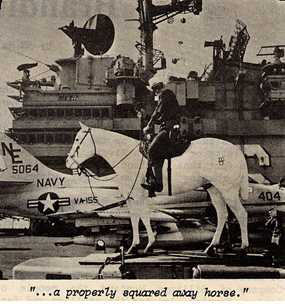
On the other hand, our ship really did have a horse, fiberglass, that is, so if the chief sent you to give it a bucket of oats, it was best to disappear for a while until everyone else in the compartment was done laughing at the joke.
–
Update: Since this post was written, the USS Ranger was sold for scrap because in all the years it was available to be purchased by a group willing to turn it into a museum, no viable plan was submitted to the navy. Movie stars spend more on their houses than was needed to preserve this ship and all the history it contained. Screwed up priorities, I guess.
Malcolm R. Campbell is the author of the Vietnam War-era novel set on board an aircraft carrier, “At Sea.” For David Ward, going in harm’s way seems to apply more toward the people back home than life in the sailor towns and the ship.
“Good writers are a dime a dozen. What makes you appealing?” — C. Hope Clark
When we go to a major league ball park, we expect the baseball players’ skill and professionalism to be very basic credentials for their being on the team. Ultimately, a few of them really begin to stand out. Die-hard baseball fans love their statistics, and they can tell you who got the most home runs, the most stolen bases and the best earned run average.
That is, who was better than good?
After a good ball game, fans have plenty to talk about. Often, the beer-and-bratwurst talk after the game focuses on what the players did: who made the best plays of the game and what kind of flair or attitude or extra effort did they display in the process?
In a recent writers newsletter, Hope Clark asked her readers to look at their writing and their writing platforms and figure out what they were doing or saying that might catch the attention of a reader or agent. She used a gardening analogy:
We’re all green plants to an agent or editor. Writers look
alike in that mile-high slush pile of mediocrity. Yes, that’s
how they see us . . . except for those with personality.
I’m more comfortable with baseball and other public figure analogies. So, staying away from the kinds of behavior that gets a lot of negative press, we can sat that some ball players, actors, actresses and (yes) even politicians attract our attention for positive reasons. They stand out from the crowd because they display more dedication, unique qualities and points of view, relevant comments about their profession, and have a style or attitude that calls for our respect and admiration.
Before a man or woman goes out on a date, their friends often advise them to “just be yourself.” That advice works for writers, too, in that you’ll come across as a lot more honest and sincere if you really are who you seem to be. On a date, we need to connect with just one person. As writers, we have to connect with thousands.
Changes in the publishing world are presenting prospective readers with more and more possibilities. Print-on-demand publishing and electronic publishing are bringing more and more writers out to the figurative ballpark where they plan to try out for the team. In this case, the “team” is made up of those writers who meet their goals whether it’s to sell books, win short story contests, find viable agents, have a large public following, or appeal to a specialize niche audience.
Hope Clark might ask what makes you different from the other plants in the yard (including the weeds). But sticking with baseball, I’m asking what do you do at the ballpark that brings fans out to see you play even when the rest of the team is having a lousy season?
Without getting lost in the analogies here, what exactly are you doing as a writer that will make a prospective publisher sell your book or a prospective reader pick it up and then tell his friends about it?
“Every step toward greater consciousness creates a kind of Promethean guilt. Through self-knowledge, the gods are, as it were, robbed of their fire; that is, something that was the property of unconscious powers is torn out of its natural context and subordinated to the whims of the conscious mind. The one who has “stolen” the new knowledge becomes alienated from others.” — Daryl Sharp
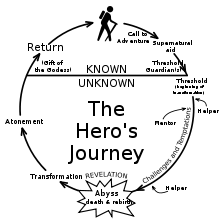
Hero's Journey - Wikipedia drawingFriends and acquaintances are often the first to urge us to heed the “call to adventure.” That call represents an opportunity. It may be a college degree, a summer abroad, a spiritual retreat, or a new job. If we listen, the new world we experience is likely to be mind-expanding and to change us.
Our friends and acquaintances might be the first casualties, not because we wish to cast them out, but because they don’t want to change and we do. While our new knowledge may result in an inflated ego turning us into the kind of person nobody wants to be around, it’s more likely that the new knowledge is beyond the comfort level and interest of old friends.
In his book Digesting Jung: Food for the Journey, Daryl Sharp writes that “anyone who has found his or her individual path is bound to feel estranged from those who have not.”
I’ve heard published authors say they lost their writer’s club friends the minute they became published. At the outset, everyone struggles together. They have similar problems and concerns. But when success comes, the successful one becomes different because his or her focus and needs have changed.
I’ve noticed that it many groups, there’s a lot of camaraderie in being part of “the resistance” to the status quo. Friends often urge each other to step forward and take charge. Once somebody does step forward, the camaraderie is likely to fade after the initial round of congratulations and celebrating runs its course. The new “boss” is no longer “once of us.”
In Carlos Castaneda’s Journey to Ixtlan, Don Genero tells Carlos that once a man commits to a journey of self-knowledge, he must also commit to leaving the world he knew behind. Those who are not on the figurative “journey to Ixtlan” will appear as phantoms along the road.
There’s more than petty jealousy behind the loss of friends when one takes on new responsibilities, chases his dreams and expands his personal horizons. Simply put, one is no longer compatible with many of his old friends, old pastimes, and old haunts.
In the mythic sense, alienation is the punishment of the gods visited upon a hero or seeker for listening to the call of adventure and sailing out across the wine-dark sea into the unknown. Staying home–refusing that call to adventure–appears to be the comfortable thing to do.
One must ask, I think, do I really want to go where I want to go? At this moment, of course, the conflict begins: deep regrets for staying put and alienation for leaving. This dilemma is the paradox of growth.
Malcolm R. Campbell is the author of the hero’s journey novel Garden of Heaven: an Odyssey.
Garden of Heaven is the story of a man’s spiritual journey through the mountains of Pakistan, the swamps of North Florida, the beaches of Hawaii, the waters of the South China Sea and the ivy-covered halls of an Illinois college as he attempts to sort out the shattered puzzle of his life.
In fiction writing, we have the freedom to create settings of our choice. But readers will pick up on phony settings pretty quickly. The more realistic and more interesting your setting, the more likely the characters who inhabit it will be believable and interesting to the reader. — Robert Hays (“The Life and Death of Lizzie Morris”)
Liberty Port in the PhilippinesWhen I was in high school, I tried multiple times to keep a log or journal. But that required more extended discipline than I had. While I began each attempt with the best of intentions, the entries quickly morphed from wordy and detailed into sketchy and infrequent.
A little discipline then could have saved me a lot of trouble when I began writing my novel “Garden of Heaven.” It uses settings I should know well: Glacier National Park, Montana; Tate’s Hell Forest and Tallahassee, Florida; Olongapo, Philippines; the aircraft carrier USS Ranger; Decatur, Illinois; Gronigen, Netherlands.
Each of these places holds memories for me that fit the plot and themes of the novel. Yet, when it comes to nitty-gritty details, memory can be tricky. When exactly did the USS Ranger leave Alameda for Vietnam in 1968 and what stores existed on Tallahassee’s College Avenue a few years before that? What year did the Decatur transfer house get moved and how far was the Galaxy Bar from the main gate?
Fortunately, books, magazines and online research helped fill in the gaps. So did e-mail correspondence with people at Glacier, Tate’s Hell, and Decatur. Frankly, a good journal would have taken me a lot less time. Not that I would have recorded everything I might have needed in a novel written decades later. But recording my observations would have given me a good start.
USS Ranger (CVA-61)Since it’s quite likely that a writer will end up using places he has a passion for or where defining moments occurred–whether it’s the town where he grew up, the theater where his military service unfolded or the destination for his favorite vacation–I’m thinking it just makes good sense to become a bit more of a packrat.
In addition to photographs, a few notes, brochures, newspaper clippings, ticket stubs, itineraries, and other materials will not only reinforce the writer’s observations when he’s there; they’ll support his memory years later when he puts his protagonist into the deep swamp he saw when he was a kid or the sailor’s liberty town he saw when he was in the Navy.
Such details don’t need to turn into the pages and pages of description readers of today’s novels often skip over. They do bring a place to life. They’re the difference between a setting with depth and one that appears plastic and ill-formed.
And if you have the discipline, keep a diary, log, journal or notebook: your readers will thank you and your writing will be all the stronger for it whether you’re writing about stealing cookies on the mess-decks of an aircraft carrier or the sound a panther makes in a notorious Florida Swamp.
My rating: 4 of 5 stars
Sassy, high-spirited and boy crazy, seventeen-year-old Darcie Edglon is abruptly taken away from the Charlotte, North Carolina world she knows three weeks after her parents are killed in an automobile accident. Responsible for her now, her older brother Ian orders her to pack her things without discussion or questions and prepare herself for an extended stay in the family’s mountain house near the Nantahala National Forest in Western North Carolina.
While the house is spacious and mountains near Franklin, Dillsboro and Cherokee are beautiful, this is hardly recompense for being wrenched away from her friends and activities in Charlotte. Her opinion begins to change, however, when she meets a recently widowed young Cherokee man named Wa’si.
“The Long Night Moon” is a magically told story about a teenager woman with a secret on the cusp of womanhood. The Cherokee and high-country themes run through the novel like pure mountain water, and are a compelling counterpoint to the rebellious, city-wise Darcie. With her attraction to Wa’si–whom her brother Ian has told her to leave alone–Darcie cannot help but be drawn into a culture and a place that will support her during the trials to come.
Darcie is a strong-willed, inventive and intelligent young woman. When the person she is becoming is severely tested, these traits will serve her well. While Darcie’s final test is wrapped up somewhat abruptly and the novel’s concluding chapter could have been more expansive, Elizabeth Towles’ novel is a very satisfying story.
On a personal note, I was drawn to this book partly because my family has made dozens of vacation trips over the last 50 years to the Western North Carolina mountains where the story is set. We owned property in the area, found lasting friendships and–of course–explored the Nantahala and Pisgah national forests, the Great Smoky Mountains National Park, and the trails along the Blue Ridge Parkway to Mt. Mitchell. Elizabeth Towles really makes this land come alive in “The Long Night Moon.” If we had a time machine, I believe the Cherokee ancestor in my wife’s family would agree.
–
Malcolm R. Campbell is the author of Garden of Heaven, The Sun Singer and Jock Stewart and the Missing Sea of Fire.
For Father’s Day, here’s another poem written by my father that was once posted on our refrigerator door:
Yet I Can Live
I cannot pierce the veil that hides
The unreal from the real
Nor penetrate the curtains
Which the Infinite conceal;
I cannot well define the Deity
Nor His eternal plan,
Explain the miracle of life,
The mystery of man;
I cannot with this finite mind
In true perspective view,
Yet I can live, yet love, yet serve,
See beauty, seek the true.
–Copyright (c) by Laurence R. Campbell
– SATIRE: If your thoughts turn to humor on Father’s Day, I invite you to read Jock Stewart’s latest column called “Father’s Day is No Laughing Matter”
HERO’S JOURNEY: For thought’s about the shadows in the hero’s path, I invite you to read “The Shadow Knows”
In a recent writer’s blog post “Helping Your Child Find the ‘Inner Writer,'” author Misha Crews (Homesong) suggests ways parents can encourage children to discover and develop their writing talents. It’s wonderful reading if you’re a parent with a prospective young writer in the house.
One of her points is never criticize. “There are few things on earth more fragile than the creative spirit,” she says. “You’d be amazed at how easy it is to crush a burgeoning artistic impulse. A well-intentioned but careless comment from you could easily put your children off writing for quite some time.”
As I read that wonderful advice, I remembered how nurturing my parents were when they read the poems and other writing experiments my two brothers and I posted on the refrigerator door. Like the pristine refrigerator doors all over town, our’s soon became covered with recipes, notes from friends, doctor’s appointment cards and other memorabilia. At some point, my father began posting poems there. Many were short and humorous like:
Some poems diamonds are
That nothing can surpass,
But the jingles that I write
Are only broken glass.
Others were seasonal, focused on birthdays and anniversaries and current events.
Soon, my brothers and I were doing this, too. We often wrote poems about nature, including the large national forest south of town and the beaches of the north Florida Gulf coast. Even though our efforts didn’t always obey the laws of poetry–to the extent we understood them–they were praised. To our embarrassment, our parents started pointing out the publishing nature of the refrigerator door to friends, family coming through town, and even the TV repairman and others making service calls.
Initially, I think some readers were drawn to the output of The Refrigerator Door Publishing Company, Ltd. by the humorous quatrains of my father.
Like a postage stamp
On the wrong letter,
He married badly,
Knowing no better.
(I’m sure the fact that my mother was a good cook and kept the refrigerator well stocked with quality eating materials probably played in to the door’s high ratings.)
When my brothers and I weren’t feeling especially creative, we transcribed well-known poems from famous poets and posted them on sheets of paper with titles like POEM OF THE WEEK or WEEKLY VERSE or SONNETS FROM OLD BOOKS IN THE HOUSE.
The door was a blank slate, a continuing opportunity, an exciting playground for word games, and–when it came down to it–our first publishing house. Everyone read it and talked about it, and some people even remembered what they read there, especially when my father’s latest humor appeared:
His wife may lack brains,
Her beauty may dim,
But like good glue she’ll
Stick always to him.
The kitchen was a very encouraging environment: it was almost like a writer’s club or round table. The poems on the that door were a constant dance of words for over 30 years. When Crews speaks about a child developing his or her inner writer, she says “There are few things in life more gratifying than helping a child to achieve satisfaction and gain a sense of accomplishment and of his or her own self-worth.”
She could have been talking about my parents and the smiles and kind words that greeted each new work disseminated to the readers of the Betton Hills subdivision–and from there, Tallahassee and the world. Without The Refrigerator Door Publishing Company, Ltd., I might have ended up as a grave digger, street sweeper or a pickpocket.
–
Poems in this post Copyright (c) by Laurence R. Campbell.
 Puberty hits us like the opening of a starting gate in a horse race. And, what a horse race it is: sex, drugs, and rock and roll for a short-term rush that often has long-term consequences.
 MYTHRIDER: Did you know Adam and Eve were created in north Florida? Preacher E. E. Callaway thought so and, for years, promoted
  MORNING SATIRICAL NEWS: Jock talks about the new study which claims it’s
  WRITER’S NOTEBOOK: My friend Rhett DeVane has co-written (with Larry Rock) a fabulous spoof of the latest vampire fad in fiction called “Evenings on Dark Island.” I couldn’t resist posting a snippet or two in today’s
 The Sun Singer is gloriously convoluted, with threads that turn on themselves and lyrical prose on which you can float down the mysterious, sun-shaded channels of this charmingly liquid story. –Diana Gabaldon, Echo in the Bone (Outlander)