A car chase with meaning

On my writer’s website, I refer to my “Garden of Heaven” (coming soon to print) and “The Sun Singer” novels as adventures for the spirit. I often call them mythic, though that sometimes causes people’s eyes to glaze over when they think back to their boring high school mythology class.

Last year a friend and I talked about how odd it was that we both watched the exploits of Jack Bauer on the popular TV series “24.” It was odd because both of us are non-violent and–in real life–would never sanction more than a fraction of the stuff Bauer got away with as a government operative on that show.

So why did we watch a show where people were getting shot, knifed, kicked, blown up, or crushed during one of the many car chases? Because it was fun seeing somebody getting results in a world where there are so many shades of grey, it’s often hard to make any project move forward. Jack brought out the dark and dangerous hero in us–while we were watching the show.

Weeks later, we had little memory of one episode of “24” or another because it was all rather like pure sex, a string of one-night stands, an orgy of sensation that–while hot and thrilling at the moment–didn’t mean anything, didn’t help anyone, and didn’t leave anyone with any food for thought.

An adventure of the spirit is rather like a car chase with meaning. “Star Wars,” “Lord of the Rings,” “The Matrix” “The Golden Compass” and similar feature films have their share of high-pitched action, but they are also mythic. They address universal themes, show characters struggling against great odds (including their personal demons) to improve themselves and the world around them.

In the process, mythic books and films also leave the reader with food for thought, something to ponder and talk about after the thrill of the car chase or the gun fight in the lobby or the battle is over. If an author is lucky, some readers find ways to improve their own lives after seeing how the fictional characters did it.

If you’ve seen one Hollywood car chase down a busy street and through a crowded parking garage, you’ve seen them all. Each new car chase sequence has to show larger explosions, more cars flipping over or careening through plate glass windows, or we’ll all be bored. That’s how it is with one-night stands and drugs: without a higher peak experience, there’s nothing there.

Neither “The Sun Singer” nor “Garden of Heaven” have a car chase in them. But each has elements of grief, mystery and danger. I hope readers will find meaning in the way my characters resolve their challenges. One is caught in a battle, and the other is kidnapped. Both discover their lives are at in danger.

Unlike so many of the lives in a non-stop-action car chase movie, I want you to come away from “The Sun Singer” and “Garden of Heaven” thinking “these lives matter.” I want you to care what happens to Robert Adams and to David Ward. I want you to feel that they’re more than one of the innocent people along the street Jack Bauer runs over them en route to catching a world-class criminal.

That’s an adventure of the spirit, a car chase or a plane crash or a battlefield scene that stays with you–perhaps even bothers you–long after you’ve read the book.

Malcolm R. Campbell is the author of “Garden of Heaven,” “The Sun Singer” and “Jock Stewart and the Missing Sea of Fire.”

Moving on after the announcement

Writers, I think, are often at a loss about what they should do next after they announce the release of a new book. Obviously, we do what we can to promote it; that can keep an author very busy. But that’s not the kind of moving on I’m talking about here. Quite simply, whether it’s blogs or friends, we become tongue-tied after the initial “Hey, my book got published today,” and all the WOW and CONGRATS and WHERE CAN I BUY IT and HOW SOON WILL HOLLYWOOD CALL comments have run their course.

Friends are ready to move on, and I don’t blame them. They don’t want the book to come up in every conversation any more than they want to rehash the same movie every time they meet for dinner or a drink. Unless the friend is exceptionally close, the book discussion pretty much runs its course after the first time it comes up. Yet, from the writer’s point of view, the book is a continuing presence, much more like having a baby or getting married than a topic to be squeezed in while waiting for the waitress to refill the coffee cups.

The book has not only been a large part of the author’s life prior to publication, it remains part of his life forever. It’s not just the job of promoting it that consumes time and energy; nor is it handling the reviews, good and bad, or figuring out whether to set up a book signing three states away, or gearing up to write a sequel. The writing of the book has changed the author: and for better or worse, he will always be dealing with who he has become and whether he’s happy with that. Don’t even suggest that he ought to take a bill to get over it.

There are times when I wish the art and craft of writing weren’t viewed by the general public as a weird process done by weird people. “Yeah, I already heard about your new book,” we hear when we bring it up again. I want to reply, “well, I already heard about your sales job, but that hasn’t stopped you from telling me about your boss and your co-workers and your trips and the breakroom chatter for the last 15 years.”

I think about saying that, but I don’t, because writing–in the eyes of others–is just too different to fit well into dangling conversations on the carpool ride home or while waiting for the movie to begin. I know my writing caMalcolm R. Campbell is the author of “Garden if Heaven,” “The Sun Singer,” and “Jock Stewart and the Missing Sea of Firereer will never get equal time with selling cars or driving trucks because non-writers just don’t know how to give it.

But I think it’s only fair to remind people once and a while: like a new wife and a new baby, the book is part of my life now. Get used to it.

Malcolm R. Campbell is the author of “Garden of Heaven,” “The Sun Singer,” and “Jock Stewart and the Missing Sea of Fire.”
Glacier Centennial: James Willard Schultz

“As a resort for the sportsman the Chief Mountain country cannot be excelled. The scenery is grand, game plenty, the fishing unexcelled.” — James Willard Schultz, as quoted in Man in Glacier

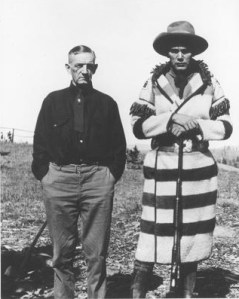
Schultz and his son (right) Hart - MSU Archives
James Willard Schultz (1859 – 1947) was explorer, hunter, mountain guide and author who came to the Backbone of the World before Glacier National Park was established, and then popularized the area through his books about the Blackfeet and the mountains.

Schultz is responsible for calling magazine editor George Bird Grinnell’s attention to the region and to the plight of the Blackfeet. Schultz served as Grinnell’s guide when the “Forest and Stream” editor came west. Grinnell, who would later become known as The Father of Glacier National Park, used his influence to gain the mountains’ national park status.

Schultz lived among the Blackfeet, marrying Matzi-awotan (Fine Shield), whom he referred to as Natahki. She had been badly injured during the notorious Baker massacre in 1870 and would remain partially crippled the rest of her life. Schultz, known as Apikuni (Spotted Robe) by the Blackfeet, and Natahki had one son, Hart Merriam Schultz (Lone Wolf). Hart (1882 – 1970) became a noted artist and illustrated his father’s books.

In addition to Grinnell, Schultz was a contemporary of scout and explorer Joe Kipp and explorer Hugh Monroe. While his books helped popularize the area, he later lamented about the rules and regulations that came with the area’s status as a park. He also wondered where some of the new place names were coming from:

“In 1915, the last time James Willard Schultz traveled into the (Swiftcurrent) valley, the Piegans with him asked about the place names. Who is this McDermott? The lake should be named Jealous Woman after the old story. Are the men behind these names powerful chiefs? Schultz confessed that he had never heard of most of them. The party thought even the wild animals looked changed, domesticated for the visitors in some way. McDermott Lake would later be given the long-time local name of Swiftcurrent.” (Malcolm R. Campbell, “Bears, Where They Fought” in Nature’s Gifts.)

Today in Glacier National Park, you will find Lake Natahki by following Apikuni Creek from the shore of Lake Sherburne. Geographical features in the park named by Schultz include Grinnell Glacier, Going-to-the-Sun Mountain and Singleshot Mountain. Apikuni Mountain (spelled “Appekuny” on older maps and trail guides) carries Schultz’s Blackfeet (Piegan) name.

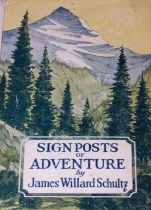
Books by Schultz, some of which are available today in reprint, include his autobiography My Life As an Indian, his account of a Missouri River trip with Natahki, Floating on the Missouri, and Sign Posts of Adventure:Glacier National Park as the Indians Know It.

Like Grinnell, Schultz documented much of the early history of the shining mountains that would one day become Glacier National Park. Like others who wrote about the region over a period of time, Schultz occasionally appeared to have memory lapses about people and events wherein one published account didn’t quite match another. As the late historian Jack Holterman wrote in Who Was Who in Glacier Land, “Many persons have been lured to Glacier by the fictions of James Willard Schultz, wondering where to draw the line between fiction and fact.”

A novel set in the park's Swiftcurrent Valley

I had high hopes for literary monkeys

“Remember the old adage about how an infinite number of monkeys typing on an infinite number of typewriters will eventually type something beautiful? Well, the Internet disproves that.” — Kurt Vonnegut

I’ve had high hopes a monkey or two would make it onto the New York Times bestseller list. Figuratively speaking, these hopes have been realized many times over.

But literally, literary monkeys have been a disappointment, though the odds (I thought) were good that sooner or later, out of all the gibberish and all the jammed keyboards, a monkey would finally type: “Call me Ishmael” or “Lolita, light of my life, fire of my loins.”

Some say that the opening line to Finnegan’s Wake would have been better if a monkey had co-authored the book with James Joyce, starting with: “riverrun, past Eve and Adam’s, from swerve of shore to bend of bay, brings us by a commodius vicus of recirculation back to Howth Castle and Environs.”

As far as I know, there aren’t currently any Federally funded monkey typing and literature experiments even though finding out once and for all whether an infinite number of monkeys typing on an infinite number of typewriters will eventually type something beautiful is a typical usage of tax dollars.

I mean no disrespect to monkeys: there’s nothing better than a barrel if them for a lot of laughs, and I’m talking about higher quality laughs than I’m hearing on most ABC network sitcoms which, quite possibly, may have been scripted by monkeys to a greater extent than we know.

Monkeys get a lot of bad press, bless their hearts, for you seldom hear anyone say that something or other is more fun than a barrel of laughing hyenas or that an infinite number of wharf rats typing at an infinite number of typewriters will ultimately write a novel that begins “Once upon a time and a very good time it was there was a moocow coming down along the road and this moocow that was coming down along the road met a nicens little boy named baby tuckoo.”

Most wharf rats are looking for something better than the lowly life of a writer: Congressman, for example, or IRS agent.

Most logical people think that monkeys will never amount to anything, but that if they did, they would find their true calling in show business rather than the writing business. Hollywood has proven to us that this is true since an above average number of celebs either claim to be monkeys’ uncles or act like them.

“I wish either my father or my mother, or indeed both of them, as they were in duty both equally bound to it, had minded what they were about when they begot me; had they duly considered how much depended upon what they were then doing.” Such thoughts have occurred to many people, especially to Hollywood agents, Congressmen and IRS operatives because, when it comes down to it, even if a monkey had accidentally typed it, it’s not a monkey sentiment.

Of course, to some, Tristram Shandy might have been a better book had it been improved with either monkey business or rat droppings. My theory has always been that no self-respecting money will type everything it can just because it can, meaning that some of the worst possible fiction has yet to be created.

Thousands and thousands of monkeys are sensible enough not to ape everything a human under the pressures of riches and deadlines might type on a single typewriter in a single day. That’s my theory, anyway, and I’m sticking to it.

–Malcolm, author of “Jock Stewart and the Missing Sea of Fire,” a satirical thriller that pokes fun at the real or imagined monkeys in government and newsgathering.

Alligators, bullies and becoming a writer

My life began at a Gulf Oil Service Station at Immokalee, Florida, back in the days when the attendants came out with a whisk broom and swept the beach sand out of your car while they pumped your gas for you.

Papa at work
Word is, I was swept out of the back seat of our 1949 Nash even though I didn’t look like beach sand. Since authorities were certain that even though I was an ugly five-week-old baby, somebody would claim me sooner or later, they put me in the service station window with a sign that said IS THIS YOUR BABY?

An aging alligator couple took pity on me and raised me as one of their own. They taught me to swim and they taught me to lurk in the water with only my eyes showing so that I could grab hapless ducks in my teeth and bring them home for Duck a la Orange.

Mugsy Walters Requesting Lunch Money
When I got to high school, playground bullies made fun of my swamp dialect and taunted me with phrases like “see you later alligator” and “after while crocodile.” That’s what they said after they stole my lunch money.

Papa Gator said, “Son, you’re never going to bring home the bacon with your teeth like your brothers and sisters. You’re going to have to use your wits.” That advice has served me well.

I convinced the playground bullies of several truths: (1) When I grew up, I was going to be a famous writer and would put all of them in my books for better or worse, (2) Looking good in a novel was a good way to pick up chicks, something they needed to think about since their teeth weren’t large enough to grab anyone at the prom, (3) Papa Gator knew where they lived.

No doubt, truth number one (1) got their attention; that, along with my weekly column in the school newspaper called “Alligator Alley Gossip.” Everybody read it, but nobody wanted to be in it: Is that hickey on a certain red-haired girl’s neck a true love bite or did somebody forget their lunch again? Once again, a lover’s lane romeo with the initials W. S. forgot the distinction between “Jail Bait” and “Gator Bait.” Note to S. T.: old lady Anderson doesn’t keep the test answers in her drawers any more.


The world has moved on from the Immokalee I once knew. The Gulf Oil Station was torn down years ago. Seaboard closed down the rail line. Most of the gators, including many who still remember my name, have retreated deeper into the swamps. And now, the people coming to town aren’t there for the fishing, but for the Zig Zag Girlz Blackjack at the Seminole Casino.

The basic truth comes down to this. If you can’t earn a living with your teeth, you need to go out and find an occupation that fits your station in life, one that honors how you were brought up. Even those who don’t know my first adult meal was a pine warbler on toast or that I still make slaw with swamp cabbage, walk carefully around any writer who just might put them in his books.

Papa Gator would be proud.

Malcolm R. Campbell is the author of the comedy/thriller novel “Jock Stewart and the Missing Sea of Fire,” a novel where poor Jimmy Pew met up with Papa Gator and became a believer.

A few writing resources.

VHP Author Blog: In this new blog, the authors from Vanilla Heart Publishing focus on writing tips, techniques and ideas.

Interesting Links: I finally got around to adding a links page to my website. If you’re a writer, you might find a few things to check out here.

Promo Day: This network and learning event is aimed at writers and publishers who want to promote their books while learning more about the promotion process. This year’s event is May 15. There’s also a Promo Day Blog with additional information.

C. Hope Clark’s Blog: Clark, who maintains the popular Funds for Writers site, offers tons of advice in her blog for writers and editors. See Funds for Writers for information about writing grants, contests and markets; while there, check out the newsletters.

Pub Rants Blog: Writing and publishing from an agent’s perspective.

Writer Beware: What to watch out for in the world of publishing, agents, and writing.

Open Directory Project: More writers’ resources than you can shake a stick at.

National Parks Off the Beaten Track

Well-known parks such as Yosemite and Yellowstone often get more attention than the 56 other national parks. Here are ten others to consider as you make this summer’s vacation plans:

Smallest: Hot Springs, Arkansas. Only 5,549 acres, but it has 47 thermal springs. Jump in a tub and enjoy.

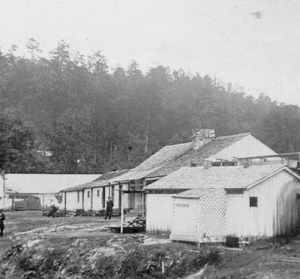
1860s bath house, Hot Springs - NPS


Least Visited: Kobuk Valley, Alaska. While Grand Canyon had 4.4 million visitors in 2008, Kobuk Valley only had 1,565. Why? It’s far away and there are no roads. Get a plane, boat or snowmobile and see what it’s like north of the Arctic Circle.

Most Bears: Great Smoky Mountains, Tennessee. The park has an average of two black bears per square mile. No wonder there are often bear-sighting traffic jams along park roads.

Most Prehistoric: Petrified Forest, Arizona. Once upon a time it was a tropical floodplain. Now you can see 225 million years of history in the fossilized trees.

Tallest or Thickest: Your call. It’s either the Redwoods or King’s Canyon/Sequoia in California. The Redwoods include trees 38 stories high. While Sequoia has tall trees, too, they include the General Sherman tree that’s wider than three lanes of traffic.

Most Isolated: Isle Royale, Michigan. It takes a 3-5 hour boat ride to reach this primitive wilderness in Lake Superior.

Wettest: Olympic, Washington. You’ll find many ferns, mosses and lichens in this rain forest with an annual precipitation of twelve feet.

Darkest: Big Bend, Texas. In this remote and relatively cloud-free desert, the Milky Way is bright enough to cast a shadow.

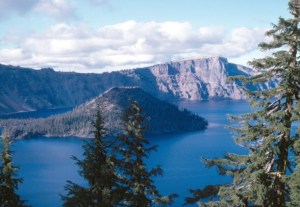
Deepest: Crater Lake, Oregon. The lake in this volcanic basin is the seventh deepest lake in the world at 1,943 feet.

Crater Lake - NPS Photo


Newest: Great Sand Dunes, Colorado. This 30-square mile dune field was switched from a national monument to a national park in 2004. You’ll find short-horned lizards, bighorn sheep and mule deer here as well as some wonderful dunes to slide down.


Source: “National Parks Less Traveled” in AARP Magazine, May/June 2010

Purchases benefit the Glacier Park Centennial Program

What are spammers like in real life?

Suppose you’re at a backyard barbecue. Everyone’s having a good time enjoying the food, the beer, and the afternoon.

Your good friend, Bob, comes over to tell you about his trip to Yellowstone. Turns out, he had a great time except for the fact that while he and his wife were there, they started wondering if they’d left the coffee pot on.

As the two of you talk about Yellowstone, a guy neither of you really knows stands there with a Pabst listening. As soon as Bob mentions the nagging coffee pot worry, this guy blurts out: I OWN A COFFEE POT STORE.

While that’s a little awkward, you turn to him and say, “great,” to which he responds that modern coffee pots automatically shut off after two hours and maybe y’all could come down and look at them after the barbecue.

Even with today’s lower standards about what’s rude and what’s not rude, I’m guessing that most people at the barbecue are not there to be badgered to death by sales talk.

But that’s what SPAM is when we see such behavior on line. Sometimes I wonder if spammers are as rude in real life as they are in the blogging world. But then I think, well, spammers aren’t real people. Maybe they are bots that go out and find a key word in a post and then dump complete gibberish into a comment field as though that’s going to help sales.

Sometimes I’m amused by what I find in the SPAM filter. If I mention Glacier Park on this blog, there’s probably going to be a comment caught in the SPAM filter that links back to a site selling tours, gear, or something randomly connected with glaciers and parks.

Though it’s all so blatantly obvious, it must generate sales or it wouldn’t be happening. Logically, it would seem that more sales would result from comments that actually have something to do with the post like, “Jim and I have gone to Glacier for 20 years in a row, and we’ve never see a bear do what that grizzly did on the Hi-Line Trail.” And then you see its posted by JIM&JOES TOURS.

Heck, I’d probably go and take a look at what they offered. Maybe they want my business just as much as the guy at the barbecue who owns a coffee pot store. But with me, they’re more likely to see me on their site or in their store because they know what’s polite and what’s not.

I’m thinking of addressing all of this in my prospective SPAMMING FOR IDIOTS book. It will be so lighthearted, you can even read it around the camp fire at Glacier or Yellowstone.

See how casual that was. I didn’t hit you over the head with it!

Malcolm

Our Stories Make Good Conversation

“We’re all natural storytellers, sharing our stories every time we communicate with someone — whether it’s a casual water-cooler chat or deep conversations with a close friend.” — Mark David Gerson in “When Was the Last Time You Told Your Story?

I read Mark David’s post about our natural inclination for sharing our stories with each other right after getting home from a weekend trip for visits with friends and family. Family visits often include updates about what people we used to know are doing now, leading often to “remember the time when” accounts of things that happened a quarter of a century ago.

Visits with friends begin with “what’s been going on lately?” and, as the evening gets late, morph into childhood stories that come forth as one topic leads to another topic through a myriad of diverse pathways. Saturday night, we ended up talking about pivotal moments, events that had a large impact on our life’s work and our points of view. We learned, among other things that our good friend Gordon had had near brushes with death as a child: these were stories we’d never heard even though we’ve known him and his wife Joyce since the 1970s. It just never came up before.

When I was going to graduate school at Syracuse University, my father quite naturally began thinking about his work as the acting dean of the journalism school there when I was several years old. As I haunted the streets he used to know, he began to think of old stories, things that just never came up during dinner table conversations back home. Every week or so, I received a typewritten letter of several pages not only relating tall tales about Syracuse in the old days, but incidents in his life in Quincy, Washington, Ft. Collins, Colorado and the Colorado Rockies, and the San Francisco Bay Area.

These letters painted a picture of what my father’s life was like as a child and also as a young man the same age I was at the time I read them. Unfortunately, during the summer term, we had to vacate the graduate student apartment building to provide living space for summer session students, and this meant storing a lot of stuff in the locked units in the basement. When I came back to Syracuse that fall, I discovered that in spite of the locks, many of the units had been broken into and the contents had been stolen.

I lost a good pair of “roper’s boots” purchased several years earlier in Browning, Montana, and I lost a briefcase where I had stored my father’s letters. Some scum–in my estimation of the people who committed the burglary–was wearing my boots and maybe even attending classes in the same buildings I was using my briefcase. The letters were, no doubt, tossed in the trash.

Today, those letters would be sitting in a computer and could be printed out again. As it was, there was no way to replace them or even to remember the stories they contained.

I thought of this last night when Gordon spoke of putting some of his stories into a book. No doubt, they would mean a great deal to his sons even in e-mail form. But they would have a wider audience for they’re not only interesting–simply as good storytelling–but they contain details about another time and place…what it was like to work in a steel mill or for the long-gone Nickel Plate Railroad.

As a writer, I see Gordon’s stories and my late father’s stories first as the way they might appear as written accounts–prospective essays, articles short stories and novels. But there’s more to them. For a family, they’re history and legacy; for friends, they’re a sharing of experiences.

Our stories not only make good conversation, they forge deeper friendships. So I ask, as Mark David asked in his post, when was the last time you told your story?

Malcolm

Each purchase benefits Glacier National Park

Fu Dog Substitute

Allerton Fu Dog
Stone Fu Dogs, displayed in pairs, guarded the entrances of Chinese imperial palaces and temples for years, and now can be found at the entrances of homes and businesses. They serve the same function as gargoyles, figuratively–or perhaps, magically–guarding the structure and those inside from harmful people and evil vibes.

When I visited Robert Allerton Park, in Monticello, Illinois, as a child, I was not only impressed by the statue of the Sun Singer, but with the numerous Fu Dogs. I imagined that one day I would own an estate with a pair of these dogs at the entrance, the female on the left and the male on the right greeting all who might visit.

My estate and my Fu Dogs haven’t materialized. Perhaps it’s fate or the humor of the universe or–more likely–simply a lack of funds.

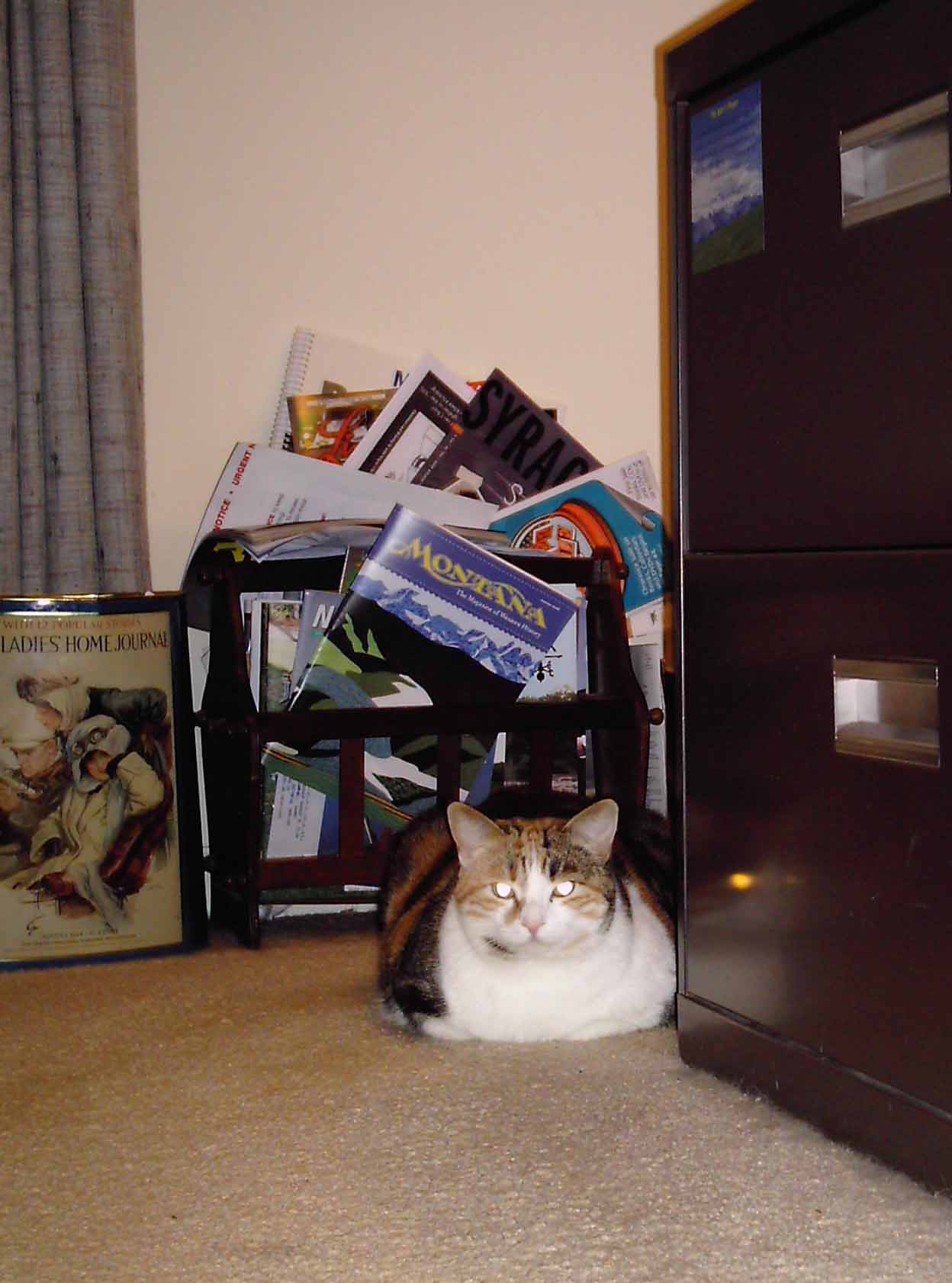
Even so, my den is is guarded by two substitute Fu Dogs. One is a two-inch high gargoyle modeled after those at Asheville’s Biltmore house. The other is Katy, a large–and potentially overweight–calico cat who persists in monitoring everything that happens in my office. She either sits on the back of my large desk chair or positions herself next to the file cabinet so she can see all the way down the hall toward the foyer of the house.

If another cat or my wife or anyone else ventures into my domain, Katy is right there, quick to show her displeasure by either her posture or the flattened-back position of her ears. Fortunately, she doesn’t move on to hissing, growling or biting.

We are all somewhat amused, but not having real Fu Dogs at my front door or even at the door to my den, Katy provides all the protection of need from the slings and arrows of evil spirits to the (probably) malicious intentions of other cats sneaking down the hallway.

I feel so fortunate.

Malcolm