Rome, Georgia, July 16, 2016, Star-Gazer News Service–Malcolm R. Campbell, author of the hoodoo novel Conjure Woman’s Cat, was doing hex research on a dark and stormy night when he went to a nearby graveyard to try out a haint calling spell to see what would happen.
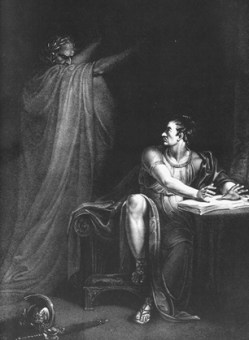
Campbell being bugged by a haint while he tries to write the next chapter of his book.
Haints happened, more than he could shake a stick at (like that would do any good), and while they were generally friendly, they wanted haint tasks: people to scare, places where ghost lights would improve the ambiance, bad neighbors who needed to experience a plague of rabid bull frogs, people walking on lonely roads in search of spooky entertainment.
“I didn’t realize the spell worked until I got home,” said Campbell. “My three cats are always chasing invisible things around the house, so everything seemed normal when I got home from the graveyard. When the cats wouldn’t settle down, I turned off all the lights and was surprised to see a living room full of haints, Most of them threatened to turn on Fox “News” 24/7 unless I kept them busy with exciting haint chores.”
Campbell, who has always believed 100% accuracy makes for better fiction, told reporters during a “fluke rain storm” of flying fish, that trying out the haint spell was bad idea because it didn’t come with any directions for sending the haints back to the graveyard.”
Medicine men, shamans, cops, witches and everyday people with shotguns visited Campbell’s house to try their hand at getting rid of the haints. Nothing worked.
“I have to admit it was fun for a while,” said Campbell, “because when they weren’t out causing mischief, they sat in my Naugahyde recliner and offered tips for the haint scenes in my work in progress. For example, the idea that haints mainly haunt people in cemeteries is pretty much of a myth: more hauntings happen in abandoned Walmart stores than anywhere else.”
Campbell has a hotline with local police to assure them that “his haints” aren’t responsible for every “weird” 911 in Rome and Floyd County.
Security paint at Campbell’s house.
“There’s been so much publicity about the haint infestation,” said Officer Smith (not his real name), “that people just assume Campbell forgot to close the front door and the haints flew out trying to make every night like Halloween. We’ve advised Campbell to keep each haint on a leash so that innocent people won’t get scared and pee in their pants.”
According to one haint who told his story to a local television station, “We haven’t had this much fun since the spiritualism era of the late 1800s and early 1900s when seances were all the rage, Ouija Boards were selling faster than hotcakes, folks wanted to believe they could talk to dead aunts and uncles, and tables all around the country were rocking, rolling and tapping.”
Campbell told the Feds, who came to town to investigate, that the haints were starting to get bored and were planning to leave for Washington, D.C. during the next thunderstorm when energy fields are high and spiritual travel is easier than falling off a tombstone.
“As soon as they leave, I’m buying a fresh can of haint blue paint for the front of my house to make sure they don’t come back,” Campbell told Agents Houdini and Doyle. The agents subsequently confirmed “things are weirder than usual” whenever Congress is in session.
–
Story by Jock Stewart, Special Investigative Reporter.
“Perhaps the most succinct evidence for the potent magic of written letters is to be found in the ambiguous meaning of our common English word ‘spell.’ As the Roman alphabet spread through oral Europe, the Old English word ‘spell, which had meant simply to recite a story or tale, took on a new double meaning: on the one hand, it now meant to arrange, in the proper order, the written letters that make up the name of a thing, in the correct order, was to effect a magic, to establish a new kind of influence over the entity, to summon it forth. To spell, to correctly arrange the letters to form a name or a phrase, seemed thus at the same time to cast a spell, to exert a new and lasting power over the things spelled.”
The old adage “Sticks and stones may break my bones, but words will never hurt me” is rather false. Consider the sound-bite phrases and misleading comments in the current Presidential campaign alone that, once said, become gospel. Consider perjury in a courtroom, verbal bullying in a school, highly messaged government-speak, dear john letters, exaggerations on product labels and advertising, and phrases from religious books that are taken out of context. The pen and the voice really are mightier than the sword, the stick, or the stone.
In my Sun Singer’s Travels blog, I recently posted “What the hell are these important writers talking about?” Primarily, this was a rant about the obscure (and possibly gibberish) discussions between some writers and some interviewers that make no sense whatsoever to most readers and natural writers. By natural writers, I mean those who discover their stories as they write and, while they usually know the ins and outs of style and technique, they don’t look upon words as requiring a doctoral dissertation to set down on the page in a story.
If a writer creates elaborate outlines, s/he also may write organically while putting words on the page if s/he uses the outline as a rough guide rather than a recipe to be followed precisely. Personally, I think outlines get in the way of the story, though that’s simply my approach.
Hoodoo Reading the Bones
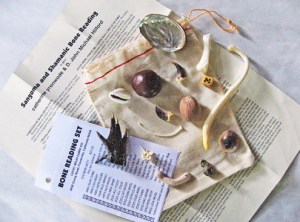
This kit is available from the Lucky Mojo Curio Company.
Traditional conjurers (also called hoodoo practitioners or root doctors) often use a form of divination called “reading he bones” to obtain answers to questions for themselves or their clients. Possum and chicken bones are often used; others (as the picture shows) add other objects such as stones, nuts and shells.
While some conjurers paint or number the bones, assign a meaning to each one–like the meanings assigned to individual Tarot cards–others throw the bones into a small circle drawn in the dirt (see picture here) and listen for the voices of their ancestors who were also conjurers. As with Tarot card readers who are advanced enough to forget the descriptions of each card that they read in a book, conjurers reading the bones may variously say they’re using their intuition, tapping into their inner selves, or hearing the voices of the “old ones” in their lineage.
In short, they use the bones as they view them on the ground as catalysts for channeling information from outside themselves. You can’t do this unless you can step away from the logical “what-ifs” that come to mind when you ask the bones a question. Too much logic destroys a reading because the conjurer is thinking of typical speculative answers to the question (my missing spouse stayed late at work, got in a car wreck, ran away with a co-worker, forgot to tell me s/he had a dinner meeting, etc.) rather than listening for the ancestors or intuition to speak.
Discovery writing
Writing with no outline–or a few sketchy ideas–is often called “discovery writing” because the writer discovers what the characters are going to do and say while writing rather than creating an outline or a list of scenes in advance. Many of us have a general idea what we’re going to do before we start writing. While writing “Conjure Woman’s Car,” for example, I knew that my main character was an old-style conjure woman living with her cat in the Florida Panhandle in the 1950s. I also knew that the Klan was going to do something bad and she was going to respond with hoodoo (folk magic).
Other than that, the story evolved as I told it. In a sense, my muse, my intuition, and even the developing characters “decided” what was going to happen next. When I finished a scene or a chapter, suddenly the thing that was going to happen next came to mind. I supported my intuition by reading a lot about conjurers, spells and related blues songs. Quite often, I’d learn what was going to happen next in my story by the “coincidental” reading of a certain conjuring practice or a historical KKK tactic.
I like to think that when a writer is using discovery writing, s/he is following a practice very similar to the traditional conjurer who throws the ones and listens for the voices of her ancestors for the answer. The conjure woman asks a question and allows the process to create the answer. The discovery writer asks “What If,” listens for the voice of his “muse” and or his unconscious mind and allows the writing process to create the story.
We are, in this way, attempting to cast a spell in the sense David Abram suggests in the quote at the beginning of this post. No, we are not using words to “force” our readers to write us large checks or leave town or change their political beliefs. We’re using words to cast a spell called a story that claims the reader’s imagination from the first word through “the end.”
When the short story or novel comes out well, we’re often praised for our imaginations. That’s okay, but really, our ability is simply to listen and record what we hear. When the story or novel doesn’t turn out well, we probably stepped in the way of the natural process and tried to plan or micro-manage the action down one road or another where it didn’t belong.
At best, we’re conjurers who know as our experience grows how to establish a process that works. Those who read the bones know that they get better results when they wash and dry the bones before throwing them on an animal hide or into a circle. They know not to touch the bones with their hands but to use a stick. Likewise, writers know what conditions make it easier for them to write: some listen to music; others like the background sounds of a natural setting or a coffee shop. Whatever conjurers and writers typically do when they work evolves into rituals that support hearing the true answer to the question or hearing where the story needs to go.
Answers and stories live and breathe on their own. If we have a talent, it’s being able to keep out of the way.
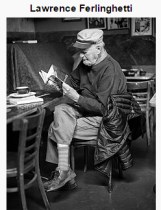
“Tall and agile at 97, with a neatly trimmed gray beard and oval tortoise shell glasses that magnified his glassy blue eyes, Mr. Ferlinghetti could pass for a man in his 70s. He still writes almost every day — ‘When an idea springs airborne into my head.’”
Lawrence Ferlinghetti, whose poems I feel like I’ve been reading for several lifetimes, is polishing up a memoir/novel after years of badgering by his 96-year-old literary agent Sterling Lord. Their ages give me hope.
Wikipedia photo
Hope. because it’s nice to live that long. It’s nice to still have words and a voice at that age and keep on writing. It’s nice to see that it’s possible to have a friend and colleague you’ve known since the beat-poet era of the 1950s. It’s nice and its hopeful to think that when one has a lot of ideas s/he wants to put into writing, it just might be possible to do it.
Not that I think I can equal Ferlinghetti’s 50 volumes of poetry by writing 50 novels. I’m realistic. Unlike Stephen King, who writes most of his novels in a couple of months,
I’m a lot slower. Ferlinghetti is, like Herman Wouk, (now 101) in that group of writers about whom people say, “Gosh, I thought he probably died years ago.” I don’t know how Ferlinghetti, Lord and Wouk react to those sentiments.
Doesn’t matter, really. It’s nice to know that if they ever hear people say that, they’re still around to say “I’m not only alive and kicking, I’m also alive and writing.” (There’s an interesting Herman Would article here.)
Photo from Herman Wouk’s web site.
Writing, I think, is one of those occupations that not only keeps people alive and kicking, it wards off the morbid maybe I should cash in my chips feelings a lot of people seem to get when they become senior citizens. Fortunately, writing doesn’t require heavy lifting or many other kinds of physical stamina that are usually gone by the time people each 96, 97 and 101. In fact, reading and writing are said to help develop people’s brains and minds when they’re young and keep brains and minds more facile and creative when they’re old.
What’s not to like?
Perhaps some of us will say everything we want to say before we’re old and grey. We’ll spend our years traveling. Tending our bees or our roses. Reading as much as we can. Enjoying family and friends and everything else with agile minds (due to the reading).
It’s hard to imagine not writing, even if we write only for ourselves and stash all those poems, novels and essays into basement file cabinets. When I was young, I once visited my 100-year-old aunt who not only remembered dozens of stories from crossing the country in a covered wagon, but also knew everything about current day books, politics and culture. I wondered how it felt to be 100. Mainly, I wondered if I’d be a totally different person. I’m not a hundred, but as the years pass, my greatest surprise has been that age doesn’t change who one basically is–yes, we might have put away many of the thoughts and hobbies of youth, but still, we begin our days with hopes, many of which are similar to the hope felt when we were kids and beginning our first jobs and seeing our children born.
The writing gets better with age. Mostly, that’s just practice and experience. If you write for 60 years, you’re bound to get better. Most writers look forward to getting better even if they have great success when they’re young. We want to get better because no matter how well a book or a poem turns out, we see that it never quite matches the dreams we had for it when we wrote the first draft.
Like opera singers, we may lose some of the raw, unbridled power of our youth. There’s always more to be said, though. The fates are kind to give us time to say it.
–Malcolm
Malcolm R. Campbell is the author of “Sarabande” and “Conjure Woman’s Cat,” both of which are available in paperback, e-book, and audiobook editions.
I knew before life got derailed in April and May with unexpected trips to the hospital for unplanned surgeries, that a new character was about to appear in my work in progress, a guy named Rutherford “Rudy” Flowers. I also knew he was going to show up in the next scene in the book.
But after the surgeries–and a reasonable recovery period–I couldn’t write that scene. Uh oh, writer’s block. I even knew what critical piece of information he planned to tell my protagonist. But still, I hadn’t figured out the character, and that meant–well, the writer’s block.
Wikipedia photo.
This is a potential problem for those of us who write with no outlines and with no nailed-down sequences of events in mind for our novels and short stories. Every once in a while, something is supposed to happen. We don’t know why, and we can’t move until some of that why comes to mind.
When this happens to me–as it just did–I tinker around the edges of the book without writing anything. Since it’s set in the 1950s, I can always go more research into slang, clothing, events, foods and products of the time period. Some of what I learn actually comes in handy. This tinkering, though, ultimately unlocks my writers block. It’s odd, I know, but research often brings things to light that I wasn’t looking for, things that turn out to be vital to the story.
If you believe in muses–and I do–it’s almost as though the muse has put a hex on my being able to open the Word file with the story in it until I figure out there’s something I need to know before I go back to it. Now that I’ve found that something, I see there were clues to it all over the place that I just wasn’t noticing. Now I know who Rudy Flowers is and how vital he and his mother are to the story.
Writer’s block is usually aggravating, especially when your publisher is waiting for you to hand in the manuscript. I’ve never been able to force myself out of writer’s block like those writers and teachers who say it’s better to sit down and write anything at all rather than to write nothing. I’m better off writing nothing (not counting blogs and tweets) than trying to force a story to happen when the words aren’t there.
If you’re a writer, how do you face writer’s block and finally get back to work? As for me, I’m back to my story because the muse has come home.
When Thomas Wolfe published Look Homeward, Angel in 1929, there was a fair amount of grumbling in his home city of Asheville, NC due to similarities between the book’s characters and people in the community. To use a modern term, I’ve always assumed his writing of the book with such strong autobiographical ties was his way of processing parts of his life he wanted to exorcise or better understand.
Time heals, some say. It’ll all come out in the wash, others say. Perhaps so.
I’ve never felt the need to write a torrid tell-all book loosely based on people I know, though every few years or so novels come out that reveal old secrets and/or that live up to that writer’s tee shirt gag, “Don’t piss me off or I’ll kill you in my next book.”
I do tend to help things in my own life come out in the wash by writing about them, often long after the fact, and seldom in any way that links the fictionalized version to me.
For example, the last post on this blog Again and Again Throughout the Long Night is a short story based on events in my own experience that occurred in the 1980s. Yet they always bothered me, so finally my way of helping them come out in the wash is writing a fictionalized version of them using characters and locales vastly different from those in the true story.
A lot of people process their stuff by journaling or writing memoirs. I’m not famous, so I fail to see the need–much less the practicality–of writing a memoir. So I dribble the process stuff out into stories and novels over time and it really seems to help.
My doctor confirmed today that I have kidney cancer, but that it was caught early enough–in a cat scan the hospital did while diagnosing appendicitis last week–that two hours of surgery in a couple of weeks should completely remove it without any likelihood of recurrence or chemo/radiation. Sooner or later, this will show up in a story because what I have not yet processed is the fact that had I not had appendicitis, the kidney cancer wouldn’t have been caught until things were already potentially hopeless. The doctor called my appendicitis “the bellyache that saved your life.”
I have no clue how I’m going to fictionalize that. But like everything else in life that I’ve had to ponder or mull over looking for the inherent meanings, this will have to come out in the wash one way or another.
I always hope that those who don’t consider themselves to be writers will at least put their “out in the wash” kinds of thoughts into diaries, and potentially even experiment with creating fictional versions of them. Writing, for me, as been the best therapy I know. (And I say this as somebody who worked briefly in the mental health field and strongly considered becoming a psychologist.)
Writing just seems to help things settle.
–Malcolm
I appreciate those of you who have gone out to Kindle to download a free copy of my short story “Waking Plain.” It will be free for a few more days.
Frankly, I don’t like reading specific directions for summoning evil spirits because I’m afraid I’ll accidentally think them or recite them and suddenly a hideous monster will appear.
From hoodoo to witchcraft to high magic, the lore is filled with cautions about the dangers of summoning bad stuff because unless you know what you’re doing, the bad stuff will come after you. This would be kind of like purchasing a rabid dog to keep traveling salesmen away from your door. The odds seem high that the dog will attack you first.
Another reason I don’t like reading specific directions for summoning evil spirits is the feds. They probably track this stuff and the last thing I need is the NSA telling the FBI that I used the search terms “black arts conjure oil” or “hoodoo demon-calling spell” enough times for it “to be a problem” as opposed to looking for crossword clues.
Writers often talk about stuff like this. We worry about doing research about how to kill people, make bombs, mix deadly and untraceable poisons, and making pacts with the devil. The people who have that kind of history on their computers usually tern out to be serial killers or the kind of nut cases who join ISIS and saying “I’m just writing a book” probably won’t cut it when the cops arrive.
I didn’t worry about this when I was writing Conjure Woman’s Cat because for that book, I was looking up good spells, good charms, and how to reverse jinxes. But in the sequel, my good conjure woman is combating a black arts root doctor and so I have to know more about that side of the business for her to be able to speculate about what he’s doing and how.
Since I try to make the spells and uses of herbs as realistic as possible within the world of conjure, I don’t feel right just making it up. Suffice it to say, the curses I’ve found aren’t going into the sequel verbatim. For one thing, I have to find a spell or recipe in multiple places before I’ll trust that it’s more than the imaginings of one resource. For another, what if the thing works as advertised? I don’t need to see on CNN that people are using my book to summon demons to go after their spouses’ lovers or to disrupt law-abiding governments (if any). So, everything has to be blurred around the edges: exact enough to make a real conjure woman nod in agreement but inexact enough to your child, spouse or neighborhood crook can’t use it.
By the way, plate-eyes aren’t seen very much any more, but generally they’re unpleasant, what with their glowing eyes the size of plates. If one bothers you, you can get rid of it with anything that smells bad. I’m pretty sure I’m not going to use any plate-eyes in the sequel to Conjure Woman’s Cat because nobody seems to know how to contact one of them. Haints, well, they’re okay, but they usually have their own agendas.
Demons, though, they’re looking pretty good, figuratively speaking, because they’re easier to summon that most people think and fewer people are going to question whether the author has used the right technique or the wrong technique to call them.
When the book comes out, I promise it won’t contain the exact technique for calling a demon. It will be close enough to make the book slightly dangerous. But that’s what readers want.
–Malcolm
Malcolm R. Campbell is the author of “Conjure Woman’s Cat” and a batch of paranormal Kindle short stories.
Those words that might change the world: perhaps you don’t know you’ve written them. You wrote them in a letter that changed another person’s life, and then others and countless others, and you never knew.
Those words that might change the world: perhaps you wrote them in your diary. You didn’t know what they meant until you wrote them and when you knew, you were changed and the ways you changed impacted what you wrote and published after that.
Those words that might change the world: perhaps they’re within a poem, a short story or a novel that never found a publisher. Even if none of your heirs find and publish those words and change the world long after you’re gone, they exist now and are part of your life, a life that would have gone down different roads without those words hidden away in a drawer.
You draw strength from the words you write because every word you write changes you into a person who is different than the one who sat down to write. Your strengths ripple outward and impact people who never see the words that served as a catalyst. Who you are now is always partly determined by the growth you achieved through writing words you may never publish.
The words you write are never wasted even if you throw them away. They are never quite gone from you even if your conscious mind cannot recall them. They are like a continuing breath, unseen but life altering and life giving.
You have cast a spell on yourself, enchanted yourself, discovered heretofore unknown dimensions of yourself, and from such things, there’s no return.
Since you cannot return, you will write other words that are impacted by your older words, you will say something wondrous to a stranger that you meet because the you who wrote those words walks down different streets with influences you may never see, you will wave to a man or woman on the street who will be changed, perhaps ever so slightly, by that wave or the smile behind it even though s/he will never know of the long lost words that brought about that moment.
This is the power of words that exist but remain hidden while their energy turns the world on its axis and casts devils into the sea.
Writers spend a lot of time not writing. Not writing includes marketing, promotional stuff, platform building, blog posts and other ways of establishing a writer’s online presence and calling attention to the books. It also includes book signings, readings, appearing on panels and running a booth at a book fair.
Maybe this works for screen writing teams, but it doesn’t look good for novelists.
The headline for this posts tells you I’m skeptical about, say, slumber parties for writers or retreats where writers show each other what they’re going and discuss it and the whole concept of write-ins.
A write-in, as I learned in an Indies Unlimited post (Do You Need to Be Closer to More Writers?) this morning is (basically) a bunch of writers with laptops assembled around a big table all typing diligently into a DOCX file some meaningful scenes in their work in progress.
WTF
Okay, for those who love these things and come home with some work accomplished, go for it. But this sounds more like an excuse to sit around and shoot the breeze and have a few beers rather than doing serious work. As far as I know the whole shebang isn’t like synchronized swimming and other similar events at the Olympics. To work, this is going to require discipline. Every time one of the writers sighs, laughs, or utters a string of profanity, everything’s going to stop and people will talk about that.
In my world, a writer goes into a cave, works on his or her book, and when it’s done, s/he comes out and gives it to an editor who cleans up the parts of it that are a mess. The whole concept of having beta readers looking over a writer’s shoulder during this process gives me the willies. Next thing, there will be focus groups to decide whether, say, allowing Bob to have sex with Jane will lose readers or gain readers.
Hemingway once told writers to be careful about talking their novel/story away. By this he meant, sitting down with another writer and telling them the plot of a story-to-be, getting into a discussion about it, and then suddenly losing the whole thing. That fits my concept of writing: nobody sees anything until it’s done. No write-ins, no beta readers, no family inputs, not posting scenes on bulletin boards for critiques, no sharing.
All that stuff leads me away from the process of creating a story. It sounds too much like a committee approach or maybe a screwing-around-drinking-coffee-rather-than-actually-writing approach.
That’s my two cents for today.
–Malcolm
Malcolm R. Campbell is the author of various things which are available in various places for various prices.
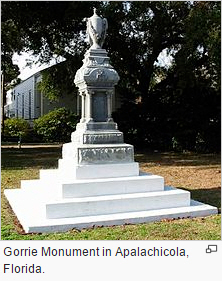
Dr. John Gorrie of Apalachicola Florida was a pioneer in the development of mechanical refrigeration in the 1840s. He saw cool air, whether from ice or from the lowering of the temperature in a room, as a medical means of combating such diseases as yellow fever and malaria. However, as a “Smithsonian” article about him suggests, he received a chilly reception, lost backers, and was never able to pursue the equipment’s development based on his early patent.
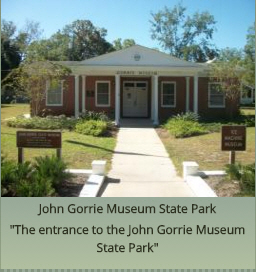
I first saw the John Gorrie museum, a Florida State Park, in Apalachicola when it opened in 1958. It is one of the treasures of visiting the “other Florida” or “the forgotten coast” in the panhandle by following U.S. Highway 98. Now, we take the creation of ice for granted and–except for days when we’re waiting for the repairman–we rely our window air conditioners and central HVAC systems.
However, the creation of ice by man was thought by some during Gorrie’s time as an affront to nature as “Smithsonian” noted in its July 2002 article: “Gorrie, who used air as the working gas in his machine, took his idea north to the Cincinnati Iron Works, which created a model for public demonstration. But the notion that humans could create ice bordered on blasphemy. In the New York Globe, one writer complained of a ‘crank’ down in Florida ‘that thinks he can make ice by his machine as good as God Almighty.'”
An opposing view appears on the state park’s website: “Not long after the death of Dr. Gorrie in 1855, famed botanist and physician Alvan Wentworth Chapman commented to celebrated botanist Asa Gray, ‘Gray, there is the grave of a man we recognize as superior to all of us.’ The technology needed to discover the cure for yellow fever still does not exist. Gorrie’s valiant attempt inadvertently created a machine and theory that changed the world forever. The John Gorrie Museum State Park reveals this remarkable and compassionate man and shows the amazing machine he created.”
While the original Gorrie ice making machine is in the Smithsonian Institution, you can see a replica of it while visiting the Gorrie Museum on 6th Street in Apalachicola, one block off U.S. Highway 98.
Malcolm R. Campbell grew up in the Florida Panhandle and has written fiction such as “Conjure Woman’s Cat” set in the areas he explored many years ago.
There’s a small ad in the right-hand column from a nostalgia stock photo agency showing a guy with a pipe writing the great American novel on an ancient Underwood typeriter.
A few days later, a woman is shown in a sponsored post typing her memoir, or perhaps journaling, via a somewhat more modern (but non-electric) portable.
Few people notice.
The following week, typewriters begin to appear in book promotion posts, inspirational status updates about the myth of writer’s block, and in pleas from publishers asking us to send them our best work (albeit in a DOCX file).
So far, the Centers for Disease Control appears not to have noticed the infestation.
Speculation from conspiracy fans is rife: (a) Those who distrust writers want to hypnotize us into using outmoded equipment, (b) there’s been a security breach at an Area-51 lab experimenting with sending hexed typewriters to third-world planets, (c) Somebody found an abandoned warehouse filled with typewriters and is trying to unload them on aspiring writers before they (the writers) learn there’s no place to buy typewriter ribbon.
Is Facebook’s typewriter infestation innocent nostalgia, an on-gong “Throw Back Thursday” of yesteryear images, or just a lot of overworked copywriters copying each other?
Perhaps.
I don’t have any proof yet, but I suspect the glut of typewriters appearing on Facebook is more nefarious than we can imagine and that if you look closely at any of Nostradamus’ more obscure prophecies, you’ll see that he said this was going to happen.



 I’ve never felt the need to write a torrid tell-all book loosely based on people I know, though every few years or so novels come out that reveal old secrets and/or that live up to that writer’s tee shirt gag, “Don’t piss me off or I’ll kill you in my next book.”
 From hoodoo to witchcraft to high magic, the lore is filled with cautions about the dangers of summoning bad stuff because unless you know what you’re doing, the bad stuff will come after you. This would be kind of like purchasing a rabid dog to keep traveling salesmen away from your door. The odds seem high that the dog will attack you first.
 Those words that might change the world: perhaps you wrote them in your diary. You didn’t know what they meant until you wrote them and when you knew, you were changed and the ways you changed impacted what you wrote and published after that.
 Dr. John Gorrie of Apalachicola Florida was a pioneer in the development of mechanical refrigeration in the 1840s. He saw cool air, whether from ice or from the lowering of the temperature in a room, as a medical means of combating such diseases as yellow fever and malaria. However, as a “Smithsonian” article about him suggests, he received a chilly reception, lost backers, and was never able to pursue the equipment’s development based on his early patent.
 An opposing view appears on the state park’s website: “Not long after the death of Dr. Gorrie in 1855, famed botanist and physician Alvan Wentworth Chapman commented to celebrated botanist Asa Gray, ‘Gray, there is the grave of a man we recognize as superior to all of us.’ The technology needed to discover the cure for yellow fever still does not exist. Gorrie’s valiant attempt inadvertently created a machine and theory that changed the world forever. The John Gorrie Museum State Park reveals this remarkable and compassionate man and shows the amazing machine he created.”
 A few days later, a woman is shown in a sponsored post typing her memoir, or perhaps journaling, via a somewhat more modern (but non-electric) portable.
