- Blood test this morning. The tech couldn’t find a vein. Ended up sticking both arms looking for blood. Might have been less painful if she’d bit my neck.
 Congratulations to my Thomas-Jacob Publishing colleague Sharon Heath (The Fleur Trilogy) on the release of her new novel Chasing Eve, “a funny, sad, hair-raising adventure into the underbelly of the City of Angels, where society’s invisible people make a difference to themselves and to others, and where love sometimes actually saves the day.”
-

Bodkin Point Arrow – Wikipedia photo I usually write fiction in third person restricted. Among other things, that means that basically the entire novel is shown via the point of view of the protagonist. If you use that POV, you know there are dozens of ways of showing the protagonist’s attitude without saying “he thought” or “she thought.” Now that I’ve chosen to write the work in progress with an omniscient narrator POV without showing what anyone (mostly) is thinking, I keep having to delete things I’d normally write. Even something so mundane as Luckily the barking dog finally shut up is out of bounds because somebody has to be thinking that; I’m not going to be an old-fashioned author who intrudes into his stories by commenting on things as they happen. Tentatively, the book is called Dark Arrows.
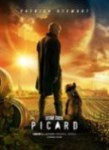 Yes, we will be watching Star Trek: Picard starting tonight on CBS All Access. The next-generation series with Patrick Stewart was, I think, the best of the Star Trek programs, so it will be nice to see him again in this ten-episode series. I read that CBS has already ordered more episodes, so perhaps we’ll have at least two seasons to look forward to.
- My blood test results show that the forty days of radiation therapy probably got rid of the prostate cancer. Even though the radiation oncology department thinks “that’s that,” the urology department thinks it’s safe for me to continue the hormone therapy for two years as long as I can dolerate the shots. I said, “Tolerate the shots? Does that mean they don’t kill me.” The answer was, “If you get bad hot flashes, we’ll stop them.” Oh.
Category: writing
Writers who stop writing have moved on to what?
Writers who step away from writing often tell me they’ve “moved on.” I want to ask (but I don’t) “moved on to what?”
If one’s chosen career is to be a writer, I’m not sure where a writer goes when s/he moves on. Not that being a writer is sacred. Not that writers don’t get to retire at some point or even try something else.
 Writers often say that doing the writing itself is their primary joy. Of course, if writing is a business for them, they can’t pretend that running at a loss every year will pay the rent or buy the groceries. A lot of writers get around his problem by earning an income doing something else, but continuing to write in their spare time.
Most of my writing life I earned a living by writing for computer companies. That’s what paid the rent. I’ve been officially unemployable ever since I was laid off after 9/11 even though the large tech company I worked for said they weren’t going to do that. Unless you’re famous or have a rare skill, it’s hard to find jobs when you’re over 50, which I was. So, I turned my parttime writing into fulltime writing.
Until I’d sold a few books, I told people I was retired. At my age, that was believable. I had no desire whatsoever to buy a motor home and spend my life driving around the country, or fishing, or stamp collecting, or whatever else retired people are supposed to do. Luckily, I found a few nonprofits who needed somebody to write grants, and I did turn out some successful proposals. But fiction was what I wanted to write, so that’s what I’m doing.
I can’t imagine moving on. My father was a successful book reviewer, article writer, and textbook author long after he was forced to retire from university teaching. He was happy doing it and so am I. Maybe psychologists will claim I’m taking after my father. I don’t think so, but is I were, I’d be okay with that.
Does your best paragraph belong in your book?
Consider this paragraph from a well-known novel:
“It rained for eight days without taking a breath. No dank December drizzle this, but rain with attitude. The rogue progeny of some sweet-named Caribbean hurricane had come north, liked it and stayed. Rivers in the Midwest burst their banks and the TV news was awash with images of people crouched on rooftops and the bloated bodies of cattle twirling like abandoned airbeds in swimming-pool fields. In Missouri a family of five drowned in their car while waiting in line at McDonald’s and the President flew in and declared it a disaster, as some on the rooftops had already guessed.”
Do you recognize the passage? If so, you have a good memory. If not, it’s because it’s not usually one of those excerpts that reviewers and sites like GoodReads quote from the novel.
 I noticed this paragraph recently because I’m re-reading the book. I smiled as I read it because it’s the kind of thing I would write for a satirical novel or blog post. Bits and pieces of it could even fit in a comedian’s stand-up comedy routine. For satire and/or dark humor, the paragraph is slick, well-written, and filled with sadistic puns and groaner double entendres.
However, the paragraph appears in a book listed as a psychological thriller that focuses on love, loss, family, and coming to grips with massive change. That being the case, I think the author should have cut this graph from the novel and saved it for another book because outside of comedy or satire, this is over the top:
- taking a breath
- rain with attitude
- liked it and stayed
- news was awash with images
- abandoned airbeds
- And then we end with the family drowning in a line at McDonald’s followed by the President declaring it (the flood or the McDonalds?) a disaster area
The passage gets “worse and worse” the farther it goes and becomes really dark with the Missouri family/disaster area juxtapositioning.
I believe most critics and writing professors would classify all this as “too much” in a mainstream novel. In context, the passage seems out of place at the beginning of a subsection in which a young girl is in a coma while her parents wonder if she’ll survive. Perhaps the novelist saw this as a transitional, “adding insult-to-injury” kind of paragraph. Or maybe he liked the contrast between the slick weather description and the horror of the girl supported by machines, tubes, and sensors.
In general, what do you think?
Does your opinion change one way or the other when I tell you this excerpt came from The Horse Whisperer by Nicholas Evans?
Writers are advised to kill their darlings. I wish Evans had pulled the trigger or put these words into a drawer for later use.
My eight novels and numerous short stories fit into the genres of contemporary fantasy, magical realism, paranormal, and satire. Other than the Special Investigative Reporter, my storytelling focuses on magic.
Your writing: business or hobby?
Gurus–and, let’s face it, they’re a dime a dozen–are always telling writers to decide whether we want a career or just want to tinker. In part, we don’t always have a clear choice.
Most authors aren’t living off their writing income. They have 9-5 jobs doing something else, often teaching. Many also have families with the usual responsibilities that implies. So writing often gets shunted into the hobby category where it’s wedged into the weekly schedule by hook or by crook.
In her latest Funds for Writers newsletter, Hope Clark wrote, “You’ve decided you are a writer. Like any profession, part-time or full-time, you have to map out your days, weeks, and months for better efficiency. Same goes for writing. ” In part, she focuses on realistic goals and organization. So, in one respect, writing is like any other business: you can’t just wing it.
As far as I can see, the more successful we become at the writing part of our career, the more we’re going to need to treat it as a growing business–or, at least, as a money-making portion of our multiple careers.
Clark suggests that we stay away from what she calls “pie-in-the-sky goals that are, in essence, fluffy resolutions.” Instead, look at what’s possible in your schedule as it is now. Can you write and publish one book a year and possibly submit five short stories to competitions? If so, that can be the foundation for a sound business plan.
Without that plan, it will be hard for any of us to evolve into full-time authors, in part, because we don’t really see what it takes to make that happen or we treat our writing as a hobby and allow everything else in our lives to take precedence over it.
Like a lot of things, becoming successful depends on how badly we want it.
P.S. Thank you for the ideas for solving my POV problems with my work in progress. I’m tending toward an omniscient narrator who sees everything that happens but who doesn’t know anyone’s thoughts.
Telling a story from the point of view of a sickening character
I’m not going to tell you how to do it because I can’t force myself to do it. In my work in progress, somebody is shooting KKK members. At the outset, I don’t want the reader to know who’s doing it. Yet, if I tell the story from the point of view of the person who is doing it, I won’t be able to hide what they know.
 Unless they were hypnotized or have random bouts of amnesia or I resort to some combination of trickery and/or bad writing, their thoughts are otherwise transparent to the reader.
I catch writers doing this all the time. They’re “inside the head of one of the characters” who has just done something important. But, since the author doesn’t want the readers to know what that character did, s/he simply doesn’t allow the character to think about it.
Not possible (other than the amnesia or brainwashing thing) and yet it happens do often, I wonder why editors don’t catch it.
One alternative (in my work in progress) would be to tell the story from one or more of a KKK members’ POV. I saw too much of the KKK when I was growing up, and looked up more about them while working on Conjure Woman’s Cat and its two sequels. It’s one thing to know the organization’s history, rituals, and symbols, but quite another to know the workings of a member’s heart and soul.
I don’t want to know that because I’m not strong enough to know.
I once wrote a story from the POV of a woman (Sarabande) who was assaulted. It seemed to work. But I never could have written those scenes from the POV of the bad guy. I cannot go inside the head of a rapist any more than I can go inside the head of a KKK member.
It’s one thing to tell a realistic story. It’s another to jeopardize one’s sanity. I’ve read some nasty things in novels and whenever they are told from the POV of the perpetrator, I wonder how the author survived the experience.
Some clinical psychologists have told me they take a shower when they get home from work and, while doing it, visualize the disturbing things heard during the day being washed down the drain. Would that work for a write? I’m not willing to find out.
What about you? Do you ever wonder how authors handle some of the hideous things in their novels, especially when told from the perp’s POV?
Note: I announced on my website today that I need a break and will discontinue the site by February 20. This blog will remain as will my author’s page on Facebook.
What Your Choice of Dialogue Tags Says About You
One way to look at it is to consider any movement away from the exclusive use of said or asked a step away from the very “best” writing, from the kind of writing intended to be considered “literary.” If you spend any small amount of time examining blogs or books on writing, you will find that this is a very common directive: use said, asked, and nothing else.
There are a number of reasons for this, but the most common works in conjunction with that other famous maxim: show, don’t tell. If you use the word ranted to describe the speech act of one of your characters, you’re telling your readers how to understand what is happening rather than illustrating through action and dialogue.
Source: What Your Choice of Dialogue Tags Says About You | Jane Friedman

One of the first things a new writer hears about dialogue tags is how annoying it is when somebody finds a thesaurus and inserts a dozen synonyms into his/her story for “said” and “asked.” The result is often highly annoying except when it is done sparingly.
For humor, where was the ever-popular, “‘Ouch,’ he explained” approach and the campy Tom Swifty insertion of a punning adverb such as: “‘Let’s get married,’ Tom said engagingly.”
I see nothing wrong with substituting the word “shouted” when the people are far apart from each other or in a noisy place. Otherwise–as the article says–we have author intrusion into the story and telling rather than showing when we substitute words for “said.”
Writers can avoid the fact they’re inserting an editorial opinion into the story when they, for example, substitute a word like “ranted” for “said.” The character’s thoughts can show that he’s ranting and so can his facial expressions and movements during the conversation.
Big-name authors often take a stylistic approach to dialogue tags. One in particular constantly uses “observed.” That’s really not a good general synonym for “said,” especially, in quick back-and-forth dialogue because it implies that the comment is measured and based on logic rather than simply uttered.
When an author goes nuts looking at a manuscript page of dialogue with the word “said” all over it, one way to avoid this repetition is to ask how many of those dialogue tags are needed. A back-and-forth conversation doesn’t need a dialogue tag after every line as long as the reader can always tell which person is speaking.
A lot of food for thought in this blog post from
Twelfth Night Thoughts
“A real artist is the one who has learned to recognize and to render… the ‘radiance’ of all things as an epiphany or showing forth of the truth.”
– Joseph Campbell
Twelfth Night, the twelfth day of Christmas, is also known as Epiphany Eve. Many traditions surround this time, but many of them consider Twelfth Night to be January 5th with Epiphany celebrated on January 6th. Some refer to Epiphany as Three Kings Day, and see it as a celebration (primarily) of the visit of the Magi and the revelation of the incarnation of God in Jesus. Others link the day to Jesus’ baptism.
The symbolism here would take multiple posts to discuss and, regardless of one’s church or sect or denomination, the meaning, I believe, transcends temporal orgnizations and faiths and instead reminds us of the most important epiphany each of us can have: the realization of the divine within ourselves.
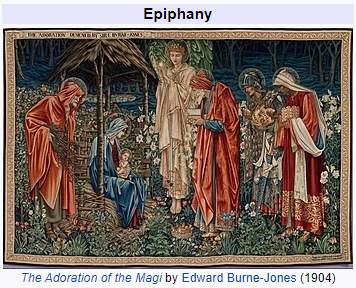
Originally, when people spoke of having an epiphany, the default value of the experience was that the insight they found came from the god of their hearts. Now, such realizations are often considered to be of a logical or scientific or psychological origin. It’s all the same, I think.
As writers, our best work seems to come from multiple epiphanies, from having our fingers or thoughts on the pulse of the universe and the channels through which cosmic energies flow.
Or, perhaps you are more comfortable with the idea of inspiration or having a real or figurative muse. Looking at it that way seems less presumptuous!
My muse tells me to follow the old traditions and to take down my Christmas decorations today or otherwise be stuck leaving them up until Candlemas. It’s hard enough explaining to neighbors why our decorations are up longer than most people’s; it would be more difficult if our lights and greenery were up until February 2. The decorations, when they go up, and when they’re put away are guidelines, not rules, for the paths we’re following.
Perhaps the decorations symbolize a person’s readiness to discover and interpret the radiance of all things.
A writer’s concern: what if the FEDs look at my browsing history
 As a writer, I hear other writers talking about the browsing history on their computers. Sites about murder, poison, making bombs, laundering money, you know, stuff that doesn’t look good after the FEDs kick open the front door to your house, announce that you have a right to remain silent while hoping you don’t, and then run off with your computer.
Let’s say your arrested for a crime of which you’re innocent but your browsing history includes sites about how to murder your spouse without getting caught. When the trial comes, the D.A. asks you to explain these searches and you say you were doing research for a book. When asked to produce the manuscript, you can’t since you haven’t started writing it yet.
If you watch the series “Bull” on TV about a company that specializes in jury selection and find people like that to defend you, you might have a prayer. Otherwise, it’s going to be a life sentence without any chance of parole. Or, at the very least, if I ever run for President, my opponents will ask why I spent 10000 hours on murder for fun and profit sites.
Since I believe in Murphy’s Law, I think of this when I head out to incriminating sites. “Yep, the NSA/CIA/FBI are probably monitoring this site,” I think. Frankly, I think authors ought to be given a “Get out of Jail Free” card to cover innocent research that makes them look guilty.
I’ve been doing more research into the KKK, supplementing what I did before writing the three books in my Florida Folk Magic Series. Every time I access a KKK site, I think I hear some FBI Special Agent saying, “Ah, Malcolm again, Now I’ve got you, you son of a bitch.” What if the Southern Poverty Law Center finds out; will I be labelled as a Hate Site? That won’t be good for book sales.
If you’re not a writer, you have no idea of the risks we take to bring you true-to-life, accurate, and frightening stories about evil people. We’re walking in harm’s way to give you a good story. So, when we get rounded up in a sting operation at the library, we hope you’ll be there with bail money.
When I was in high school, I hid “questionable” novels under the mattress so my folks wouldn’t find them. I never told them what movies I was going to see because I didn’t want to get in trouble. But they didn’t have today’s technology. They didn’t know how to hack into the GPS system and/or live-feed traffic cams to see where I was. But, apparently, the FEDs know where I am 24/7. There ought to be a law against that but when people complain, they’re told, “If you have nothing to hide, there’s nothing to worry about.”
Everyone has something to hide, but especially writers.
Perhaps I’ll Write Today
You don’t stop brushing your teeth during the holidays, so don’t stop putting a few words on paper. It’s your habit. It’s your mission. Unless it’s a hobby, which in that case you only write when you feel like it. Only you know the difference. – Hope Clark
So, what do you think about this quote?
Hope Clark tries for a thousand words a day. But if something gets in the way, she tries to put as many words down as possible. Maybe it’s a hundred, maybe it’s a thousand. It’s something, though, because she’s a professional novelist and that means putting words on the page is just as important as an otherwise employed worker showing up at the office every day.
She’s the author of “The Edisto Island Mysteries” and the “Carolina Slade Mysteries.” They read well and she’s developing a platform and a lot of satisfied readers. I mention all this, not to promote Hope Clark, but to note that while many of you may not have heard of her, she’s a successful novelist.
 Many of us are not successful novelists, as the industry views the phrase, because we don’t write every day. We may have a few published books out there via small presses or self-publishing, yet we write more from the perspective of hobbyists than professionals. I suppose that if a writer’s books have never made money, then s/he finds it hard to see himself/herself as a professional. If you’re not making money or slowly gaining a list of satisfied readers, there’s no incentive for writing 200 words or a thousand words a day.
So, we rely on bursts of creativity and sooner or later we finish a book or a collection of short stories and then it gets published and appears on various online bookseller sites. Sure, we wish either that Oprah would call and tell us our latest is her next book club selection or that a Hollywood studio found our latest and has put down the cash for an option on the material. But, the chances of that are slim to none, so there’s no reason to try and turn out as many novels per year as James Patterson.
Perhaps writing when we feel like it is an expensive hobby, but more exciting than collecting stamps and coins, taking photographs of every national park, or joining a quilting club. Early on, we decided we are who we are and so that’s the way we’re going to write. If you’re young, maybe you want to keep pushing. If you’re not young, maybe you don’t.
I have no regrets about being who I am. I hope you feel the same about yourself and the number of words you write per day. We need to follow our hears when it comes to who were are and how often we write.

Rebel in English Class
I never understood why I was forced to take English courses since I was fluent in the language. Consequently, the rules made no sense to me because they seemed to be applied after the fact to something I did naturally. Also, I associated the rules with drill which was tedious and boring and seemed to have no practical application to speaking or writing.
Think of something you do naturally–like walking. Suppose you were forced to take a class in walking which was based on all the scientific things known about a person’s body and how it walks. Quite likely, you might think–unless you wanted to become a doctor–that the science of walking had little to do with your ability to walk. Yet, your school system mandated a course in walking because, after all, people need to be able to walk.
 In today’s world, immersion-style approaches to learning a language seem to get the best results. Languages, such as Scots Gaelic, Blackfeet, and Hawaiian that were on the verge of extinction are being rescued through an immersion approach. I often wonder whether I would have been less at war with my English teachers if they had focused on immersion rather than atomistic drill.
Being a rebel had some unfortunate consequences when it came to learning other languages. When I took courses in Spanish and German, those courses were based on formal grammar rules. So, when the teacher said, “Today we’re going to talk about the XYZ rule,” I had no idea what that referred to because I hadn’t retained any rules by name from my English classes. So, I was behind the eightball since I had to figure out what kinds of phrases those rules applied to in English before I knew what the Spanish teach or German teacher was talking about.
It seemed to me that everyone who wasn’t a rebel in English class and who went to the trouble to learning all the rules had a much easier time when they showed up in a German, Spanish, or French class. When the teacher said, “Today, we’re going to look at the future perfect conditional,” everyone but me seemed to know what that was.
When I was taking German and Spanish in high school and college, I think an immersion-style course or study abroad approach would have helped me rather than approaching the languages in courses based on rules and drill. The rules make no sense to me in English, so I have no jumping-off point for learning new languages in a rules-based approach.
With a Scots ancestry, I’ve always wanted to learn Scots Gaelic (Gàidhlig), a language that I think might be coming back after years of being banned and slandered by the English. I also wished I was capable of learning Blackfeet because I began my writing career with a focus on Montana and also Hawaiian because I love the Islands. Knowing the language is the key to many things because it’s tied directly to the soul of the people who speak it. No wonder the U.S. banned Hawaiian and Blackfeet for years.
But, I digress. When the Blackfeet Nation started a school in Browning, MT that would help people recover their own language, they corresponded with experts in Hawaii who were using immersion techniques to save the Islands’ language from extinction. I corresponded with educators in both groups about 20-30 years ago. I felt bad because my country tried to destroy those languages just as the English tried to destroy my ancestors’ language. But I was stuck: I couldn’t learn any of these languages by going to the places they were taught/spoken and I couldn’t learn them based on language structure drills.
My view is that we need to find ways of saving dying languages and better ways of teaching our own. I have no clue what those ways are, but as an author, I know I’d be lost if my own language suddenly became illegal due to the edict of one conqueror or another. The theft/destruction of a people’s language is about as low as one can go; it’s unconscionable. Goodness knows I can’t help fix the problem because being a rebel in English class had more far-reaching ramifications than I knew.
My view is that we should spend time and resources restoring all the American Indian languages we tried to destroy.
 My ignorant love of languages has led to the use of Hawaiian, Blackfeet, Tagalog, and Gàidhlig in my books with a lot of help from native speakers. I appreciate the help of an instructor from the University of Hawaii for the translations in this novel.
 Malcolm's Round Table